Table of Contents >> Show >> Hide
- The Story Behind the Cardboard Circle
- Why a Giant Circle Works (Even If It Looks Ridiculous)
- Social Distancing 101: What It Was Trying to Accomplish
- The “Personal Space Era”: When Everyone Invented Their Own Bubble
- A Brief (Surprisingly Fashionable) History of “Stay Away From Me”
- What the Cardboard Circle Gets Right (and What It Doesn’t)
- The Real Lesson: Distance Is a System, Not a Personality Trait
- If You Tried This at Home: A Lighthearted “Don’t Be Reckless” DIY Moment
- Why This Went Viral: Because It’s Relatable, Not Just Weird
- Conclusion: The Cardboard Circle as a Symbol (and a Warning)
- Experiences Related to “Man Wears Giant Cardboard Circle” (Extended Reflection)
The year was 2020. The vibe was “don’t touch your face,” and suddenly everyone became a part-time
epidemiologist with a full-time talent for standing exactly three inches behind you in line.
Then a hero emergednot in a cape, but in something far more aerodynamic: a giant cardboard circle.
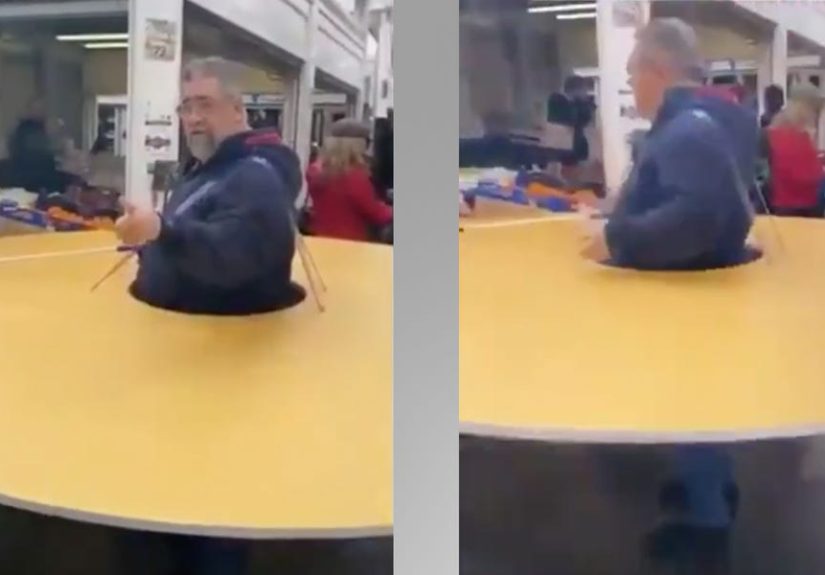
Yes, a man was filmed strolling through Rome with a huge orange cardboard disc strapped around his waist,
turning “personal space” into a full-body event. It looked like a wearable Do Not Enter sign,
a human-sized “buffer zone” you could see from space (or at least from the next produce stall).
And while the internet had its fun, the idea underneath the meme was surprisingly serious:
when people can’t feel distance, sometimes you have to wear it.
The Story Behind the Cardboard Circle
The clip that launched a thousand jokes shows a man walking around an open-air market area in Rome,
keeping others away by simply… occupying more geometry. When someone asks why he’s doing it,
he responds plainly: it’s for coronavirus. No lecture. No diagram. Just a giant circle and a deadpan answer.
He even appears to carry a grabber tool, suggesting he’s trying to minimize contact with surfaces while he’s at it.
This wasn’t a random fashion moment. Early in the pandemic, Italy was facing intense restrictions and widespread fear.
People were learning (in real time, with imperfect information) how to navigate everyday life while reducing risk.
The cardboard circle was a DIY solution to a real problem: how do you keep distance in a place designed for closeness?
Why a Giant Circle Works (Even If It Looks Ridiculous)
On paper, “keep your distance” sounds simple. In reality, humans are famously bad at estimating spaceespecially in
crowds, lines, markets, sidewalks, and anywhere a stranger can materialize beside you like a side quest.
The cardboard circle solves that by turning an invisible guideline into a visible boundary.
1) It makes the invisible visible
Most public health guidance relies on cooperation and spatial awareness. But six feet (or about two arm lengths)
is hard to judge without a measuring tape and a willingness to look unhinged. A wearable circle is basically
a measuring tape with confidence.
2) It removes negotiation
Without a clear boundary, people negotiate distance through awkward body language: the half-step back,
the polite lean away, the “I’ll just hold my breath and hope for the best.” The circle says,
“Negotiation closed. Please talk to my perimeter.”
3) It’s behavioral design, not just “personal preference”
Public spaces nudge behavior. So do objects. Floor arrows, queue ropes, cones, and stanchions exist because
we follow cues better than we follow vibes. The cardboard circle is a cue you can’t miss.
Social Distancing 101: What It Was Trying to Accomplish
Social distancing (often called physical distancing) is about reducing close face-to-face interactions
to slow the spread of respiratory viruses. During COVID-19, guidance commonly emphasized maintaining distance
from people outside your household when possibleespecially indoors or in crowded settings.
Distance matters because respiratory particles tend to be more concentrated up close. Add time and poor ventilation,
and risk can rise. That’s why public health advice often paired distancing with other measuresmasking, hygiene,
staying home when sick, and improving ventilationbecause no single strategy is perfect.
The cardboard circle doesn’t filter air. It doesn’t sanitize hands. It doesn’t fix ventilation.
What it does do is change interactions: fewer close conversations, fewer accidental shoulder bumps,
fewer strangers leaning in to ask if avocados are “the good ones.”
The “Personal Space Era”: When Everyone Invented Their Own Bubble
The cardboard circle guy wasn’t alone in the “wear your personal radius” movement.
During the pandemic, people around the world experimented with physical cues to demonstrate distance:
hula hoops, pool noodles, taped-off zones, and even wearable contraptions that turned sidewalks into a live
urban planning critique.
The “social distancing machine” problem
One widely shared concept involved a large wearable ring meant to represent required spacing,
showing how narrow sidewalks and crowded streets make distancing difficult. The point wasn’t just safety;
it was design. If the built environment can’t support basic health behaviors during a crisis,
that’s not only a personal responsibility issueit’s an infrastructure issue.
In that sense, the cardboard circle becomes more than a joke. It becomes a question:
Are our everyday spaces built for human wellbeing… or just human throughput?
A Brief (Surprisingly Fashionable) History of “Stay Away From Me”
If a cardboard donut feels like modern absurdity, consider this:
history is full of clothing that created distancesometimes intentionally, sometimes as a side effect of style.
Hoop skirts and crinolines, for example, physically expanded the space around the wearer.
In crowded settings, that shape could enforce a kind of buffer zone, whether anyone called it “social distancing” or not.
What changed in 2020 wasn’t the concept of using objects to manage space.
What changed was the reason: instead of status, silhouette, or spectacle, it was health.
The same basic mechanismmake your boundaries biggerjust got a new plotline.
What the Cardboard Circle Gets Right (and What It Doesn’t)
What it gets right
- Clarity: People can’t pretend they “didn’t realize” they were close.
- Consistency: Your distance doesn’t shrink when you’re distracted.
- Comedy: Humor lowers tension and can make safety behaviors feel more approachable.
Where it falls short
- Practicality: Try turning a corner, entering a doorway, or browsing an aisle without becoming a demolition derby.
- False confidence: Distance is helpful, but it’s not a force fieldespecially indoors or over long periods.
- Social friction: Some people will treat it like a challenge instead of a boundary (because humans).
The Real Lesson: Distance Is a System, Not a Personality Trait
One of the most exhausting parts of pandemic life was that basic safety became a constant negotiation:
“Can you step back?” “Is it okay if I pass?” “Are you comfortable with this?”
The cardboard circle dodges the conversation by changing the environment around the person.
That’s the deeper idea behind a lot of effective public health design:
don’t rely only on perfect individual behaviorbuild systems and cues that make the safer option easier.
It’s why stores used one-way aisles, why floors got distance markers, why workplaces reconfigured layouts,
and why outdoor meetups became the social event of the decade.
If You Tried This at Home: A Lighthearted “Don’t Be Reckless” DIY Moment
Could you make your own cardboard circle? Sure. Should you? Only if you enjoy attention and have a deep emotional
connection to arts and crafts. If you do attempt a “personal space prop,” think safety and convenience:
Basic design principles (so you don’t take out a lamp)
- Keep it lightweight (cardboard, foam board, or a flexible hoop).
- Make it visible (bright color or reflective tape).
- Choose a manageable size for where you’ll be walking.
- Use secure straps that won’t slip into chaos mid-stride.
- Don’t block exits, aisles, or other people’s movement (your boundary shouldn’t become their hazard).
Most importantly: treat it like a reminder, not medical armor. The smartest “protective gear” is layered:
distance when possible, good ventilation, sensible masking when appropriate, and staying home when sick.
Why This Went Viral: Because It’s Relatable, Not Just Weird
The cardboard circle worked as internet content because it captured a universal feeling from that era:
the frustration of trying to do the right thing while the world kept bumping into youliterally and figuratively.
It’s slapstick, yes, but it’s also a tiny protest against chaos:
“If you won’t give me space, I’ll bring my own.”
And that’s why people shared it. Not because they all wanted to cosplay as a traffic cone.
Because they recognized the social problem it solved in the bluntest way possible.
Conclusion: The Cardboard Circle as a Symbol (and a Warning)
“Man Wears Giant Cardboard Circle” is funny on the surfacea walking donut, a human target, a pandemic meme
with legs. But underneath, it’s a reminder that good health behaviors are easier when the world around us supports them.
Sometimes that support looks like better-designed sidewalks, clearer public cues, and workplaces that don’t reward
“powering through” illness.
And sometimes, in a moment of pure DIY brilliance, it looks like a man in Rome wearing a giant cardboard circle,
calmly insisting on space in a crowded world.
Experiences Related to “Man Wears Giant Cardboard Circle” (Extended Reflection)
If you lived through the era when “six feet” became a household phrase, you probably remember the strange feeling
of suddenly being aware of every human body in your orbit. Grocery shopping turned into a tactical mission.
Sidewalks became obstacle courses. Elevators felt like tiny confession booths where everyone silently admitted,
“None of us wants to be here, but we all have places to go.”
That’s where the cardboard circle hits a nerve: it exaggerates something people were already trying to do mentally.
Many of us developed informal “distance rituals” without even noticing. You’d slow down to avoid passing someone too closely.
You’d wait at the end of an aisle until the other person finished choosing cereal like they were defusing a bomb.
You’d do the little sidewalk dancetwo strangers politely negotiating who steps into the street for three seconds.
It wasn’t fear in the dramatic movie sense; it was constant micro-calculation, repeated dozens of times a day.
People also got creative in ways that were both hilarious and oddly comforting. Some families used hula hoops with kids
as a playful way to visualize space in parks. Others turned distance into games: “Can you pretend you’re a magnet repelling
strangers?” or “Let’s walk like we’re in invisible bubbles.” It sounds silly, but it helped, especially for children,
because it replaced abstract rules with something they could see and feel. Adults did the same thingjust with less honesty.
We called it “being careful,” but sometimes it was basically the grown-up version of imagining a force field.
There was also the emotional side of distance. Staying apart was physically simple but socially complicated.
Friends became “outdoor friends.” Your closest relationships learned the language of awkward waves and car-window conversations.
Even the most confident people discovered they had no idea what to do with their hands when they couldn’t shake anyone’s hand.
Some folks leaned hard into humorjokes about “my bubble,” “my perimeter,” “my emotional support space.”
It was a coping mechanism, but it was also a quiet way of asking for respect without turning every interaction into conflict.
The cardboard circle is basically that feeling made visible. It’s what a lot of people wished they could say without saying it:
“Please don’t crowd me.” And honestly, even outside of pandemic life, that desire didn’t disappear.
Many people realized they liked having spaceon commutes, in lines, in stores, in social settings.
The pandemic didn’t invent personal boundaries, but it made them easier to name. It also highlighted how different comfort levels can be.
Some people missed closeness immediately. Others felt relief. Many bounced between both depending on the day, the place, and the mood.
So when you see “Man Wears Giant Cardboard Circle,” you’re not just seeing a viral clip.
You’re seeing a snapshot of a collective experience: people trying to build order inside uncertainty,
using whatever tools they hadguidelines, tape on the floor, one-way arrows, hand sanitizer stations,
and occasionally… a giant cardboard donut strapped to their waist.
It’s funny because it’s absurd. It’s memorable because it’s honest. And it sticks because it captures something real:
sometimes the best way to protect your space is to stop hoping others will guess where it is,
and start drawing the linebright orange, wearable, and impossible to ignore.