Table of Contents >> Show >> Hide
- Design Starts With Flow, Not FOMO
- Pick Your “Style Sentence” Before You Shop
- Cabinets: The Biggest Visual Decision You’ll Make
- Countertops and Backsplashes: Durable Can Still Be Cute
- Lighting: The Upgrade That Changes Everything After 6 PM
- Storage That Looks Good (and Actually Works)
- The Island: MVP or Traffic Cone?
- Small Kitchen Design Tricks That Don’t Feel Like Tricks
- Finishes, Hardware, and the “Jewelry” Moment
- Decor That’s Practical: Make the “Everyday” Stuff Look Intentional
- Budget-Friendly Updates That Feel Like a Remodel
- Quick Checklist: A Kitchen That Looks Good and Works Better
- Experience Notes: What People Learn After Living With Their Kitchen
- Conclusion: Make Your Kitchen Your Co-Pilot
Your kitchen is basically the home’s mission control: coffee launches, snack diplomacy, and the occasional
“why is the smoke alarm yelling at me?” incident. Good kitchen design doesn’t just look pretty in photosit
keeps your daily life moving. The best part? You don’t need a celebrity budget to get a kitchen that feels
custom, cozy, and shockingly functional.
Below are practical, design-forward kitchen decorating and design ideaspulled from what U.S. designers,
remodeling pros, and home experts consistently recommendso you can make smart choices that hold up through
weeknight chaos and holiday-level traffic.
Design Starts With Flow, Not FOMO
Before you pick backsplash tile (or fall in love with a faucet that costs the same as a small used car),
figure out how the kitchen needs to work. A beautiful kitchen that makes you walk a mile to
drain pasta is… a slow-burn tragedy.
Use the “work triangle” (or work zones) to cut down on unnecessary steps
Classic kitchen planning often connects the sink, cooktop/range, and refrigerator into a “work triangle.”
The idea is simple: keep the main stops close enough to be efficient, but not so close that two people
bump elbows like it’s a sitcom set.
- Triangle basics: aim for comfortable distances between the key points (not tiny, not a hike).
- No traffic through the triangle: don’t route the whole household through the cook’s workspace.
- Work zones work, too: prep zone, cooking zone, cleanup zone, and snack/coffee zone can be even more realistic for modern kitchens.
Plan clearance like you actually live there
Clearance is the unglamorous hero of great kitchens. When spacing is right, the kitchen feels calm.
When spacing is wrong, you end up doing the “sorry-sorry-sorry” shuffle every time someone opens the dishwasher.
- Work aisles: give yourself generous aisle widthespecially if more than one cook is common.
- Walkways: keep pathways clear so people can pass without interrupting cooking.
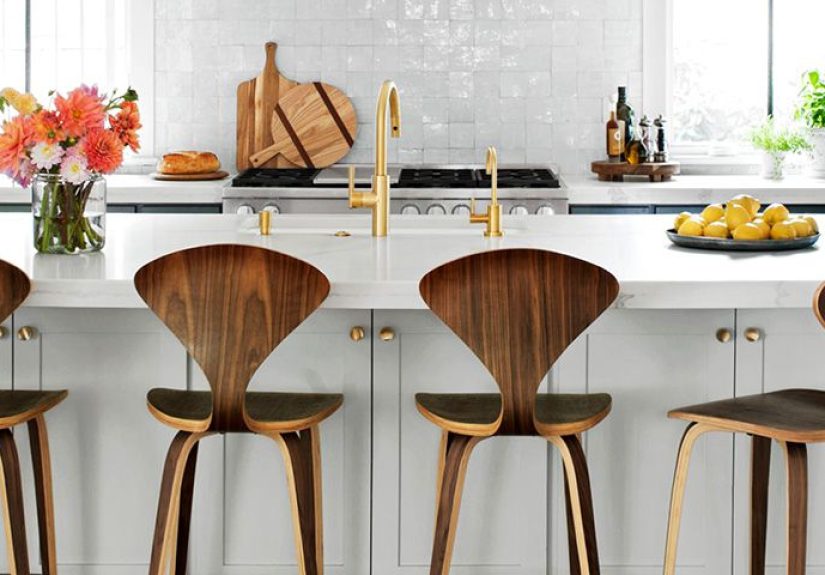
- Seating clearance: bar stools need space for legs, movement, and the inevitable chair scoot.
Pick Your “Style Sentence” Before You Shop
The fastest way to avoid a kitchen that feels like five Pinterest boards collided is to pick one guiding
sentenceyour style anchor. Think of it as the kitchen’s personality in one line.
Examples of a “style sentence” (steal one)
- Warm modern: creamy cabinets + walnut accents + soft brass + textured tile.
- Classic American: shaker cabinets + stone counters + timeless pendants + polished nickel.
- Moody and grounded: deep green/black cabinets + warm wood + stone backsplash + layered lighting.
- Light and airy: pale cabinets + reflective surfaces + simple hardware + open shelving (used responsibly).
Once you have the sentence, decorating gets easier: anything that doesn’t fit your sentence goes back on the shelf.
(Yes, even the adorable rooster cookie jar. Be strong.)
Cabinets: The Biggest Visual Decision You’ll Make
Cabinets take up a lot of visual real estate, so their color and style set the tone. In recent U.S. design coverage,
you’ll see a clear trend: homeowners are shifting from “all-white everything” toward warmer neutrals, earthy color,
and personalitywithout going full circus.
Cabinet color ideas that feel currentand livable
- Warm whites and creams: softer than bright white and less harsh under nighttime lighting.
- Nature-forward greens: sage, olive, and deeper forest tones read cozy and sophisticated.
- Inky charcoals and blacks: dramatic, especially when paired with wood or light counters.
- Clay and warm browns: terracotta-adjacent hues bring warmth without feeling trendy-for-a-week.
- Two-tone cabinets: darker lowers + lighter uppers can ground the room and visually expand it.
How to choose the right cabinet finish (so you don’t regret it)
- Test undertones: paint samples shift under daylight vs. evening bulbscheck both.
- Balance with counters and backsplash: choose cabinets first, then counters, then backsplash (in that order).
- Pick a door style that matches your home: shaker works in most homes; flat-panel feels modern; detailed doors lean traditional.
Countertops and Backsplashes: Durable Can Still Be Cute
These surfaces do the most workand get the most abuseso let function lead. The winning combo is:
easy to clean + hard to damage + good-looking enough to make you happy.
Backsplash ideas that update the kitchen without a full remodel
A backsplash is both protection and personality. It can quietly blend in or become the room’s jewelry.
Consider what you want: calm backdrop, bold feature, or “somewhere in between because I’m indecisive and I love that for me.”
- Classic tile layouts: subway tile, vertical stack, or herringbone can feel timeless with the right grout and finish.
- Full-height slab: running stone up the wall reduces grout lines and can look high-end.
- Handmade-look tile: zellige-style or texture-rich ceramic adds depth and imperfect charm.
- Color-coordinated backsplash: matching or harmonizing with cabinet color creates a modern “wrapped” look.
- Peel-and-stick options: good for rentals or low-commitment upgradespick a style that doesn’t scream “temporary.”
Countertop choices (quick reality check)
- Quartz: popular for consistency and low maintenance; great for busy households.
- Granite: natural variation; can be very durable, but choose the right seal and finish.
- Marble: gorgeous, but it can etch and stainbest if you’re okay with “patina” as a lifestyle.
- Butcher block: warm and welcoming; needs regular care and smart placement (great away from the sink).
Lighting: The Upgrade That Changes Everything After 6 PM
If you do only one thing to transform your kitchen, make it lighting. Paint is greatuntil nighttime hits and your
kitchen looks like a sad office break room. Layered lighting fixes that.
The 3-layer lighting plan that designers swear by
- Ambient lighting: overall illumination (recessed, flush mounts, or a central fixture).
- Task lighting: focused light for countertops and sinks (under-cabinet, pendants, directional fixtures).
- Accent lighting: mood and highlights (cabinet lighting, shelf lighting, toe-kick glow, interior cabinet lights).
Under-cabinet lighting: small detail, huge payoff
Under-cabinet lighting makes countertops safer and more pleasant to work on, and it also makes the whole kitchen feel
more expensive. If you’re upgrading, energy-efficient LED options are widely recommendedmany ENERGY STAR-certified
products use significantly less energy and last much longer than older bulb types.
- Placement tip: mount lights so they illuminate the work surface without harsh glare.
- Color consistency: keep the “white” tone consistent across fixtures so the room doesn’t look mismatched.
- Dimmers: use dimmers to switch from “chop onions” mode to “wine and gossip” mode instantly.
Storage That Looks Good (and Actually Works)
Great kitchen decor isn’t just what you addit’s what you don’t have to see. Smart storage is basically aesthetic
self-care. If your counters are always crowded, it’s rarely a “you problem.” It’s usually a “storage plan” problem.
Storage upgrades that make kitchens feel bigger
- Deep drawers for pots and pans: easier than lower cabinets where items vanish into darkness.
- Pull-outs: spices, trash/recycling, and pantry pull-outs maximize awkward spaces.
- Lazy Susans and corner solutions: stop sacrificing half your cabinet to the void.
- Vertical dividers: store baking sheets and cutting boards upright (no more clattering pile).
- Magnetic knife storage: frees drawer space and keeps tools accessible (safely placed).
Open shelving (use with a seatbelt)
Open shelves can look amazing, but only if you treat them like curated decornot overflow storage. Keep it simple:
a few stacks of plates, a couple of everyday glasses, and one or two warm accents (wood, ceramic, or a plant that
can survive steam and chaos).
The Island: MVP or Traffic Cone?
A kitchen island can be a prep station, storage hub, homework desk, snack bar, and social magnet. Or it can be the
world’s most expensive obstacle. The difference is clearance, function, and honest self-awareness.
Make the island earn its keep
- Build in storage: drawers, cabinets, and open cubbies can hold the things that clutter counters.
- Add outlets: for mixers, phone charging, and the air fryer you swore you wouldn’t buy (but did).
- Plan seating wisely: allow room behind stools so people can pass without hip-checking a family member.
- Consider a movable island: a rolling cart can be perfect in small kitchens or rentals.
Small Kitchen Design Tricks That Don’t Feel Like Tricks
Small kitchens aren’t doomedthey just can’t afford wasted space. The best small kitchen ideas focus on light,
vertical storage, and visual simplicity.
What helps a small kitchen look bigger
- Reflective finishes: some glossy or light-bouncing surfaces can expand the feel of the room.
- Glass-front uppers: a couple of glass doors can create depth without going full open-shelf stress.
- Continuous flooring: running the same floor into adjacent spaces can visually stretch the kitchen.
- Keep the palette tight: fewer competing colors and patterns makes the space feel calmer and larger.
- Use vertical space: wall rails, shelves, and tall storage take advantage of height.
Small kitchen decorating idea: “one statement, not ten”
In a tight kitchen, a single bold element reads intentional: a standout pendant, a patterned runner, or a fun tile
moment. If you try to make everything the star, the room starts to feel like it’s yelling.
Finishes, Hardware, and the “Jewelry” Moment
Hardware is the easiest way to update the kitchen’s vibe without a full renovation. Think of it like a haircut:
it won’t change your whole life, but it can absolutely change your mood.
Hardware and metal-mixing rules that actually work
- Pick a main metal: brass, polished nickel, matte black, or stainlesschoose one to dominate.
- Add a supporting metal: keep it subtle (light fixtures or faucet) so it feels layered, not chaotic.
- Match your home’s tone: older homes often suit warmer metals; modern spaces can handle sharper contrasts.
Decor That’s Practical: Make the “Everyday” Stuff Look Intentional
The secret to a kitchen that looks styled is not buying more decorit’s making functional items look good on purpose.
Practical can be pretty.
Easy kitchen decor moves with big impact
- Countertop tray: corral soap, a candle, and a scrub brush so it looks curated, not random.
- Canisters for staples: flour, sugar, coffeebonus points if they match and seal well.
- Art in the kitchen: yes, it’s allowed. Pick something wipeable or frame it properly.
- A washable runner: adds color and softness where hard surfaces dominate.
- Greenery: herbs, a small plant, or even a vase of grocery-store flowers makes the room feel alive.
Budget-Friendly Updates That Feel Like a Remodel
Not every upgrade needs a contractor. If you want a noticeable change without a full kitchen renovation, focus on the
high-visibility, high-function items.
High-impact, lower-commitment upgrades
- Swap lighting: new pendants or a statement fixture can reset the whole room.
- Paint (strategically): cabinets, walls, or even just the islandsmall shifts can be huge.
- Upgrade the faucet: it’s used constantly, and a great faucet makes the sink area feel “done.”
- Replace hardware: a weekend project with “how is this the same kitchen?” results.
- Update the backsplash: even a modest tile change can modernize the room dramatically.
Quick Checklist: A Kitchen That Looks Good and Works Better
- Start with flow (triangle or zones), then pick finishes.
- Choose cabinets first, then counters, then backsplash.
- Layer lighting: ambient + task + accent.
- Prioritize storage that reduces countertop clutter.
- Keep decor practical and intentional.
- Pick a tight palette, then add one or two “personality” moments.
Experience Notes: What People Learn After Living With Their Kitchen
If you want the truth about kitchen decorating and design ideas, don’t just look at reveal photoslisten to what
homeowners say after six months of real life. The “experience gap” is where the best lessons live.
One of the biggest repeat stories: not enough outlets. People plan for the fridge and the microwave,
then realize their daily routine includes a coffee grinder, toaster, blender, phone charger, and (somehow) a rice
cooker that appears twice a week like a friendly ghost. The fix isn’t glamorous, but it’s life-changing: place outlets
where you’ll actually work, and don’t forget the island. When outlets are convenient, counters stay tidier because
appliances can live where they belongused, then put awayrather than camping out permanently.
Another common experience: lighting regret. Many kitchens look fine during the day, then feel harsh or
dim at night. People often realize too late that one overhead fixture can’t do everything. The happy ending is layered
lighting: under-cabinet lights that make prep easy, pendants that give personality, and a dimmer that lets the room
shift from “weekday efficiency” to “weekend ambiance.” Also, mixing bulb colors (some warm, some cool) is a sneaky way
to make a kitchen feel “off.” Keeping lighting tones consistent makes the space feel intentional.
Then there’s the open shelving reality check. Open shelves can be beautiful, but they demand habits.
People who love them long-term tend to use shelves for daily items they already keep neat: plates, bowls, and glasses.
People who regret them often used shelves as “miscellaneous storage,” which turns into visual clutter fast. A balanced
approach works well: a small open shelf moment for charm, plus closed storage for everything you don’t want to dust.
Grout and texture show up in experience stories a lot, too. A backsplash might look amazingbut if it’s
heavily textured or has lots of grout lines behind the stove, cleaning can become a frequent, dramatic monologue. Many
homeowners end up preferring finishes that still have character but wipe down easily. That doesn’t mean boring; it just
means choosing where the “high-maintenance beauty” goes (maybe not right behind the frying pan).
Finally, people consistently say the best kitchens feel personal because they reflect routines. A coffee zone makes
mornings smoother. A landing space near the fridge prevents the “arms full of groceries” juggling act. Deep drawers
keep cookware accessible. The most satisfying kitchens aren’t the ones that copy a trend perfectlythey’re the ones
designed around the household’s real habits, with just enough style to make you smile while you’re doing the dishes.
Conclusion: Make Your Kitchen Your Co-Pilot
The best kitchen decorating and design ideas are the ones that make your day easier and make the room feel like
home. Start with flow and clearance, build your style sentence, invest in lighting and storage, and then layer in
personality with color, texture, and practical decor. If your kitchen supports your real life, it will always look good
even on spaghetti night.