Table of Contents >> Show >> Hide
- Before You Start: What “Authentic” Looks Like
- Step 1: Vet the Seller and the Story (Yes, the Boring Part)
- Step 2: Confirm the Coat’s Identity (Style Name, Era, and Basic Features)
- Step 3: Inspect the Fabric Like a Grown-Up (Even If You’re Not One Yet)
- Step 4: Audit the Burberry Check Pattern (The Plaid That Makes People Act Up)
- Step 5: Study the Buttons and Hardware (Tiny Metal, Big Truth)
- Step 6: Check the Stitching and Construction (The “Luxury Is Quiet” Section)
- Step 7: Evaluate the Neck Label and Brand Fonts (Logos Aren’t Just “Close Enough”)
- Step 8: Read the Care Labels and Codes (The Paper Trail Inside the Coat)
- Step 9: Use Verification Moves That Actually Protect You
- Quick Red-Flag Summary (A.k.a. “Run” in Bullet Form)
- Real-World Experiences (Extra Notes From the Resale Trenches)
- Conclusion
Buying a Burberry coat secondhand can feel like adopting a fancy, beige-and-check-patterned rescue dog: you want the real deal, not a surprisingly confident impostor. Counterfeiters have gotten better at copying the “big picture” (the plaid, the logo, the vibe). The good news: they still mess up the details. And Burberry, as a luxury brand with a long heritage, is basically made of details.
This guide walks you through nine practical, real-world checks to authenticate a Burberry coatespecially trench coatswithout turning you into a full-time textile detective. (But if you start saying “stitch density” at brunch, I won’t judge.)
Before You Start: What “Authentic” Looks Like
Authentic Burberry coats are built like investment pieces: consistent stitching, premium materials, clean branding, and finishing that feels intentional. Fakes often look fine from five feet away and then fall apart when you get closelike a movie set “door” that’s actually just painted plywood.
Pro tip: Don’t rely on one single sign. Authenticity is a “stack of evidence” situation. One weird detail could be a repair, a vintage variation, or a factory change. But multiple mismatches? That’s the coat telling you, “I’m not who you think I am.”
Step 1: Vet the Seller and the Story (Yes, the Boring Part)
If a listing is suspicious, the coat doesn’t even need to be fake to become your problem. Start with risk management:
- Pricing: Deep discounts can happen, but huge markdowns with a “brand new” story are a classic counterfeit setup.
- Photos: You need clear images of the neck label, size tag, care label(s), lining/check pattern, buttons/hardware, and overall front/back.
- Return policy: A legitimate seller won’t act allergic to returns or extra photos.
- Provenance: Receipts and order confirmations help, but don’t treat screenshots like sacred textsscreenshots can be faked, too.
Example: “Gifted, no receipt, but definitely authentic” plus blurry tag photos plus a too-good-to-be-true price is the resale version of a haunted house invitation.
Step 2: Confirm the Coat’s Identity (Style Name, Era, and Basic Features)
Burberry trenches often come in named silhouettes (examples include Kensington, Chelsea, Sandringham, Westminster). A credible listing should be consistent about what it is. Your job: make sure the coat’s features match the claimed style and era.
Quick reality checks
- Cut and details: Double-breasted vs. single-breasted, raglan vs. set-in sleeves, belt shape, storm flap, epaulettes, cuff straps.
- Lining placement: Many trenches feature Burberry check lining or check under the collar, but not all Burberry coats do.
- Vintage branding: Older pieces may show “Burberrys” (with an “s”) rather than “Burberry.” That can be legitimate depending on era.
Example: If the listing claims a classic heritage trench but the coat has oddly modern, flimsy hardware and no structure, pause. A trench should feel like it could survive a dramatic movie rain scene without dissolving.
Step 3: Inspect the Fabric Like a Grown-Up (Even If You’re Not One Yet)
Fabric is where luxury brands quietly flex. Authentic Burberry trench coats are known for high-quality materials and finishing. Many heritage trenches use gabardinea tightly woven, weather-resistant fabric that feels smooth, dense, and substantial.
What to look for
- Hand feel: Authentic outer fabric shouldn’t feel papery, plasticky, or unusually thin.
- Drape: A real trench holds its shape but moves cleanly. A fake may look limp or oddly stiff.
- Consistency: Fabric should be consistent across panels (no weird shading differences unless clearly due to wear).
Example: If the coat claims “cotton gabardine” but feels like a costume-store rain poncho, that’s not “rare vintage,” that’s “rarely authentic.”
Step 4: Audit the Burberry Check Pattern (The Plaid That Makes People Act Up)
The Burberry check is iconicand that’s exactly why counterfeiters love it. But checks are hard to reproduce perfectly because they require accurate color, spacing, and alignment.
Pattern tells that matter
- Alignment at seams: On higher-end pieces, checks often line up neatly at center seams and across major panels. Small misalignment can happen, but sloppy mismatching is a red flag.
- Color accuracy: Look for balanced tones (a warm beige base with crisp black/white lines and a controlled red accent in many classic versions). Fakes may skew orange, muddy, or overly bright.
- Symmetry: Many authentic linings look visually “planned,” not randomly placed.
Example: If a red stripe hits the left side seam and then “teleports” two inches higher on the right side seam, that’s not artistic expressionit’s manufacturing chaos.
Step 5: Study the Buttons and Hardware (Tiny Metal, Big Truth)
Buttons and hardware are counterfeit kryptonite because they’re expensive to replicate correctly. Burberry coat buttons are typically sturdy and cleanly finished, and branded hardware (when present) should look precise.
Button and buckle checklist
- Weight: Buttons shouldn’t feel hollow or toy-like.
- Finish: Clean edges, consistent color, and no cheap-looking plating.
- Engraving/branding: If the coat has branded buttons or buckles, text should be crisp and centerednot shallow, fuzzy, or uneven.
- Attachment: Button stitching should be neat and secure, not loose with dangling threads.
Example: If “BURBERRY” looks like it was engraved by a tired squirrel, you’ve got a problem.
Step 6: Check the Stitching and Construction (The “Luxury Is Quiet” Section)
Luxury construction looks boring in the best way: straight lines, consistent stitch length, tidy edges, and clean finishing inside the coat.
Where to look
- Collar and lapels: Should be structured and evenly stitched.
- Buttonholes: Should be tight, clean, and symmetrical.
- Seams and hems: No bubbling, puckering, or messy thread ends.
- Inside finishing: Lining seams should be neat. Cheap overlocking and sloppy trimming can be a bad sign.
Example: One loose thread isn’t a conviction. But if the coat looks like it fought a stapler and lost, keep shopping.
Step 7: Evaluate the Neck Label and Brand Fonts (Logos Aren’t Just “Close Enough”)
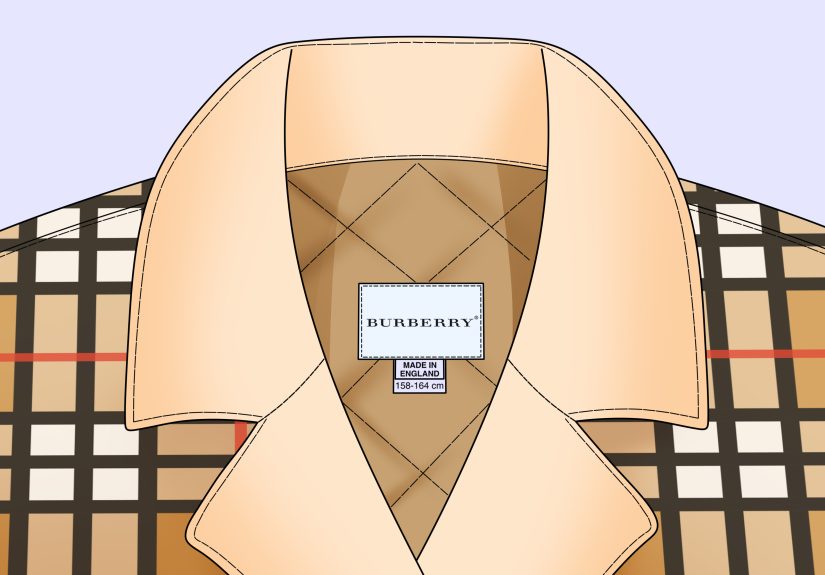
Counterfeits frequently mess up typography. On authentic pieces, labels are typically crisp, evenly stitched, and well centered. Letter spacing should look intentionalnot stretched, squished, or inconsistent.
Label details that matter
- Embroidery/printing quality: Sharp edges, no bleeding, no fuzzy outlines.
- Centering: The logo and text should sit straight and centered.
- Brand variations by era: Some older coats may legitimately say “Burberrys.” Newer pieces typically use “Burberry.” Use era consistency, not assumptions.
Example: A label that looks slightly off can be a clue, especially if other details are also questionable. Fonts don’t lie, but counterfeiters do.
Step 8: Read the Care Labels and Codes (The Paper Trail Inside the Coat)
Care labels are one of the most useful authenticity checkpoints because they combine: manufacturing information, material composition, care instructions, and sometimes internal style references. They’re also hard to replicate perfectly because counterfeiters often reuse generic tags.
What you want to see
- Clear printing: Sharp text, no smudges, no weird spacing.
- Consistent information: If the coat has a model/style name, it should match across internal tags where present.
- Reasonable country-of-origin info: Authentic items can be made in different countries depending on line and era, so don’t declare “Made in X” an automatic fake. Focus on overall consistency and quality.
- Materials that make sense: For example, a “100% cashmere” trench at a suspiciously low price deserves extra scrutiny (and possibly a dramatic eyebrow raise).
Example: If the care label says one thing and the coat behaves like another (e.g., “wool” that feels like thin polyester), trust your senses.
Step 9: Use Verification Moves That Actually Protect You
When in doubt, don’t “manifest authenticity.” Verify it.
Smart verification options
- Compare to known-authentic references: Use photos from reputable resale platforms or authorized retailers to compare label layouts and details.
- Choose platforms with authentication: Some marketplaces route higher-value items through authentication processes.
- Consider third-party authentication: Professional authenticators evaluate brand-specific markers and can provide an opinion based on detailed photos.
- Pay with protection: Use payment methods that offer dispute options. Avoid wire transfers or “friends and family” payments for luxury items.
Example: If the seller pressures you to skip buyer protection because it’s “faster,” that’s not customer servicethat’s a trap with shipping.
Quick Red-Flag Summary (A.k.a. “Run” in Bullet Form)
- Price is wildly low for the claimed condition and style.
- Photos avoid labels, buttons, lining, or inside tags.
- Check pattern looks off-color, blurry, or poorly aligned.
- Buttons/hardware feel lightweight, cheap, or poorly engraved.
- Labels have messy stitching, odd fonts, or inconsistent info across tags.
- Seller refuses returns, extra photos, or basic questions.
Real-World Experiences (Extra Notes From the Resale Trenches)
Here’s what actually happens when people try to authenticate a Burberry coat in the wildbecause reality rarely looks like a perfectly lit product page.
Experience 1: The “It Looked Perfect Online” Coat
A common scenario: the listing photos are beautiful, the seller seems friendly, and the coat arrives looking impressiveuntil you notice the inside label stitching is slightly crooked and the letters on the brand name look thicker in some spots than others. When buyers compare it to reputable resale listings, the label layout is “close,” but the font spacing isn’t. The lesson: counterfeiters often win the first impression and lose the close-up.
Experience 2: The “Vintage Means Authentic” Myth
Vintage Burberry is real, collectible, and often labeled “Burberrys”but “vintage” is not a magical anti-counterfeit force field. Shoppers sometimes see an older label and assume the coat must be legitimate, even when the lining check is oddly colored or the buttons look suspiciously lightweight. Experienced buyers treat vintage as an era to research, not a guarantee. They look for era-consistent branding, materials, and constructionand they expect a genuine vintage coat to feel well-made even after years of wear.
Experience 3: The “One Weird Detail” Debate
Sometimes a coat has one oddity: a replaced button, a missing belt, a repaired lining seam, or a care label that’s partly faded. That doesn’t automatically mean fake. Real coats get altered and repaired all the time. What matters is whether the odd detail fits a believable story. A single replaced button with otherwise excellent construction is different from a coat where the buttons, label fonts, lining colors, and stitching all feel slightly “off” in different ways.
Experience 4: The “Authentication Ping-Pong” Moment
Buyers sometimes bounce between opinions: a friend says “looks real,” a reseller says “not sure,” and the seller insists it’s “100% authentic.” In these situations, people get stuck because they want certainty from one clue. The more reliable approach is stacking evidence: seller credibility, clear tag photos, material quality, check alignment, hardware finishing, and consistency across labels. If the stack doesn’t add up, experienced shoppers walk awayeven if the coat is cutebecause return shipping is cheaper than regret.
Experience 5: The “I Saved Money… Until I Didn’t” Lesson
One of the most useful mindsets in luxury resale is recognizing that the true cost includes risk. A slightly higher price from a reputable platform with authentication, buyer protection, and a return policy can be less expensive than a “deal” that turns into a dispute. Many seasoned shoppers set a personal rule: if a listing doesn’t provide the exact photos needed to authenticate (labels, care tags, lining, hardware, full front/back), they don’t buyno matter how tempting the discount is.
In other words: you don’t need to become an expert in Burberry coats. You just need a repeatable processand the confidence to say, “No thanks, I like my trench coats authentic and my stress levels low.”
Conclusion
Spotting a fake Burberry coat comes down to disciplined skepticism and a few consistent checks. Start with the seller and the listing quality, confirm the coat’s style and era, then zoom in on what counterfeiters struggle to replicate: fabric quality, check pattern precision, hardware finishing, label typography, and clean construction. If you’re still unsure after running the nine steps, don’t guessverify with reputable authentication options or choose a purchase path with strong buyer protection.