Table of Contents >> Show >> Hide
- Start Here: The 3 Rules That Keep You From Being Wrong (A Lot)
- Oculesics 101: The Eye Cues People Actually Show
- How to Read Eye Expressions in Real Life: A Practical Pattern Guide
- Common Myths That Ruin Eye-Reading
- High-Accuracy Method: The 15-Second Eye Expression Read
- Practice Drills (So You Can Get Good Without Being Weird About It)
- Use It Ethically: Don’t Weaponize Eye Reading
- Real-World Experiences: What Eye Expressions Look Like in the Wild (About )
- Conclusion: Read Eyes Like a Human, Not a Scanner
- SEO Tags
Eyes are the VIP section of body language. They broadcast attention, emotion, and “please stop talking” faster than most people can fake a smile.
But here’s the catch: reading eye expressions isn’t mind-reading. It’s pattern-reading. It’s noticing what changes, when it changes, and what else changes at the same time.
Do it well and you’ll understand people more clearly. Do it badly and you’ll think your coworker is “lying” when they’re actually just allergic to your office plant.
This guide will teach you how to read eye expressions using evidence-based cues: gaze direction, eye contact patterns, blink rate, pupil size, eyelid tension, and the “eye region”
signals that show up during real emotion (including microexpressions). You’ll also learn the biggest traps (lighting, culture, neurodiversity, and stress),
plus a practical step-by-step method you can use in everyday conversations.
Start Here: The 3 Rules That Keep You From Being Wrong (A Lot)
1) Context beats any single cue
Eye expressions change for dozens of reasonssocial, emotional, physical, and environmental. A wide-eyed look can mean surprise, fear, excitement, or “I just remembered I left the stove on.”
Always anchor your interpretation to what’s happening in the moment.
2) Look for a baseline, then look for a shift
“Baseline” means what’s normal for that person in that setting. Some people blink more. Some people make less eye contact even when they’re fully engaged.
You’ll get far more accurate by noticing changes from their usual pattern than by comparing them to a body language “cheat sheet.”
3) Read clusters, not clues
The safest way to interpret eye expressions is to combine at least three things: the eyes (gaze/pupils/blinks/lids), the rest of the face (brows/mouth),
and the body/voice (posture, gestures, tone, pacing). A single cue is just a clue. A cluster is a pattern.
Oculesics 101: The Eye Cues People Actually Show
The fancy term for eye behavior in nonverbal communication is oculesics. It covers how we use gaze, eye contact, blinking, and pupil changes
to regulate conversation, show interest, or signal discomfort.
Pupil size: the “arousal dial” with a huge disclaimer
Pupils can dilate (get larger) with emotional arousal, mental effort, stress, and attractionbut also with low light, certain medications, and many medical factors.
In other words: pupil size can reflect activation, not a specific emotion. Think “system turned up,” not “they’re definitely flirting.”
- Likely meaning (in context): increased interest, stress, excitement, fear, cognitive load, or attraction.
- Common false alarms: dim lighting, sunglasses coming off, stimulants/caffeine, some medications, fatigue, eye conditions.
- Best practice: compare to the person’s baseline in the same lighting and distance, and pair it with other cues.
Blinking: a stress and thinking signal (not a lie detector)
Blink rate often shifts with attention and workload. Many people blink less when intensely focused and more when stressed, uncomfortable, or juggling mental effort.
In some deception research, blink patterns can changeyet the big takeaway for everyday life is simpler: blinking is a load signal more than a “truth signal.”
If you treat it like a lie alarm, you’ll accuse innocent people who are just anxious, tired, or doing math in their head.
- Faster blinking can suggest: stress, discomfort, pressure, uncertainty, or cognitive effort.
- Slower blinking can suggest: deep focus, intense listening, concentration, or deliberate control.
- Watch for timing: Does blinking spike when a specific topic comes up? That’s more informative than overall blink rate.
Eye contact: connection, dominance, and “please don’t stare into my soul”
Eye contact is one of the strongest social signals we have. It can communicate attention, warmth, respect, and intimacy. It can also communicate dominance, challenge,
or pressureespecially when it’s intense and unbroken. Research even suggests that in some persuasion contexts, direct gaze can create resistance rather than agreement.
That means “more eye contact” isn’t always better; appropriate eye contact is better.
- Comfortable mutual gaze: often signals engagement and rapport.
- Hard, unblinking stare: can signal dominance, confrontation, or high intensity.
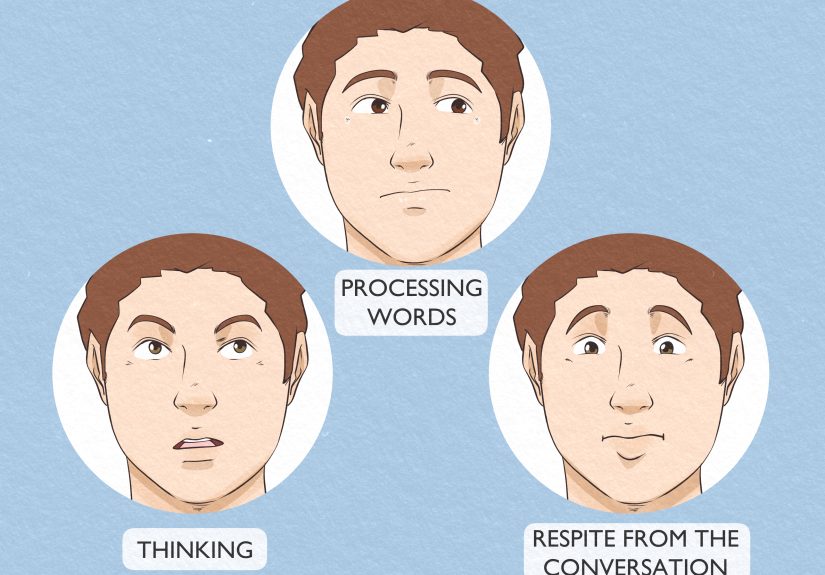
- Frequent gaze breaks: can be normal (thinking, politeness), or can signal discomfort depending on clusters.
- Culture matters: norms for “respectful” eye contact vary widely across communities and settings.
Eyelids and squinting: the underrated truth-tellers
The eye region is packed with muscles that react quicklyoften before someone can edit their expression. Two eyelid patterns show up constantly:
-
Lid tightening / squinting: A narrowed gaze can indicate skepticism, evaluation, annoyance, anger, or concentration.
When paired with a tense jaw or compressed lips, it often leans toward irritation. When paired with a tilted head and curious brow, it can lean toward analytical focus. -
Upper eyelid raising (wide eyes): Eyes that suddenly widen can reflect surprise, fear, shock, or sudden interest.
“Wide eyes + frozen face” often reads like surprise. “Wide eyes + tension + pulled-back mouth” can read more like fear.
The “real smile” clue lives near the eyes
A genuinely happy smile often involves the eye regionespecially the cheek raise and the little crinkles at the outer corners (“crow’s feet”).
This is sometimes described as a Duchenne-style enjoyment smile. It doesn’t mean someone can’t fake it, but the eye region is harder to control than the mouth alone.
If the mouth is smiling but the eyes look flat or tense, you may be seeing a polite or social smile rather than delight.
How to Read Eye Expressions in Real Life: A Practical Pattern Guide
Below are common “eye expression patterns.” They’re not guaranteesthink of them as the most likely interpretations when the context and clusters match.
Pattern A: Interest and engagement
- Eyes: steady but relaxed eye contact, natural blink rate, occasional quick glances to your face/mouth.
- Extra hints: slight forward lean, nodding, responsive facial expressions.
- Example: Your friend listens to your story, meets your gaze, then looks away briefly while picturing the scenethen returns to you.
Pattern B: Skepticism or evaluation
- Eyes: narrowed lids (squint), slower gaze shifts, side-eye or “look over the glasses” energy.
- Extra hints: one brow raised, lips pressed or pulled to one side, head tilt.
- Example: You propose an idea in a meeting and someone squints slightly, looks at the slide, then back at you with a tight eye regionevaluating.
Pattern C: Stress or discomfort
- Eyes: increased blinking, more gaze breaks, darting to exits/phone/notes, eyes widening briefly then tightening.
- Extra hints: self-soothing gestures (rubbing hands, touching face), tense shoulders, faster speech or very clipped speech.
- Example: During a tough conversation, their eye contact becomes “on/off,” blinking spikes, and their voice speeds upstress load is rising.
Pattern D: Anger or defensiveness
- Eyes: hard stare or narrowed lids, reduced “softness” in the eye area, fewer friendly eyebrow movements.
- Extra hints: jaw tension, tight mouth, rigid posture, sharper tone.
- Example: You interrupt someone and their eyes lock on you with a tight squint and stillnessdefensiveness is likely.
Pattern E: Attraction or warmth
- Eyes: lingering gaze with relaxed lids, frequent return to eye contact, genuine smiles that reach the eyes.
- Extra hints: open posture, mirroring, playful facial expressions, comfortable proximity.
- Example: On a date, they look at you, glance down briefly with a smile, then look backwarmth plus social ease.
Common Myths That Ruin Eye-Reading
Myth 1: “Looking away means lying.”
People look away to think, remember, manage emotion, reduce sensory overload, or follow cultural norms. Eye contact avoidance can mean discomfortbut not automatically deception.
If you want accuracy, focus on changes from baseline and clusters (voice, timing, story coherence, body tension).
Myth 2: “Blinking fast means they’re hiding something.”
Fast blinking can be stress, dry eyes, contacts, bright lights, fatigue, anxiety, or cognitive effort. If it spikes only on one topic, that topic mattersbut the “why” still needs context.
Myth 3: “Pupil dilation means attraction.”
It can. It can also mean fear, excitement, workload, low light, or medication. Treat pupil changes as “activation,” then confirm with other signals.
High-Accuracy Method: The 15-Second Eye Expression Read
- Check the environment: lighting, distance, screens, caffeine, stress level, and anything eye-related (contacts, allergies).
- Find baseline: their normal gaze and blink style in the first minute of interaction.
- Spot a shift: what changed (blink rate, squinting, gaze breaks, widening eyes, staring)?
- Time-stamp it: what was said or happening when the shift occurred?
- Confirm with clusters: match the eye shift with mouth/brows, posture, and voice.
- Test gently: ask a neutral follow-up (“Can you say more?”) and see if the pattern intensifies or resolves.
This approach keeps you curious instead of judgmental. It also prevents the classic body language mistake: deciding what something means first, then hunting for “proof.”
That’s not observationit’s a detective cosplay with confirmation bias.
Practice Drills (So You Can Get Good Without Being Weird About It)
Drill 1: The baseline habit
Pick one low-stakes conversation per day (barista, coworker, friend). Spend the first 30 seconds noticing baseline: blink pace, gaze style, and eyelid openness.
Don’t interpret. Just notice. Your accuracy jumps when baseline becomes automatic.
Drill 2: Topic-trigger mapping
In a longer conversation, silently note when the eye region changes. Then compare it to the topic shift.
People often show eye changes during emotionally loaded subjects (money, status, conflict, attraction) or high mental effort (explaining, remembering details).
Drill 3: “Soft eyes” vs “tight eyes”
Watch for muscle tension around the eyes. Tightness often appears in stress, anger, skepticism, or effort. Softness often appears in comfort, warmth, and ease.
Combine it with the mouth: a soft eye region plus a relaxed smile reads very differently than tight eyes plus a grin.
Use It Ethically: Don’t Weaponize Eye Reading
Reading eye expressions should improve empathy and communicationnot turn you into a human polygraph machine.
It’s easy to overreach and label people (“She’s deceptive,” “He’s attracted,” “They’re intimidated”) based on a few cues.
Instead, use eye-reading to choose better responses:
- If you see stress cues: slow down, offer clarity, reduce pressure.
- If you see skepticism cues: provide evidence, invite questions, don’t bulldoze.
- If you see warmth cues: match the energy, build rapport naturally.
- If you see discomfort cues: create space, check consent, adjust the topic.
The most powerful “body language move” isn’t spotting a microexpressionit’s responding in a way that makes people feel safe enough to be honest.
Real-World Experiences: What Eye Expressions Look Like in the Wild (About )
The best way to learn how to read eye expressions is to connect them to moments you’ve probably lived through. Here are five common scenarios (composite, real-life patterns)
and what the eyes often revealplus what to do with that information without turning into a courtroom cross-examiner.
1) The job interview “spotlight blink”
You ask a candidate about a gap in their resume. Their blink rate jumps, eye contact breaks more frequently, and they glance down before answering.
The rookie mistake is yelling “Liar!” in your head. A better read: the topic increased pressure and cognitive load. They may be choosing words carefully,
recalling details, or managing anxiety. What helps? A calm follow-up: “Totally finewalk me through what you were doing during that period.”
If the story becomes clearer and their eye behavior settles, you likely witnessed stressnot deception.
2) The first date “soft eyes + return gaze”
When people feel comfortable and interested, you often see relaxed lids (not tight squinting), natural blinks, and a repeated “return” to eye contact after brief gaze breaks.
They look at your face, glance away, then come backlike their attention has a home base. Pair that with genuine smiles that show in the eye area and open posture,
and you’ve got a strong warmth cluster. What to do? Don’t overanalyze the pupils in dim restaurant lighting. Just match the ease: listen well, smile naturally, and keep the vibe light.
3) The meeting where someone’s eyes say “I have concerns”
You pitch a plan. One teammate narrows their eyes slightly and holds their gaze on the slide longer than usual, blinking less while processing.
That can read like skepticism or heavy evaluation. If their mouth is neutral and their posture is forward, it may be thoughtful critique rather than negativity.
The right response is not defensivenessit’s invitation: “What’s the risk you’re seeing?” You’ll often watch the eye tension release once concerns are named.
4) The conflict conversation “tight eyes + hard stare”
During an argument, eye expressions can intensify: narrowed lids, reduced blinking, and a more fixed gaze. This can signal defensiveness or anger,
especially when combined with a tightened jaw or clipped tone. The goal isn’t to “win” by spotting itit’s to de-escalate.
Try slowing your speech and lowering your volume. If you see their gaze soften and blinking normalize, you’re moving out of threat mode.
5) The friend who avoids eye contact but is still engaged
Some peopleespecially under stress, in sensory-heavy environments, or due to personal/cultural communication stylesmay use less direct eye contact while still listening deeply.
They might look at your mouth, forehead, or off to the side, and still respond perfectly. The best “experience lesson” here is humility:
judge engagement by the full cluster (responses, timing, curiosity), not just gaze. If you want connection, you can say, “Let me know if you want a pausethis is a lot,”
rather than forcing eye contact as a test of respect.
Conclusion: Read Eyes Like a Human, Not a Scanner
If you remember nothing else, remember this: eyes are powerful signals, but they’re not subtitles for someone’s soul.
You’ll get the best results by (1) checking context, (2) establishing baseline, and (3) reading clustersespecially blink changes, eyelid tension, and gaze patterns.
Use the skill to build empathy, improve conversations, and catch emotional shifts early. And when in doubt, do the most advanced body language technique available:
ask a kind, direct question and actually listen to the answer.