Table of Contents >> Show >> Hide
- Why Care Labels Matter (Besides Saving You Money)
- The 30-Second Decoder Ring: The 5 Main Symbols
- 1) Washing Symbol (The Tub): How to Wash Without Regret
- 2) Bleaching Symbol (The Triangle): The “Don’t Nuke Your Colors” Zone
- 3) Drying Symbol (The Square): Air-Dry vs Tumble-Dry Clarity
- 4) Ironing Symbol (The Iron): Heat Levels and Steam Warnings
- 5) Professional Cleaning Symbol (The Circle): Dry Clean, Wet Clean, or “Don’t Even Try”
- Putting It All Together: A Simple Step-by-Step Label Check
- Quick Reference: The 5 Symbols at a Glance
- Common Label Mistakes (So You Don’t Become a Laundry Cautionary Tale)
- Conclusion: Read the Label Once, Wear the Clothes Longer
- Experience: Real-Life Laundry Lessons (The Part You Learn After Ruining Something Once)
Clothing care labels are basically tiny instruction manuals… written in a code that looks like it was designed by a minimalist who hates words.
The good news: you don’t need to be a textile scientist to decode them. You just need to recognize five “main symbol families”
(wash, bleach, dry, iron, and professional cleaning), plus a couple of modifiers like dots and lines.
Learn these symbols and you’ll stop turning sweaters into doll clothes, keep black jeans from fading into “sad charcoal,”
and avoid the heartbreak of discovering your “dry clean” blazer has become “dry, clean-ish, and now weirdly crunchy.”
Why Care Labels Matter (Besides Saving You Money)
In the U.S., apparel typically comes with care instructions so consumers can clean items without damaging them.
Care labels exist because different fabrics react dramatically differently to heat, water, agitation, bleach, and solvents.
Cotton can handle more than silk. Wool gets offended by hot water. Spandex panics in high heat. Rayon can shrink if you look at it wrong.
The label’s job is to tell you the safest (and sometimes the only) cleaning method that won’t wreck the garment.
Think of it as the difference between “this is washable” and “this is washable if you whisper apologies and use cold water.”
The 30-Second Decoder Ring: The 5 Main Symbols
Most care labels follow a predictable system: five categories of symbols, usually shown in this order:
Washing, Bleaching, Drying, Ironing, and Professional Cleaning.
Each category has a base shape you can recognize instantly.
- Washing = a little tub of water
- Bleaching = a triangle
- Drying = a square (sometimes with a circle inside)
- Ironing = an iron shape
- Professional cleaning = a circle (dry clean / wet clean instructions)
Now for the two “universal modifiers” that show up across categories:
Modifier #1: Dots = Heat Level
One dot means low heat, more dots mean higher heat. This can refer to wash water temperature, dryer temperature, or ironing temperature.
If you remember only one thing, remember: more dots = more heat.
Modifier #2: Lines/Bars = Gentler Treatment
Lines (or bars) under a symbol usually mean a gentler cycleless agitation, lower spin, or a more delicate process.
Again: more lines = more gentle.
1) Washing Symbol (The Tub): How to Wash Without Regret
The wash tub symbol tells you whether you can machine wash, what temperature to use, and how gentle the cycle should be.
This is the symbol family you’ll see most oftenand the one that can save your favorite clothes fastest.
Common washing symbols you’ll see
- Plain tub = machine washable (normal cycle unless other marks say otherwise)
- Tub with a number (like 30, 40) = maximum wash temperature in Celsius
- Tub with dots = temperature level (more dots = warmer/hotter)
- Hand in tub = hand wash only (or “please don’t let your washer get involved”)
- Tub with an X = do not wash
Cycle lines under the tub (the “be gentle” warning)
- No line = normal cycle
- One line = permanent press / wrinkle-control (moderate agitation, usually cooler spin)
- Two lines = gentle / delicate (lowest agitation)
Real-life examples
Example A: Cotton T-shirt
If you see a plain tub (or tub with warm-ish dots), you’re usually safe with a normal or permanent press cycle.
Want the shirt to last longer and keep color? Cold water is often the “less drama” option.
Example B: Wool sweater
If the label shows a hand in the tub (or a tub with two lines), treat it like a fragile masterpiece.
Use cold water, minimal agitation, and avoid “I’ll just toss it in with towels.” That’s how sweaters become felt.
Example C: Athletic wear (polyester/spandex)
These often tolerate machine washing but hate heat. Look for low-temp dots and gentler cycles.
Performance fabrics can lose stretch and shape if you run them too hot.
2) Bleaching Symbol (The Triangle): The “Don’t Nuke Your Colors” Zone
Bleach is powerfuland not in a “hero of laundry day” way for many fabrics. The triangle tells you whether bleach is safe and what kind.
This matters because chlorine bleach can weaken fibers, damage elastics, and cause color loss.
Common bleach symbols
- Empty triangle = any bleach allowed (rare on many modern dyed items)
- Triangle with diagonal lines = non-chlorine bleach only (often oxygen bleach)
- Triangle with an X = do not bleach
Real-life examples
Example A: White cotton socks
If the label allows bleach, you can use itthough many people choose oxygen bleach for less fiber damage.
Example B: Black jeans
If there’s an X over the triangle, avoid bleach entirely. If it’s “non-chlorine only,” stick to oxygen bleach and spot-test first.
Chlorine is basically the villain origin story for your dark wash.
3) Drying Symbol (The Square): Air-Dry vs Tumble-Dry Clarity
Drying symbols start with a square. If there’s a circle inside the square, that’s tumble drying (your dryer).
If there’s no circle, it’s natural drying (air drying).
Tumble dry symbols (square with a circle)
- Square + circle = tumble dry allowed
- Dots inside the circle = dryer heat level (1 dot low, 2 medium, 3 high)
- Square + circle with an X = do not tumble dry
- Lines under the symbol = use permanent press (one line) or gentle (two lines)
Natural drying symbols (square without a circle)
- Vertical line = line dry (hang it up)
- Horizontal line = dry flat (great for sweaters)
- Three vertical lines = drip dry (hang wet, don’t wring)
- Shaded corner = dry in the shade (helps prevent fading)
Real-life examples
Example A: Stretchy leggings
If tumble dry is allowed but shows one dot (low heat), obey it. High heat can break down elastics over time.
If the label says “do not tumble dry,” air drying helps preserve stretch and fit.
Example B: Sweaters
“Dry flat” is not a suggestion for people with extra free timeit’s how you avoid shoulder bumps and weird stretching.
Hanging a wet sweater is basically asking gravity to redesign it.
4) Ironing Symbol (The Iron): Heat Levels and Steam Warnings
The iron symbol tells you whether ironing is safe and how hot you can go.
Many fabrics (especially synthetics) can shine, melt, or warp if ironed too hot.
Common ironing symbols
- Iron with dots = iron allowed at a specific heat (1 dot low, 2 medium, 3 high)
- Iron with an X = do not iron
- Iron with steam lines crossed out = no steam (dry iron only)
Real-life examples
Example A: Polyester blouse
If you see one dot, keep the iron low. Use a pressing cloth if you’re worried about shine.
Better yet: steam from a distance (if allowed) and let gravity do half the work.
Example B: Linen shirt
Linen usually handles higher heat (often two or three dots), but it wrinkles like it’s competing for an award.
A slightly damp press can helpjust follow the label’s dot level.
5) Professional Cleaning Symbol (The Circle): Dry Clean, Wet Clean, or “Don’t Even Try”
The professional cleaning family uses a circle and may include letters. This is where labels get serious
especially with structured garments, delicate fabrics, and anything you’d describe as “an investment piece.”
Common professional cleaning symbols
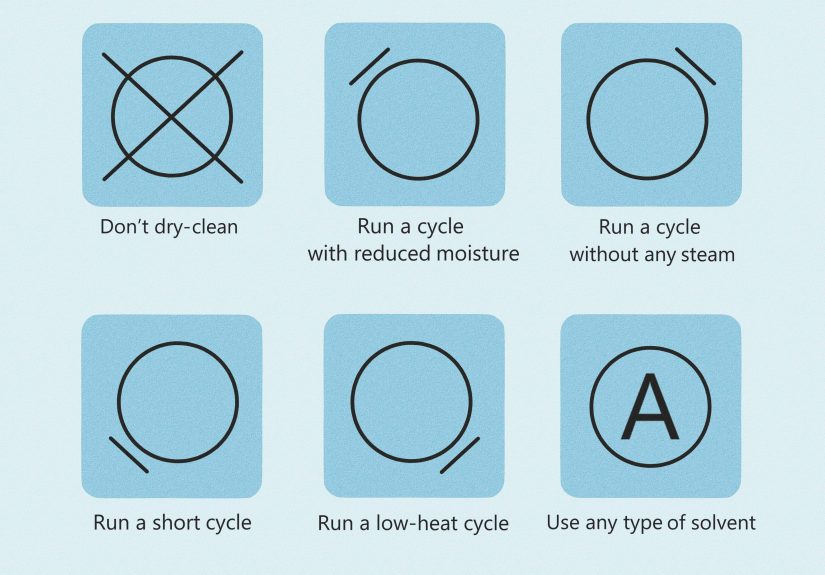
- Plain circle = professional cleaning is allowed
- Circle with an X = do not dry clean
- Letters inside the circle (like P or F) = tells professionals which solvents/processes are appropriate
- Circle with a W = professional wet cleaning (a controlled, gentle water-based process)
- Bars under the circle = gentler professional process requested
What about “Dry Clean Only”?
If your label explicitly says “dry clean only” (or shows a strong “professional cleaning only” instruction),
that’s a risk-management moment. Some items can be hand-washed successfully, but others will lose shape, bleed dye,
or develop weird bubbling in linings. If the piece is structured (blazers, coats) or has special trims, play it safe.
Putting It All Together: A Simple Step-by-Step Label Check
- Start with the wash tub: Can you machine wash, hand wash, or not wash at all?
- Check the dots/number: What’s the max temperature?
- Look for the triangle: Is bleach allowed, and if yes, what kind?
- Move to the square: Can it go in the dryeror should it air dry (flat, line, shade)?
- Finish with the iron/circle: Iron heat level and whether professional cleaning is recommended.
Quick Reference: The 5 Symbols at a Glance
| Symbol Family | Base Shape | What It Controls | Most Useful Clue |
|---|---|---|---|
| Washing | Tub | Machine/hand wash, cycle, water temp | Lines under tub = gentler cycle |
| Bleaching | Triangle | Bleach allowed or not, type of bleach | Diagonal lines = non-chlorine only |
| Drying | Square | Tumble vs air dry, heat level, method | Circle inside square = dryer |
| Ironing | Iron | Iron allowed, heat level, steam | Dots = temperature level |
| Professional Cleaning | Circle | Dry clean/wet clean guidance | Letters/bars guide the cleaner |
Common Label Mistakes (So You Don’t Become a Laundry Cautionary Tale)
Mistake #1: “Do Not Tumble Dry” ≠ “You Can’t Dry It”
It usually means “air dry.” Many items that can’t go in the dryer are still washablejust dry flat or line dry.
This is especially common with knits, elastics, and delicate synthetics.
Mistake #2: Ignoring the Gentle Lines
If your wash tub has one or two lines underneath, that’s not decorative minimalism. It’s the garment asking for less agitation.
A gentle cycle can prevent pilling, stretching, and seam stress.
Mistake #3: Assuming All Dots Mean the Same Exact Temperature
Dots always mean “more heat vs less heat,” but exact temperatures can vary by system and region.
When you see a number (like 30 or 40), treat it as the max Celsius temperature and follow it closely.
Mistake #4: Using Chlorine Bleach When the Triangle Says “Non-Chlorine Only”
That striped triangle isn’t saying “bleach me however you feel today.” It’s saying “avoid chlorine.”
Oxygen bleach is typically the safer route for colors and many synthetics.
Conclusion: Read the Label Once, Wear the Clothes Longer
Clothing care labels aren’t trying to ruin your funthey’re trying to keep your clothes looking good, fitting correctly,
and lasting longer. Memorize the five main symbol shapes, remember that dots mean heat and lines mean gentle cycles,
and you’ll be able to decode 95% of what shows up on a tag.
Next time you’re about to do laundry on autopilot, pause for five seconds and check the label.
Future you (and your favorite sweater) will be grateful.
Experience: Real-Life Laundry Lessons (The Part You Learn After Ruining Something Once)
Most people don’t become “care label readers” because it’s fun. They become care label readers because of a specific event:
a tragedy so small, so personal, and so avoidable that it leaves a permanent mark on the soul… and the closet.
One classic experience is the Shrunken Sweater Incident. It usually starts with optimism:
“It’s just a sweater. How complicated can it be?” Then the sweater meets hot water and regular agitation, and suddenly it’s
the size of a fashionable potholder. This is where the wash-tub symbol and those gentle lines matter.
If you’ve ever pulled a knit out of the washer and thought, “Why does this feel… denser?” you’ve met accidental felting.
The label’s gentle/hand-wash instruction isn’t about being preciousit’s about preventing the fiber structure from locking up.
Another very common story: The Bleach Betrayal. Someone sees a stain, reaches for bleach like it’s a superhero,
and forgets that bleach does not negotiate with dye. The result is a bright spot on a dark shirt that looks like a tiny comet hit it.
That triangle symbol is your warning system. If the label says “do not bleach,” you’re better off with a stain remover,
oxygen bleach (if allowed), or targeted spot treatmentanything that doesn’t permanently “redecorate” the fabric.
Then there’s The Dryer Surprise, also known as “Why is my waistband crunchy?” Heat is rough on elastic and performance fabrics.
People often assume, “Low heat and high heat are basically the same.” They are not. Dryer dots exist for a reason.
If the square-with-circle symbol has one dot (low heat) or the label says no tumble dry, that’s your hint that the item’s stretch,
finish, or shape depends on staying cool. Air drying can feel inconvenientuntil you realize it’s the cheapest way to preserve fit.
Ironing experiences tend to come in two flavors: Shine and Melt. Synthetics can develop a shiny patch if ironed too hot,
and some fabrics can warp if steam and heat are used incorrectly. That’s why the iron symbol’s dots matter.
One-dot ironing is basically the garment saying, “I’m delicate. Please don’t treat me like denim.”
A pressing cloth, a lower heat setting, and patience can save a shirt from looking like it got polished.
Finally, the most expensive lesson: The “Dry Clean” Debate. Many people gamble on washing something that suggests professional cleaning.
Sometimes they win. Sometimes they lose in a dramatic waylining bubbles, shoulder structure collapses, or the dye migrates like it’s trying to escape.
The circle symbol is less about fear and more about risk. If the garment is tailored, lined, or made of finicky fibers (silk, wool blends, specialty finishes),
professional cleaning is often the safer bet. The best “experience-based” habit is this: if replacing the item would hurt, follow the label.
Over time, these little experiences build a simple personal rulebook: check the tub before washing, check the square before drying,
respect the triangle, and never assume the iron knows what it’s doing. The label is tiny, but the consequences are… highly visible.