Table of Contents >> Show >> Hide
- Quick Navigation
- Why the Ending of a Complaint Letter Matters
- How to End a Complaint Letter: 8 Steps
- Step 1) Restate your desired resolution in one sentence
- Step 2) Add a reasonable deadline (and make it a date)
- Step 3) Make the next action easy: how should they contact you?
- Step 4) Reference your documentation (without dumping a paper avalanche)
- Step 5) Use a firm-but-professional “future step” line (no threats, no tantrums)
- Step 6) Add one sentence of courtesy (yes, even when you’re annoyed)
- Step 7) Choose the right complimentary close (and keep it boring on purpose)
- Step 8) Finish with the mechanics: signature, name, and “Enclosures/CC” if needed
- Complaint Letter Ending Examples (Good, Better, Best)
- Common Complaint Letter Closing Mistakes (and the Fix)
- Conclusion
- Real-World Experience: What Actually Works (and What Doesn’t)
- 1) The best closings sound calm, not clever
- 2) Deadlines work better when they’re paired with a simple next step
- 3) “Here’s what I want” beats “Here’s how I feel” at the finish line
- 4) One line of gratitude can change the whole response
- 5) Attachments don’t impress anyone if they’re a scavenger hunt
- 6) The “wrong” sign-off can accidentally start a tone war
- 7) Keep your exit ramp clean: name, contact info, and a paper trail
- 8) The most effective closings assume a reasonable person is reading
The ending of a complaint letter is where good intentions go to either (a) get results or (b) die quietly in someone’s inbox under the subject line “Misc.”
You can write a flawless recap of the problem, attach every receipt since the dawn of time, and still blow the landing by finishing with something like:
“Fix it ASAP!!!” (Translation: “Please ignore me.”)
A strong complaint letter closing does three things at once: it stays polite, it stays firm, and it makes the next step painfully obvious.
Think of it as the “call to action” of the business-letter worldexcept you’re not selling a course, you’re trying to get your money back.
Why the Ending of a Complaint Letter Matters
The final paragraph and sign-off are your letter’s “handshake.” It’s the last thing the reader sees before deciding whether to:
forward it to the right department, respond with a solution, request more details, or pretend they didn’t see it.
A strong complaint letter closing also protects you. It documents what you asked for, how you want the company to respond,
and what you’ll do next if the issue isn’t resolved. In other words: polite today, prepared tomorrow.
How to End a Complaint Letter: 8 Steps
Below are eight practical steps to close a complaint letter so it’s more likely to get a real response (not a copy-paste apology
and a coupon for 10% off socks you didn’t want in the first place).
Step 1) Restate your desired resolution in one sentence
Your closing should make it impossible for the reader to misunderstand what you want. If your letter ends and they still wonder,
“So… what are they asking for?” you’ve just volunteered for a second letter.
- Good: “I am requesting a full refund of $129.99.”
- Better: “I am requesting a full refund of $129.99 to the original payment method.”
- Best: “I am requesting a full refund of $129.99 to Visa ending in 1234, or a check mailed to the address above if that is not possible.”
Step 2) Add a reasonable deadline (and make it a date)
“Please respond soon” is cute. It’s also useless. A deadline creates urgency without drama. Use a specific date so there’s no
debate later about what “soon” means.
Keep it reasonable: most companies need time to investigate, route your letter, and actually do the thing. Your goal is progress,
not a rhetorical mic drop.
Example: “Please respond by March 10, 2026.”
Step 3) Make the next action easy: how should they contact you?
The end of a complaint letter is not the time to play hide-and-seek with your own contact information.
Give them a clear way to reach you: email, phone, and the best time window if relevant.
This is also a subtle power move: you’re signaling you expect a real response, not a generic auto-reply.
Example: “You can reach me at (555) 012-3456 or [email protected], weekdays after 4 p.m.”
Step 4) Reference your documentation (without dumping a paper avalanche)
A complaint letter closing is a great place to confirm what you included. Think of it as the “receipt for your receipts.”
Mention attachments briefly: order confirmation, photos, invoice, repair reportwhatever proves your point.
Pro tip: send copies, keep originals, and keep a copy of your entire letter for your records. If the issue escalates, you’ll be
thrilled you did.
Example: “Enclosed are copies of my receipt, order confirmation, and photos documenting the damage.”
Step 5) Use a firm-but-professional “future step” line (no threats, no tantrums)
If the problem isn’t resolved, you may need to escalatemanagement, a consumer agency, dispute resolution, a regulator, or legal options.
Your closing can mention that calmly. The key word is calmly.
- Not great: “If you don’t fix this I’m going to destroy you on the internet.”
- Better: “If I do not hear back by March 10, 2026, I will consider filing a complaint with the appropriate consumer assistance office.”
You’re not trying to scare themyou’re documenting your plan. That’s different. And far more effective.
Step 6) Add one sentence of courtesy (yes, even when you’re annoyed)
You can be upset and still be strategic. A single line like “Thank you for your attention to this matter” keeps the tone professional
and makes it easier for the reader to help you without feeling attacked.
Courtesy is not weakness. Courtesy is lubricant for the bureaucratic machine.
Step 7) Choose the right complimentary close (and keep it boring on purpose)
The best sign-off is the one that doesn’t distract from your request. In American business writing, these are safe choices:
- Sincerely, (classic, widely accepted)
- Respectfully, (slightly more formal; good when writing to an agency)
- Best regards, (professional, slightly warmer)
Avoid anything that sounds passive-aggressive in writing (because it will). And unless you’re writing your grandma, skip:
“Warmly,” “Yours truly,” and definitely “With all due respect” (which rarely contains respect).
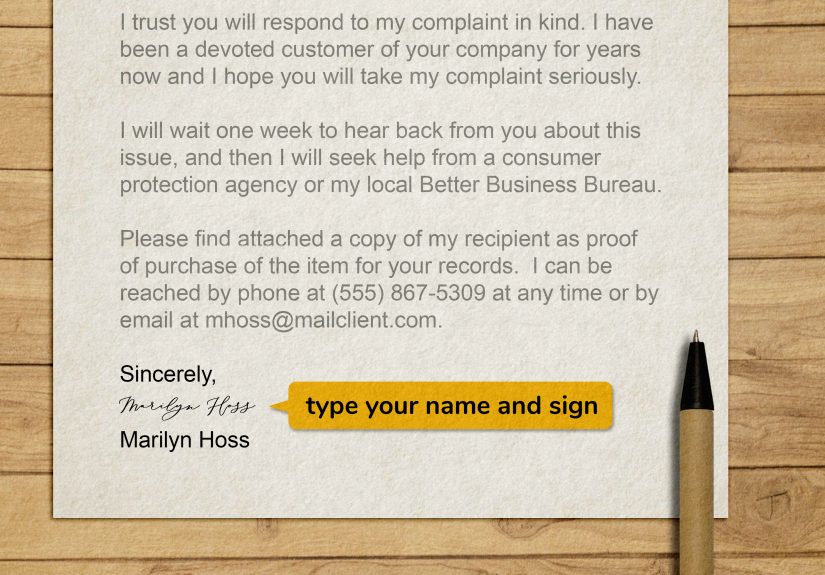
Step 8) Finish with the mechanics: signature, name, and “Enclosures/CC” if needed
A clean finish signals credibility. Include:
- Your typed name (and signature if printing)
- Your address / phone / email if not already in the header
- Enclosures: list (optional)
- CC: (only if you actually copied someone)
If you’re mailing the letter, consider a delivery method that gives you proof of mailing and deliveryespecially if the dispute could
become formal later. If you’re emailing, save PDFs and screenshots of what you sent.
Complaint Letter Ending Examples (Good, Better, Best)
Example 1: Refund request (product issue)
Good:
“Please issue a refund. Thank you.”
Better:
“To resolve this issue, I am requesting a full refund of $129.99. Please respond by March 10, 2026. Thank you for your attention to this matter.”
Best:
“To resolve this issue, I am requesting a full refund of $129.99 to the original payment method. Please respond by March 10, 2026. You can reach me at (555) 012-3456 or [email protected] if you need any additional details. Enclosed are copies of my receipt and photos of the defect. Thank you for your prompt attention.”
Example 2: Service complaint (hotel, contractor, subscription)
Best:
“I am requesting a $75 credit to reflect the services not provided as described. Please confirm by March 10, 2026 whether you will apply the credit, and when it will appear on my account. If we can’t resolve this directly, I will consider escalating the matter through the appropriate consumer assistance channels. Thank you for your help.”
Example 3: Billing dispute (keep it precise)
Best:
“Please correct the billing error of $42.18 and send an updated statement showing a zero balance for the disputed charge. Please respond by March 10, 2026. I’ve attached copies of the invoice and my payment confirmation. Thank you for your assistance.”
Example 4: Demand-style closing (when you need a clear consequence)
This tone is firmer, but still professional. It’s useful when money is owed or a contract wasn’t honored.
Best:
“I am requesting payment of $600 for the completed work described above. Please remit payment by March 10, 2026. If I do not receive payment or a written proposal to resolve this issue by that date, I will consider pursuing additional remedies available to me. I prefer to resolve this matter directly and appreciate your prompt attention.”
Common Complaint Letter Closing Mistakes (and the Fix)
Mistake: Ending with emotion instead of action
“I’m extremely disappointed” is understandable, but it doesn’t tell the reader what to do next.
Fix: Add a clear request + deadline.
Mistake: Vague deadlines (“ASAP,” “soon,” “immediately”)
Fix: Choose a date. If you want to be extra helpful, include a time window:
“within 10 business days (by March 10, 2026).”
Mistake: Threats, sarcasm, or “I’m going viral” language
Threats make people defensive and slow things down. They can also undermine your credibility if the matter becomes formal.
Fix: Use a calm escalation line: “If unresolved by [date], I will consider filing a complaint with…”
Mistake: No proof, no paper trail
Fix: Mention enclosures, keep copies, and use a trackable delivery method when appropriate.
Mistake: The sign-off doesn’t match the tone
If your letter is formal, end it formally. “Sincerely” beats “XOXO” every day of the week, and twice on Monday.
Fix: Pick a standard business close and move on with your life.
Conclusion
Ending a complaint letter well is less about fancy wording and more about clarity and control.
You’re closing the loop: what you want, when you want it, how to reach you, and what happens if it’s not resolved.
Keep it professional, keep it specific, and keep a paper trailbecause “I definitely emailed them” is not a strategy.
Real-World Experience: What Actually Works (and What Doesn’t)
Let’s talk about the “in the wild” side of complaint letter closingsthe part you don’t learn until you’ve watched a few disputes
crawl their way through customer service systems. These are patterns that show up again and again, regardless of industry.
1) The best closings sound calm, not clever
A surprising number of people try to “win” the ending with a mic-drop line. It feels good for approximately 11 seconds,
and then it becomes the reason your letter is forwarded to “Legal” (where time moves differently).
Calm language gets routed faster because it reads like a normal business request, not a flare gun.
2) Deadlines work better when they’re paired with a simple next step
A date alone helps, but a date plus a clear “what happens next” helps more. Not a threatjust a plan.
Something like, “If I don’t hear back by March 10, 2026, I’ll escalate to management or the appropriate consumer assistance office.”
That line quietly tells the reader: “This isn’t my first rodeo, and I’m keeping records.”
3) “Here’s what I want” beats “Here’s how I feel” at the finish line
Feelings belong in the body (briefly) if they help explain impact. But the closing needs to be operational:
refund, replacement, correction, repair, cancellation, apology letterwhatever the resolution is.
If your last paragraph is mostly emotions, you’ve basically ended your letter with a fog machine.
4) One line of gratitude can change the whole response
It’s not magic; it’s psychology. The person reading your letter is often not the person who caused the problem.
A simple “Thank you for your time and attention” lowers their defenses and makes it easier for them to help.
You’re not thanking them for the messyou’re thanking them for fixing it.
5) Attachments don’t impress anyone if they’re a scavenger hunt
When you reference documentation in the closing, keep it tidy. If you have ten pages, label them:
“Attachment A: Receipt,” “Attachment B: Photos,” “Attachment C: Service ticket.”
The goal is to make your proof easy to verify in under a minute. Most disputes are decided by whoever makes the reviewer’s job easiest.
6) The “wrong” sign-off can accidentally start a tone war
Ending with something overly warm can feel weirdly casual for a serious complaint, while ending with something icy can feel like a threat.
“Sincerely” and “Respectfully” are boringand boring is perfect. Boring means the reader focuses on your request, not your vibe.
7) Keep your exit ramp clean: name, contact info, and a paper trail
Many stalled complaints aren’t stalled because the company refusedthey’re stalled because they couldn’t verify the account, couldn’t reach the sender,
or couldn’t match the complaint to a transaction. A good closing prevents that by restating the essentials:
who you are, how to contact you, and what you included.
8) The most effective closings assume a reasonable person is reading
This is the weirdest trick of all: write your closing as if a competent adult will respond (even if you’re not feeling optimistic).
That tone invites a competent-adult response. You’re setting the standard for the conversation.
And if you do need to escalate later, your calm, precise ending becomes Exhibit A in “I tried to handle this like a grown-up.”