Table of Contents >> Show >> Hide
- Why Daytime Crate Training Matters
- Before You Start: What the Crate Should and Should Not Be
- How to Crate Train a Puppy during the Day: 23 Expert Tips
- 1. Choose the right crate size
- 2. Put the crate in a calm but lived-in area
- 3. Let your puppy discover the crate before you close the door
- 4. Feed meals in the crate
- 5. Use high-value, crate-only rewards
- 6. Keep the door open at first
- 7. Start closing the door for tiny intervals
- 8. Increase duration slowly, not heroically
- 9. Pair crate time with potty breaks
- 10. Use the month-plus-one rule as a rough ceiling
- 11. Build a daytime schedule your puppy can predict
- 12. Practice crating when you are still home
- 13. Teach a crate cue
- 14. Reward calm behavior, not just going inside
- 15. Open the door when your puppy is calm
- 16. But do not ignore true distress
- 17. Exercise before crate time
- 18. Use naps to your advantage
- 19. Make the crate cozy, but keep safety first
- 20. Do not leave your puppy crated all workday
- 21. Use a puppy pen or “puppy zone” for longer absences
- 22. Gradually increase freedom outside the crate
- 23. Ask for help if progress stalls
- A Sample Daytime Crate Training Routine
- Common Daytime Crate Training Mistakes
- of Real-World Experience and Lessons Learned
- Final Thoughts
Daytime crate training sounds simple until you meet a real puppy. Then it becomes a full-contact sport involving tiny teeth, dramatic sighs, surprise puddles, and a face that says, “I cannot believe you closed that door for 90 seconds.” The good news is that daytime crate training does work when you do it gradually, consistently, and with a little strategy.
A crate is not supposed to be puppy jail. It is supposed to become your puppy’s safe little bedroom, nap zone, and calm-down spot when you cannot supervise every second. Used correctly, it can help with house training, prevent destructive chewing, build independence, and make travel, vet visits, and future emergencies a lot less stressful. Used badly, it can turn into the furniture-sized version of a family argument. So let’s avoid that.
Below, you’ll find 23 expert-backed tips to help you crate train a puppy during the day without turning your living room into a daily protest march.
Why Daytime Crate Training Matters
Nighttime crate training gets most of the attention because, naturally, humans enjoy sleep and prefer not to discuss 2:17 a.m. whining. But daytime crate training is just as important. It teaches your puppy how to settle when life is happening around them. It also helps them learn that being alone for short stretches is normal, safe, and not the end of civilization.
That matters because puppies do not magically learn independence. They learn it through short, successful repetitions. One calm minute becomes five. Five becomes fifteen. Fifteen becomes a quick errand. Eventually, your puppy starts seeing the crate as a place to rest instead of a betrayal chamber with metal bars.
Before You Start: What the Crate Should and Should Not Be
The crate should be comfortable, boring in a good way, and predictable. It should not be where your puppy goes because they chewed a sneaker, launched themselves at your curtains, or treated the hallway rug like a restroom. If the crate becomes the place where all fun ends and all frustration begins, your puppy will notice.
Think of it this way: you want your puppy to believe the crate is where snacks appear, naps happen, and weird household chaos fades into the background. You do not want them thinking it is where they are sent after committing crimes against throw pillows.
How to Crate Train a Puppy during the Day: 23 Expert Tips
1. Choose the right crate size
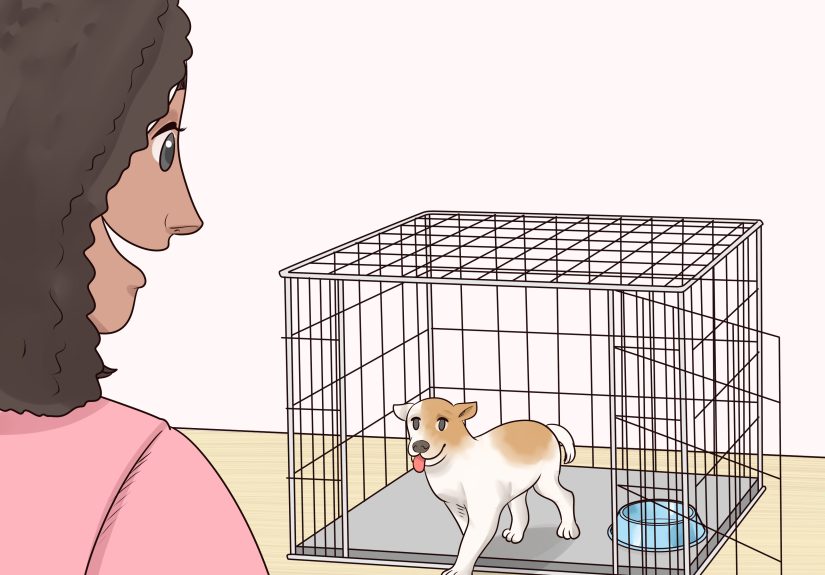
Your puppy should be able to stand up, turn around, and lie down comfortably. But the crate should not be so large that one end becomes a bedroom and the other end becomes a bathroom. If you have a large-breed puppy, use a crate with a divider so the space can grow with them.
2. Put the crate in a calm but lived-in area
For daytime training, place the crate where your family spends time, but not in the noisiest traffic zone of the house. A corner of the living room or home office usually works better than a lonely basement or the center of a chaotic kitchen.
3. Let your puppy discover the crate before you close the door
Do not start by stuffing your puppy inside like you are packing a suitcase. Toss treats near the crate, then inside the crate, and let curiosity do the work. The first lesson is simple: the crate is safe, and entering it makes good things happen.
4. Feed meals in the crate
Meals are powerful. When breakfast and dinner start appearing in the crate, the crate suddenly develops a much better public image. If your puppy is hesitant, begin with the bowl near the opening and move it farther inside over several meals.
5. Use high-value, crate-only rewards
Give your puppy something special that mostly appears in the crate: a stuffed rubber toy, a safe chew, or a food puzzle. This creates a strong mental shortcut: crate equals jackpot. That association makes daytime crating dramatically easier.
6. Keep the door open at first
In the beginning, your puppy should be free to walk in and out while exploring. This keeps them from feeling trapped too early. Confidence comes before confinement.
7. Start closing the door for tiny intervals
Once your puppy happily goes in for food or treats, close the door briefly while they eat, then open it before they finish. Later, try ten seconds, then twenty, then one minute. Tiny wins matter more than dramatic leaps.
8. Increase duration slowly, not heroically
One of the biggest mistakes puppy owners make is moving too fast. A puppy who can rest for three minutes is not ready for thirty. Build in small steps so your puppy stays under their stress threshold.
9. Pair crate time with potty breaks
Take your puppy out right before crate time and immediately after crate time. This helps prevent accidents and teaches a clean pattern: potty, rest, potty again. Puppies learn routines faster than they learn speeches.
10. Use the month-plus-one rule as a rough ceiling
A common guideline is to take your puppy’s age in months and add one to estimate the maximum number of hours they might hold it in a crate. So a 3-month-old puppy may manage about 4 hours in ideal conditions. But treat that as a ceiling, not a daily target. Many puppies under 6 months still need breaks every 3 to 4 hours or sooner during the day.
11. Build a daytime schedule your puppy can predict
Puppies thrive on rhythm. Potty, play, training, crate nap, potty again. When the day becomes predictable, the crate stops feeling random and starts feeling normal. An unpredictable schedule often creates an overstimulated puppy who melts down at crate time.
12. Practice crating when you are still home
Do not only crate your puppy when you leave the house. That teaches them the crate predicts your disappearance. Instead, do short practice sessions while you fold laundry, answer emails, or pretend to be a productive adult.
13. Teach a crate cue
Use a simple cue like “crate,” “kennel,” or “bed.” Say it in a cheerful or neutral tone, then reward your puppy when they go in. Over time, this becomes incredibly useful when guests arrive, deliveries happen, or your puppy decides the vacuum is suspicious.
14. Reward calm behavior, not just going inside
Getting into the crate is step one. Relaxing in the crate is the real goal. Quiet lying down, chewing calmly, or settling after a few moments should all earn gentle praise or a small reward.
15. Open the door when your puppy is calm
If you regularly release your puppy while they are barking, pawing, or shrieking like a tiny opera singer, they may learn that noise opens doors. Wait for a brief pause or a calmer moment when possible. The lesson is calm behavior gets results.
16. But do not ignore true distress
There is a difference between mild protest and panic. A little fussing for a moment can be normal. Escalating screaming, frantic biting at the crate, nonstop panic, or obvious inability to settle means the process is moving too fast. Slow down and adjust.
17. Exercise before crate time
A puppy with unspent energy is less likely to settle. A short walk, gentle play session, sniffing game, or a few minutes of training before crate time can make a huge difference. You are not trying to exhaust your puppy into another dimension, just take the edge off.
18. Use naps to your advantage
The best time to practice daytime crating is when your puppy is biologically ready to rest. After play, training, or a potty break, many puppies are primed for a nap. That is your moment. Fighting a fully awake land shark at noon is a much worse idea.
19. Make the crate cozy, but keep safety first
Soft bedding is great if your puppy does not shred and eat it. If they do, use simpler, chew-safe options. Add a safe toy or two, keep the environment comfortable, and avoid cluttering the crate with a mountain of cute but unsafe accessories.
20. Do not leave your puppy crated all workday
This is the rule many people want to negotiate with. The answer is still no. Young puppies need bathroom breaks, movement, social interaction, and mental stimulation. If you will be gone longer than your puppy can reasonably handle, arrange a pet sitter, neighbor help, dog walker, or a larger puppy-safe confinement area attached to or surrounding the crate.
21. Use a puppy pen or “puppy zone” for longer absences
If your puppy must be alone longer than crate time allows, set up a larger confinement space with an open crate, water, a rest area, safe toys, anddepending on your training plana designated potty setup. This helps you avoid pushing the crate beyond what your puppy can physically or emotionally manage.
22. Gradually increase freedom outside the crate
The crate is not the end goal. The goal is a puppy who can eventually rest calmly in the house without eating baseboards. Move from crate to pen, then to one puppy-proofed room, then to more freedom as your puppy proves they can handle it.
23. Ask for help if progress stalls
If your puppy seems unusually distressed, never settles, or regresses despite a careful plan, talk to your veterinarian or a qualified positive-reinforcement trainer. Some puppies need a more customized approach, especially if anxiety is part of the picture.
A Sample Daytime Crate Training Routine
Every puppy is different, but a sample schedule for a young puppy might look like this:
- 7:00 a.m. Potty break
- 7:15 a.m. Breakfast in the crate
- 7:30 a.m. Potty break
- 8:00 a.m. Play, short training, sniffing time
- 8:45 a.m. Potty break
- 9:00 a.m. Crate nap with safe chew or stuffed toy
- 10:00 a.m. Potty break and calm play
- Late morning Repeat the pattern
The exact times matter less than the flow. Puppies usually do best with a repeating loop: bathroom, activity, rest, bathroom again. When owners skip that rhythm, puppies often get overtired, overstimulated, and much louder about their opinions.
Common Daytime Crate Training Mistakes
Moving too fast
If your puppy was fine yesterday and screams today, the jump in difficulty may have been too big. Go back to an easier step and rebuild.
Only using the crate when leaving
This can create a puppy who thinks the crate predicts isolation. Mix in happy crate sessions while you are home.
Ignoring potty timing
Sometimes whining is not drama. Sometimes it is biology. Young puppies simply cannot hold it for adult stretches.
Using the crate as punishment
This is the fastest way to ruin the crate’s reputation in your puppy’s mind.
Expecting perfection in a week
Some puppies adapt in days. Others need weeks. Crate training is not a race, and your puppy did not read your timeline.
of Real-World Experience and Lessons Learned
One of the most common real-life experiences puppy owners describe is this: the first few days go better than expected, then suddenly the puppy starts objecting. That usually does not mean crate training has failed. It often means the puppy is getting more comfortable in the home overall and has become confident enough to have opinions. In practice, that is normal. Many owners assume the plan stopped working, when really the puppy just noticed they live here now and would prefer open access to every sock in the building.
Another common experience is the “too much freedom too soon” problem. A puppy does one solid afternoon outside the crate without chewing anything important, and the humans decide they now own a tiny furry gentleman with mature judgment. Then comes the remote control incident, the table leg incident, or the mysterious silence from the hallway that always means paperwork is being destroyed. In real homes, crate training works best when freedom is earned in small pieces, not handed out like a graduation gift after one decent Tuesday.
Owners who work from home often run into a different issue: their puppy becomes great at relaxing only when a human is nearby. Then the moment that human steps out to grab the mail, the puppy objects like they have been abandoned on a mountaintop. The fix is usually not more constant companionship. It is actually more structured practice with short, boring absences while the owner is still generally around. Puppies need to learn that humans can move in and out of view without everything falling apart.
Families with children often report that crate time improves once the household starts respecting it. A crate works far better when it is treated as the puppy’s quiet zone, not a petting zoo exhibit. Puppies who are poked, awakened, or constantly invited back into the action often struggle to settle. Once the family starts protecting nap time, the puppy usually relaxes faster and becomes less wild later in the day. That is a good trade for everyone, especially the ankles in the house.
Another real-world lesson is that many puppies do best when crate training is paired with enrichment, not just confinement. Owners frequently see better results when they stop putting the puppy in the crate “empty” and start adding a food-stuffed toy, a short sniff session before nap time, or a predictable routine. A puppy with something appropriate to do is much less likely to invent a side hobby like protest barking.
Finally, experienced puppy owners often say the breakthrough happens quietly. It is not dramatic. One day the puppy walks into the crate, circles twice, flops down, and goes to sleep. No speech, no protest, no courtroom appeal. Just a nap. That is usually how you know the training is working: not because your puppy suddenly loves rules, but because the crate has become familiar, safe, and very boring in the most beautiful possible way.
Final Thoughts
If you want to crate train a puppy during the day, think gentle progress, not brute force. Build positive associations. Practice short absences. Respect your puppy’s age, bladder, and attention span. Use the crate as part of a larger routine that includes potty breaks, naps, enrichment, and realistic expectations.
Most of all, remember that the goal is not to make your puppy “put up with” the crate. The goal is to teach them that the crate is safe, normal, and sometimes even the best seat in the house. Once that happens, daytime crate training gets easier for both of you.