Table of Contents >> Show >> Hide
- Meet the Star: The Western Spotted Skunk
- How Ancient Climate Change Reshaped the Skunk Family Tree
- From Three Clades to More Species: The Story Got Bigger
- The Difference Between Ancient Climate Change and Today’s Warming
- What the Spotted Skunk Teaches Us About Evolution
- Why This Tiny Carnivore Deserves More Respect
- Experiences That Bring This Story to Life
- Conclusion
- SEO Tags
Most people hear the word skunk and immediately think of one thing: a smell so powerful it could end a neighborhood barbecue. Fair enough. But one skunk in particular deserves a much better publicist. The spotted skunk is tiny, flashy, unexpectedly cute, and famous for doing a full handstand before spraying. Yes, evolution really looked at this animal and said, “Let’s make it dramatic.”
But the western spotted skunk is more than a furry acrobat with a built-in chemical warning system. It is also a surprisingly elegant example of how climate change can shape evolution. Long before modern headlines about rising temperatures, melting ice, and shifting habitats, ancient climate swings were already rearranging life across North America. In the case of spotted skunks, those changes did not just move animals around on a map. They helped split populations, alter their genetic makeup, and set the stage for the diversity scientists recognize today.
This is what makes the spotted skunk such a fascinating animal. It shows that evolution is not always a slow, vague blur in a textbook. Sometimes it looks like glaciers advancing, forests shrinking, habitats breaking into isolated patches, and a small black-and-white carnivore quietly becoming several distinct lineages over time. In other words, climate did not merely inconvenience this skunk. It helped write its family history.
Meet the Star: The Western Spotted Skunk
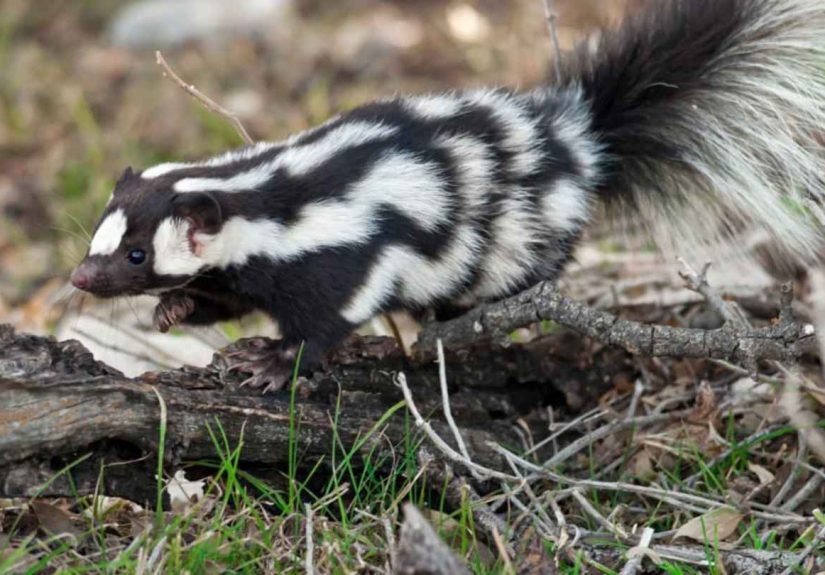
The western spotted skunk is smaller than the better-known striped skunk, with a body that looks compact, agile, and almost weasel-like. Its coat is not marked by two bold racing stripes. Instead, it wears a more artistic pattern of broken white lines and spots, as if someone decorated it with a paintbrush and a little too much confidence. It can climb trees, slip through cover, and survive in a surprising range of habitats, from drier regions in the Southwest to more wooded landscapes in the West.
And then there is the handstand. When threatened, the animal may rise onto its forelegs, tail high, hindquarters up, and deliver one of the most memorable warning displays in North American wildlife. It is both adorable and deeply persuasive. A predator seeing that performance should probably make better life choices.
That showy behavior helps explain why people remember spotted skunks. Science, however, became interested in them for another reason: their DNA. Researchers studying the western spotted skunk found that the species carried deeper genetic divisions than expected. At first glance, you might assume those divisions formed because mountain ranges, rivers, or deserts boxed populations apart. That is the classic explanation. Nature builds a barrier, populations stop mixing, and evolution gets to work.
But spotted skunks turned out to be more interesting than the standard script.
How Ancient Climate Change Reshaped the Skunk Family Tree
During the Pleistocene, North America went through repeated glacial and interglacial cycles. Huge ice sheets expanded and retreated. Temperature and rainfall patterns shifted. Habitats moved, shrank, vanished, and reappeared. Forests did not stay politely in one place for the convenience of mammals. The landscape kept changing the rules.
For western spotted skunks, that meant suitable habitat was not continuous across the continent. Instead, as glaciers and colder conditions reshaped the environment, skunks were likely pushed into separate pockets of livable habitat known as climate refugia. These refugia acted like biological waiting rooms. Populations that ended up in different refugia stopped interacting regularly. Once that happened, genetic differences could build over thousands of years.
That point matters. Evolution is not always driven by a giant canyon saying, “You go left, you go right.” Sometimes climate creates the separation indirectly by changing where food, cover, and survivable conditions exist. If wooded habitat contracts and open terrain expands, a small carnivore that depends on cover may suddenly find itself effectively isolated, even if no dramatic rock wall appears between populations.
Researchers studying mitochondrial DNA from western spotted skunks found three major clades, or genetic groups, tied more closely to historic climate regions than to simple geological barriers. In plain English, ancient climate change appears to have mattered more than mountains in shaping the animal’s evolutionary pattern. That is a big deal, because it shows that habitat suitability can be just as powerful as hard physical separation when it comes to driving divergence.
Why Refugia Matter
Climate refugia sound technical, but the idea is simple. When a changing climate makes most of a landscape hostile, some small areas remain favorable enough for a species to survive. Those safe zones become holdouts. If several populations end up marooned in different holdouts, they begin following separate genetic paths.
For the spotted skunk, refugia likely worked like this:
- Glacial periods reduced or rearranged suitable habitat.
- Skunk populations became isolated in separate regions with workable conditions.
- Over long stretches of time, those isolated groups accumulated genetic differences.
- When climates shifted again, the descendants carried those differences forward.
That is evolution without fanfare, but with major consequences. The skunk did not suddenly become a different creature overnight. Instead, climate repeatedly squeezed and released its habitat, and those pulses of isolation helped shape its lineage.
From Three Clades to More Species: The Story Got Bigger
If the 2017 work on western spotted skunks opened the door, later genomic research kicked it much wider. More recent phylogenomic studies of the genus Spilogale suggested that spotted skunk diversity across North America had been underestimated. Instead of just a few broad species, researchers found evidence for seven genetically distinct species-level lineages, with Pleistocene climate cycles playing a major role in their diversification.
That matters for two reasons. First, it shows that the western spotted skunk story was not an isolated curiosity. It was part of a bigger pattern across spotted skunks as a group. Second, it changes conservation thinking. When scientists realize that what looked like one widespread animal is actually multiple distinct evolutionary lineages, management becomes more precise. You stop treating all spotted skunks as interchangeable fuzz-bombs and start recognizing that different populations may face different risks.
One especially interesting takeaway from later research is that the southern United States and northeastern Mexico appear to have been an important cradle of diversity for spotted skunks. In other words, this region was not just a place skunks passed through. It was a center where evolutionary splitting and persistence happened over deep time.
That is one of the sneaky ways climate change shapes life. It does not just threaten species. Across long time scales, it also creates opportunities for populations to split, specialize, and diversify. Of course, that process only works when change happens slowly enough, and when enough habitat remains for populations to persist at all. Modern climate change is testing those conditions in a much harsher way.
The Difference Between Ancient Climate Change and Today’s Warming
Here is where the story stops being a neat Ice Age mystery and starts feeling uncomfortably current. Ancient climate shifts helped drive spotted skunk evolution, but they unfolded over thousands to tens of thousands of years. That gave populations time to move, contract, expand, and adapt across generations.
Modern human-driven climate change is different. It is faster, layered with habitat fragmentation, and tangled up with roads, intensive agriculture, urban expansion, and altered fire patterns. A skunk population today is not responding to climate in a wild, open landscape with room to maneuver. It is responding in a world full of fences, highways, disappearing cover, and human land use that can block movement just when movement matters most.
So no, the lesson is not “climate change made skunks evolve before, so they will be fine now.” That would be like saying your grandparents survived walking to school, so you should be great in a tornado. The pace and context are different.
Modern research on spotted skunks backs this up. Studies of plains spotted skunks have found that temperature patterns, especially winter cold and extreme temperature variation, play an important role in habitat suitability. Precipitation matters too, likely because it influences vegetation and prey. Recent work also shows that land cover features such as pasture, shrubs, and vegetation structure can shape where these skunks persist. In short, climate and habitat are working together, not separately.
That is a crucial point for SEO, science, and common sense alike: wildlife does not experience climate change as a line on a graph. Animals experience it as colder snaps, hotter stretches, drier soils, shifting prey, reduced cover, altered denning options, and harder movement across fragmented land.
What the Spotted Skunk Teaches Us About Evolution
The spotted skunk is a useful reminder that evolution is not only about dramatic new traits, giant fossils, or creatures with impossible teeth. Sometimes evolution shows up as hidden structure in DNA. Sometimes it appears in how lineages split across a landscape. And sometimes an “ordinary” animal turns out to be a map of ancient climate history wearing a fluffy tail.
It also teaches a more subtle lesson: adaptation is not the same as invincibility. Yes, spotted skunks are flexible. They occupy a wide range of habitats. Some can den in varied environments, adjust activity patterns with weather, and exploit diverse food sources. But flexibility has limits. Small carnivores still need shelter, prey, and routes between suitable habitat patches. Once the environment changes too quickly or becomes too chopped up, the room for adjustment narrows.
This is why the spotted skunk is such a strong symbol for modern conservation. It is both resilient and vulnerable. It has a deep evolutionary story shaped by climate, yet it also depends on the practical details of habitat management in the present.
Specific Examples That Make the Science Real
Take the Pacific Northwest. Recent western spotted skunk ecology work shows that scientists are still filling basic knowledge gaps about how these animals use landscapes, especially in temperate rainforests. That means conservation is still catching up with biology.
Now look at the plains spotted skunk in places such as South Dakota. Modeling suggests that temperature, precipitation, and land cover all help determine habitat suitability. That means future climate instability could shift the balance in ways that are not immediately obvious from a simple “warmer equals better” or “warmer equals worse” headline.
Then consider island spotted skunks on California’s Channel Islands. Their isolation adds yet another layer to the story, showing how geography, colonization history, and evolutionary divergence can interact over time. What looks like one cute skunk in a trail camera photo can actually represent a highly specific lineage with its own conservation importance.
Why This Tiny Carnivore Deserves More Respect
Let’s be honest: the spotted skunk has suffered from branding problems. It is not as famous as wolves, not as photogenic as foxes, and not as marketable as sea otters floating around like furry billionaires on vacation. But scientifically, it is a gem.
It is charismatic without trying too hard. It has a defense display that looks like a circus act. It carries evidence of Ice Age climate history in its genes. And it helps scientists understand a larger truth: climate is not just weather stretched over time. It is a force that can rearrange habitats, isolate populations, and shape the evolutionary future of species.
That makes the spotted skunk more than adorable. It makes it important.
Experiences That Bring This Story to Life
One reason this topic resonates so strongly is that the spotted skunk makes evolution feel personal. Not personal in the sense that you and the skunk are about to exchange holiday cards, but personal in the sense that this story can be felt in real places, by real people, in surprisingly vivid ways.
Imagine a biologist checking a remote camera in the American West after a long day of dust, sun, and hiking. The footage shows a tiny skunk stepping into frame, pausing, then flipping into its famous handstand. It is funny for half a second, and then it becomes profound. That little performance is not just cute behavior. It is the living presence of a lineage that survived shifting climates, moving habitats, and long periods of isolation. Suddenly, evolution is not abstract. It is standing upside down in front of a trail camera.
There is also the museum experience. A drawer opens. Inside are carefully labeled skunk specimens collected across decades and regions. To most people, it might look like old fur, tags, and quiet storage. To researchers, it is a time machine. Those samples let scientists compare DNA, reconstruct population splits, and see how climate shaped distribution through deep time. A century-old specimen stops being a dusty archive and becomes evidence. That is the kind of moment that changes how people think about natural history collections. They are not dead storage. They are libraries of evolution.
Then there is the experience of seeing climate history in the landscape itself. Drive across the West and you move through desert, grassland, woodland, mountains, and coastal zones in a relatively short span. That patchwork helps explain why climate mattered so much to the spotted skunk. When temperature and rainfall shifted during the Ice Age, those habitat mosaics shifted too. The result was not random chaos. It was a series of changing opportunities and barriers. Once you understand that, every canyon, thicket, and open plain starts to look like part of a much older ecological story.
Even for ordinary readers, there is something strangely moving about learning that a small mammal can hold such a huge lesson. The spotted skunk reminds us that climate change is not only about future fear. It is also about deep history. It has shaped life before. It has left signatures in genes, species ranges, and behavior. But it also reminds us that the pace of change matters. Ancient skunks had time. Modern wildlife often has less.
That is why this animal sticks with people. It is cute, yes. It is weird, definitely. But it is also a messenger from evolutionary time. The next time someone laughs at a skunk handstand, they may also be looking at the legacy of glaciers, refugia, and survival written across a small black-and-white body. That is a pretty remarkable experience to carry home from one very smelly little carnivore.
Conclusion
The western spotted skunk proves that climate change has been shaping life for a very long time. Ice Age glacial cycles fragmented habitats, isolated populations in refugia, and helped drive the genetic divergence that scientists still detect today. Later genomic work expanded that picture, revealing even more hidden diversity across spotted skunks.
But the biggest takeaway is not just that climate once shaped this adorable animal’s evolution. It is that the relationship between climate and life is ongoing. The same kind of environmental pressure that once promoted divergence can now become a threat when change happens too fast and landscapes are too fragmented. The spotted skunk, with all its charm and chaos, is both a survivor of ancient climate turbulence and a warning light for modern conservation.
Not bad for an animal most people reduce to a smell joke.