Table of Contents >> Show >> Hide
- Why This Challenge Feels So Weird (and So Good)
- What Science Actually Says About Switching Hands
- The “Hey Pandas” Version: Make It a Tiny, Joyful Dare
- How to Do the Left-Hand Drawing Challenge (Without Hating Your Life)
- 12 Prompts That Work Great With Your Left Hand
- Level-Up Modes (When You Want More Chaos in Your Bamboo)
- Common Problems (and the Fixes That Actually Work)
- A 7-Day Mini-Plan (10 Minutes a Day)
- Real-Life Experiences: What the Left-Hand Challenge Feels Like ()
- Conclusion: The Point Isn’t the PictureIt’s the Permission
Somewhere on the internet, a crowd of strangers (affectionately called “Pandas”) dares each other to do delightfully impractical things.
Today’s dare: draw something with your left hand (or, if you’re left-handed, your non-dominant hand).
It sounds simpleuntil your pencil starts wobbling like a baby giraffe on roller skates. And that’s the point.
This challenge isn’t about creating museum-ready art. It’s about learning, loosening up, and discovering what happens when you stop letting your
“good hand” run the show like a tiny, overconfident CEO.
Why This Challenge Feels So Weird (and So Good)
Your dominant hand is basically on autopilot. It has years of practice. It knows how hard to press, how to curve a line, when to slow down,
and how to quietly fix mistakes before you even notice them.
Your left (or non-dominant) hand? That hand is the new intern. It’s enthusiastic, confused, and keeps emailing the entire company by accident.
When you draw with it, you’re forced to pay attention again: grip, pressure, shoulder movement, and where your eyes are actually looking.
That attention shift is the magic ingredient. Many artists use “off-hand” drawing to interrupt habits, break perfectionism, and train observation.
You stop drawing what you think a thing looks like and start drawing what you seeeven if the result looks like your coffee mug
just survived a small earthquake.
What Science Actually Says About Switching Hands
Let’s clear the bamboo: using your non-dominant hand won’t instantly make you “smarter” or unlock some mythical creativity vault.
The brain doesn’t work like a two-room apartment where “logic” lives in one room and “creativity” throws paint in the other.
What the evidence does support is more practical (and honestly more useful): when you train a new fine-motor skillespecially one that
feels awkward at firstyour brain adapts. With repeated practice, performance improves, and measurable changes in coordination-related networks
can show up in brain imaging studies. Translation: if you practice left-hand drawing for days in a row, you’ll probably get less shaky and more
precise at… left-hand drawing. Not magiclearning.
There’s also a psychological angle. When you knowingly choose a “worse tool” (your non-dominant hand), your expectations drop.
That can quiet the inner critic and make experimentation easier. When perfection is impossible, play becomes allowed.
So the real win isn’t “I became a genius.” It’s: “I practiced a hard thing, stayed curious, and got betterwhile making weird little drawings that
made me laugh.” That’s a great trade.
The “Hey Pandas” Version: Make It a Tiny, Joyful Dare
The best part of a community prompt is that it’s low-stakes and oddly motivating. You don’t need a studio, an expensive tablet, or an identity as
“an artist.” You need a pen, paper, and five to fifteen minutes of willingness to be a little bad at something.
Think of it as a creativity snack. Not dinner. Not a seven-course tasting menu. A snack.
How to Do the Left-Hand Drawing Challenge (Without Hating Your Life)
Set yourself up to succeed
- Use a forgiving tool: a soft pencil, gel pen, or marker that glides easily. Avoid scratchy pens that demand perfect pressure control.
- Go bigger than you think: drawing larger shapes reduces the need for tiny, fiddly finger movements.
- Move from the shoulder: anchor your wrist less, and let your arm do more of the work. It feels silly. It helps.
- Time-box it: 3–10 minutes keeps it playful. Longer sessions are for later, when your left hand stops acting haunted.
- Lower the standards on purpose: your goal is not “pretty.” Your goal is “done.”
A 10-minute warm-up routine
- Minute 1: scribble freely, continuous line, no lifting the pen.
- Minutes 2–3: draw basic shapes (circles, squares, triangles), slowly and oversized.
- Minutes 4–6: draw parallel lines and gentle curveslike you’re making fancy ramen.
- Minutes 7–10: pick one simple object and draw it once, without erasing.
If you want a single rule that improves results immediately: slow down. Your brain is sending instructions to a hand that doesn’t
speak the language fluently yet. Give it time to translate.
12 Prompts That Work Great With Your Left Hand
Choose one prompt, set a timer, and go. The goal is a finished attemptnot a masterpiece.
- Your hand, as a landscape: trace it, then add “topography lines” like a map.
- A coffee mug: focus on the ellipse at the top and the handle shape.
- Your keys: messy, shiny, oddly satisfying.
- A leaf or small plant: perfect for practicing curves and veins.
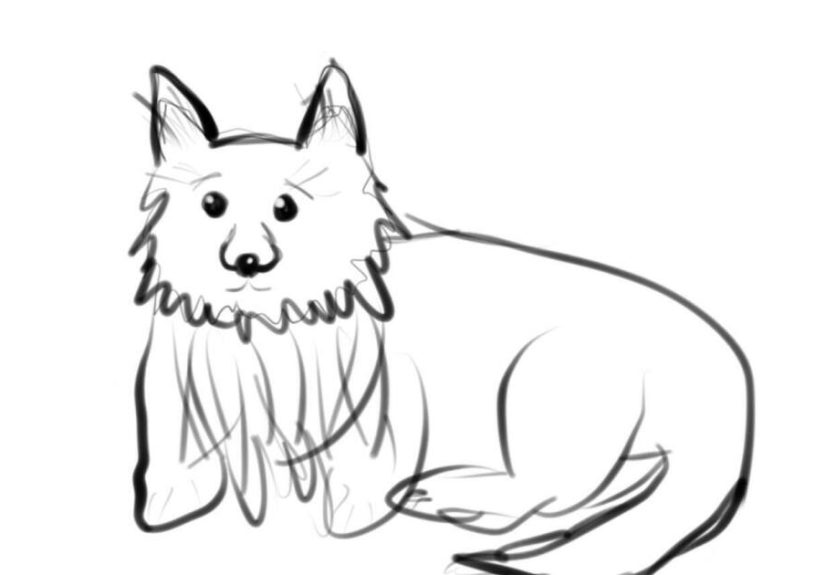
- A simple animal: start with blobs (head, body), then add legs and ears.
- A cartoon panda face: two circles for eyes, black patches, tiny nose. Instant morale boost.
- Your shoe: it’s basically geometry with personality.
- A piece of fruit: apple, banana, orangefriendly shapes.
- A household object: spoon, remote, bottleanything with clear edges.
- Your favorite emoji: draw it big, add your own twist.
- “What I feel like today” as a shape: abstract is allowed. Encouraged, even.
- A memory snapshot: the view from your childhood window, a pet, a place you misskeep it simple and symbolic.
Level-Up Modes (When You Want More Chaos in Your Bamboo)
Blind contour drawing
Pick an object, then draw it without looking at your paper. Keep your eyes on the subject and move your pen slowly.
It trains observation and hand-eye coordinationand it produces the kind of art that makes people say, “I love it,” with a tone that means
“I’m frightened, but supportive.”
Continuous line challenge
Keep your pen on the page the whole time. No lifting. No erasing. It forces commitment and flow.
Negative space drawing
Instead of drawing the object, draw the spaces around it. Your brain hates this at first. Then it suddenly clicks.
Great for breaking the “symbol drawing” habit (like drawing an eye as an almond shape because your brain filed it under “eye icon” in 2003).
The “two takes” method
Draw the same object twice: first with your dominant hand, then with your left. Compare them like you’re judging a friendly talent show.
You’ll notice what your dominant hand “cheats” for you automaticallyproportions, pressure, line confidence.
Common Problems (and the Fixes That Actually Work)
“My lines are shaky.”
Totally normal. Try drawing larger, slowing down, and using your whole arm. Also: embrace the wobble. Wobble can be style.
If anyone asks, tell them it’s “expressive line work.” Say it confidently.
“My hand hurts.”
Stop and loosen your grip. A death-grip is your body’s way of shouting, “I am stressed and would like to be a claw now.”
Use a softer lead pencil, take short breaks, and don’t push through pain.
“I keep trying to erase.”
Put the eraser in another room. Or better: use a pen. The no-undo rule is a creativity cheat code.
“It looks like a kindergartener drew it.”
Congratulations: you have rediscovered beginner’s mind. Kids draw with boldness because they haven’t learned the fear of being cringe.
The left-hand challenge is a shortcut back to that freedom.
A 7-Day Mini-Plan (10 Minutes a Day)
- Day 1: Scribbles + big shapes + one object (mug or fruit).
- Day 2: Continuous line drawing of a plant or keys.
- Day 3: Blind contour drawing (3 minutes) + a second “normal” left-hand attempt (3 minutes).
- Day 4: Negative space drawing (chair, scissors, or headphones).
- Day 5: Simple animal prompt (cat, dog, panda face) + add one detail you normally avoid.
- Day 6: Two-takes method: dominant hand vs. left hand. Note what changed.
- Day 7: “Anything goes” day: draw a tiny scene (desk corner, window view, your snack) with a timer and zero erasing.
Track it with photos. Not to humblebrag. To prove to your own brain that practice works. Even when it’s messy.
Real-Life Experiences: What the Left-Hand Challenge Feels Like ()
People who try the “draw with your left hand” prompt tend to describe a very specific emotional roller coasterusually in the span of five minutes.
It often starts with confidence (“I can draw a simple cat”), followed by surprise (“Why does my cat look like it pays taxes?”), and ends with a strange
affection for the chaos (“Okay, but I kind of love it.”).
The first sensation is physical: your grip feels wrong. Your wrist wants to stiffen. Your brain over-corrects every curve, like it’s steering a boat
in choppy water. Many people report that their lines come out heavier because they press too hard, trying to control the wobble. Then, halfway through,
they realize the real control move is the oppositelighter pressure, slower motion, and letting the line be imperfect.
Mentally, the challenge often scrambles your usual “drawing shortcuts.” With your dominant hand, you can rely on muscle memory: you’ve drawn circles and
squares a million times, so your hand fills in gaps automatically. With your left hand, that autopilot disappears. That’s why so many folks suddenly notice
details they usually ignorethe tilt of a mug handle, the angle of a leaf stem, the way a shadow isn’t a blob but a shape with edges. It’s not that your eyes
got better overnight; it’s that your hands stopped pretending they already knew the answer.
Emotionally, a common experience is unexpected relief. When a drawing looks “bad” immediately, the pressure to be impressive evaporates.
You’re allowed to experiment because there’s no realistic path to perfection in the first place. Some people describe it like turning down the volume on the
inner critic. Instead of narrating every mistake (“That line is wrong”), your brain shifts into problem-solving (“What happens if I draw bigger?”).
That shift can feel playfuleven calmingbecause you’re present, focused, and not trying to win.
Over multiple days, the experience changes again. By Day 3 or Day 4, many people notice their hand feels less foreign. The wobble doesn’t vanish, but it becomes
predictable. Circles get rounder. Shapes become more intentional. The biggest difference is confidence: not “I’m amazing,” but “I can do this for ten minutes
without getting frustrated.” That’s a real skillemotional endurance for learning.
One of the most relatable experiences is sharing the results. In community threads, people often laugh at their drawings, then proudly post them anyway.
That combinationhumor plus courageis the entire point of the Hey Pandas vibe. Your left-hand drawing may not be elegant, but it’s honest.
And honestly? Honest drawings are more fun to look at than perfect ones. They’re proof that you showed up, tried something awkward, and made a mark.
Conclusion: The Point Isn’t the PictureIt’s the Permission
The “Hey Pandas, draw with your left hand” challenge is a quick way to practice a surprisingly powerful creative skill: being a beginner on purpose.
It trains observation, softens perfectionism, and reminds you that making art is allowed to be messy, funny, and wonderfully human.
Grab a pen. Set a timer. Draw something with your left hand. Then post it proudlylike the slightly chaotic panda you were born to be.