Table of Contents >> Show >> Hide
- Signal’s “Business Model” Is… Not Having One
- What Your Donation Actually Pays For
- “But I Thought Signal Was Free?” YepAnd That’s the Point
- Why Paying (When Offered) Can Be Just as Important as Donating
- Signal’s Privacy Advantage: It’s Not Just the Encryption
- What Happens If People Don’t Donate?
- “I’m Not Doing Anything WrongWhy Do I Need This?”
- How to Decide If You Should Donate (A Practical Checklist)
- Common Objections (And the Reality Check)
- Conclusion: Funding Signal Is Funding Independence
- Experience Stories: What It Feels Like to Support Signal (500+ Words)
Signal is the rare app that does something almost suspicious in 2026: it behaves like it actually likes you. No ads. No trackers. No “we value your privacy” banner followed by 47 third-party pixels doing backflips in your browser. It’s a privacy-first messenger built around end-to-end encryptionand it’s run by a nonprofit. Which means it doesn’t have a growth team whose job is to convert your relationships into quarterly revenue.
But there’s a catch (because math): private infrastructure costs real money. Servers aren’t powered by good vibes. Engineers don’t accept “exposure” as payment. If you want a secure, independent messaging app that isn’t quietly monetizing your life, someone has to fund it. That’s where donatingor paying for optional paid featurescomes in.
Signal’s “Business Model” Is… Not Having One
Most “free” messaging apps are free the way a “free” puppy is free. You don’t pay at the door, but you’ll be paying in other waysattention, data, metadata, and all the weird inferences advertisers can make from who you talk to and when.
Signal flips that script. It’s explicitly designed to avoid collecting sensitive data and to keep message contents private via end-to-end encryption. In plain English: Signal can’t read your messages and calls, and it tries hard not to know much about you in the first place.
Nonprofit matters more than you think
A nonprofit structure makes it harder (not impossible, but harder) to drift into the usual Silicon Valley loop: “Step 1: Grow. Step 2: Monetize. Step 3: Oops, sorry about the privacy thing.” Signal’s mission is to keep private communication accessible and securewithout turning users into inventory.
What Your Donation Actually Pays For
Donating to Signal isn’t a symbolic tip jar. It helps cover the boring-but-critical costs that make the app work for millions of people: servers, bandwidth, security engineering, ongoing development, and support. In other words: the stuff that keeps your messages moving without creating a data trail a marketer would frame and hang on the wall.
Infrastructure: the invisible bill you’re not seeing
Every message you send has to travel somewhere. Even with end-to-end encryption, you still need reliable infrastructure for message delivery, voice/video calls, spam and abuse mitigation, and service uptime. Signal leadership has publicly discussed that operating a privacy-preserving platform at scale is expensiveand that costs can climb into the tens of millions annually as usage grows.
Engineering privacy is harder than engineering “engagement”
Many apps can add features quickly by collecting more data. Signal has to do the opposite: build features while minimizing data, limiting metadata, and preserving security properties. That’s slower, more complex, and (yes) more expensive.
“But I Thought Signal Was Free?” YepAnd That’s the Point
Signal being free to download is a feature, not a funding plan. It means anyone can use itincluding people who need private communication the most (journalists, activists, organizers, people in sensitive situations, or anyone who simply doesn’t want their conversations turned into a behavioral profile).
Donations let Signal stay accessible while keeping its incentives aligned with users instead of advertisers. If you can afford a few dollars a month, your contribution helps keep the door open for everyone else. That’s not charity; it’s a privacy infrastructure membership.
Why Paying (When Offered) Can Be Just as Important as Donating
Historically, Signal has relied on donations. But optional paid features can also be a sustainable way to fund costly services without resorting to surveillance-style monetization. When a privacy tool offers a paid add-on, the key question is: does paying reduce the incentive to collect data? With Signal, the goal is to cover real costs (like storage and transfer) while keeping the core messenger private and accessible.
Example: paid encrypted backups (optional)
Media storage is expensiveespecially if you do it in a way that keeps it encrypted end-to-end and doesn’t tie your backup to a profile that can be mined later. Signal has experimented with (and publicly discussed) optional paid backup/storage features aimed at covering those costs while preserving privacy properties. If you use those features, paying is not “going premium”it’s funding a privacy-respecting version of a service that most companies would subsidize with data collection.
Signal’s Privacy Advantage: It’s Not Just the Encryption
People love to say “It’s end-to-end encrypted!” like that’s the whole story. It’s a big storybut not the only one. Many platforms can encrypt message content and still collect loads of metadata: who you talk to, when, how often, your device details, your contact graph, and more.
Signal has a long-standing reputation for minimizing what it can provideeven under legal pressure. In documented subpoena scenarios, Signal indicated it could provide only limited account-level timestamps rather than the kinds of rich contact graphs and message histories other platforms might store. That’s not magic; it’s design.
Open source and public cryptography specs
Signal’s core technology and cryptographic approach are widely scrutinized and discussed publicly, including formal specifications like the Double Ratchet algorithm used for secure message exchange. Open development and public specs don’t automatically guarantee perfectionbut they do make it harder to hide sloppy security behind marketing.
What Happens If People Don’t Donate?
If user support dries up, a privacy-first nonprofit has limited options:
- Cut costs (fewer engineers, slower security improvements, fewer features, less resilience).
- Find major donors (helpful, but concentrated funding can create fragility and perception risks).
- Adopt a commercial model (subscriptions, paid add-ons, or worst case: incentives that reward data collection).
The healthiest option is a wide base of small recurring donorspeople who treat private communication like a public good. Even small monthly donations create stability, reduce reliance on a few large benefactors, and keep Signal’s incentives aligned with users.
The underrated power of “boring” recurring donations
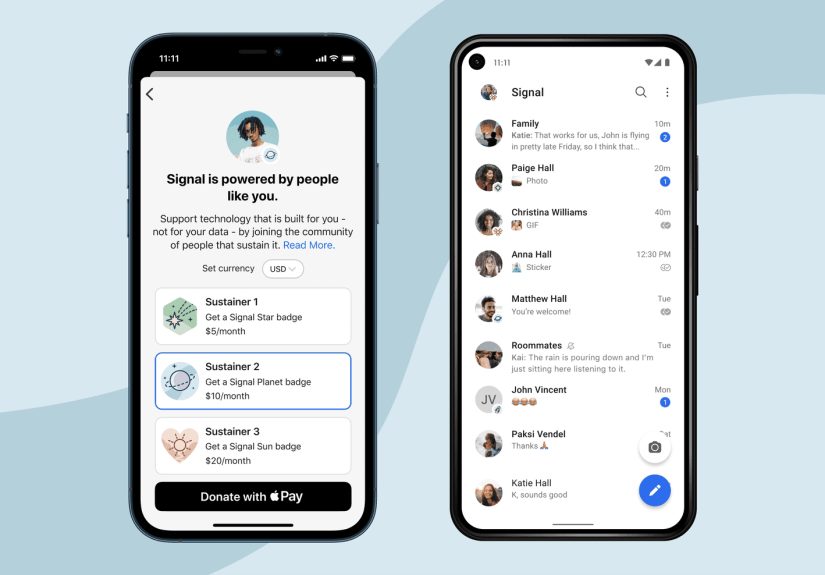
One-time donations are great. Recurring donations are better. They let the organization planhire, maintain infrastructure, respond to security issues, and avoid financial whiplash every time the internet collectively remembers privacy exists (usually right after the next data scandal). Signal even offers a “sustainer” concept to encourage predictable monthly support.
“I’m Not Doing Anything WrongWhy Do I Need This?”
Privacy isn’t about hiding crimes. It’s about reducing unnecessary exposure. You lock your door not because you’re running a secret lair, but because you’d rather not hand strangers a map of your living room.
Private messaging protects:
- Personal safety (harassment, stalking risks, abusive situations).
- Work and business communication (confidential projects, negotiations, client data).
- Community organizing (coordination without creating an easy-to-monitor social graph).
- Everyday dignity (not turning your relationships into a dataset).
How to Decide If You Should Donate (A Practical Checklist)
You don’t have to donate out of guilt. Donate (or pay for optional features) because it matches your values and usage. Here’s a simple gut-check:
- If you use Signal weekly: consider a small recurring donation.
- If you use it daily: you’re basically on the “privacy infrastructure” plandonate what you can.
- If you rely on it for sensitive conversations: a few dollars a month is cheaper than the consequences of exposure.
- If you can’t afford it: keep using Signal. The whole point is access.
Specific examples (without the moral theater)
If you spend $5/month on coffee upgrades, you can probably spend $3/month on a tool that keeps your communications private. If you’re a small business owner, supporting privacy tools is like paying for locks and alarmsmundane, unglamorous, and deeply sensible. If you’re a student or on a tight budget, sharing Signal with friends and family is also support: network effects matter.
Common Objections (And the Reality Check)
“But WhatsApp is encrypted too.”
Message content encryption is importantbut metadata still matters. Signal’s brand is built on minimizing data and avoiding ad-driven incentives. If your goal is the smallest possible data footprint with strong encryption by default, Signal is designed to be that option.
“I’ll donate when they add Feature X.”
Totally fair to want features. But funding is what makes features possible. Supporting the project helps the team ship improvements without compromising privacy to do it faster. Think of it less as “paying for a feature” and more as “funding the constraints” that keep the app trustworthy.
“I don’t trust any app.”
Healthy skepticism is good. That’s why open development, public security discourse, and a nonprofit model matter. You’re not asked to trust a glossy promiseyou can evaluate the project’s structure and track record over time.
Conclusion: Funding Signal Is Funding Independence
Donating to Signal (or paying for optional paid features) is a vote for a different internet: one where privacy tools aren’t forced to become surveillance tools just to survive. If you want messaging that’s built for peoplenot advertisers, not data brokers, not engagement dashboardssupporting Signal is one of the most practical things you can do.
Your support helps keep Signal:
- Independent (less pressure from investors and ad markets).
- Private by design (minimal data, strong encryption, careful engineering).
- Accessible (free core service for anyone who needs it).
- Sustainable (stable funding for infrastructure and security work).
So yesdonate if you can. Pay for privacy-respecting add-ons if you use them. And if you can’t, keep using Signal and invite others. The best privacy tool is the one your people actually use… and the best-funded privacy tool is the one that can keep its promises.
Experience Stories: What It Feels Like to Support Signal (500+ Words)
“Donate to an app” sounds abstract until you connect it to real momentsthose tiny, everyday scenes where private communication stops being a philosophy and becomes a relief. Here are experience-based scenarios drawn from common user stories and patterns people describe when they switch to Signal and decide to support it financially. No hero capes required.
1) The family group chat that finally stops feeling like a billboard. Someone in the family sends a photo, another person drops a voice note, and suddenly you realize: there’s no sponsored post wedged between your aunt’s lasagna and your cousin’s baby picture. Nobody is being nudged to “react” for algorithmic reasons. It’s just… communication. The calmness is subtle. A few weeks later, the person who usually pays for “random helpful internet stuff” sets up a small recurring donation. Not because Signal “owed” them something, but because the quiet absence of manipulation started to feel worth preserving.
2) The organizer who learns that privacy is logistics, not paranoia. If you’ve ever coordinated volunteers, mutual aid deliveries, or community events, you know the chaos: phone numbers flying everywhere, last-minute changes, and sensitive details shared in a hurry. People often migrate to Signal for group chats and disappearing messagesnot as a dramatic gesture, but as a practical way to reduce risk. Eventually, someone asks, “How does Signal pay for this?” That question is a turning point. The group realizes the app isn’t funded by selling the very network they’re building. They treat a small monthly contribution like paying for a community room or shared supplies: part of keeping the project running.
3) The small business owner who sees privacy as professionalism. Freelancers and small teams regularly share invoices, addresses, contracts, or client details. Even if the content is encrypted elsewhere, the idea of a platform building a shadow profile from your communication habits is unsettling. Signal’s appeal here isn’t just secrecy; it’s clarity. The business owner who decides to donate often frames it like this: “I’m paying for a tool that doesn’t monetize my client relationships.” It’s not a big, dramatic expensemore like buying sturdy locks for the door you already use every day.
4) The “I didn’t think I needed this” moment. Many people don’t care about privacy until they do. A doxxing incident in a friend group. A messy breakup. A workplace conflict. Suddenly, you want tighter control over who can contact you, what’s visible, and what lingers in chat history. When privacy becomes personal, the value of a nonprofit messenger becomes easier to grasp. Supporting Signal financially becomes less about ideology and more about making sure the tool is there the next time life gets complicated.
5) The paid feature dilemmaresolved. When privacy tools introduce optional paid features (like storage or backups), some people worry: “Is this the start of paywalling privacy?” But a lot of users land on a more nuanced view: the core messenger stays free, and the paid add-on covers a concrete, expensive service that would otherwise be subsidized by ads or data extraction. In practice, paying feels less like buying status and more like choosing the honest funding route. If you use the feature, you’re directly covering the cost you generatewithout turning other users into products.
The common thread in these experiences is simple: donating or paying for Signal is how people keep a rare thing alivean internet tool that can’t be “made free” by monetizing your life. Support doesn’t have to be huge. It just has to be real, steady, and aligned with the kind of digital world you want to live in.