Table of Contents >> Show >> Hide
- So, When Can a Baby Go in a Pool?
- Why Many Experts Recommend Waiting Until Around 6 Months
- Age-by-Age Pool Guide for Babies
- Pool Safety Rules Every Parent Should Follow
- What About Chlorine and Saltwater Pools?
- Swim Diapers: Helpful, but Not Magical
- When Your Baby Should Not Go in a Pool
- How to Make Baby’s First Pool Day Go Smoothly
- Can Babies Learn to Swim?
- Real-Life Experiences: What Baby Pool Time Actually Feels Like
- Conclusion
Note: This article is for general education and is based on current U.S. pediatric water-safety guidance. For babies born early, babies with medical conditions, or babies recovering from illness or surgery, parents should ask their pediatrician before pool time.
Few parenting milestones feel more picture-perfect than a baby’s first pool day. Tiny swimsuit? Adorable. Oversized sun hat? Comedy gold. Baby sunglasses that stay on for exactly four seconds? A memory for the scrapbook. But before you dip those deliciously chubby toes into the water, there is one big question every parent asks: when can your baby go in a pool?
The practical answer is this: for most healthy, full-term babies, many pediatric experts recommend waiting until around 6 months old before taking them into a swimming pool. That does not mean your baby magically becomes a mermaid at the half-birthday mark. It simply means that by about 6 months, babies usually have better head control, improved body temperature regulation, a stronger immune system than a newborn, and a better chance of fitting safely in appropriate swim gear.
Still, pool safety for babies is not just about age. It is about water temperature, sun protection, chlorine levels, illness, supervision, and whether the adult holding the baby is fully presentnot “half watching while answering a text about snacks.” Babies and pools can absolutely mix, but the recipe needs a heavy scoop of caution.
So, When Can a Baby Go in a Pool?
Most healthy babies can begin brief, closely supervised pool time at around 6 months of age. Before that, public pools and large backyard pools are usually not ideal because young infants have a harder time staying warm, may not have strong head and neck control, and are more sensitive to sun, chemicals, and germs.
At 6 months, your baby may be ready for a short, gentle introduction to water if the pool is clean, warm, well-maintained, and not overcrowded. The key word is introduction. This is not the time for cannonballs, dunking, or “Look, Grandma, he’s swimming!” It is more like a calm meet-and-greet: baby meets water, water behaves itself, everyone goes home happy.
For babies younger than 6 months, stick with safe bath-time play at home. A clean baby bathtub or regular bathtub with constant hands-on supervision is a better place to introduce splashing. Even there, an infant should never be left alone near waternot for a second, not while you grab a towel, and not because “the phone is right there.” Water safety starts long before the pool gate.
Why Many Experts Recommend Waiting Until Around 6 Months
1. Babies Lose Body Heat Quickly
Young babies cannot regulate body temperature as well as older children and adults. Pool water that feels “refreshing” to you may feel like an arctic expedition to a small infant. If a baby gets chilled, they may become fussy, sleepy, or shaky. Shivering is a clear sign that pool time should end immediately.
Choose a comfortably warm pool, especially for a baby’s first swim. Indoor heated pools or warm private pools are often better than cool outdoor pools. If you are unsure, test the water with your own body first and keep the first session shortabout 10 minutes is plenty for a beginner baby.
2. Head and Neck Control Matter
Before pool time, your baby should have good head control. Babies need enough strength to keep their head steady while being held in the water. They are not expected to support themselves, float, or swim, but a floppy-necked newborn is not ready for a pool environment.
By around 6 months, many babies can hold their heads up reliably. This makes it easier for parents to hold them safely, position them comfortably, and keep their mouth and nose well above the water.
3. Newborn Skin Is Sensitive
Baby skin is soft, thin, and dramatic. It can react to chlorine, saltwater, sunscreen, heat, cold, and even a scratchy towel with the enthusiasm of a tiny theater critic. Well-maintained chlorinated and saltwater pools are generally considered safe for older babies, but chemical balance matters.
If a pool smells overwhelmingly “chlorine-y,” looks cloudy, or irritates your own eyes and skin, it is not a great place for a baby. After swimming, rinse your baby with clean water, gently pat the skin dry, and use a baby-safe moisturizer if your pediatrician recommends it.
4. Babies Need Better Sun Protection
Babies younger than 6 months should be kept out of direct sunlight as much as possible. Their skin is especially vulnerable, and sunscreen use in very young infants should be limited unless shade and protective clothing are not available. For babies 6 months and older, parents can use broad-spectrum, water-resistant sunscreen made for children, but sunscreen is not a permission slip to roast the baby like a poolside marshmallow.
Use shade, a wide-brimmed hat, UV-protective swimwear, and a stroller canopy or umbrella. Plan pool time early in the morning or later in the afternoon when the sun is less intense. A shaded baby is a happier babyand a less crispy one.
Age-by-Age Pool Guide for Babies
Newborn to 3 Months: Skip the Pool
Newborns are not ready for public pool water. Their immune systems are still developing, they get cold quickly, and they lack the head and body control needed for safe water play. At this age, water fun should be limited to safe baths with an adult’s hands on or near the baby at all times.
3 to 5 Months: Be Very Cautious
Some parents may wonder if a calm private pool is acceptable for a 4- or 5-month-old. In most cases, it is still better to wait. If there is a special circumstancesuch as a warm therapy pool or a pediatrician-approved activityask your baby’s doctor first. Even then, keep the session extremely short and controlled.
6 to 12 Months: Gentle Pool Introduction
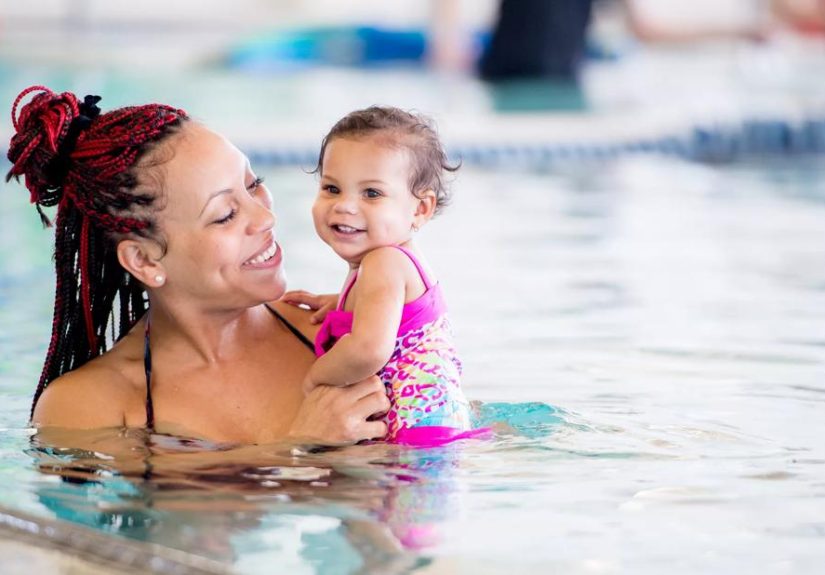
This is the window when many babies can enjoy their first pool experience. Keep it short, warm, and relaxed. Hold your baby securely against your chest, maintain eye contact, talk in a calm voice, and let them splash with their hands. If your baby cries, clings, shivers, coughs, or seems overwhelmed, get out and try again another day.
12 Months and Older: Consider Swim Readiness
The American Academy of Pediatrics supports swim lessons as one layer of protection against drowning for many children starting around age 1, depending on readiness. This does not mean every 1-year-old must start formal swim lessons. Readiness depends on emotional maturity, physical ability, comfort in water, frequency of water exposure, and any health concerns.
Parent-and-child swim classes can help toddlers become comfortable in water, learn safe entry and exit habits, and practice basic water skills. However, no swim class can drown-proof a child. Supervision remains the star of the show.
Pool Safety Rules Every Parent Should Follow
Stay Within Arm’s Reach
For babies and toddlers, “supervision” means close enough to touch. You should be in the water, holding or supporting your baby the entire time. Watching from a lounge chair does not count. Watching while scrolling your phone definitely does not count. Babies can slip, inhale water, or become distressed in seconds.
Use a Designated Water Watcher
At family gatherings, everyone assumes someone else is watching the baby. That is how accidents happen. Choose one adult as the water watcher, and make it official. That person should avoid phones, alcohol, long conversations, and multitasking. When they need a break, they should clearly hand the job to another adult.
Do Not Rely on Floaties
Inflatable arm bands, baby neck floats, pool noodles, and cute rafts are not safety devices. They can slip off, tip over, deflate, or create false confidence. If your baby needs flotation near water, use a properly fitted U.S. Coast Guard-approved life jacket when appropriate, especially around open water or boats. In the pool, your arms and attention are the main safety equipment.
Fence the Pool
If you have a home pool, install a four-sided fence that fully separates the pool from the house and yard. The gate should self-close and self-latch. Remove toys from the pool area after swimming so toddlers are not tempted to wander back. A silent backyard pool can be more dangerous than a noisy one because trouble may happen when nobody thinks swimming is even happening.
Learn Infant and Child CPR
Parents, grandparents, babysitters, and regular caregivers should know infant and child CPR. Hopefully, you will never need it. But in an emergency, knowing what to do while waiting for help can make a critical difference.
What About Chlorine and Saltwater Pools?
For babies over 6 months, a properly maintained chlorinated pool is generally considered safe. Chlorine helps kill many germs, which is why pool maintenance matters. Too little chlorine can allow harmful bacteria and viruses to spread. Too much chlorine can irritate skin, eyes, and airways.
Saltwater pools may feel gentler on the skin and eyes, but they are not chemical-free. Saltwater pools still use systems that create chlorine, and they still need regular maintenance. Whether the pool is chlorine, saltwater, indoor, or outdoor, the safest pool is clean, clear, properly treated, and supervised.
A good rule for parents: if the water looks cloudy, smells harsh, or the pool area seems poorly maintained, skip it. Your baby’s first pool experience should not include a mystery soup situation.
Swim Diapers: Helpful, but Not Magical
Swim diapers are useful because they help contain solid poop. However, they are not leak-proof and do not prevent all germs from entering the water. They also do not absorb urine like regular diapers, which is exactly why they do not balloon into a soggy bowling ball in the pool.
Check swim diapers frequentlyabout every hour and anytime you suspect a diaper situation is brewing. Change diapers away from the poolside in a proper changing area, then wash your hands. If your baby has diarrhea, do not go swimming. Not in a pool, not in a splash pad, not in the “just for a minute” kiddie pool. Diarrhea and shared water are a bad team.
When Your Baby Should Not Go in a Pool
Skip pool time if your baby has a fever, diarrhea, vomiting, a contagious illness, an unexplained rash, open wounds, ear tubes that have not been cleared by a doctor, breathing trouble, or seems unusually sleepy or unwell. Also avoid swimming if the weather is too hot, the sun is intense, the water is cold, or the pool is crowded and chaotic.
If your baby was born premature, has heart or lung conditions, has immune system concerns, has a feeding tube, recently had surgery, or has a skin condition such as eczema that flares easily, ask your pediatrician before swimming. The answer may still be yesbut it should be a confident yes, not a “we guessed and packed snacks” yes.
How to Make Baby’s First Pool Day Go Smoothly
Pack Smart
Bring swim diapers, a regular diaper for after swimming, towels, a dry outfit, baby-safe sunscreen if your baby is old enough, a wide-brimmed hat, a shaded place to rest, feeding supplies, and a plastic bag for wet clothes. Add snacks for adults, because hungry parents make questionable decisions.
Start Slowly
Do not rush into the water. Sit near the pool first. Let your baby watch the movement, hear the splashing, and study the scene like a tiny lifeguard supervisor. Then dip their feet. If they seem comfortable, move in gradually while holding them close.
Keep It Short
A first swim does not need to be long. Ten minutes can be a complete victory. Babies get tired quickly because pool time is full of new sounds, sensations, temperature changes, and bright light. End on a good note before your baby reaches meltdown mode.
Rinse and Warm Up
After swimming, rinse your baby with clean water, dry them well, change out of wet swimwear, and offer a feeding if needed. A warm towel and a cuddle can turn the end of pool time into a cozy reset instead of a dramatic finale.
Can Babies Learn to Swim?
Babies cannot truly “swim” the way older children can. Some infant water programs teach floating, breath control, or self-rescue skills, but parents should be careful with marketing that suggests a baby can be drown-proofed. No baby is drown-proof. No toddler is drown-proof. Honestly, some adults are not pool-proof when a diving board is involved.
For babies under 1 year, water play should focus on comfort, bonding, and gentle exposurenot performance. Parent-and-baby classes can be enjoyable when they are warm, calm, developmentally appropriate, and led by trained instructors. Avoid any program that forces submersion, ignores distress, or makes big safety promises.
Real-Life Experiences: What Baby Pool Time Actually Feels Like
The first time you take a baby to the pool, expect less “magical vacation commercial” and more “mobile command center with towels.” You may spend 25 minutes applying sunscreen, adjusting the hat, finding the swim diaper, removing the regular diaper you forgot was still on, locating the backup swim diaper, and wondering why one small human requires the luggage of a touring musician.
Then you finally reach the pool. Your baby may squeal with delight, stare suspiciously at the water, or cling to you like a tiny koala who has just read the safety manual. All reactions are normal. Some babies love water immediately. Others need several visits before they decide the pool is not a giant bathtub with strangers.
A helpful first experience is calm and slow. Hold your baby chest-to-chest so they can feel your body and hear your voice. Let their feet touch the water first. Smile, talk, and keep your face relaxed. Babies are excellent emotional detectives. If you look nervous, they may decide the pool is full of sharks, paperwork, or both.
One parent-friendly trick is to create a predictable rhythm. Dip toes, pause. Wet hands, pause. Sit on the steps with baby in your lap, pause. Move gently side to side, pause. This gives your baby time to process each new feeling. The goal is not to “get them used to it” by overwhelming them. The goal is to help them associate water with safety, warmth, and connection.
Another real-world lesson: babies get tired fast. Pool time may look effortless, but for a baby, it is a full sensory workout. There is sunlight, echoing noise, moving water, new textures, and the suspicious presence of floating toys. Watch for signs of fatigue such as yawning, rubbing eyes, turning away, fussing, or becoming unusually quiet. A calm exit beats a dramatic poolside opera every time.
Parents also learn quickly that timing matters. A baby who is hungry, overdue for a nap, or already cranky is not likely to become cheerful because you added water. Plan swimming after a nap and feeding, but not immediately after a big meal. Give your baby time to digest and settle. The happiest baby swim sessions often happen when the parent has no big expectations and no strict agenda.
Finally, remember that confidence builds through repetition. Your baby may only tolerate five minutes the first time. That is not failure. That is a five-minute foundation. Over time, gentle exposure can help your baby enjoy splashing, kicking, floating with support, and feeling comfortable around water. Keep it safe, keep it short, and keep your sense of humor nearby. It will be needed when you discover the swim diaper worked perfectlybut the car seat snack cup did not.
Conclusion
For most healthy babies, the best time to go in a pool is around 6 months old, when they have better head control, improved temperature regulation, and a greater ability to tolerate a short, gentle water experience. Even then, pool time should be brief, warm, shaded, and fully supervised.
The safest baby pool experience is not built on fancy gear or fearless baby swim videos. It is built on close adult contact, clean water, sun protection, smart timing, proper barriers, and a parent who understands that water deserves respect. Let your baby meet the pool slowly, happily, and safely. The goal is not to raise the next Olympic swimmer before teething. The goal is to create a safe, positive relationship with waterone tiny splash at a time.