Table of Contents >> Show >> Hide
- What Was the Global Climate Strike 2019?
- Why the Strike Happened
- What Happened During the Global Climate Strike
- Why the Global Climate Strike 2019 Mattered
- Criticisms, Limits, and the Hard Reality Check
- The Legacy of the Global Climate Strike 2019
- Experiences Related to the Global Climate Strike 2019
- Conclusion
The Global Climate Strike 2019 was not just another protest with handmade signs, tired sneakers, and a few megaphones trying their best. It was a giant, youth-powered wake-up call to governments, corporations, and basically every adult who had ever said, “We’ll get to it later.” Spoiler: the kids were not interested in waiting politely while the planet kept heating up.
In September 2019, students, parents, teachers, scientists, workers, and everyday people poured into streets across the world to demand stronger action on climate change. The strike became one of the biggest climate demonstrations in history, and it helped turn climate activism from a niche concern into a loud, mainstream, impossible-to-ignore public movement. It also proved something politicians often forget: when enough people show up at once, “young people are not paying attention” stops being a believable excuse.
What Was the Global Climate Strike 2019?
The Global Climate Strike was a coordinated wave of demonstrations that took place during the week of September 20–27, 2019. The biggest day of action came on September 20, just before the United Nations Climate Action Summit in New York. The timing was deliberate. Protesters wanted world leaders to arrive at the summit already hearing the roar from the streets.
At the center of the movement was Greta Thunberg, whose solo school strike in Sweden had grown into the global Fridays for Future movement. What began as one teenager sitting outside parliament with a sign became a worldwide model for climate activism. By 2019, that simple act had inspired a broad coalition of young people who were done being told to recycle harder while fossil fuel emissions kept climbing.
The strike was global, but it also had strong local flavor. In the United States, organizers built marches, rallies, walkouts, speeches, and teach-ins around local concerns such as wildfire smoke, hurricanes, flooding, public transit, air pollution, and environmental justice. So while the banner headline was climate change, the lived meaning changed from city to city. In one place it was about sea-level rise. In another it was about asthma near highways. In another it was about whether future summers would feel like weather or punishment.
Why the Strike Happened
A Generation Grew Tired of Waiting
The deeper story behind the Global Climate Strike 2019 was frustration. Young people had spent years hearing that climate change was urgent while watching action move at the speed of a sleepy turtle wearing office loafers. Scientific warnings kept getting sharper, but policy responses often stayed cautious, delayed, or watered down. To many student organizers, that gap between the science and the politics felt like a betrayal.
Climate change was not an abstract future threat to this generation. It already looked real. Stronger storms, longer fire seasons, more severe heat, shrinking ice, and rising seas had become part of the public conversation. Major science institutions had already made clear that Earth was warming and that human activity was the main driver. That scientific backdrop gave the strikes moral force. These protesters were not marching because climate danger might show up someday. They were marching because it already had.
The Movement Was About Justice, Not Just Carbon
Another reason the strike resonated was that it linked climate policy with fairness. Many organizers argued that climate change does not hit everyone equally. Low-income communities, island nations, Indigenous communities, and neighborhoods already burdened by pollution often face the greatest harm first and the least protection. That gave the strike a broader message: climate action was not only about emissions targets and international diplomacy. It was also about health, safety, accountability, and who gets sacrificed when action comes too late.
This justice-centered framing made the movement bigger and smarter. It welcomed people who might not have shown up for a generic environmental rally but would absolutely show up for cleaner air, safer neighborhoods, better public transportation, a just transition for workers, and a political system that treats the future like something more than an optional add-on.
What Happened During the Global Climate Strike
Millions in the Streets
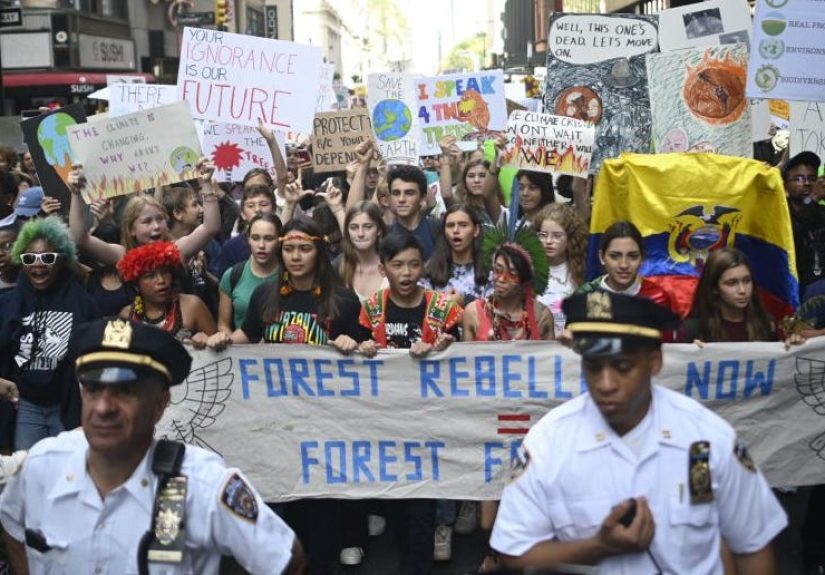
On September 20, 2019, cities around the world filled with marchers. New York became one of the most visible centers, especially because the U.N. summit was about to begin and Greta Thunberg was there. But the story was far bigger than one city. Demonstrations unfolded across the United States and far beyond it, with huge turnout in countries including Germany, Australia, the United Kingdom, Canada, and many others.
The numbers made headlines for good reason. Estimates varied, as they often do with mass protests, but the scale was undeniable. Millions participated on the first major day alone, and organizers later estimated 7.6 million people joined actions over the full week. That kind of turnout gave the climate movement something powerful: visual proof. It is one thing to say people care about climate action. It is another thing entirely to watch city streets overflow with them.
Students Led, Adults Joined
One of the most striking features of the 2019 climate strike was its leadership. Young people were not serving as symbolic mascots while adults managed the real machinery. They were organizing, messaging, speaking, and setting the tone. In the United States, youth-led coalitions helped coordinate the effort, while adult allies, labor groups, nonprofits, educators, and parents backed them up.
That changed the energy of the event. The adults were not there to pat the kids on the head and say, “What a nice science project.” They were there because the kids were right. Plenty of marchers skipped work, left campus, or paused their routines because the movement made a compelling case that business as usual was exactly the problem.
The Signs Were Sharp, and So Was the Message
Climate protests have a long tradition of memorable signage, and the Global Climate Strike 2019 did not disappoint. There were signs full of grief, anger, science, jokes, and savage one-liners. Protest language mixed urgency with wit because, frankly, humor travels farther than a spreadsheet. Underneath the clever slogans, though, the message stayed clear: leaders had wasted too much time, and half-measures were no longer good enough.
That clarity mattered. The strike was not merely a symbolic release valve for eco-anxiety. It made political demands. Protesters called for faster emissions cuts, an end to new fossil fuel expansion, stronger commitments from governments, and policies that matched the scale of the crisis. The movement’s tone was not “please consider caring.” It was “the science is here, the damage is visible, and the delay is indefensible.”
Why the Global Climate Strike 2019 Mattered
It Changed the Public Mood
The Global Climate Strike did not solve climate change in a week. Nobody marched home, checked the thermostat of Earth, and declared victory. But it did change the public mood. It made climate activism look organized, diverse, intergenerational, and impossible to dismiss as a fringe obsession. After 2019, public conversations around climate became harder to wave away as idealistic noise.
The strike also gave climate action a cultural jolt. News outlets covered it intensely. Politicians had to respond to it. Schools, universities, workplaces, and families talked about it. Even people who disagreed with the protests had to acknowledge them. That is often how public shifts begin: not with universal agreement, but with a topic becoming too visible to ignore.
It Elevated Youth Voices in Politics
Another major legacy was political. The strike showed that young people were not just worried about climate change; they were prepared to organize around it. That mattered because youth political energy is often underestimated right up until it starts filling streets, shaping campaigns, and changing what counts as a mainstream issue.
In the years after the strike, climate politics increasingly reflected language that youth activists had pushed forward: urgency, justice, accountability, fossil fuel dependence, and generational responsibility. Not every government suddenly transformed, of course. Politics rarely turns on a dime. It prefers a slow, dramatic swivel. But the strike accelerated that swivel.
It Exposed the Gap Between Rhetoric and Action
Perhaps the most important thing the 2019 strike accomplished was exposing a giant contradiction. Leaders around the world were happy to say climate change was serious. The protesters asked the uncomfortable follow-up question: then why are the policies still so timid? That question cut through polished speeches and diplomatic language like a hot knife through room-temperature butter.
By placing mass protest right next to an international summit, the strike forced a comparison between public urgency and political caution. It became harder to celebrate small gestures when millions of people were demanding structural change.
Criticisms, Limits, and the Hard Reality Check
No serious analysis of the Global Climate Strike 2019 should pretend the movement was above criticism or instantly transformative. Critics questioned whether student walkouts were effective, whether protest messaging was too broad, and whether media attention around celebrity activists overshadowed grassroots organizers from more vulnerable communities.
There was also the basic challenge that all protest movements face: visibility is not the same as policy. Marches can reshape culture, pressure institutions, and open political space, but they do not automatically rewrite laws. Climate action still ran into the same barriers it always had: lobbying, partisan division, short election cycles, infrastructure dependence, and governments that love long-term goals almost as much as they love postponing them.
Still, focusing only on what the strike did not accomplish misses the point. Mass movements are not magic tricks. They are pressure systems. Their job is not to solve everything in one grand cinematic moment. Their job is to shift what people will tolerate, what leaders must answer for, and what future organizing can build on. By that measure, the strike was hugely important.
The Legacy of the Global Climate Strike 2019
Years later, the Global Climate Strike 2019 remains a landmark in modern climate activism. It stands as a moment when the climate crisis moved from policy reports and conference rooms into city streets on a scale that was impossible to shrug off. It also showed that youth activism could be disciplined, strategic, media-savvy, and morally persuasive without losing its edge.
The strike’s legacy lives on in later climate demonstrations, campus organizing, local climate campaigns, and the continued rise of young activists as serious political actors. It also helped normalize the idea that climate change belongs in every major conversation about the future: economics, health, energy, housing, labor, migration, and democracy.
Most of all, the Global Climate Strike 2019 revealed something simple but powerful: people, especially young people, were no longer content to be passive witnesses to a warming world. They wanted a say in what comes next. And they were willing to miss class, take over streets, and make a very public fuss about it. Honestly, good for them.
Experiences Related to the Global Climate Strike 2019
To understand the Global Climate Strike 2019, it helps to imagine not just the headlines but the experience of being part of it. For many participants, the day started with a strange mixture of adrenaline and awkward logistics. Students packed signs into backpacks, texted friends about where to meet, and negotiated with teachers, parents, or employers. Some walked out of class with confidence. Others did it with the look of someone who had just decided to jump into a cold pool and was hoping courage would arrive before regret.
Then came the shift that mass gatherings create almost magically. A person standing alone with a climate sign can feel vulnerable, overly earnest, even easy to ignore. A few dozen people create curiosity. A few thousand create momentum. Suddenly the private fear that maybe nobody cares gets replaced by a very public answer: actually, a lot of people care, and some of them brought drums.
Participants often described the atmosphere as emotional but not hopeless. That is an important distinction. The signs were full of urgency, and the speeches did not sugarcoat the science, yet the marches also had humor, music, chanting, and the buzzing energy of collective purpose. It did not feel like a funeral for the future. It felt more like a giant refusal to let the future be quietly wrecked.
There was also a noticeable mix of people. Teenagers stood beside parents, scientists, teachers, labor organizers, clergy members, and retirees. Some had spent years in climate advocacy. Others were showing up for the first time because the movement finally made the issue feel immediate and human. That blend mattered. It turned the strike from a youth story into a society story.
On the ground, the experience was often sensory in the most basic ways: feet getting tired, voices going hoarse, signs bending in the wind, subway platforms packed with marchers, and strangers nodding at one another like teammates in a game none of them had wanted to inherit. In large cities, there was that unmistakable protest rhythm of waiting, chanting, walking, stopping, cheering, and walking again. It was messy, loud, imperfect, and alive.
For many people, one of the strongest feelings was relief. Relief that climate anxiety no longer had to stay trapped inside private conversations or doom-scrolling sessions at midnight. Relief that the burden of caring could be shared. Relief that concern could become action, even if only for a day, and that action could become community.
After the march, the emotional comedown was real too. Some people went home energized. Others felt frustrated that governments still seemed so slow. Many felt both at once. That blend of hope and impatience may be the most honest emotional legacy of the Global Climate Strike 2019. It was inspiring, but it was not comforting. It did not tell people everything would be fine. It told them they were not alone in demanding better.
And maybe that was the experience that mattered most. The strike gave participants a concrete memory they could return to later: a day when the climate crisis was no longer just a report, a graph, or a grim headline. It was a crowd, a voice, a route through the city, and a public declaration that the future was worth showing up for.
Conclusion
The Global Climate Strike 2019 mattered because it transformed climate concern into mass public action. It fused science, youth leadership, political frustration, and moral clarity into a movement that could not be dismissed as background noise. The strike did not end the climate crisis, but it changed the conversation around it. It forced institutions to confront a generation that had studied the evidence, seen the impacts, and decided that patience was no longer a virtue.
That is why the event still resonates. It was not only a protest about emissions or a week of marches before a U.N. summit. It was a cultural turning point. It showed that climate activism had entered a new phase: broader, younger, more urgent, and far less willing to accept polite delay. In that sense, the Global Climate Strike 2019 was not just about one week in September. It was about drawing a line and saying, clearly and loudly, that the future is not a side issue.