Table of Contents >> Show >> Hide
- Why “Skibidi Biden” Felt Like a Cultural Jump Scare
- The Joke Was Supposed to Be About Campaign Desperation
- Irony Does Not Magically Remove the Cringe
- Late-Night TV Has a Harder Job Than It Used To
- Why Political Meme Strategy So Often Backfires
- The Real Crime Was Comic Overproduction
- What the “Skibidi Biden” Experience Actually Felt Like
- Conclusion: No Jail Time, Just a Long Timeout From the Algorithm
Note: This headline is satire. No one is literally being accused of a crime. The only offense being discussed here is creative misconduct in the first degree.
There are bad jokes, there are stale jokes, and then there are jokes so spectacularly cursed that they make an entire audience feel like they accidentally walked into a group project between cable television and the algorithm that runs a middle-school iPad. That is where “Skibidi Biden” lives. Not in comedy heaven, not even in comedy purgatory, but in the fluorescent waiting room where every trend goes to be explained by adults who learned the word “rizz” from a newsletter.
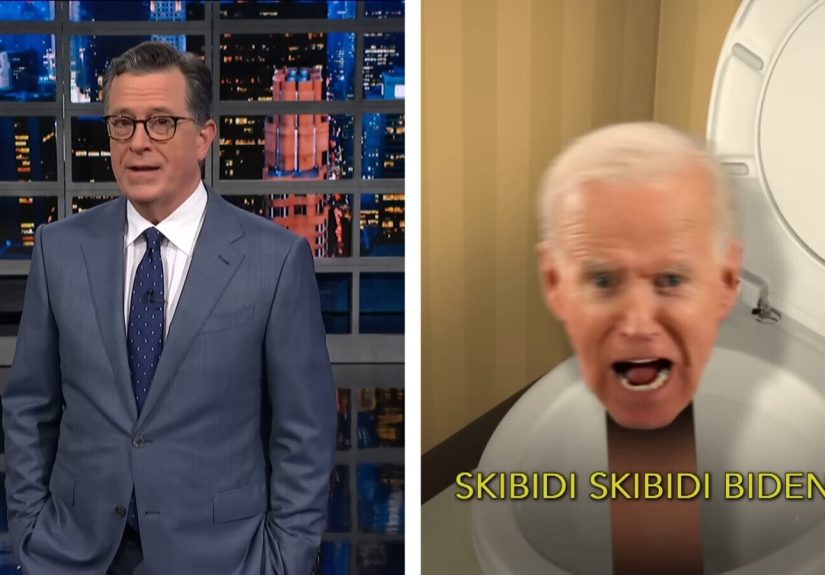
When The Late Show with Stephen Colbert rolled out the now-infamous “Skibidi Biden” bit, the segment was clearly trying to do two things at once: mock the Biden campaign’s internet outreach and parody the desperate, slightly sweaty way politics keeps trying to flirt with online youth culture. On paper, that is a solid target. In practice, the joke landed like a shopping cart full of buzzwords rolling down a flight of stairs.
And that is what makes the bit fascinating. “Skibidi Biden” was not merely weird. Weird can be good. America was built on weird. This was something more specific: a joke about cringe that became even cringier than the thing it was mocking. It was satire that accidentally satirized itself. It was a hall of mirrors built out of toilet humor, campaign panic, and the haunting realization that late-night TV now has to compete with a universe where ten-year-olds understand irony on at least six more levels than the rest of us.
Why “Skibidi Biden” Felt Like a Cultural Jump Scare
The reaction to the video was immediate because the bit compressed several already-annoying realities into one short burst of televised chaos. First, there was the underlying news hook: the Biden campaign’s effort to sharpen its digital game and work with meme pages. Second, there was the broader political truth that campaigns in 2024 were increasingly trying to win attention with internet-native language, influencer strategy, and vibes. Third, there was “Skibidi Toilet,” one of the most baffling and massively successful pieces of Gen Alpha internet culture, which already functioned as shorthand for brain-rot humor, generational confusion, and the terrifying speed at which online culture mutates.
So when Colbert’s team mashed those ingredients together, the result was less “sharp media critique” and more “your uncle trying to explain TikTok during Thanksgiving dinner while somebody microwaves fish.” You could see the intention. You could also see the smoke coming out of the engine.
That is why the backlash was so strong. Viewers were not just reacting to one joke. They were reacting to the feeling that mainstream media had once again sprinted into the meme economy wearing dress shoes. The segment became memorable not because it was incisive, but because it perfectly captured the terrible moment when an institution decides it is going to be “online.”
The Joke Was Supposed to Be About Campaign Desperation
To be fair, the target was real. By the spring of 2024, the Biden campaign was plainly trying to meet younger voters where they lived online. That included TikTok, meme partnerships, digital creators, and a broader push to make campaign messaging feel less like a brochure and more like something that could survive contact with a For You page. There was strategy behind that. Young voters are online, fragmented, skeptical, and hard to reach through conventional political media. If campaigns want attention, they have to fish in fast-moving waters.
But that strategy also contains a built-in humiliation risk. Internet culture is not just fast; it is merciless. The second a politician, corporation, or TV writer tries too obviously to “use the language of the internet,” the internet responds the same way a cat responds to a cucumber: confusion, panic, and immediate violence.
Colbert’s monologue was trying to expose exactly that trap. The problem is that exposing a trap by stepping into it face-first is not always the most elegant form of commentary. The segment was saying, “Look how embarrassing it is when politics borrows meme culture,” while borrowing meme culture in an even more embarrassing way. That is not a takedown. That is a reenactment.
Irony Does Not Magically Remove the Cringe
One of the oldest mistakes in modern comedy is believing that self-awareness is a Get Out of Jail Free card. It is not. Doing something annoying on purpose is still doing something annoying. If a restaurant serves you a terrible sandwich and says, “Relax, it’s ironic,” you are still eating a terrible sandwich. That was the problem with “Skibidi Biden.” The bit assumed that by parodying meme-chasing, it could safely become meme-chasing for a minute. Instead, it demonstrated a harsher rule: irony can describe cringe, but it does not disinfect it.
This is why the clip felt so spiritually exhausting. It was not just corny. It was overdetermined. It had the energy of a creative room trying to reverse-engineer online humor from a whiteboard full of nouns. Biden. Skibidi. Toilet. Youth vote. Boom, joke. Except that online humor rarely works like that. The best memes spread because they are odd, accidental, timely, or communal. They do not arrive with the expression of a man in a blazer who has just said, “Okay team, let’s manufacture spontaneity.”
The Difference Between Being Online and Looking Online
That distinction matters. Plenty of political figures and media brands want to seem internet-literate. Far fewer actually understand how digital culture works. Being online is not the same as referencing online things. It is not about sprinkling slang over a script like parsley. It is about tone, rhythm, timing, platform behavior, and a thousand tiny social cues that cannot be recreated by committee once the moment has passed.
That is why so many campaign meme efforts feel cursed. They often treat the internet as a costume closet instead of a living ecosystem. Put on “skibidi,” throw in “rizz,” maybe a little “delulu,” and suddenly someone in a conference room thinks the youth have been reached. Meanwhile, the youth are already somewhere else, making jokes about the fact that you are still saying “the youth.”
Late-Night TV Has a Harder Job Than It Used To
There is also a bigger media story here. Late-night used to sit comfortably near the center of the culture. It commented on the day’s news, sharpened it into jokes, and sent those jokes into the national bloodstream. But the bloodstream is now a pile of competing apps, fragments, private group chats, clipped videos, and niche fandoms. A host like Stephen Colbert is not just competing with other comedians anymore. He is competing with streamers, meme pages, YouTube editors, niche podcasts, and some teenager in Ohio who can make a better joke in seven seconds with CapCut.
That does not mean late-night is doomed. It means late-night has to choose its battles. When it tries to imitate digital absurdism too directly, it often looks like a luxury sedan trying to drift in a supermarket parking lot. The machine is simply built for something else. Colbert is good at a lot of things: political monologues, theatrical indignation, polished satire, the kind of studio-audience rhythm that made him a giant in the first place. But “Skibidi Biden” was an example of a legacy format trying to cosplay as pure internet chaos. That is a risky hobby.
Ironically, the bit might have worked better if it had gone smaller. A single throwaway line about campaign meme-hunting could have landed. A dry visual could have landed. Even a straight-faced explanation of how ridiculous the phrase “content and meme pages” sounds in a presidential campaign job description might have landed. Instead, the show committed to the full fever dream. Once you do that, the audience stops evaluating the premise and starts asking whether everybody involved slept badly.
Why Political Meme Strategy So Often Backfires
The deeper issue is that politics wants the rewards of meme culture without accepting its basic logic. Memes are volatile, communal, and often anti-authoritarian in flavor. Campaigns, by contrast, are disciplined, transactional, and profoundly uncomfortable with losing control. The result is usually a strained compromise: content that wants to feel organic while carrying the unmistakable scent of deodorized focus-group air.
Biden’s team was hardly alone in this. By 2024, both major parties understood that digital culture could shape attention, identity, and voter emotion. Campaigns wanted viral moments because viral moments are cheaper than persuasion and faster than trust. But online popularity is not the same thing as political connection. A meme can travel farther than a policy argument while doing almost nothing to build durable support. It can also backfire in public, which is what made “Skibidi Biden” such an ideal punchline. The segment was not just mocking one campaign tactic. It accidentally illustrated the weakness of the whole genre.
And once the internet detects effort, the game is over. Modern audiences, especially younger ones, are exceptionally good at smelling desperation. They know when somebody is trying to win them over with borrowed language. They know when brands, politicians, or TV producers are making content that has been pre-aged in the lab to look naturally chaotic. Nothing becomes uncool faster than being caught reaching for coolness with both hands.
The Real Crime Was Comic Overproduction
So should everyone at The Late Show go to jail for the “Skibidi Biden” video? Of course not. This is a comedy article, not a grand jury. But the hyperbole sticks because it expresses the correct emotional temperature. Viewers did not experience the clip as an ordinary miss. They experienced it as an act of collective psychic trespass.
The offense was not political. It was aesthetic. It was the sensation of watching professional comedy people knowingly build a joke that looked algorithmic, labored, and spiritually damp. It was the horror of seeing satire become indistinguishable from the culture it meant to mock. It was the feeling, familiar to anyone who has spent too much time online, that irony had finally eaten its own tail and was now gnawing on the furniture.
Still, there is something useful in the failure. “Skibidi Biden” exposed the gap between television comedy and internet-native humor more clearly than a successful bit ever could. It showed that mainstream satire cannot simply borrow a viral reference and expect to inherit its energy. It showed that meme politics is easier to discuss than to perform. And it showed that once online culture becomes self-conscious, the whole machine starts to squeal.
In that sense, the clip was educational. Painful, yes. Deeply cursed, absolutely. But educational. Like touching a hot stove and learning a lesson that should have been obvious from the start.
What the “Skibidi Biden” Experience Actually Felt Like
What made the whole episode linger was the experience of watching it unfold in real time. If you were online when the clip started spreading, you probably had the same reaction as thousands of other viewers: a flash of disbelief, a pause to confirm that yes, this was real, and then a strange kind of secondhand embarrassment on behalf of every institution involved. It felt like seeing several different corners of American culture collide in the least graceful way possible. Network television. Campaign digital strategy. Gen Alpha slang. Presidential branding. Toilet memes. None of these things should naturally share a room, and yet there they were, stacked on top of one another like folding chairs in a windstorm.
For older viewers, the experience probably felt like whiplash. One second you are watching a familiar late-night monologue structure; the next, you are staring into a joke assembled from symbols that belong to a much younger, much faster internet. For younger viewers, the reaction was different but no less intense. It was the familiar agony of watching mainstream media discover a reference long after its peak and then use it with the confidence of somebody who absolutely should not be holding it. The bit became a shared event because both groups understood, in their own way, that something had gone wrong.
There is also a broader, almost universal experience attached to this kind of content now. Most people have watched a brand, politician, celebrity, or media company try to jump into online slang and instantly age 40 years in the process. You can feel the gears turning behind the joke. You can hear the strategy meeting hiding inside the punchline. That is what “Skibidi Biden” represented for a lot of viewers: not just one weird clip, but the whole exhausting pattern of institutions trying to borrow internet fluency instead of earning it.
And yet, that discomfort is what made the clip memorable. The experience was horrible, but it was clarifying. It reminded everyone that there is still a difference between understanding online culture and merely pointing at it. It reminded comedy writers that references alone are not comedy. It reminded campaigns that youth outreach cannot be built on panic and borrowed slang. And it reminded the rest of us that every generation eventually gets the privilege of watching the culture industry humiliate itself in an attempt to look current.
Maybe that is the final gift of “Skibidi Biden.” It gave the internet one more example of a timeless truth: the moment powerful adults try hardest to seem digitally natural is usually the exact moment they become the meme instead. That experience is embarrassing, funny, and a little painful to watch. It is also, somehow, one of the most honest portraits of modern political media you could ask for.
Conclusion: No Jail Time, Just a Long Timeout From the Algorithm
“Skibidi Biden” will not be remembered as a brilliant satire, a clever campaign critique, or a historic moment in late-night television. It will be remembered as a warning label. It is what happens when television tries to impersonate internet chaos, when politics tries to flatter youth culture by renting its vocabulary, and when everyone involved mistakes recognition for relevance.
The joke was supposed to be that campaigns are embarrassing when they chase memes. The actual joke was that the segment proved the point too well. And maybe that is enough. Not jail, exactly. But perhaps a respectful distance from the content mines, a temporary suspension of internet privileges, and a handwritten promise never to utter “Skibidi Biden” in a writers’ room again.