Table of Contents >> Show >> Hide
- Why Victory in Europe Day Still Matters
- What the Original V-E Day Photos Actually Show
- The 70th Anniversary in 2015: How the Photo Story Changed
- Iconic Visual Themes in Victory in Europe Day Photography
- How to Read V-E Day Photos Like a Historian
- What the Photos Leave Out
- The Experience of Looking at V-E Day Photos 70 Years Later
- Conclusion
Some photographs do not simply record history. They grab history by the lapels, shake it a little, and say, “Pay attention, this mattered.” That is exactly what the best Victory in Europe Day images do. The photos tied to the 70th anniversary of the end of World War II in Europe are not just about waving flags, crowded streets, and smiling faces. They are about relief with a lump in its throat. They are about joy wearing muddy boots. They are about a world exhaling after years of bombs, occupation, rationing, and unbearable loss.
When people search for End of World War II 70th Anniversary Photos or Victory in Europe Day photos, they are usually looking for more than pretty archive shots. They want to understand what V-E Day looked like, what it felt like, and why those images still hit so hard decades later. The answer is not simple, which is exactly why the photos remain unforgettable. Some frames are loud: confetti in Times Square, crowds in London, cheering in Paris. Some are quiet: wounded soldiers, formal surrender documents, old veterans in 2015 standing a little slower but remembering very clearly.
The genius of V-E Day photography is that it captures two endings at once. One was military: Nazi Germany had surrendered, and the war in Europe was over. The other was emotional: millions of people suddenly realized they had survived long enough to see that moment. That is why these photos still feel alive. They are not frozen in the past. They are still vibrating.
Why Victory in Europe Day Still Matters
Victory in Europe Day, commonly called V-E Day, marks the defeat of Nazi Germany in Europe in May 1945. But the story is not as neat as one calendar square. Germany signed an unconditional surrender at Reims on May 7, and a second formal act was signed in Berlin on May 8. In the West, May 8 became the day of celebration. In the Soviet sphere, May 9 became the main day of remembrance. History, in other words, arrived with paperwork, politics, and no shortage of exhausted generals.
That detail matters when you look at anniversary photos from 2015, the 70th anniversary of V-E Day. Those images were never just nostalgic tributes. They were reminders that the end of war was both a military event and a public emotion. Ceremonies, wreaths, old aircraft, museum exhibitions, and surviving veterans all helped connect 2015 back to 1945. The anniversary photos work because they carry two timelines in one frame: the moment of victory and the memory of victory.
And memory, unlike confetti, does not just drift away. It has to be tended. That is why museums, archives, and commemorative events matter so much in the visual history of World War II. A photograph is not only evidence. It is also inheritance.
What the Original V-E Day Photos Actually Show
Street Celebrations That Feel Almost Too Big for the Frame
The most famous V-E Day images are the crowd scenes, and for good reason. They look like civilization itself just remembered how to smile. In New York, Times Square became a storm system of ticker tape, paper scraps, flags, and faces turned upward. In London, Trafalgar Square and the area around Buckingham Palace filled with people who had spent years under blackout rules, bombing raids, and rationing. In Paris, streets that had known occupation and fear turned into routes of release.
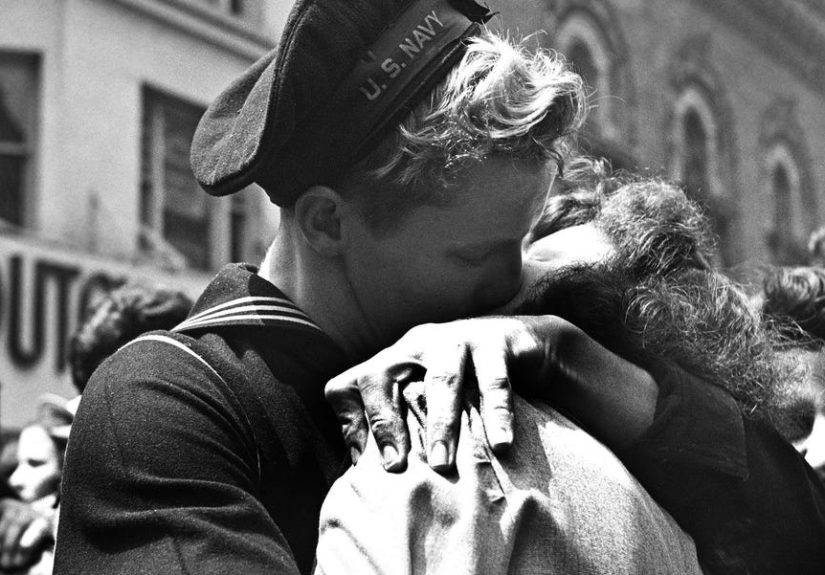
These photos are visual overload in the best way. They are crowded, messy, ecstatic, and wonderfully uncomposed. Nobody appears to have paused to ask whether the lighting was flattering. That is one reason they still feel authentic. These were not staged lifestyle images. They were history having a spontaneous nervous breakdown in public, except this time in a happy direction.
Yet even the loudest crowd photos carry complexity. The smiles are real, but so is the fatigue. You can almost feel the years behind the faces: sons gone, homes damaged, uniforms worn thin, nerves stretched to wire. That is what gives the best World War II anniversary photos their power. They are celebrations, yes, but not carefree ones.
The Balcony, the Broadcast, and the Bureaucracy
Some V-E Day images are grand and theatrical. Winston Churchill and the British royal family on the Buckingham Palace balcony turned victory into a public stage. Those pictures communicate national unity, symbolism, and spectacle. They are the sort of photos history textbooks adore because everyone looks like they understood the assignment.
But other images remind us that wars do not end only with cheering crowds. They end with signatures, stamps, translations, military protocols, and long tables full of men who have slept terribly. Photographs from Reims and Berlin show the surrender process itself, which can look surprisingly plain compared with the emotional explosion outside. That contrast is part of the V-E Day story. One room ended the war on paper. Millions of people outside had to figure out what that meant for real life.
This is why a strong article about Victory in Europe Day photos cannot stop at crowd scenes. The paper trail matters. The official images matter. Without them, the celebrations would float free of context. With them, the visual story becomes complete.
Relief, but Never a Clean Happy Ending
If you only looked at the most jubilant photos, you might think May 1945 wrapped the war up with a giant patriotic ribbon. It did not. The war in the Pacific was still ongoing. Holocaust survivors were still being found and aided. Prisoners, refugees, wounded troops, grieving families, and devastated cities did not suddenly become footnotes because bells rang in London or flags waved in Manhattan.
That is why some of the most important V-E Day-related images are not the happiest ones. Photos of wounded servicemen in hospitals, bomb-damaged cityscapes, military cemeteries, and liberation scenes keep the visual record honest. They stop the story from turning into easy sentiment. They remind viewers that victory was real, but so was the cost.
The 70th Anniversary in 2015: How the Photo Story Changed
Washington, D.C., Became a Living Photo Album
One of the most memorable 70th anniversary scenes in the United States came from Washington, D.C., where commemorations included wreath-laying, veteran tributes, and the celebrated Arsenal of Democracy flyover. World War II aircraft crossed the sky above the National Mall, giving photographers a rare chance to frame old machines against modern monuments and aging veterans below. It was history meeting memory at full altitude.
These anniversary photos differ from 1945 originals in a striking way. The 1945 images are about release. The 2015 images are about recognition. In the later photos, veterans wear medals instead of field gear. Crowds lean in not because victory has just arrived, but because the witnesses are leaving. The emotional tone shifts from explosive joy to reverent gratitude.
That shift gives 70th anniversary photography its own identity. It is not a rerun of V-E Day. It is a conversation with V-E Day. The lens is asking a different question now: what do we do with memory when the people who carried it are in their nineties?
Why the Anniversary Photos Feel More Solemn
The answer is visible in almost every major anniversary image. You see veterans in wheelchairs, veterans standing with canes, veterans touching wreaths, veterans staring into distance like they are seeing two centuries at once. You see children and grandchildren watching them. You see aircraft from the 1940s flying over a capital city that has changed almost beyond recognition. And you realize that the mood is not merely celebratory. It is protective.
These photos are guarding something: historical memory, moral clarity, and a direct human connection to the war that shaped the modern world. In 1945, the camera recorded a breaking event. In 2015, it recorded an act of stewardship.
Iconic Visual Themes in Victory in Europe Day Photography
Times Square: Joy with a New York Accent
No city performs public celebration quite like New York, and V-E Day proved it. LIFE and other photo archives preserved images of Times Square in full eruption: paper raining from buildings, crowds packed shoulder to shoulder, American flags popping out of the sea of heads, and people kissing strangers because apparently the city had collectively decided personal space could take the day off.
These images remain some of the most searched and shared V-E Day celebration photos because they condense a global event into one recognizable place. Times Square was already a symbol of American modernity. On V-E Day, it also became a symbol of relief.
London: Ceremony, Royal Symbolism, and Surviving the Blitz
London’s V-E Day photography has a different flavor. The images often balance celebration with endurance. Crowds gather below landmarks that had lived through blackout years and air raids. Balcony appearances and public speeches give the photos a ceremonial structure, but the human details keep them grounded. You can see people who look thrilled, tired, dazed, and proud all at once.
That mix is what makes London images so memorable. They are not merely pretty scenes of victory. They are visual proof that a city targeted, threatened, and darkened for years still had enough spirit left to fill the streets when the moment finally came.
Paris and Reims: From Occupation to Closure
Paris brings emotional sweep to the V-E Day photo archive. Crowds along the Champs-Elysees and around the Arc de Triomphe look almost cinematic, but the historical context makes them more than beautiful scenes. Paris had lived through occupation, humiliation, resistance, and liberation. By May 1945, celebration there carried an especially sharp sense of earned release.
Reims adds the final hinge to the visual narrative. It was one thing for a crowd to celebrate. It was another thing for surrender to be formally signed in the schoolhouse headquarters where military history took one of its decisive turns. Together, Paris and Reims create one of the strongest photo pairings of the war’s end: public emotion and official closure.
How to Read V-E Day Photos Like a Historian
First, look past the obvious. The flags and smiles are only the entry point. Ask what newspapers people are holding, what buildings loom in the background, what uniforms signal rank or injury, and what details suggest scarcity or exhaustion. In the best V-E Day images, celebration and strain often occupy the same square inch.
Second, notice who is not centered. A lot of famous V-E Day photography celebrates urban crowds, famous leaders, and symbolic public squares. But the wider historical experience also included hospital wards, displaced civilians, concentration camp survivors, grieving families, and soldiers who never came home. Great history writing does not attack the happy images; it simply refuses to let them do all the talking.
Third, compare 1945 with 2015. The 70th anniversary photographs teach viewers how memory evolves. Original images capture the event. Anniversary images capture the inheritance of the event. One is immediate emotion. The other is curated remembrance. Both matter, and together they tell a fuller story.
What the Photos Leave Out
Even the richest archive has limits. V-E Day photos can show jubilation, documents, uniforms, aircraft, and public ceremonies, but they cannot fully show what people were carrying inside. They cannot measure survivor’s guilt, wartime trauma, or the fear of what came next. They cannot fully show that for Americans, victory in Europe was only part of the war’s end. They cannot fully show the scale of destruction across the continent or the moral shock of what Allied forces were finding in liberated camps.
That is why the strongest photo essays and commemorative articles do not treat V-E Day as a fairy-tale finale. They treat it as a hinge point. The guns were quieting in Europe, but grief, rebuilding, justice, and remembrance were only beginning.
The Experience of Looking at V-E Day Photos 70 Years Later
There is a very specific feeling that comes from spending time with End of World War II 70th Anniversary Photos. It is not the same as reading a timeline or watching a documentary clip. Looking through these images, especially in sequence, feels like moving through a series of emotional rooms. The first room is noisy. You see Times Square, Trafalgar Square, Paris boulevards, waving flags, faces tilted toward the sky, and the visual commotion of a world that has suddenly been told it can breathe again. The pictures are crowded and restless, and even though they are still images, they almost seem to shake with sound.
Then the mood shifts. You begin to notice the details behind the excitement: uniforms that hang a little loosely, bandages, tired shoulders, people clutching newspapers as if the headline itself were a life raft. Some of the faces do not look wildly happy at all. They look stunned. That is one of the most human parts of the V-E Day archive. Not everyone celebrates in the same way. Some people dance. Some people stare. Some people pray. Some people look like they have been holding tension in their bones for so long that they no longer know how to stand without it.
The anniversary photos from 2015 create a different but equally powerful experience. Instead of young crowds pressing forward into an unknown future, you see elderly veterans standing inside a memory that the rest of the world can access only through stories, museums, and photographs. Those images can be surprisingly emotional because they turn history from abstraction back into human scale. A medal on a blazer, a hand on a cane, a wreath near a memorial, an old bomber crossing the Washington sky: suddenly the war is not “the 1940s” anymore. It is something a living person still remembers in detail.
There is also a strange intimacy to these anniversary scenes. In 1945, the camera often captured public release. In 2015, it often captured private reflection happening in public space. A veteran watching a flyover is not simply attending a ceremony. He may be hearing engines that sound like his youth. A family member beside him is not just standing politely for a photo. She may be realizing that memory is now being handed down, not merely observed.
That is why these images stay with people. They allow modern viewers to experience V-E Day in two layers at once. The first layer is the original emotional blast of victory. The second is the later realization that history survives only if someone keeps looking, keeps asking, and keeps telling the story accurately. In that sense, the experience of looking at V-E Day photos 70 years later becomes an act of participation. You are not just consuming images. You are helping keep a hard-won memory alive.
Conclusion
The best Victory in Europe Day photos do more than document the end of World War II in Europe. They show what victory looked like when it arrived in real human lives: loud in some places, restrained in others, joyful almost everywhere, but never untouched by loss. The 70th anniversary images add another layer by reminding us that remembrance has its own visual language. In 1945, cameras captured a world in release. In 2015, they captured a world trying to remember well.
That is the real power of End of World War II 70th Anniversary Photos. They are not just pictures of the past. They are evidence that the meaning of V-E Day keeps evolving, from breaking news to national memory to a warning, a tribute, and a lesson. History may fade at the edges, but a great photograph refuses to let it disappear quietly.