Table of Contents >> Show >> Hide
- Object-Shaped, Animal-Shaped, And Delightfully Literal
- Buildings That Twist, Melt, Lean, Or Seem Slightly Unwell
- Futuristic Buildings That Look Like They Landed Here By Accident
- When Architects Turn Cities Into Fantasy Sets
- Why Weird Buildings Matter More Than You’d Think
- The Experience Of Seeing Weird Buildings In Real Life
- Final Thoughts
- SEO Tags
Some buildings are designed to blend in. Others show up like they just lost a dare. Somewhere between serious architecture, public art, tourism bait, and pure “who approved this?” energy lives the weirdest buildings in the world. These are the structures that make people stop mid-walk, squint at the skyline, and say, “Wait… is that a giant basket?”
And honestly, that is part of their charm. Weird buildings are memorable because they ignore the boring rulebook. They twist, wobble, bloom, glare, resemble household objects, imitate animals, or look like they dropped straight out of a sci-fi movie with a very healthy special-effects budget. Some were built to symbolize culture or innovation. Some were built to attract customers. Some seem to exist because an architect had a bold vision and nobody nearby said, “Maybe let’s sleep on that.”
This roundup celebrates 52 of the strangest, funniest, and most fascinating buildings from around the world. A few are famous icons. A few are giant visual punchlines. All of them prove the same thing: architecture does not have to be quiet to be brilliant.
Object-Shaped, Animal-Shaped, And Delightfully Literal
Let’s start with buildings that do not believe in subtlety. These are the structures that look exactly like what they want you to think about.
- Longaberger Basket Building, Ohio, United States An office building shaped like a gigantic picnic basket, because apparently branding can go very, very hard.
- The Big Duck, New York, United States A duck-shaped building so iconic it helped define the whole idea of novelty architecture.
- Lucy the Elephant, New Jersey, United States A colossal elephant by the shore that feels like a seaside daydream with windows.
- Dog Bark Park Inn, Idaho, United States A beagle-shaped inn that answers the question nobody asked: what if your hotel wagged its tail?
- Elephant Building, Bangkok, Thailand A commercial complex that unmistakably forms the silhouette of an elephant, complete with architectural commitment.
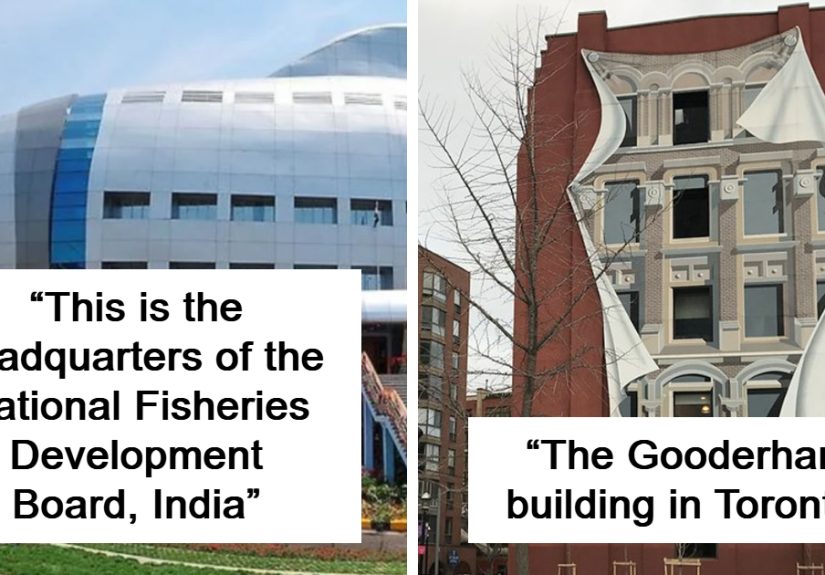
- National Fisheries Development Board Headquarters, Hyderabad, India Yes, it looks like a giant fish. No, you are not seeing things.
- Community Bookshelf, Kansas City, Missouri, United States A parking garage dressed up as a towering row of giant books, which is the correct level of drama for a library.
- WonderWorks, Orlando, Florida, United States An upside-down building that looks as if gravity simply gave up and walked away.
- Piano and Violin House, Huainan, China A glossy black piano with a glass violin attached, as though architecture joined the school orchestra.
- Tianzi Hotel, Langfang, China A hotel shaped like three giant robed figures, because a normal hotel facade was apparently too easy.
- Lotus Temple, New Delhi, India A serene white structure unfolding like a lotus flower, elegant enough to be weird in the best possible way.
- Casa do Penedo, Portugal A house wedged among giant boulders that looks less built than discovered.
- Bubble Palace, France A home made of rounded, bubble-like forms that seems designed by someone who firmly rejected straight lines.
Buildings That Twist, Melt, Lean, Or Seem Slightly Unwell
Some buildings do not mimic objects. Instead, they mess with your eyes. They bend expectations, distort symmetry, and make the whole street feel a little tipsy.
- Krzywy Domek (The Crooked House), Sopot, Poland A warped, fairytale-like facade that looks as though it softened in the sun.
- Dancing House, Prague, Czech Republic Two forms leaning together in motion, like architecture decided to try ballroom.
- Cube Houses, Rotterdam, Netherlands Tilted cube homes perched at angles that make your inner geometry teacher sweat.
- Inntel Hotel Zaandam, Netherlands A stacked collage of green Dutch house forms that looks like a village played Tetris.
- Hundertwasserhaus, Vienna, Austria Uneven floors, bright colors, and joyful rebellion against straight-line seriousness.
- Waldspirale, Darmstadt, Germany A snaking apartment building with a roofline that rolls like a hill after too much espresso.
- Casa Batlló, Barcelona, Spain Bone-like balconies, shimmering color, and a facade that feels gloriously alive.
- La Pedrera (Casa Milà), Barcelona, Spain Rippling stone and surreal rooftop chimneys that look like they are plotting something.
- Mind House, Barcelona, Spain Part sculpture, part building, part visual riddle that keeps your eyes moving.
- Kunsthaus Graz, Austria Nicknamed the “Friendly Alien,” which is exactly what it resembles.
- Selfridges Building, Birmingham, England A curving blue shell covered in metallic discs, like a fashion accessory the size of a department store.
- Habitat 67, Montreal, Canada A housing complex assembled from boxy modules stacked into a futuristic cliff.
- Palais Idéal, Hauterives, France A dreamlike, hand-built palace that feels like imagination hardened into stone.
Futuristic Buildings That Look Like They Landed Here By Accident
Then there are the buildings that appear less “constructed” and more “deployed.” These are the ones that make cities look like concept art for the future.
- Atomium, Brussels, Belgium A giant metallic monument that resembles a molecular model enlarged by someone with terrific confidence.
- Niterói Contemporary Art Museum, Brazil A saucer-like masterpiece floating above the landscape with peak alien elegance.
- Museu Oscar Niemeyer, Curitiba, Brazil Commonly called the Eye Museum, because it looks exactly like a giant watchful eye.
- National Centre for the Performing Arts, Beijing, China A smooth dome rising from water like a silver egg with excellent acoustics.
- Museum of the Future, Dubai, United Arab Emirates A torus-shaped landmark that makes ordinary office blocks look deeply underdressed.
- Aldar Headquarters, Abu Dhabi, United Arab Emirates A circular glass form that looks like a coin standing upright in the desert.
- Burj Al Arab, Dubai, United Arab Emirates A sail-shaped tower so theatrical it practically demands its own entrance music.
- Matrimandir, Auroville, India A golden sphere that feels like a meditation center from another civilization.
- Cathedral of Brasília, Brazil White structural curves reaching skyward like hands, feathers, or a very elegant crown.
- Harpa Concert Hall, Reykjavík, Iceland A faceted glass structure that changes mood with the light like a giant crystal.
- Hallgrímskirkja, Reykjavík, Iceland A church with a towering form that looks carved from frozen sound waves.
- Eden Project, Cornwall, England Massive biomes that resemble giant bubbles parked in a crater.
- Montreal Biosphere, Canada A geodesic sphere that still looks like the future even decades later.
When Architects Turn Cities Into Fantasy Sets
These final picks prove that weird architecture is not always playful. Sometimes it is ambitious, symbolic, slightly absurd, and unforgettable all at once.
- Guggenheim Museum Bilbao, Spain Titanium curves and sculptural swagger turned a museum into a city-defining event.
- Gate Tower Building, Osaka, Japan Famous for the highway passing through it, because compromise took a very literal form.
- Asahi Beer Hall, Tokyo, Japan A sleek black block topped with a golden sculpture that sparks endless debate and zero indifference.
- Fuji Television Building, Tokyo, Japan A giant suspended sphere turns an office complex into full science-fiction mode.
- Mode Gakuen Cocoon Tower, Tokyo, Japan A cocoon-shaped skyscraper proving educational buildings do not have to look sleepy.
- Marina Bay Sands, Singapore Three towers topped by a ship-like sky park, as if the skyline decided to flex.
- Esplanade – Theatres on the Bay, Singapore Famously spiky domes that inspired comparisons to durian fruit almost immediately.
- The Hive, Singapore A stack of rounded learning towers that look like giant concrete baskets or futuristic beehives.
- Raffles City Chongqing, China A mega-complex linked by a horizontal sky bridge, because vertical ambition was not enough.
- Heydar Aliyev Center, Baku, Azerbaijan A sweeping white form that seems to rise from the ground without a single harsh thought.
- Big Idaho Potato Hotel, Idaho, United States A giant potato turned lodging, which is either genius or proof that travel got interesting.
- Robot Building, Bangkok, Thailand A robot-faced office block with giant circular eyes and unapologetic personality.
- Casa Terracota, Villa de Leyva, Colombia A flowing clay house that feels sculpted by hand, whim, and a refusal to be square.
Why Weird Buildings Matter More Than You’d Think
They make cities memorable
A city can have excellent infrastructure, great food, and lovely parks, but one truly strange building can become the image people remember. That is the hidden power of unusual architecture: it gives a place a visual signature. It becomes the postcard, the social post, the “you have to see this in person” recommendation, and the landmark people use when giving directions.
They turn function into storytelling
A library dressed as giant books is not just a building. It is a message. A fish-shaped government office or a basket-shaped headquarters tells people what the building is before they even read a sign. That may sound silly, but it is also smart design. Weird architecture often succeeds because it communicates instantly and emotionally.
They keep architecture from becoming boring
Not every strange building is a masterpiece, and that is fine. The point is not perfection. The point is personality. Cities need experimental, theatrical, and occasionally ridiculous buildings the way wardrobes need one item that says, “Yes, I know this is a choice.” Without them, skylines become spreadsheets.
The Experience Of Seeing Weird Buildings In Real Life
Photos of strange buildings are fun. Seeing them in person is something else entirely. On a screen, a basket-shaped office or an upside-down attraction is a punchline. In real life, it becomes scale, texture, weather, noise, movement, and that odd moment when your brain tries to understand what your eyes are reporting. You do not just look at weird architecture. You physically negotiate it.
That is part of why these places stick with people. The first experience is usually disbelief. You round a corner and there it is: an elephant with windows, a silver dome floating over water, a hotel that seems to be dancing, a house that appears to have melted into a cartoon. For a split second, it feels fake, like a movie set or a digital trick. Then the details kick in. There are doors. There are railings. There is a person inside ordering coffee, checking into a room, or reading a museum brochure. Suddenly the absurd becomes practical, and that contrast is unforgettable.
Weird buildings also change how people behave around them. A normal building gets a glance. A bizarre one creates a small public performance. People stop. They laugh. They point. They take the same photo from six different angles because somehow none of them fully capture what is happening. Families spend ten minutes debating whether a building looks more like a spaceship, a sea creature, or a very expensive kitchen appliance. Even people who claim not to care about architecture somehow end up caring a lot when the architecture looks like a giant dog.
There is also something charming about the emotional range of these places. Some feel playful and goofy, like roadside attractions that grew up and got building permits. Others feel spiritual, dreamlike, or oddly moving. The Lotus Temple, for example, is strange in a quiet way. It does not make you laugh; it makes you slow down. The same goes for some futuristic structures that seem impossible from a distance but surprisingly peaceful up close. Weird does not always mean loud. Sometimes it means unforgettable because it refuses ordinary logic.
Travelers often remember these places more vividly than technically “better” buildings because weird architecture creates stories. Nobody returns from a trip saying, “I saw a perfectly adequate rectangular structure.” But they absolutely come back saying, “I stayed inside a beagle,” or “we ate lunch next to a building with a highway through it,” or “the library parking garage looked like giant books and somehow that made me ridiculously happy.” Those stories are portable. They turn buildings into memories, and memories into recommendations.
In that sense, unusual buildings are not just visual oddities. They are experience machines. They surprise people out of autopilot. They make cities feel less standardized and more human, even when the building itself resembles a robot, a potato, or a fish. And maybe that is their real gift. In a world full of copy-and-paste development, weird buildings remind us that someone, somewhere, once stood in a meeting and said, “Hear me out,” and the world became more interesting because nobody stopped them.
Final Thoughts
The weirdest buildings in the world are not weird by accident. Even the funniest among them reveal something about taste, ambition, branding, spirituality, engineering, or local identity. Some are glamorous. Some are gloriously goofy. Some look like they came from the future, while others look like they escaped from a child’s sketchbook. But all 52 share one gift: they are impossible to forget.
That is what great architecture can do, even when it is strange enough to spark arguments. It can create wonder, attract visitors, define neighborhoods, and make the built world feel far less predictable. So the next time you see a building shaped like a basket, a dog, a fish, or something that appears to be mid-dance, do not dismiss it too quickly. It may be odd. It may be hilarious. It may even be a little ridiculous. But it is also doing something many ordinary buildings never manage making people feel something the second they look at it.