Table of Contents >> Show >> Hide
- What Is a Blue Trojan Sawhorse?
- Why This Sawhorse Design Still Matters
- Key Features of the Blue Trojan Sawhorse
- TS-27 vs. TS-35: Which Height Makes More Sense?
- How to Set Up a Blue Trojan Sawhorse
- Best Uses for the Blue Trojan Sawhorse
- How It Compares With Plastic and Modern Folding Sawhorses
- Buying Tips Before Choosing a Blue Trojan Sawhorse
- Maintenance and Safety Tips
- Common Mistakes to Avoid
- Who Should Use a Blue Trojan Sawhorse?
- Experience Notes: Living With a Blue Trojan Sawhorse in Real Projects
- Conclusion
Note: This article is written for web publishing and synthesizes real product information, workshop-use principles, safety best practices, buyer considerations, and practical experience related to the Blue Trojan Sawhorse without inserting source links.
The Blue Trojan Sawhorse is one of those tools that looks almost too simple to be interestinguntil you actually use it. At first glance, it is not a flashy gadget with laser guides, Bluetooth, or a tiny screen that judges your life choices. It is essentially a pair of blue steel sawhorse legs designed to grip a standard 2x wood crossmember. That is the magic. Instead of forcing you into a fixed-size plastic or metal work support, the Trojan-style sawhorse lets you decide the length, height, and usefulness of your work surface.
For carpenters, remodelers, contractors, DIY homeowners, and garage tinkerers, that flexibility is a big deal. A good sawhorse is not just a place to cut boards. It becomes a temporary workbench, a painting stand, a door-finishing station, a lumber rack, a plywood support, a jobsite helper, and occasionally the one quiet coworker that never complains about holding something heavy. The blue Trojan design has stayed relevant because it solves a very old problem in a refreshingly straightforward way: how do you support material safely, quickly, and without taking up half the shop?
What Is a Blue Trojan Sawhorse?
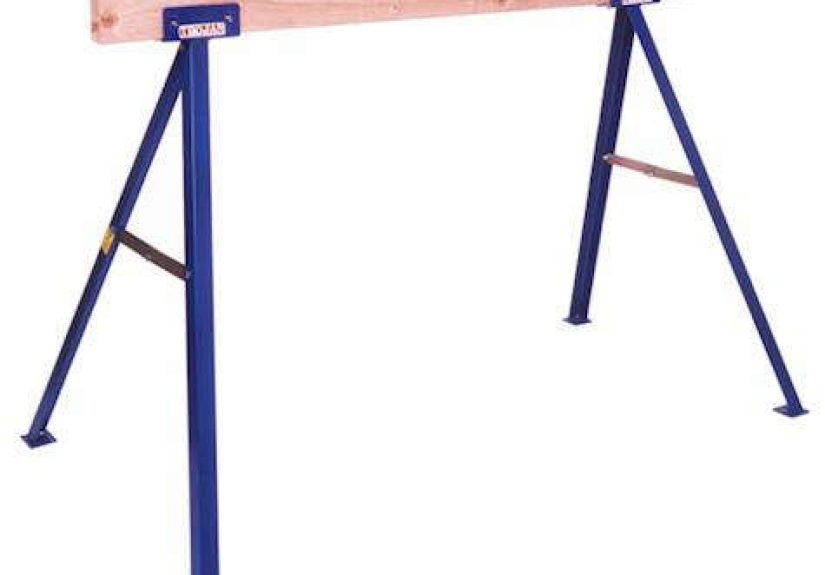
The Blue Trojan Sawhorse generally refers to blue powder-coated Trojan or Guardian-style folding sawhorse legs, commonly associated with models such as the TS-27 and TS-35. These models use rugged steel leg assemblies that clamp onto standard 2x lumber. Once the wood crossmember is seated into the gripping teeth, the sawhorse becomes a sturdy support that can be made as short or as long as the job requires.
Unlike many modern folding sawhorses that come as complete one-piece units, the Trojan design separates the durable metal legs from the replaceable wooden top. That means if the wood gets sliced, drilled, stained, painted, or otherwise abused in the noble service of a project, you do not have to retire the whole sawhorse. You simply replace the board. It is the tool equivalent of wearing an apron: let the cheap, replaceable part take the damage.
The blue finish is more than decoration. Powder coating helps protect the steel from normal wear and corrosion, especially when the tool is moved between garages, job trailers, workshops, and outdoor work areas. The color also makes the legs easy to spot in a crowded shop, which is helpful when your workspace contains fourteen extension cords, three buckets of screws, and one mysteriously missing tape measure.
Why This Sawhorse Design Still Matters
There are plenty of sawhorses on the market today: plastic folding horses, adjustable steel models, clamp-ready stands, compact work supports, and heavy-duty jobsite tables. The Blue Trojan Sawhorse remains interesting because it is built around a low-tech idea that still performs beautifully. It does not try to be everything. It gives you strong steel legs, reliable lumber-gripping teeth, compact folding storage, and the freedom to use your own 2x material.
It Uses Standard Lumber
One of the best features is the ability to use common 2x lumber as the crossmember. A short board can create a compact cutting support for tight spaces. A long board can create an extended support for trim, doors, siding, sheet goods, or long framing members. This makes the Trojan sawhorse especially useful for people who do not want a fixed-width support system.
The Top Is Replaceable
Every real workshop eventually teaches this lesson: the top of a sawhorse is going to get damaged. Circular saw cuts happen. Paint spills happen. Glue drips happen. Someone will absolutely use it as a temporary anvil for something that should not be hammered there. With a Trojan-style sawhorse, that wear is not a tragedy. The wood crossmember is sacrificial, inexpensive, and easy to replace.
It Folds Down for Storage
Space is a luxury in most garages and job trailers. A tool that folds flat earns immediate respect. Blue Trojan sawhorse legs are designed to collapse into a compact shape once removed from the wood crossmember or folded with the setup broken down. For contractors, that makes transport easier. For homeowners, it means you can store serious work supports without turning the garage into a permanent obstacle course.
Key Features of the Blue Trojan Sawhorse
- Blue powder-coated steel construction: Built for durability and visibility in workshop or jobsite conditions.
- Gripping teeth design: The leg assemblies bite into standard 2x lumber without requiring screws or nails for basic setup.
- Folding legs: The legs collapse for easier storage and transportation.
- Custom length: The user controls the width of the sawhorse by choosing the length of the lumber crossmember.
- Replaceable wood top: Cutting into the crossmember is not a disaster because the wood can be swapped out.
- Multiple height options: Common versions include 27-inch and 35-inch models, allowing users to choose a working height that suits the task.
- Jobsite-friendly simplicity: No complicated assembly, no batteries, no app, no drama.
TS-27 vs. TS-35: Which Height Makes More Sense?
The Blue Trojan Sawhorse is often discussed in connection with two popular heights: the 27-inch model and the 35-inch model. Both serve the same basic purpose, but the right choice depends on how you work.
| Model Style | Best For | Main Advantage |
|---|---|---|
| 27-inch sawhorse | Cutting boards, lower work positions, compact shop setups | Stable lower height and easy material handling |
| 35-inch sawhorse | Assembly work, finishing, sanding, taller users, ergonomic work surfaces | More comfortable standing height for many tasks |
A 27-inch setup is great when you want the material lower to the ground, especially for cutting long boards or working with heavy pieces. A 35-inch setup can feel more like a temporary workbench height, reducing the amount of bending required. For people who spend long hours sanding doors, painting trim, assembling frames, or laying out project parts, that extra height can feel like a small vacation for the lower back.
How to Set Up a Blue Trojan Sawhorse
Setup is refreshingly simple. Choose a straight piece of 2x lumber, place the leg assemblies at the desired distance, and seat the board into the gripping teeth. The legs should be positioned evenly so the sawhorse stands square and stable. Before loading materials, press down firmly and check for wobble.
For best results, use clean, solid lumber without major cracks, severe twist, or deep splits. The metal legs may be strong, but the system depends on the wood crossmember as part of the structure. A warped or damaged board can make the sawhorse less stable. Think of the crossmember as the spine of the setup. If the spine looks like a pretzel, do not ask it to do serious work.
When using two sawhorses together, make sure they are aligned and placed on level ground. Spread the load evenly across both supports. Avoid standing on ordinary sawhorses unless the setup is specifically designed and rated for that purpose. A sawhorse is a support tool, not a circus platform, and your knees deserve better than a surprise meeting with gravity.
Best Uses for the Blue Trojan Sawhorse
Cutting Lumber and Sheet Goods
The most obvious use is cutting boards, trim, and sheet materials. Because the top board is replaceable, accidental saw marks are less stressful. You can set up two horses, lay material across them, and make controlled cuts with enough support to keep the workpiece from sagging or pinching the blade.
Painting and Finishing
Two Blue Trojan Sawhorses can support doors, cabinet parts, shelves, shutters, and trim pieces during painting or staining. Add scrap strips on top to reduce contact points, and you have a practical finishing station. The steel legs provide the support, while the wood top can take the occasional paint drip without causing emotional damage.
Temporary Workbench
Add a sturdy plywood sheet across two sawhorses and you have a quick temporary workbench. This is excellent for jobsite layout, small repairs, tool staging, and assembly work. It will not replace a permanent woodworking bench with vises and dog holes, but it will absolutely save the day when you need a flat surface now.
Long Material Support
Because you choose the crossmember length, a Trojan-style sawhorse can support long materials better than many fixed-width models. This is especially helpful for trim carpentry, siding work, deck boards, long shelves, and window or door projects.
How It Compares With Plastic and Modern Folding Sawhorses
Plastic folding sawhorses are lightweight, affordable, and easy to carry. Many homeowners love them for weekend projects. However, plastic models can feel less confidence-inspiring under heavy or awkward loads, and once the top is damaged, repair options are limited.
Modern steel folding sawhorses often include built-in clamps, adjustable legs, carry handles, and high advertised load capacities. These are excellent features for many users. The tradeoff is that more features can mean more moving parts, more bulk, and sometimes more cost. The Blue Trojan Sawhorse takes the opposite route. It is simple, rugged, and adaptable. It does not win the beauty contest by wearing fancy accessories; it wins by showing up in work boots.
The biggest advantage of the Trojan style is customization. You decide the width. You replace the top. You can keep different lengths of 2x lumber ready for different tasks. This makes it especially appealing for users who value flexibility over built-in bells and whistles.
Buying Tips Before Choosing a Blue Trojan Sawhorse
Before buying, consider your typical projects. If you mainly cut small boards in a garage, the 27-inch model may be enough. If you often use sawhorses as a temporary bench or prefer a taller working surface, the 35-inch model may be more comfortable. Also think about transport. If the sawhorses will live in a truck, folding storage and fast setup matter. If they will stay in a home shop, you may care more about height, stability, and how easily they pair with plywood tops.
Check whether the listing includes legs for one sawhorse or a pair. Some Trojan-style products are sold as legs for one complete sawhorse, meaning you may need two sets if you want the classic two-horse setup. That detail matters, unless your plan is to support one end of a board with optimism. Optimism is not a structural material.
Also confirm the model number, height, material, and warranty terms. Look for steel construction, folding capability, and the gripping-tooth system. If you are buying online, read the product description carefully so you know whether lumber is included. In most cases, the user supplies the 2x crossmember separately.
Maintenance and Safety Tips
Maintenance is minimal, but it matters. Keep the steel legs clean and dry when possible. If the powder coating gets scratched, monitor the exposed area for rust, especially if the tool is stored in a damp trailer or shed. Check the welds, hinges, and gripping teeth before heavy use. Replace the wood crossmember when it becomes badly cut, split, warped, or weakened.
Safety starts with setup. Place the sawhorse on firm, level ground. Keep the legs fully opened and properly seated. Do not overload the system beyond what the product and your lumber can reasonably handle. Remember that the wood crossmember is part of the load path, so cheap, cracked, or damaged lumber can reduce performance.
If you use sawhorses to create a platform, be extra cautious. Ordinary sawhorses are not automatically scaffolds. Elevated work platforms must meet appropriate safety requirements, including proper support, secure planking, fall protection where required, and stable access. For everyday DIY use, the simplest rule is this: use the sawhorse to support the work, not your body.
Common Mistakes to Avoid
- Using twisted lumber: A warped crossmember can make the sawhorse unstable.
- Forgetting to check the grip: Always confirm that the teeth are properly seated in the wood.
- Assuming one set means two horses: Read the product listing carefully.
- Cutting without support: Long material should be supported on both sides of the cut when practical.
- Standing on the sawhorse: Unless the system is specifically rated for that use, do not treat it like a platform.
- Keeping damaged top boards too long: Replace crossmembers once they become structurally questionable.
Who Should Use a Blue Trojan Sawhorse?
The Blue Trojan Sawhorse is ideal for people who value practical, durable, and customizable tools. Contractors may appreciate the compact folding design and the ability to create long supports on-site. Woodworkers may like the replaceable sacrificial top. Remodelers can use it for doors, trim, cabinets, and general material handling. DIY homeowners can turn a pair into a weekend workbench without needing a permanent shop setup.
It may not be the best choice for someone who wants a complete ready-to-use sawhorse with built-in clamps, shelves, measuring marks, and adjustable telescoping legs. But for users who like simple tools that can take abuse and adapt to different jobs, the Trojan design makes a lot of sense.
Experience Notes: Living With a Blue Trojan Sawhorse in Real Projects
The first thing you notice when working with a Blue Trojan Sawhorse is that it does not feel precious. Some tools make you nervous the first time they get scratched. This one practically says, “Relax, I came here to work.” That attitude is useful in a real shop, where projects rarely unfold like a clean catalog photo. Boards are dusty, paint cans tip slightly, sawdust collects in corners, and every flat surface eventually becomes a temporary storage shelf.
In practical use, the ability to choose the length of the 2x crossmember is the feature that keeps proving its worth. For a small repair, a short crossmember makes a compact support that fits in a crowded garage. For a bigger project, such as trimming a door or painting long baseboards, a longer board creates a wide support area that feels much more useful than a narrow fixed sawhorse. This flexibility is especially helpful when switching between jobs during the same day. One minute you are cutting short blocking pieces; the next you need to support an eight-foot board without balancing it like a restaurant tray.
The replaceable top also changes how you work. With some finished metal or plastic sawhorses, you hesitate before making a cut near the support because damaging the surface feels permanent. With the Trojan setup, the wood top is meant to take punishment. Saw kerfs, screw holes, glue spots, and paint marks become part of the board’s resume. When it gets too chewed up, you replace it and move on. There is something satisfying about a tool that does not demand delicate treatment.
Another real-world benefit is storage. Many garages suffer from what might politely be called “horizontal surface disease,” where every table, shelf, and bench becomes covered with random objects. Folding sawhorse legs help because they do not require a permanent footprint. Break down the setup, lean the lumber against a wall, fold the legs, and the workspace returns to normal. Well, normal-ish. The mystery pile of extension cords is still your responsibility.
The main learning curve is choosing good lumber. A straight, solid 2x board makes the sawhorse feel stable and dependable. A twisted or cracked board makes the whole setup feel less trustworthy. After a few uses, most people naturally keep a couple of dedicated crossmembers around: one clean board for assembly or finishing work, and one battle-scarred board for cutting. That simple habit makes the sawhorse more versatile and keeps projects cleaner.
Overall, the Blue Trojan Sawhorse feels like a tool built around common sense. It is not trying to impress you with complicated features. It focuses on strength, simplicity, portability, and replaceable work surfaces. In a world where some tools seem designed by people who have never swept sawdust off a garage floor, that simplicity is refreshing.
Conclusion
The Blue Trojan Sawhorse proves that a great workshop tool does not need to be complicated. Its blue steel legs, gripping-tooth design, folding storage, and standard-lumber compatibility make it a smart choice for anyone who needs flexible support for cutting, sanding, painting, assembling, or general jobsite work. The ability to customize the crossmember length gives it an advantage over many fixed-size sawhorses, while the replaceable wood top makes everyday damage easy to manage.
For professionals, it is a compact and durable support system. For DIYers, it is a practical upgrade from wobbly makeshift setups. For anyone who has ever tried to cut a board while balancing it on a trash can, it is a very polite intervention. Choose the right height, use straight lumber, set it up carefully, and the Blue Trojan Sawhorse can become one of the most useful work supports in your shop.