Table of Contents >> Show >> Hide
- Introduction: Springfield’s Smallest Hearts, Biggest Lessons
- Why Crushes Matter in The Simpsons
- Bart Simpson’s Crushes: Chaos Wearing a Hoodie
- Lisa Simpson’s Crushes: Brainy, Big-Hearted, and Occasionally Doomed
- Bart vs. Lisa: Two Very Different Crush Patterns
- What These Crushes Reveal About Bart
- What These Crushes Reveal About Lisa
- Experience-Based Reflections: Why These Crushes Still Feel Real
- Conclusion: Springfield’s Most Awkward Love Lessons
Note: This article is written for web publication in standard American English and is based on real episode information from The Simpsons, official listings, episode guides, cast records, and long-running fan/critic documentation.
Introduction: Springfield’s Smallest Hearts, Biggest Lessons
Bart and Lisa Simpson may be permanently stuck at ages 10 and 8, but their crushes have somehow collected more emotional baggage than most people’s checked luggage. Across decades of The Simpsons, the two Simpson kids have fallen for rebels, musicians, overachievers, bad influences, future spouses, and the occasional person who seems designed by the writers to make Milhouse sweat through his glasses.
What makes Bart and Lisa Simpson’s crushes so memorable is not just the romance angle. In fact, the show usually treats young love less like a fairy tale and more like a comedy lab experiment: add one confused child, one wildly unsuitable love interest, a dash of Springfield chaos, and wait for the emotional explosion. Bart’s crushes often reveal his softer side hiding underneath the slingshot and prank calls. Lisa’s crushes, meanwhile, usually test her ideals, intelligence, and desire to be understood by someone who can keep up with her brain without asking if jazz is a type of cereal.
From Bart’s doomed admiration for Laura Powers to Lisa’s unforgettable crush on Nelson Muntz, these storylines give The Simpsons a surprisingly human pulse. They are funny, awkward, occasionally sweet, and often painfully accurate about how crushes work: you rarely fall for the person who makes sense. You fall for the person who makes your internal narrator scream, “Oh no, this is going to be a whole episode.”
Why Crushes Matter in The Simpsons
The Simpsons is famous for satire, absurd jokes, and Homer somehow surviving injuries that would defeat a cartoon rhinoceros. But the show has lasted so long because it occasionally pauses the chaos and lets its characters feel something real. Bart and Lisa’s crushes are perfect examples. They are small stories with big character value.
For Bart, a crush often becomes a test of identity. Is he truly a rebel, or does he just enjoy the brand? Can he care about someone without turning the entire situation into a prank? Does he want affection, attention, status, or simply someone who thinks his chaos is charming? The answer changes depending on the episode, because Bart’s emotional maturity is about as stable as Springfield Elementary’s budget.
For Lisa, crushes are usually about connection. She wants someone who sees her as more than the smart girl, more than the saxophone kid, more than the family’s tiny moral compass. Her romantic storylines often ask whether she should compromise her values for affection. Spoiler: Lisa may bend, but she rarely breaks. She is Springfield’s smallest philosopher, and even her crushes come with footnotes.
Bart Simpson’s Crushes: Chaos Wearing a Hoodie
Laura Powers: Bart’s First Big Heartbreak
One of Bart’s earliest and most recognizable crushes is Laura Powers in “New Kid on the Block.” Laura is older, cool, confident, and everything Bart imagines he wants in a girl. Unfortunately for him, she sees him more like a mischievous little neighbor than a romantic possibility. Even worse, she is interested in Jimbo Jones, a bully with the emotional range of a wet cardboard box.
What makes Laura important is that she gives Bart his first real taste of jealousy. Bart is used to getting attention through jokes, pranks, and disruption. Laura does not fall for the routine. She likes Bart, but not in the way he wants. That distinction hits him hard. His plan to expose Jimbo as less tough than he appears is funny, but underneath the joke is a surprisingly relatable feeling: the frustration of realizing you cannot prank someone into liking you.
Jessica Lovejoy: When Bart Met His Match
Jessica Lovejoy, Reverend Lovejoy’s daughter, is one of Bart’s most famous crushes for one simple reason: she is worse than he is. In “Bart’s Girlfriend,” Jessica appears sweet, polite, and church-approved. Bart is instantly fascinated. Then he discovers that behind the angelic surface is a troublemaker who makes him look like a substitute hall monitor.
This crush works because it flips Bart’s usual role. He is normally the bad influence. With Jessica, he becomes the cautious one. That is comedy gold. Bart falls for the idea of someone who understands mischief, but he quickly learns there is a difference between playful rebellion and selfish cruelty. When Jessica frames him for stealing church collection money, Bart experiences the rare horror of being morally outclassed in the wrong direction.
Jessica remains memorable because she exposes Bart’s limits. He likes trouble, but he still has a conscience. He wants to be seen as cool and dangerous, but not truly harmful. In other words, Bart wants the leather jacket without the criminal record.
Greta Wolfcastle: The Girl Bart Didn’t Appreciate Until Too Late
Greta Wolfcastle, daughter of action star Rainier Wolfcastle, enters Bart’s life in “The Bart Wants What It Wants.” At first, Bart enjoys the perks of knowing her: celebrity access, fancy treatment, and the kind of lifestyle that makes a kid from Evergreen Terrace feel like he has hacked reality. Greta likes Bart sincerely, but Bart is too distracted by the benefits to notice her feelings properly.
The twist is classic Bart: once he loses Greta, he realizes he actually cares. By then, Greta has moved on to Milhouse, which is basically Springfield’s version of romantic karma arriving in flood pants. Bart’s jealousy sends him into competitive mode, but Greta ultimately refuses to be treated like a prize. That makes the episode sharper than a simple love triangle.
Greta’s story shows Bart learning, briefly and painfully, that attention is not affection. He cannot just coast on charm. Sometimes the person who likes you will stop waiting around once they realize you are treating their feelings like a free arcade token.
Darcy: Bart Plays Grown-Up and Gets a Reality Check
In “Little Big Girl,” Bart receives a driver’s license after an accidental act of heroism and ends up meeting Darcy, an older girl from out of town. This storyline pushes Bart into a fantasy version of maturity. He can drive, he can travel, and for once he appears more grown-up than he actually is. Naturally, Springfield responds by turning the situation into a full emotional circus.
Darcy is significant because she represents the danger of pretending to be older than you are. Bart likes the freedom and attention, but he is still a child trying on adult responsibilities like a suit three sizes too large. The episode uses humor to show that rushing into grown-up situations does not magically make someone ready for them.
Unlike Jessica or Greta, Darcy is less about Bart being outsmarted and more about Bart being outpaced. He discovers that real life has complications that cannot be solved with a catchphrase. For Bart Simpson, that is practically a horror movie.
Jenny: Bart Tries to Be Good
Jenny from “The Good, the Sad and the Drugly” brings out Bart’s desire to be better. She is charitable, kind, and impressed by goodness, which creates a small problem because Bart’s resume includes vandalism, lying, and treating detention like an extracurricular activity.
To win Jenny over, Bart pretends to be more virtuous than he is. The comedy comes from watching him attempt decency with the concentration of a raccoon trying to defuse a bomb. But the episode also makes a real point: changing for a crush is not the same as changing for yourself.
Jenny likes the version of Bart he performs, not the full truth of who he has been. When the truth comes out, the relationship falls apart. Still, the crush matters because it proves Bart is not allergic to goodness. He can admire it. He can imitate it. He may even want it. He just needs to stop using romance as a costume party for his conscience.
Nikki McKenna: Mixed Signals and Modern Schoolyard Confusion
Nikki McKenna in “Stealing First Base” gives Bart one of his more confusing crush experiences. Nikki alternates between affection and rejection, leaving Bart unsure where he stands. The episode plays with mixed signals, school gossip, and the awkwardness of trying to understand another person’s boundaries when everyone involved is still learning how feelings work.
What makes Nikki’s storyline interesting is that it does not let Bart simply be the charming rebel. He has to deal with consequences, confusion, and the fact that liking someone does not give him permission to decide how the relationship should go. For a character who often acts first and thinks sometime next season, that is a useful lesson.
Lisa Simpson’s Crushes: Brainy, Big-Hearted, and Occasionally Doomed
Nelson Muntz: The Classic Opposites-Attract Crush
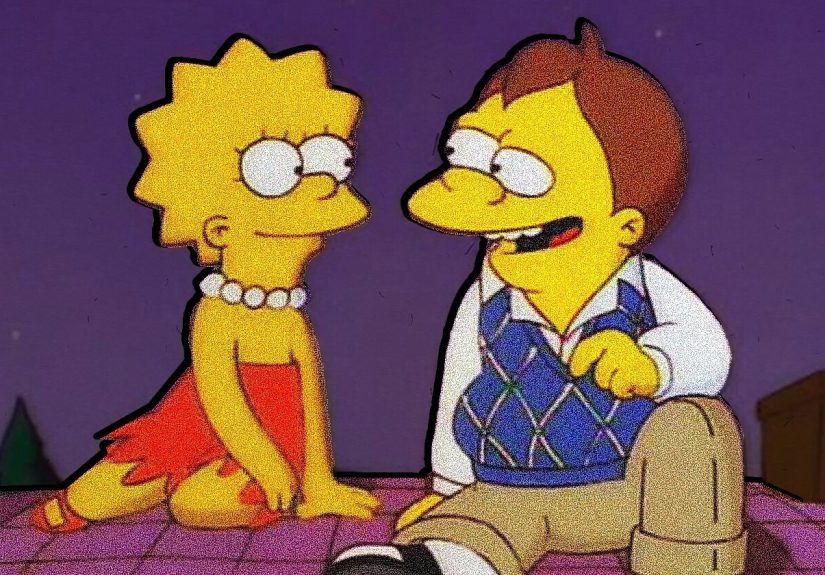
Lisa’s crush on Nelson Muntz in “Lisa’s Date with Density” is one of the show’s best young-love stories. On paper, it makes no sense. Lisa is thoughtful, bookish, sensitive, and ambitious. Nelson is a bully whose laugh has probably caused more emotional damage than most villains’ monologues. Yet the episode makes the attraction believable.
Lisa sees something vulnerable in Nelson. She senses that beneath the “haw-haw” is a lonely kid with pain, pride, and a defensive shell. Her mistake is believing that affection can reform him on schedule, like a school project with a due date. Nelson does show flashes of tenderness, but he remains Nelson. Lisa eventually realizes she cannot turn someone into her ideal version of them just because she cares.
This crush is powerful because it respects both characters. Nelson is not magically fixed, and Lisa is not mocked for caring. Instead, the episode shows the bittersweet truth that seeing good in someone does not mean you are responsible for saving them.
Milhouse Van Houten: The Eternal Maybe
Milhouse’s crush on Lisa is one of the longest-running emotional subplots in The Simpsons. Lisa does not usually return his feelings in the main timeline, but future episodes often experiment with the possibility of them ending up together. Sometimes it is sweet. Sometimes it looks like Lisa settled during a very dark week. Either way, Milhouse remains part of her romantic orbit.
Milhouse represents comfort, loyalty, and persistence, though the show wisely does not frame persistence as automatically deserving reward. Lisa often cares about him, but caring is not the same as romantic interest. That difference is important. The running joke works because Milhouse keeps hoping, but the better episodes understand that Lisa has the right to choose her own path.
In future-set stories like “Holidays of Future Passed,” Lisa and Milhouse are imagined as married with a daughter. These glimpses are not always consistent, but they reveal how the show uses future timelines as emotional “what if” machines. With Lisa and Milhouse, the question is never just “Will they?” It is “What would Lisa become if she chose safety over spark?”
Hugh Parkfield: Lisa’s Future Ideal Meets the Simpson Family
“Lisa’s Wedding” introduces Hugh Parkfield, a polished British student Lisa meets in a possible future. Hugh seems like the perfect match: intelligent, cultured, and sophisticated. He fits the version of Lisa who imagines herself escaping Springfield’s chaos and becoming the kind of adult who owns matching luggage and knows which fork is for fish.
But Hugh’s flaw is enormous: he cannot accept Lisa’s family. That creates the episode’s emotional core. Lisa may be embarrassed by Homer, frustrated by Bart, and exhausted by Springfield, but she loves where she comes from. Hugh wants Lisa without the Simpsons attached, which is like wanting Krusty Burger without regret. It misses the full experience.
Hugh’s storyline shows that Lisa’s ideal partner cannot simply admire her intelligence. He has to respect her roots, even the loud, donut-scented parts. Lisa choosing family over a perfect-looking future remains one of her strongest character moments.
Colin: Lisa’s Environmental Soulmate
In The Simpsons Movie, Lisa meets Colin, an Irish boy who shares her concern for the environment and plays music. For Lisa, this is basically romantic lightning in a reusable bottle. Colin understands her activism, supports her interests, and does not treat her intelligence as a weird hobby.
Colin is refreshing because he is one of Lisa’s healthiest crushes. Their connection is built on shared values rather than Lisa trying to fix someone or prove herself. He likes the things that matter to her. He listens. He participates. In the world of Springfield, that practically makes him a unicorn with a compost bin.
Although Colin does not become a long-running character, he remains memorable because he gives Lisa a glimpse of what mutual respect looks like. Sometimes the best crush is not the most dramatic one. Sometimes it is the person who shows up, plays along, and agrees that saving the planet is cooler than pretending not to care.
Brendan Beiderbecke: Jazz, Jealousy, and La La Land Energy
In “Haw-Haw Land,” Lisa falls for Brendan Beiderbecke, a talented young jazz pianist. The episode plays with musical romance and rivalry, especially as Nelson becomes jealous. Brendan appeals to Lisa’s artistic side. He is musical, confident, and cultured in a way that speaks directly to her saxophone-loving soul.
Brendan’s role is interesting because he competes with Nelson not through toughness but through talent. Lisa is caught between two very different kinds of attraction: the familiar emotional complexity of Nelson and the shiny appeal of someone who shares her artistic language. It is less a simple love triangle than a tiny jazz concert inside Lisa’s decision-making process.
The episode also shows how Lisa’s crushes often connect to her identity. She is drawn to people who reflect a possible version of herself: activist, artist, scholar, outsider, or future success story. Brendan represents the musical dreamer. Nelson represents emotional mystery. Milhouse represents loyalty. Hugh represents ambition. Colin represents values. Lisa’s heart is basically a debate club with a sax solo.
Bart vs. Lisa: Two Very Different Crush Patterns
Bart and Lisa approach crushes in opposite ways. Bart usually falls into attraction through excitement. He likes danger, novelty, status, or the thrill of someone unexpected. Laura is cool. Jessica is forbidden trouble. Greta gives him access to celebrity life. Darcy lets him feel older. Jenny makes him imagine being better. Nikki keeps him guessing.
Lisa, by contrast, is drawn to meaning. Nelson fascinates her because he seems wounded beneath the bully act. Hugh represents an elegant future. Colin shares her environmental mission. Brendan connects with her through music. Even Milhouse, in future timelines, represents the complicated comfort of being adored by someone who has always been nearby.
The comedy comes from how both kids misread love in age-appropriate ways. Bart confuses attention with connection. Lisa sometimes confuses potential with reality. Bart has to learn that people are not trophies. Lisa has to learn that people are not improvement projects. Together, their crushes form a surprisingly smart map of growing up.
What These Crushes Reveal About Bart
Bart’s crushes reveal that he is more emotionally sensitive than he wants anyone to know. His bad-boy act is loud, but his feelings are often fragile. When Laura likes Jimbo, Bart feels replaced. When Jessica betrays him, he is genuinely hurt. When Greta moves on, he panics. When Jenny rejects him, he learns that pretending to be good is not enough.
The best Bart crush episodes work because they puncture his confidence. They remind us that behind the prank calls and chalkboard punishments is a kid who wants to be liked for more than chaos. Bart does not always know how to express affection, but he does feel it. He just tends to express it through schemes, jealousy, and decisions that would make a guidance counselor stare silently at a wall.
What These Crushes Reveal About Lisa
Lisa’s crushes show her hunger for recognition. She wants someone who understands her intelligence, her ideals, and her emotional depth. Because she often feels isolated in her family and school, a crush can become a symbol of escape. Nelson offers emotional mystery. Hugh offers a refined future. Colin offers shared purpose. Brendan offers artistic connection.
But Lisa’s stories also protect her independence. She may be romantic, but she is rarely foolish for long. When Nelson cannot become the person she hopes for, she steps away. When Hugh rejects her family, she chooses her roots. Lisa’s crushes may challenge her, but they usually end by making her more herself, not less.
Experience-Based Reflections: Why These Crushes Still Feel Real
The funniest thing about Bart and Lisa Simpson’s crushes is how familiar they feel, even when the details are pure cartoon madness. Most viewers have never exposed a bully through a prank call to Moe’s Tavern, dated a movie star’s daughter, or met a jazz prodigy at a STEM conference. But many people understand the emotional patterns underneath. The crush on someone older. The crush on someone “bad” who seems secretly soft. The crush on someone who shares your favorite music, cause, hobby, or weird little obsession. The crush that makes you act like a totally different person because apparently your normal personality has been temporarily replaced by a committee of nervous squirrels.
Bart’s experiences are especially relatable for anyone who has tried to look cooler than they felt. He often wants to impress people by exaggerating the traits he thinks make him attractive: confidence, rebellion, fearlessness, humor. But his crushes reveal the gap between image and honesty. In real life, that gap is where a lot of awkward growing up happens. People pretend to like bands they have never heard of. They laugh at jokes they do not understand. They suddenly become “experts” in skateboarding, poetry, environmental policy, or whatever the crush of the week happens to enjoy. Bart’s attempts are funnier because they are animated, but the insecurity behind them is very human.
Lisa’s experiences connect with a different kind of viewer: the person who wants to be understood deeply. Lisa does not just want someone cute to like her. She wants someone who sees the world the way she does, or at least respects the way she sees it. That is why Colin and Brendan stand out. They connect with her interests. That is also why Nelson matters. He does not match her world, but he makes her curious. Many people have had a Nelson-style crush: someone who makes absolutely no sense on paper but somehow occupies the brain like an unpaid tenant.
These stories also capture the embarrassment of early feelings. Crushes can make smart people act silly and silly people act Shakespearean. Lisa, who can debate ethics and play jazz, still gets flustered. Bart, who can disrupt an entire school day before breakfast, still gets hurt. That mix is why the episodes work. They refuse to treat children’s emotions as meaningless. The feelings are young, but they are not fake.
From a viewer’s perspective, Bart and Lisa’s crushes also make Springfield feel bigger. Every love interest brings out a different corner of the town and a different version of the kids. Laura brings neighborhood jealousy. Jessica brings church gossip. Greta brings celebrity culture. Jenny brings moral performance. Nelson brings class and vulnerability. Colin brings activism. Brendan brings music. Hugh brings the future. Each crush acts like a mirror, reflecting what Bart and Lisa want at that moment and what they still need to learn.
The biggest experience-based takeaway is simple: crushes are rarely just about the other person. They are often about who we are trying to become. Bart wants to be cool, loved, and occasionally decent. Lisa wants to be seen, challenged, and respected. Their crushes may not last, but the lessons do. And because this is The Simpsons, those lessons arrive with jokes, chaos, and at least one adult making the situation worse.
Conclusion: Springfield’s Most Awkward Love Lessons
Bart and Lisa Simpson’s crushes remain memorable because they combine comedy with emotional truth. Bart’s romantic misadventures reveal the vulnerable kid behind the prankster mask. Lisa’s crushes reveal a young idealist searching for connection in a town that often misunderstands her. Together, their stories show that early crushes can be ridiculous, embarrassing, and surprisingly meaningful all at once.
Whether it is Bart learning that Jessica Lovejoy is too much trouble even for him, Lisa discovering she cannot reform Nelson Muntz with good intentions, or Colin giving Lisa a rare example of shared values, these episodes add depth to two of television’s most iconic kids. The crushes may come and go, but the character insights stick around. In Springfield, growing up is optional. Learning from heartbreak, however, sneaks in anyway.