Table of Contents >> Show >> Hide
- What Is Artillery Fungus (a.k.a. Shotgun Fungus)?
- Why It Shows Up: The Perfect Storm in Your Mulch Bed
- Identification: How to Tell Artillery Fungus from “Random Black Specks”
- The Biology (Without the Boring Parts)
- Damage and Risk: Ugly, Sticky, but Not a Biohazard
- Removal: What Actually Works (and What Just Makes You Tired)
- Prevention: How to Stop the “Mulch Sniper” Before It Fires
- Myth-Busting (Because the Internet Has Ideas)
- Quick Action Plan Checklist
- Real-World Experiences: What Homeowners Actually Run Into (and What Helps)
- Conclusion
- SEO Tags
If you’ve ever walked outside, admired your home, and then noticed your siding looks like it lost a
fight with a pepper shaker… congratulations (and condolences): you may have met artillery fungus.
It’s tiny, sneaky, andyesdramatic. This fungus doesn’t just release spores. It launches them like
microscopic cannonballs at whatever looks brightest and cleanest. Because of course it does.[1]
This guide will help you identify artillery fungus (also called shotgun fungus),
understand why it shows up, andmost importantlylearn how to prevent it from redecorating your home
with stubborn black specks.[2]
What Is Artillery Fungus (a.k.a. Shotgun Fungus)?
Artillery fungus is most commonly associated with species in the genus Sphaerobolus
(often cited as Sphaerobolus stellatus). It’s a wood-decaying fungus that helps break down
organic material like mulch, wood chips, and sometimes even animal dung.[3]
The good news: it’s not considered harmful to people, pets, or living plants. The bad news: it’s a
professional-grade nuisance that can stick to siding, windows, cars, soffits, downspouts, and any surface
that dares to look light-colored and respectable.[3]
Why It Shows Up: The Perfect Storm in Your Mulch Bed
1) It loves cool, wet “shoulder-season” weather
Artillery fungus tends to be most active during cool, wet conditionsespecially in spring and fall.
Some references note fruiting bodies aren’t produced above roughly 77–78°F, which helps explain why the
issue spikes when the weather is mild rather than scorching.[4]
2) It grows where wood breaks down
Hardwood mulch and wood chips can be an inviting buffet. The fungus may be easier to spot in mulch beds
that stay damp from shade, frequent irrigation, or heavy rainfall.[5]
3) It aims at light (seriously)
Here’s the part that sounds made up, but isn’t: the spore “shots” are phototropicthey launch toward
light and reflective surfaces. Translation: bright siding, shiny windows, and light-colored cars are basically
bullseyes.[6]
Identification: How to Tell Artillery Fungus from “Random Black Specks”
What the spots look like
The classic sign is tiny black or dark brown specks that look like tar flecks or pepper grains. They’re
often described around 1–2 mm and may be slightly raised. If scraped, some sources describe a gummy,
lighter-colored interior under a darker outer coat.[7]
Where the spots show up
- Low siding near foundation beds (especially close to mulch)
- Windows and trim facing the mulched area
- Cars parked near mulch beds (bonus points if the car is white)
- Downspouts/soffits and anything that catches the “spray”
A quick “is it artillery fungus?” checklist
- Do you have wood-based mulch (especially shredded hardwood) nearby?[5]
- Do the dots cluster on light/reflective surfaces facing the mulch?[6]
- Do they feel stuck like glue rather than sitting loosely on the surface?[5]
- Did the issue flare up in spring or fall?[4]
Common look-alikes (so you don’t blame the wrong suspect)
These spots are often mistaken for tar, scale insects, or insect droppings/frass.
If you’ve been losing your mind trying to identify the culprit, you’re in good companymany homeowners do at first.[7]
The Biology (Without the Boring Parts)
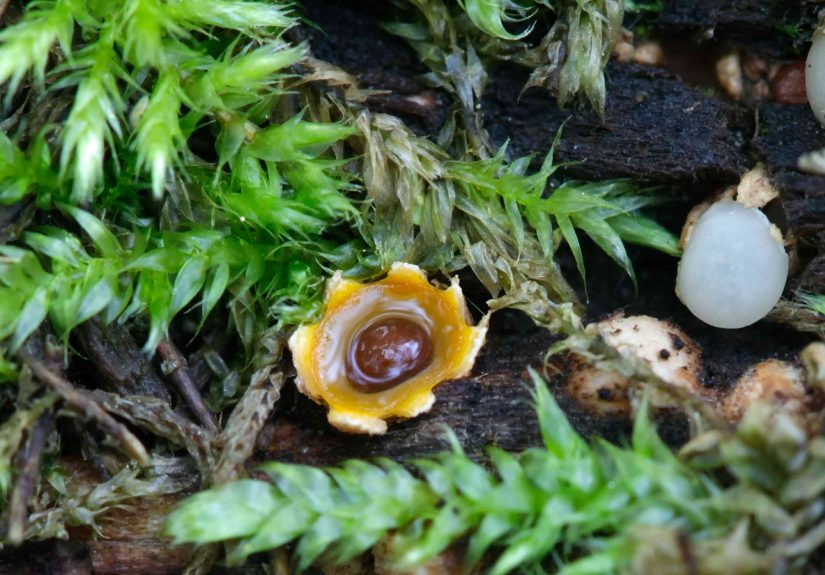
Tiny cups + one sticky “egg” = trouble
The fungus forms very small, cup-like fruiting bodies in mulch. Inside sits a dark spore mass (often called a
peridiole or glebal mass). When conditions are right, internal pressure builds and the spore mass
gets catapulted outward.[6]
How far can it shoot?
Reports commonly cite launches reaching about 20 feet horizontally (and several feet vertically), which
is why the problem can show up on siding well beyond the edge of a mulch bed.[6]
Why removal is so hard
The spore mass is coated in a sticky material that helps it adhere on impact. Once it dries, it can become
extremely difficult to remove without damaging the surface underneath.[5]
Damage and Risk: Ugly, Sticky, but Not a Biohazard
Is it dangerous?
Artillery fungus is generally considered a nuisance rather than a health threat. It’s a decomposer, not a
disease organism attacking your home’s structure or your landscaping plants.[3]
What it can damage
The real damage is cosmeticand occasionally financial. Spores can etch or stain surfaces and may be
particularly frustrating on porous materials or delicate finishes. Homeowners also report issues on vehicles,
where removal can be time-consuming and sometimes requires professional detailing.[1]
Removal: What Actually Works (and What Just Makes You Tired)
First, the reality check: there’s no magical “spray and forget” solution. Many university/extension resources
emphasize that prevention is the best strategy, because removal can be painstaking and stains may remain.[5]
Rule #1: Act fast
If you catch the spots earlybefore they fully cure and bake onto the surfaceyou’ll have a better chance
of removing the spore mass and minimizing staining.[5]
Surface-by-surface approach (practical, not magical)
Vinyl siding
- Try warm soapy water and gentle scrubbing first.
- If needed, carefully use a plastic scraper on the raised spore mass.
- Avoid aggressive abrasives that can dull vinyl.
Painted wood / trim
- Gently scrape off the spore mass (test in an inconspicuous spot first).
- Be cautious: scraping can lift paint; sanding may be required in some cases (follow by repainting).
Glass (windows)
- A razor scraper can work on glass, used carefully at the proper angle.
- Remove spores in a way that doesn’t flick them back into the mulch bed.
Brick, stucco, concrete
- These surfaces can stain and can be difficult; gentle methods may not fully restore appearance.
- Power washing can help, but high pressure can also cause damageuse caution.
Cars
- Wash promptly if you notice fresh spots.
- If bonded to paint, consult a professional detailer (clay/polish methods may be needed).
- Don’t go full sandpaper-mode on your clear coat.
Disposal: don’t boomerang spores back into the problem
Spores/peridioles have been reported to remain viable for many years, so don’t casually scrape them onto the
ground near the mulch bed and call it a day. Bag debris and dispose of it appropriately.[6]
Prevention: How to Stop the “Mulch Sniper” Before It Fires
1) Rethink your mulch (yes, really)
Many resources point to wood-based mulchesespecially shredded hardwoodas a common source. If you’ve
had artillery fungus, consider switching to mulches that are less supportive of the fungus, such as
large pine bark nuggets or other large-nugget bark mulches that stay drier and break down more slowly.[8]
Another prevention option is to skip organic mulch near the house and use stone/gravel (or other
inorganic ground covers) in foundation beds, which won’t support fungal growth the same way.[9]
2) Don’t mulch too deepand keep it maintained
Thick, wet layers can create a cozy zone for decomposers. Aim for a sensible mulch depth (often around a few
inches for landscaping), and avoid piling mulch against the foundation. Disturbing/raking mulch can also help
reduce surface fungal activity in some cases.[10]
3) Adjust irrigation and moisture
Foundation plantings that get frequent irrigation can keep mulch damp. Water plants, not the mulch blanket.
If the bed stays wet and shaded, it’s more likely to become a fungal launchpad during cool seasons.[5]
4) Consider “competitive biology” (mushroom compost blend)
Some extension guidance cites research suggesting that blending fresh mushroom compost into landscape
mulch (reported at 40% or more) may help suppress artillery fungus, potentially by shifting the microbial
community in the bed.[11]
5) Create distance and barriers where possible
Because spores can travel up to about 20 feet, simply edging the bed isn’t a guarantee. But you can still
reduce risk by:
- Keeping mulch beds as far from siding as practical
- Using a gravel strip closest to the house, with organic mulch farther out
- Installing/maintaining downspout extensions to keep the bed from becoming a wet zone
Myth-Busting (Because the Internet Has Ideas)
“Can I just spray a fungicide?”
Multiple sources note that fungicides are not a reliable or evaluated solution for homeowners, and some
references emphasize that no fungicides are registered specifically for control of this problem in the
landscape context. Translation: don’t count on chemicals to solve what is mostly a habitat issue.[9]
“If I add a fresh layer of mulch, will that fix it?”
Adding a new layer can sometimes act as a temporary barrier, and some guidance suggests yearly additions may
lessen the problem if old mulch is fully covered. But if the environment stays favorable, the issue can return.
Think of it as “buying time,” not “winning.”[10]
“Winter kills it, right?”
Cold can reduce activity, but spores can persist. If you’ve had artillery fungus before, plan prevention for the
next cool, wet season instead of assuming the problem is gone forever.[1]
Quick Action Plan Checklist
- Confirm it’s artillery fungus (mulch nearby + sticky black specks + spring/fall pattern).[7]
- Remove fresh spots quickly using gentle methods appropriate to the surface.
- Replace or modify mulch: switch to large bark nuggets or use stone/gravel near the foundation.[8]
- Reduce moisture: adjust irrigation, improve drainage, avoid overwatering foundation beds.[5]
- Consider mushroom compost blending in known problem beds.[11]
Real-World Experiences: What Homeowners Actually Run Into (and What Helps)
Let’s talk about the part that doesn’t show up in quick tips: the lived experience of artillery fungus is
basically a three-act play.
Act I: Confusion. A homeowner notices dots. The dots are on the vinyl siding, but also on the downspout,
and somehowmysteriouslyon the kid’s outdoor toy that hasn’t moved since last summer. The first theories are
always dramatic: “Is this tar? Did the roof do this? Are bugs… pooping on my house?” (Bless.)
Extension resources specifically mention that people commonly misidentify these spots as tar, scale insects, or
insect frass, which tracks with what happens in the real world: you spend a weekend diagnosing the wrong enemy.[7]
Act II: The Cleaning Olympics. Once you learn the dots are sticky spore masses, you try to clean them.
One-by-one. With the focus of a brain surgeon and the patience of a saint who has also had coffee.
The fresh ones sometimes come off with soap and water and a scrub brush, especially if you catch them early.
The older ones? They’ve essentially moved in, changed the locks, and started receiving mail. Many folks discover
that even if the raised spore pops off, a faint stain can remainespecially on porous or textured surfaces.[5]
The most frustrating moment is realizing the fungus isn’t “growing” on the sidingit fired at the siding from the
mulch bed. So you can scrub all you want, but if the bed is still a spore-launching platform, you’re cleaning a
symptom while the cause keeps reloading.
Act III: The Mulch Reckoning. This is where most success stories live. Homeowners who get lasting relief
usually do some version of the same thing: they change the habitat. That might mean removing the suspect mulch
and replacing it with large bark nuggets (which research and extension guidance frequently describe as more
suppressive), or creating a stone/gravel zone near the foundation so there’s less “launch material” close to the
target.[8]
People also learn to think like moisture detectives. Does the downspout dump into the bed? Is the sprinkler
soaking the mulch daily like it’s training for a swimming competition? Is the north side of the house staying damp
and cool for long stretches? These are the conditions that help artillery fungus thrive in many regions, which is why
adjusting irrigation and drainage can make a noticeable difference over time.[5]
One of the more interesting “real homeowner” strategies that appears in extension guidance is blending in
mushroom compost in known problem beds. The idea isn’t that mushroom compost is a magical antidoteit’s that it
may change the microbial neighborhood enough to make artillery fungus less dominant. Homeowners who try this
often describe it as a “soil improvement” move that also happens to reduce the spore problem, especially when
paired with switching away from shredded hardwood.[11]
Finally, there’s the emotional lesson: artillery fungus is small, but it’s persistent. If you treat it like a one-time
cleaning project, it wins by attrition. If you treat it like a landscape design and maintenance issuemulch choice,
moisture control, and thoughtful bed layoutyou can dramatically reduce future “spatter seasons.” And the best part?
Your house gets to go back to being beige in peace, instead of beige with confetti.
Conclusion
Artillery fungus is the ultimate tiny troublemaker: harmless in a biological sense, but wildly irritating in real life.
The fastest path to sanity is a two-part strategy: remove what you can from affected surfaces (gently and
promptly), and prevent the next round by changing the mulch habitatespecially near foundations.
Choose less fungus-friendly mulches (like large bark nuggets), manage moisture, and consider inorganic borders or
mushroom compost blending in problem beds. Do that, and you’ll turn your home from a target back into a home.