Table of Contents >> Show >> Hide
- Why Ariana Grande’s New Look Hit So Hard
- The Hair Transformation Was Not Random
- Why the Tattoos Became Part of the Headline
- Grande’s Best Transformations Work Because They Feel Controlled, Not Chaotic
- What This Says About Ariana Grande’s Current Era
- The Fan Reaction Makes Perfect Sense
- The Experience of Watching an Ariana Grande Transformation in Real Time
- Conclusion
Few celebrities can cause a full-blown internet fashion emergency with a single post quite like Ariana Grande. One minute, the timeline is minding its business. The next, fans are zooming into selfies, debating hair color undertones like licensed colorists, and asking the eternal celebrity-beauty question: “Wait, are those tattoos new, or did we all just forget she has that much ink?” That is exactly the kind of pop-culture chaos Grande’s latest transformation triggered.
Her new look did not just turn heads because it was pretty. Plenty of stars are pretty. Grande’s makeover landed because it felt like a plot twist. After spending years visually tied to her Glinda era through soft blonde shades, polished updos, and an ultra-romantic aesthetic, she started stepping back into darker hair, more visible body art, and a mood that felt less fairy godmother and more artist-in-transition. Fans noticed immediately. Of course they did. This is Ariana Grande, where even a ponytail can trend like breaking news.
What makes this moment so fascinating is that it is not simply about a haircut or a color appointment. It is about image evolution. It is about a star who has spent the last few years balancing blockbuster movie prestige, pop-star mythology, beauty-brand influence, and a fan base that can detect a vibe shift from three pixels and a caption. The tattoos matter. The hair matters. But the bigger story is what the combination suggests: Ariana Grande is no longer presenting one fixed version of herself. She is playing with character, memory, mood, and identity all at once.
Why Ariana Grande’s New Look Hit So Hard
There is a reason this transformation sparked so much conversation. Grande’s appearance has always been closely tied to specific chapters of her career. The high ponytail became a signature. The red hair years are still burned into the memory of anyone who watched her Nickelodeon era. Her platinum-to-soft-blonde Glinda period created a dreamy, almost storybook visual identity that felt distinct from earlier versions of Ariana. So when she starts moving away from that look, fans do not see a casual beauty refresh. They see an era ending and another one sneaking through the side door in expensive lighting.
That is what happened here. Her darker hair immediately read as symbolic. It felt like a move away from the polished Glinda image and toward something more grounded, richer, and maybe even more personal. The tattoos added another layer. Grande has long had a large collection of tattoos, but their visibility has fluctuated so much that fans often react to them as though they are brand-new characters entering the storyline halfway through the season.
That contrast is what made the moment pop. Soft yet dramatic. Familiar yet fresh. Delicate but not overly safe. She looked like herself, but not the same version of herself fans had been seeing lately. In celebrity branding terms, that is gold. In internet terms, that is “open the comments immediately.”
The Hair Transformation Was Not Random
From Glinda Blonde to Darker Tones
Grande’s hair evolution has been building for a while. After living in the blonde universe associated with Wicked, she gradually started shifting into warmer and darker shades. Instead of one dramatic snap from platinum fantasy to deep brunette reality, the transition felt layered. That is partly why fans were so interested: it looked intentional, not impulsive. The color changes moved through softer auburn, ginger, honey-brown, and brunette territory like chapters in a visual diary.
That kind of gradual shift matters. Hair color on a celebrity is rarely just hair color. It is signaling. A colder blonde can feel ethereal and untouchable. A warmer brunette can feel more intimate, more lived-in, and more emotionally direct. Grande’s updated look seemed to split the difference between performance and authenticity. She still looked polished, but less costume-coded. Less “I am permanently in character.” More “I am choosing exactly how much of myself to reveal.”
And that is why the reaction was so strong. Fans are not only watching for beauty trends. They are reading visual cues like detectives in a sequined trench coat. Darker hair suggested a tonal shift. It implied movement. It hinted that Grande’s current aesthetic is less about preserving one iconic image and more about letting several versions of herself coexist.
Hair as Storytelling, Not Decoration
One of the smartest things about Grande’s image lately is that it feels story-driven. Her beauty choices no longer look like isolated glam decisions. They look tied to artistic worlds. During the Glinda-heavy stretch, her styling leaned soft, rosy, luminous, and almost porcelain. With the newer hair transformations, the visual language changed. Warmer brunette and auburn shades felt moodier. More cinematic. More adult. More like a woman stepping out of one fantasy and into another.
That is especially interesting because Grande’s recent public image has stretched across multiple lanes at once. She is not just a singer. She is not just an actor. She is not just the face behind a beauty brand. She is all three, and each version of her comes with its own visual grammar. Hair becomes a bridge between those identities. The blonde can belong to Glinda. The curls can belong to home. The darker tones can belong to an artist moving between personas without fully surrendering to any single one.
Honestly, it is clever. Also a little unfair to the rest of us, because most people change shampoo and call it reinvention.
Why the Tattoos Became Part of the Headline
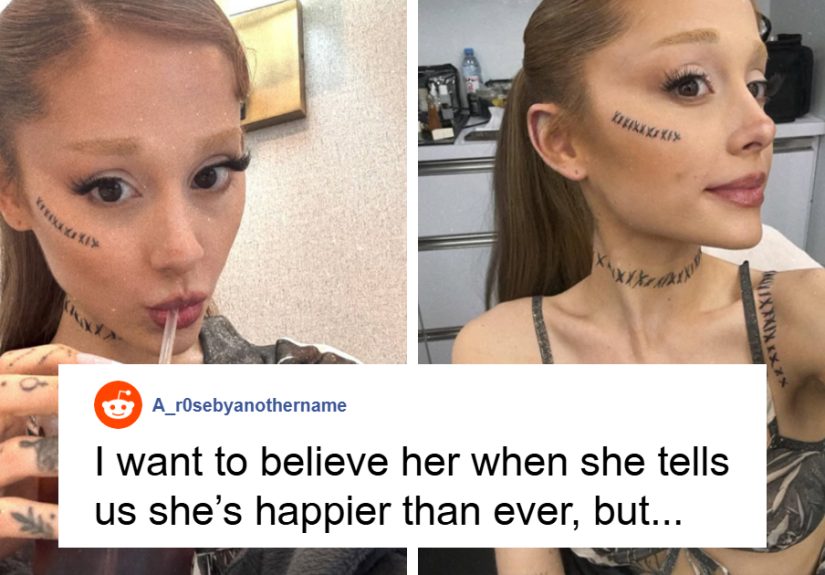
Grande’s tattoos have become one of those recurring fan fascinations that never fully disappears. She has a large collection, many of them small, sentimental, and easy to miss unless the lighting, pose, or outfit makes them obvious. Over time, fans have also noticed that some tattoos appear more visible in certain moments and nearly invisible in others. That inconsistency has fueled endless online theories, especially around tattoos that seemed faded, covered, or selectively concealed during high-profile appearances.
So when Grande debuts a fresh hair transformation and her tattoos appear especially noticeable, the internet predictably loses its collective mind. But the fascination is not only about whether the ink is new. It is about what visible tattoos communicate in contrast to a controlled public image. Tattoos read as personal. Intimate. A little less polished in the old-school Hollywood sense, even when they are beautifully done. When paired with darker hair, they can make a celebrity seem more grounded, more emotionally legible, and slightly more rebellious without doing anything overtly chaotic.
In Grande’s case, the tattoo conversation is also wrapped up in performance. Some of her ink has been covered for character work. Some pieces have looked more faded over time. Some tattoos are directly tied to personal history, artistic milestones, or close relationships. Even her matching “For Good” tattoo with Cynthia Erivo added a new emotional layer to the way fans read her body art. The ink is not random decoration. It is part scrapbook, part symbolism, part style language.
That is why the tattoo visibility mattered in this moment. The hair might have sparked the first double-take, but the tattoos deepened the reaction. Together, they created a look that felt less doll-like and more dimensional.
Grande’s Best Transformations Work Because They Feel Controlled, Not Chaotic
One reason Ariana Grande remains such a compelling style figure is that her transformations are rarely messy in the branding sense. Even when a look surprises people, it still feels curated. There is a difference between a celebrity seeming lost in reinvention and a celebrity guiding the audience through it. Grande almost always lands in the second category.
This transformation is a good example. The darker hair did not erase the softness people associate with her. The tattoos did not suddenly turn her into an edgy anti-glam rebel. Instead, the whole presentation felt balanced. Feminine, but sharper. Elegant, but less precious. Personal, but still highly image-aware. That balance is hard to pull off. On many public figures, it can look like a costume change. On Grande, it reads like continuity with better lighting and stronger subtext.
It helps that her public persona has matured in ways that support this kind of beauty shift. She has moved into a period where fans are just as interested in her artistic choices as they are in the old pop-star spectacle. Her work around Wicked, her visual storytelling tied to Eternal Sunshine and Brighter Days Ahead, and her quieter but still deliberate image choices all point to someone thinking in full narrative arcs. The hair and tattoos become part of that larger narrative machine.
What This Says About Ariana Grande’s Current Era
If the blonde Glinda period emphasized fantasy, refinement, and transformation through character, this newer look suggests something else: re-entry. Re-entry into herself, maybe. Re-entry into an Ariana who is not disappearing into one role or one aesthetic. The recent glimpses of brunette tones and natural curls reinforce that reading. They bring back a version of Grande that feels more rooted in her real texture, her real coloring, and the identity that exists outside a film costume or red-carpet concept.
That does not mean she is abandoning glamour. Absolutely not. Grande is still one of the most detail-oriented celebrity beauty presences in the game. But the emotional temperature seems to be changing. The newer looks feel warmer, less porcelain, more human. Fans respond to that because people are always hungry for authenticity, or at least the feeling of authenticity. In celebrity culture, that feeling can matter as much as fact.
It also helps that Grande understands visual nostalgia. A darker ponytail can remind longtime fans of earlier music eras. Natural curls can trigger affection because they feel rare and unguarded. Visible tattoos can create the sense that the audience is seeing something more honest, even if the overall presentation is still carefully styled. She knows which details activate memory. She knows which beauty choices make fans say, “Oh, we are back,” even when “back” is actually a brand-new version of the story.
The Fan Reaction Makes Perfect Sense
Fans did not respond so intensely because they were bored. They responded because Grande’s look told several stories at once. The hair suggested change. The tattoos suggested intimacy. The styling suggested confidence. And the overall mood suggested that this was not a random pit stop between press appearances but a meaningful pivot in how she wants to be seen.
That is what the best celebrity transformations do. They give the audience something to decode. Not in a manipulative way, but in a way that rewards attention. Grande’s audience has always been highly visual and deeply online. They track eras through screenshots, glam details, and tiny recurring motifs. So a new hair tone is never just a new hair tone. It is a thesis statement with lip gloss.
And that thesis seems pretty clear right now: Ariana Grande is embracing a more layered visual identity. Less one-note. Less locked into a single role. More willing to let softness coexist with symbolism, and polish coexist with ink. It is elegant, strategic, and just dramatic enough to keep the internet functioning exactly as intended: by overanalyzing everything and loving every second of it.
The Experience of Watching an Ariana Grande Transformation in Real Time
Part of what makes an Ariana Grande transformation so fun is that it never feels like a simple before-and-after. It feels like watching a mood board come alive in public. Fans do not just see a photo and move on. They start connecting dots. They remember old eras. They compare the new shade to the ponytail years, the Sweetener years, the thank u, next years, the Glinda years. They notice whether the brows are softer, whether the makeup feels lighter, whether the hair is more polished or more relaxed. It becomes less like celebrity gossip and more like collective cultural pattern recognition.
There is also something strangely emotional about seeing tattoos become more visible at the same time as the hair changes. Hair can feel performative. Tattoos often feel permanent. So when the two are presented together, fans read the contrast almost instinctively. The hair says, “I am changing.” The tattoos say, “I have history.” That combination hits harder than either detail on its own. It creates the impression of movement without erasing the past.
That is why these moments tend to spread so quickly online. People are not only reacting to beauty. They are reacting to the feeling that they are witnessing a person return to herself, or at least step closer to a version of herself that feels less role-bound. Even fans who could not explain color theory if their Wi-Fi depended on it can feel when a look is emotionally resonant. They know when a transformation looks cosmetic, and they know when it looks meaningful.
With Grande, there is also the long history of scarcity. She does not constantly show every side of herself in the same way. Her natural curls are rare enough to feel special. Some tattoos are visible one month and harder to spot the next. Certain glam choices become associated with specific projects, and then vanish. That scarcity makes each reveal feel more valuable. The audience is not exhausted by overexposure. They are energized by selective access.
There is a broader celebrity lesson in that. The stars who stay interesting are not always the ones changing the most dramatically. They are often the ones who understand pacing. Grande knows how to leave just enough room for interpretation. She does not need to announce every shift with a giant neon sign that says NEW ERA AHEAD. Sometimes all it takes is darker hair, visible ink, and one image that feels slightly different from the one before it. The audience does the rest.
And maybe that is the deepest reason these moments stick. Watching a celebrity transformation can be shallow fun, sure, but it can also mirror something personal. Most people know what it feels like to want a haircut after a major chapter ends. Most people understand the urge to dress differently when they are growing into a new version of themselves. Most people have had a period where they wanted to look a little less like who everyone expected and a little more like who they actually felt they were becoming. Grande’s transformations land because, underneath the luxury glam and internet frenzy, that emotion is familiar.
So yes, the photos are glamorous. Yes, the reactions are dramatic. Yes, the comments section behaves like it has seen the face of God every time the ponytail changes altitude. But beneath all that is a very human reason people care: change is compelling when it looks intentional, and identity is magnetic when it is revealed in pieces. Ariana Grande understands that better than most, and this latest look proves she is still one of pop culture’s most effective visual storytellers.
Conclusion
Ariana Grande’s latest beauty moment worked because it delivered more than a fresh hairstyle. It offered a full visual argument. The darker hair suggested transition. The tattoo-forward look suggested history, emotion, and a little mystery. Together, they created the kind of image fans cannot scroll past without opening three tabs and a group chat.
More importantly, the transformation showed that Grande is entering a phase where she does not need one fixed signature to remain instantly recognizable. She can be soft without being fragile, glamorous without being predictable, and nostalgic without repeating herself. That is a rare trick in celebrity culture. And it is exactly why this look felt less like a temporary beauty headline and more like the next chapter of Ariana Grande’s evolving visual legacy.