Table of Contents >> Show >> Hide
- Who Is Propeller Z Architektur?
- Why an Architect Visit Here Feels Different
- Project Stop One: FLAG in Fahndorf
- Project Stop Two: PLAK in Vienna
- Project Stop Three: Weingut Claus Preisinger in Gols
- Project Stop Four: Heinrich and Weninger
- Beyond Houses and Wineries
- What Architects Can Learn from a Visit
- Conclusion: Austria Through the Lens of Propeller Z
- Extended Experience: What a Visit to Propeller Z in Austria Feels Like
If you like your architecture loud, shiny, and desperate to be photographed from a drone, Propeller Z Architektur may gently suggest you take a calming walk. The Vienna-based studio works in a different register. Its buildings do not shout over the landscape; they tighten, frame, carve, hover, and occasionally smirk. That makes an architect visit to Propeller Z in Austria especially rewarding. You are not touring a portfolio of ego objects. You are touring a body of work that treats site, use, climate, and material as active participants in the design process.
That attitude matters in Austria, where architecture often has to negotiate with steep ground, old building stock, agricultural traditions, vineyard economies, and a public that can spot fake “rustic charm” from a mile away. Propeller Z’s answer is neither nostalgia nor flashy futurism. Instead, the firm tends to create what might be called disciplined tension: old and new, heavy and light, concrete and wood, enclosure and view, production and pleasure. The result is architecture that feels precise without becoming cold and contemporary without losing its common sense.
Founded in 1994 and based in Vienna, Propeller Z has worked across architecture, interiors, and exhibition design. That range shows. Even in its residential and winery projects, there is an exhibition-maker’s instinct for sequencing, framing, and orchestrating movement. You do not just enter these buildings; you are edited through them. Views arrive on cue. Thresholds do real work. Materials are spare but never boring. The studio’s conceptual approach is grounded in constraints and function, which sounds dry on paper but turns out to be surprisingly lively in built form. In other words, this is architecture that can solve problems and still keep its eyebrows interesting.
Who Is Propeller Z Architektur?
Propeller Z’s identity has long been tied to collaboration and a calm, interdisciplinary way of working. Rather than chasing one signature shape and stamping it across every project like a mildly aggressive autograph, the firm adapts its language to context. That does not mean the work lacks personality. It means the personality comes from judgment. The studio is especially good at deciding what a project should emphasize and what it should leave quiet. In an era when too many buildings want to become social media influencers, that restraint feels almost rebellious.
The current official profile highlights partners Philipp Tschofen, Carmen Wiederin, and Korkut Akkalay, and describes a conceptual architecture shaped through productive engagement with real-world constraints and functional demands. That phrase gets to the heart of why a visit to Propeller Z’s work is so instructive. The concept is not pasted on afterward like decorative icing. It grows out of circulation, topography, climate, program, and construction logic. You can feel that in the work. Nothing seems arbitrary. Even the dramatic moves have a reason for being there.
Why an Architect Visit Here Feels Different
Visiting Propeller Z projects in Austria reveals a studio deeply interested in relationships rather than isolated objects. The relationship between an old farmhouse and a new living volume. The relationship between winemaking and gravity. The relationship between a narrow hillside plot and stacked living space. The relationship between storage, production, tasting, and landscape. This is architecture that rarely treats the building as a self-contained sculpture. Instead, it behaves more like an instrument tuned to its surroundings.
That is why many of the studio’s most memorable projects are not gigantic civic landmarks but houses, wineries, and working buildings. These are types that demand seriousness. They have budgets, schedules, mess, weather, and human habits to deal with. They are not theoretical. Yet Propeller Z finds room for delight inside that realism. A terrace appears exactly where the body wants it. A tasting room becomes a lookout. A stacked wood wall doubles as insulation. A single V-shaped column creates shelter and drama at once. Good architecture, it turns out, does not need jazz hands. It just needs excellent timing.
Project Stop One: FLAG in Fahndorf
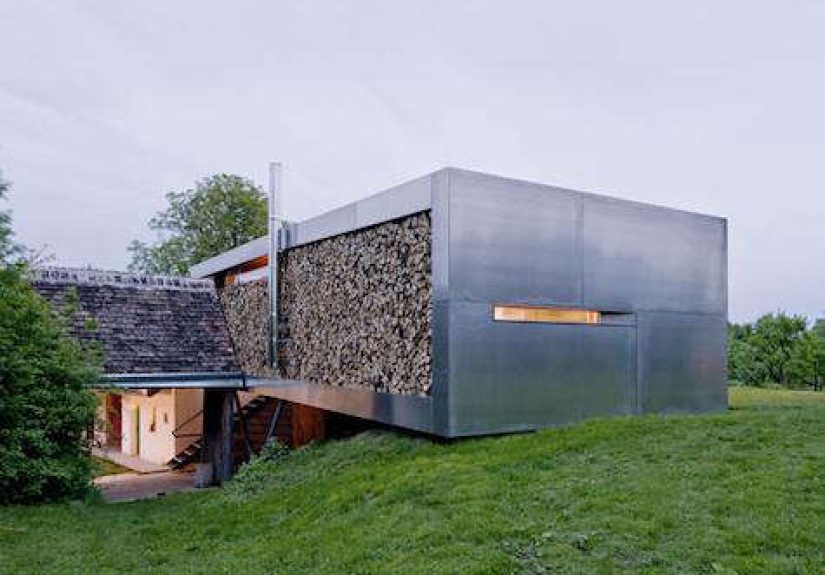
If there is one project that neatly introduces Propeller Z’s skill set, it is FLAG, the addition to a roughly 200-year-old farmhouse in Fahndorf. The project expanded a modest rural complex organized around a courtyard, with living spaces on one side and barn and stable functions on the other. The existing building had traditional logic and protective enclosure, but very little relationship to the sloping landscape around it. Propeller Z’s intervention corrected that without flattening the old structure’s character.
The new volume slips into the roof geometry almost like a precise architectural interruption. Crucially, it establishes contact with the old building without simply swallowing it whole. The addition opens toward the south and east with generous glazing while remaining largely closed to the west and north. One corner is lifted on a V-shaped steel support, creating sheltered space below and giving the new piece an almost hovering quality. That move is elegant, but it is also practical. This is classic Propeller Z: solve the problem, then let the solution become spatially memorable.
Materials do a lot of heavy lifting here. Warm wood lines the ceiling and entry platform. Floors are exposed concrete. Insulation includes recycled newspaper, and the stacked wood on the north elevation is not just a photogenic flourish for design blogs to swoon over; it improves insulation while reinterpreting local farmhouse traditions. The effect is both intelligent and slightly cheeky. Yes, it looks great. No, it is not merely showing off. FLAG remains one of the clearest examples of how the studio can modernize rural architecture without turning it into a generic glass box dropped into the countryside like a confused spaceship.
Project Stop Two: PLAK in Vienna
From rural adaptation to urban hillside living, PLAK shows another side of the practice. Located on a narrow, steep site in Vienna’s western edge, the house takes the constraints of the plot and turns them into spatial opportunity. Rather than fighting the terrain, the design stacks levels vertically and raises the primary living areas to capture better light and views. In other words, the slope writes the script, and Propeller Z directs the performance.
The building rises above neighboring structures with light cladding and large areas of glass, but it is not merely transparent for transparency’s sake. The openings are carefully positioned to create framed views, turning the city into a series of deliberate compositions instead of one big visual dump. Terraces, balconies, and sliding facades extend the living spaces outward exactly where they make sense. One balcony projects from the kitchen like a drawer pulled open for breakfast. Elsewhere, interior sight lines connect rooms and levels in ways that make the house feel taller, deeper, and more porous than its footprint suggests.
The material palette is disciplined: dark oak, white walls, exposed concrete ceilings, and dark gray window profiles. Daylight is treated as a design material, not a happy accident, and the house integrates geothermal heating and cooling through the floor system. This matters because PLAK is not just a clever object on a difficult site. It is a livable machine for seeing, cooling, warming, moving, and pausing. Plenty of houses look smart in photographs. Fewer feel smart in section. PLAK does.
Project Stop Three: Weingut Claus Preisinger in Gols
To understand Propeller Z in Austria, you have to talk about the wineries. The firm’s work in and around Gols and the Neusiedler See region places it in the wider story of Austria’s winery boom, where architecture became a serious part of wine culture, tourism, and identity. But Propeller Z’s winery projects avoid the trap of becoming oversized wine trophies. They remain grounded in production.
The Claus Preisinger winery is a standout. Built outside the village on Goldberg hill, the project reflects both the client’s expanding international reputation and a desire to connect more directly with the vineyard landscape. The building is conceived as a long, self-assured form in concrete and larch wood, shaped by topography and workflow. Production, barrel care, storage, office functions, and tasting are organized with unusual clarity. At one end, the tasting room opens out to broad views over the Neusiedler See and toward Schneeberg, giving the project a quietly ceremonial finish. After the work of making wine comes the architecture of looking.
Structurally, the project combines reinforced concrete with a timber hall, creating a compelling dialogue between mass and lightness. It was recognized with the Austrian Bauherrenpreis in 2010, and it deserves that attention because it shows how agricultural architecture can be rigorous, efficient, and poetic at the same time. The building does not romanticize winemaking. It respects it enough to organize it well. That may be the most flattering thing architecture can do for any craft.
Project Stop Four: Heinrich and Weninger
The Gernot and Heike Heinrich winery expands this conversation in a different direction. Here, Propeller Z responded to a rapidly growing family vineyard operation with a large, carefully considered economic building. A broad wooden shell spans over the vehicle hall and bottle storage, while additional cellar levels connect to the existing press house. The project reflects the Heinrichs’ biodynamic approach to agriculture by pursuing a construction strategy that is simple, efficient, recyclable, and materially direct. It avoids the obvious eco-aesthetic clichés and instead builds environmental thinking into the logic of assembly and use.
Then there is the Weninger winery in Balf, just south of the Neusiedler See. This project makes gravity the quiet hero. Grapes are brought into tanks and fermentation stands without pumps, protecting skins and preserving key qualities in the wine. The hillside site makes that production principle spatially possible. Intake and preparation happen at the upper side, the hall supports flexible work processes, and a raised office and tasting box looks both into the production space and out toward the lake landscape. This is one of the clearest cases in which Propeller Z turns an operational method into an architectural diagram. The building is not merely where winemaking happens. It is shaped by how winemaking happens.
Beyond Houses and Wineries
It would be a mistake to think Propeller Z only excels when dealing with rural houses and vineyards. The office has also worked in exhibition and commercial settings, including the M.O.O.CON home.base office conversion in Vienna and competition work associated with the Technical Museum Vienna. These projects reinforce an important point: the studio’s real specialty may be spatial choreography. Whether the program involves living, working, tasting, or viewing, Propeller Z knows how to organize movement so that it feels intuitive rather than bossy.
That museum and exhibition instinct adds richness to the residential and winery work. A hallway becomes an approach rather than dead space. A stair becomes a pause point. A window becomes an event. Architecture students are often taught to think in plan, elevation, and section, which is useful and necessary. Propeller Z reminds us to think in episodes. What do you see first? What stays hidden? When does the view open up? Where does heavy material turn suddenly light? These are questions the studio answers with enviable confidence.
What Architects Can Learn from a Visit
An architect visit to Propeller Z in Austria leaves you with several useful lessons. First, context does not mean imitation. FLAG respects the farmhouse typology without pretending the twenty-first century never happened. Second, sustainability works best when it is embedded in the building’s logic rather than pasted on as virtue signage. Third, good detailing is not fussy detailing. Propeller Z often uses a limited material palette, but the transitions are crisp enough to make the whole building feel exact.
Most importantly, the studio proves that conceptual architecture does not have to become abstract or aloof. These buildings remain attached to life. They store barrels, frame breakfasts, cool rooms, shelter work yards, guide visitors, and open outward at just the right moment. That practical intelligence is what gives the work its lasting elegance. Not spectacle. Not slogans. Just an unusually sharp sense of what each project needs to become itself.
Conclusion: Austria Through the Lens of Propeller Z
To visit Propeller Z Architektur in Austria, even through its published projects and documented spaces, is to encounter a practice that makes a persuasive case for precision, restraint, and architectural nerve. The firm’s work feels unmistakably contemporary, yet it rarely chases novelty for its own sake. Instead, it asks better questions: What does the land want? What does the workflow demand? What deserves to remain? What should be opened, lifted, stacked, framed, or left alone?
That is why the projects stay with you. They are not trying to win a shouting match with history or landscape. They are negotiating with both, and doing it with real skill. In the best Propeller Z work, Austria is not just the setting. It is the co-author. And that may be the highest compliment an architect visit can offer.
Extended Experience: What a Visit to Propeller Z in Austria Feels Like
The most striking thing about following Propeller Z’s work across Austria is how quickly you stop looking for a “signature move” and start paying attention to atmosphere. At first, you think you are hunting for forms: the hovering corner, the long winery bar, the stacked levels on a steep site. Then the visit shifts. You begin to notice how the projects handle arrival. In Fahndorf, the courtyard still carries the memory of agricultural routine, and the new intervention does not erase that rhythm. It sharpens it. You move from enclosure to openness with a small jolt of surprise, as if the building has been waiting for exactly the right second to reveal the orchard and the light beyond.
In Vienna, PLAK feels different. The experience is more urban, more vertical, more cinematic. The climb through the house creates a sequence of release points. A carefully placed opening catches the city. A terrace suddenly expands the room. A long horizontal window turns the skyline into a deliberate strip of information rather than background noise. The house teaches you that a steep site is not necessarily a problem to hide; it can be a machine for editing perspective. You do not just occupy space. You collect vantage points.
The winery projects change the mood again. In Gols and around the Neusiedler See region, Propeller Z’s architecture feels tuned to labor and landscape in equal measure. You sense the seriousness of production first: trucks, tanks, barrels, work zones, protected areas, flows of fruit and people. But then another layer appears. A tasting room lands at the end of the sequence like a well-timed exhale. Concrete carries weight without feeling brutal. Timber softens the industrial edge without becoming quaint. You understand, almost physically, that these buildings are not trying to romanticize agriculture. They are honoring it by making it work better.
What stays with you after a longer look is the confidence of the restraint. There are no unnecessary acrobatics. No decorative panic. No sense that the building is trying to impress you before you have even stepped inside. Propeller Z trusts proportion, placement, and construction. That can sound modest, but the emotional effect is not modest at all. It is deeply satisfying. You feel guided without being controlled. You feel the site more clearly because the architecture is not fighting it. And you leave with the slightly annoying realization that the smartest buildings often look obvious only after someone talented has already solved them.