Table of Contents >> Show >> Hide
- Why the Double-Slit Experiment Still Messes With Us (In the Best Way)
- The Hidden Boss of Quantum Mechanics: The Born Rule
- The “Third-Order Interference” Idea: A Sneaky Way to Test If Quantum Mechanics Is Missing Something
- A Modern Twist on a Classic: When Double-Slit Meets “Non-Classical Paths”
- So Where Does a “Theory of Everything” Actually Enter the Story?
- Modern Experiments That Keep Pushing the Double-Slit Boundary
- What Would Count as a Breakthrough (and What Would Just Be “Better Engineering”)?
- Conclusion: The Most Boring Outcome Might Be the Most Useful
If physics had a greatest-hits album, the double-slit experiment would be track oneright next to “Gravity: The Remix.”
It’s the iconic physics experiment that turns confident adults into philosophical toddlers: “Wait… the particle goes through both slits… unless I look… then it doesn’t?”
And here’s the twist: that confusion isn’t just a quirky party trick. Some physicists argue that the double-slit experimentdone with modern precision and a few clever upgradescould help expose the weak seams in quantum mechanics and point the way toward quantum gravity… the missing ingredient in any true theory of everything.
That’s a bold claim, so let’s unpack it carefully (and with minimal existential dread). We’ll start with what the double-slit really proves, then zoom into the “Born rule” that quietly runs the whole quantum show, and finally explore why tiny anomalies in interference patterns might be the breadcrumbs leading to a deeper, unified theory.
Why the Double-Slit Experiment Still Messes With Us (In the Best Way)
From 1801 to “one particle at a time”
The classic setup is simple: a source fires light or particles at a barrier with two narrow openings (the slits), and a screen catches whatever comes through.
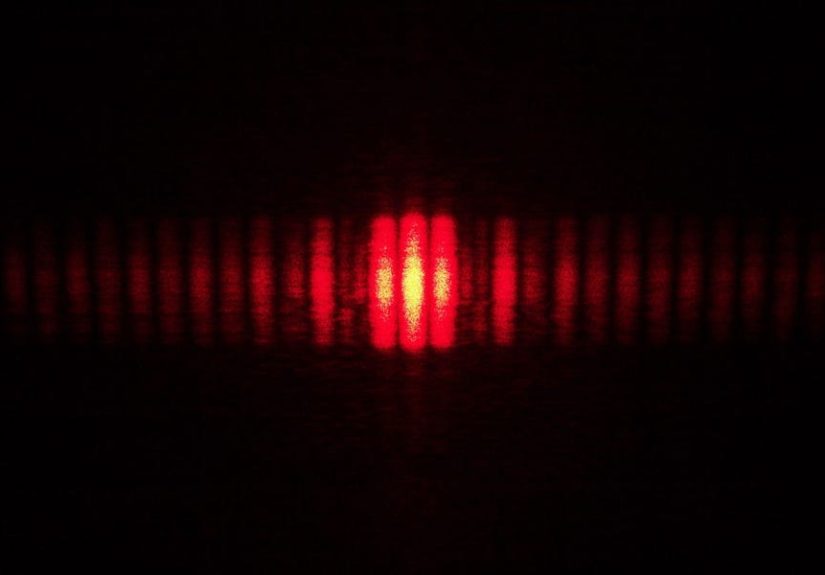
If waves go through, you expect an interference patternbright and dark bands from peaks and troughs overlapping.
If tiny particles go through, you expect two neat piles behind the slits, like paintballs obeying common sense.
Quantum physics, of course, says: “Why not both, and also neither, and also please lie down for a moment.”
Send particles through one at a timephotons, electrons, atoms, even increasingly large moleculesand the screen eventually builds up the same wave-like interference pattern.
Each detection is a single dot (particle-like), but the overall distribution follows a wave-like probability pattern.
It’s wave-particle duality with receipts.
Why measurement changes the outcome
The plot thickens when you add which-path informationanything that reveals whether the particle went through slit A or slit B.
The moment you reliably learn “which slit,” the interference pattern fades or disappears.
Not because your eyeballs shoot mystery rays, but because the system becomes entangled with a measuring device or environment.
In practice, the interference is incredibly fragile: vibrations, stray photons, air molecules, and noisy detectors can all act like tiny “nosy neighbors” that spoil the quantum secret.
That fragility is exactly why the experiment matters for big questions. If the interference pattern is a clean window into the quantum rules, then squeezing that window tightermaking the experiment more precise, more controlled, and more extremecould reveal where the current rules start to crack.
The Hidden Boss of Quantum Mechanics: The Born Rule
The rule that turns “wave math” into real-world probabilities
Quantum mechanics describes systems using a wavefunction (or quantum state). The wavefunction isn’t a physical wave sloshing around in space like ocean surf.
It’s a mathematical object that encodes the amplitudes of different outcomesnumbers that can be positive, negative, or even complex.
Here’s where the Born rule enters like the quiet manager who actually runs the store: it tells you how to turn amplitudes into measurable probabilities.
In plain terms, the Born rule says the probability of an outcome is proportional to the square of the amplitude (technically, the magnitude-squared).
That single translation step is what makes quantum mechanics a predictive science instead of interpretive poetry.
Why Born’s rule is a big deal for a “theory of everything”
If you want a theory of everything, you need a framework that unifies:
quantum mechanics (the rules of the very small) and general relativity (the rules of gravity and spacetime).
Those two theories are both spectacularly successfuland famously incompatible in extreme conditions like black hole interiors or the earliest instants after the Big Bang.
One possibility is that quantum mechanics is slightly incomplete, and its foundational ruleslike the Born ruleare approximations of something deeper.
If the Born rule fails by even a tiny amount under certain conditions, it could be a clue pointing toward the deeper machinery required for quantum gravity.
The “Third-Order Interference” Idea: A Sneaky Way to Test If Quantum Mechanics Is Missing Something
Double-slit interference is “pairwise”but what about three slits?
In standard quantum mechanics, interference in multi-path experiments behaves in a very specific way.
With two slits, you get the familiar interference term from combining two amplitudes.
With three slits, quantum mechanics predicts something subtle: the pattern can be fully explained by adding up contributions from single slits and pairwise interferencewithout any extra “three-way-only” interference term.
Some generalized theories (beyond standard quantum mechanics) allow higher-order interferencea genuine three-path interference effect that can’t be reduced to pairs.
If such a term existed, it would be a flashing neon sign that quantum mechanics, as we know it, is not the final word.
Triple-slit experiments: the universe’s version of a “null test”
This is why triple-slit experiments are so important: they’re designed as a null test.
The most exciting result would be finding a non-zero higher-order term.
But even a “nothing to see here” result is valuable because it places tighter limits on how much the Born rule could possibly deviate.
Over the past decade-plus, researchers have performed increasingly careful triple-slit-style tests (often with single photons) and found results consistent with the Born rulemeaning any deviation is extremely small, if it exists at all.
That might sound anticlimactic, but in physics, narrowing the search space is a kind of progress that ages well.
A Modern Twist on a Classic: When Double-Slit Meets “Non-Classical Paths”
Not every path is as simple as “A or B”
The cartoon version of the double-slit says a particle goes through slit A or slit B, full stop.
Real quantum physics is more mischievous: when you model the experiment using path integrals, you must consider all possible paths, including weird, indirect onessometimes called non-classical paths.
These paths can include trajectories that graze edges, loop, or effectively sample both slits in nontrivial ways.
This matters because some proposed “Born rule violation” signals could be mimicked (or contaminated) by these non-classical contributions.
In other words: before we declare “new physics,” we have to make sure we’re not just seeing the universe’s finest technicalities.
James Quach’s proposal: use detector setups to isolate deeper effects
One notable line of work suggests modifying which-path detection in a way that makes the experiment more sensitive to whether the Born rule truly holds.
The core idea is to compare outcomes from different detector configurationsso that if quantum mechanics is strictly correct, the interference behavior should match in a very specific way.
If it doesn’t, that mismatch could indicate either a violation of the Born rule or a need to rethink how we interpret multi-path contributions.
Even if this kind of test ends up confirming standard quantum mechanics yet again, that confirmation is still meaningful: it pushes would-be “beyond quantum” theories into an ever smaller corner, where only the most subtle, consistent models survive.
So Where Does a “Theory of Everything” Actually Enter the Story?
The real problem: quantum mechanics and gravity don’t speak the same language
Quantum mechanics is built on probabilities, superposition, and quantized fields.
General relativity is built on smooth geometry: gravity isn’t a force in the usual sense, but the curvature of spacetime.
When you try to merge these frameworks in extreme regimes, the math resists.
A theory of everything (as physicists usually mean it) would include a consistent theory of quantum gravity and, ideally, unify the other forces too.
Candidates like string theory and loop quantum gravity approach this differently, but they share a major challenge: direct experimental tests are hard, because quantum gravity effects are often expected to show up near the Planck scalefar beyond ordinary lab energies.
The loophole: precision experiments can replace brute-force energy
Here’s the hopeful strategy: instead of smashing particles at unimaginable energies, use precision.
Tiny deviations in interference patterns, phase shifts, or entanglement behavior could reveal whether gravity must be quantum, whether spacetime has a granular structure, or whether quantum mechanics itself needs modification.
That’s why iconic setups like the double-slit aren’t just historical demonstrationsthey’re platforms that can be upgraded into ultra-sensitive “physics microphones,” listening for faint static from deeper laws.
Modern Experiments That Keep Pushing the Double-Slit Boundary
1) Bigger and bigger objects that still interfere
One of the most dramatic trends in quantum foundations is matter-wave interferometry with increasingly massive objects.
Experiments have demonstrated interference with large moleculesfar beyond electronsshowing that quantum superposition isn’t limited to the microscopic in any simple way.
Why does this matter for unification? Because many “new physics” ideas predict that superpositions should break down as objects get larger or more complex.
Competing modelssuch as certain collapse theoriesoften predict tiny, mass-dependent deviations from standard quantum behavior.
The bigger the object you can put into an interference experiment, the more you can test (and constrain) these ideas.
2) New ways to build “slits,” including ultra-cold atoms
The experiment isn’t stuck with two razor cuts in metal.
Modern versions can use optical lattices, trapped atoms, engineered gratings, and carefully controlled quantum systems to serve as “slits” with adjustable properties.
These upgrades matter because a theory-of-everything-level discrepancy would likely be small.
You want a setup that can be tuned, stabilized, and measured with ridiculous care.
3) Atom interferometers and gravity-sensitive interference
Atom interferometers use the wave nature of atoms to measure acceleration and gravity with extreme precision.
In a sense, they are double-slit experiments stretched into time and space: an atom’s wavefunction is split into two paths and later recombined, producing an interference pattern that encodes how each path was affected.
These systems are already used as precision sensors, and they’re also candidates for probing whether gravity can act as a quantum information channelone of the key questions behind “Is gravity quantum?”
4) Tabletop quantum gravity proposals: entanglement as the smoking gun
Here’s the big idea that makes physicists grin: if two masses become entangled only through their gravitational interaction, then gravity can’t be purely classical in the usual sense.
A purely classical field typically can’t generate entanglement between quantum systems without additional quantum degrees of freedom.
That makes entanglement a kind of “yes/no” test for the quantum nature of gravityat least under well-defined assumptions.
This isn’t the same as a traditional double-slit experiment, but it’s part of the same interference-and-superposition family.
The whole game is to prepare clean quantum states, let gravity do its subtle work, and then read out an interference/entanglement signature without letting the environment ruin the party.
What Would Count as a Breakthrough (and What Would Just Be “Better Engineering”)?
Physics doesn’t hand out “new theory” trophies just because an experiment is hard.
So it helps to separate outcomes into categories:
- Sharper confirmation of standard quantum mechanics: Not flashy, but powerful. It rules out broad classes of alternatives and forces theory to stay honest.
- A reproducible anomaly in interference: If a deviation persists across setups and controls, that’s where the serious excitement begins. The first job would be to eliminate experimental artifacts.
- Evidence that gravity can entangle quantum systems: This would be a major milestone toward quantum gravity, even if it doesn’t immediately crown a single “theory of everything.”
- A measured, model-consistent violation of a foundational rule (like the Born rule): This would be seismicbecause it would mean the probability structure of quantum mechanics needs an upgrade.
Notice the theme: a theory of everything probably won’t arrive like a cinematic “Eureka!” moment.
It’s more likely to emerge from a pile of careful measurements that collectively say, “Okay, the old map is wrong in this specific way.”
Conclusion: The Most Boring Outcome Might Be the Most Useful
The double-slit experiment is iconic because it exposes the heart of quantum mechanics with minimal machinery.
That simplicity makes it a perfect stress test: if the universe is hiding deeper rules underneath quantum theoryrules that finally reconcile quantum mechanics with general relativitythen upgraded interference experiments are among the best places to look.
And yes, there’s a wonderfully physics-y irony here: the experiment that taught us “don’t assume reality is simple” might also be the experiment that helps us build the simplest possible unified description of reality.
Or, at the very least, it can keep shrinking the space of plausible theories until the universe has nowhere left to hide.
Field Notes: of “What It’s Like” Around a Double-Slit Test
Imagine you’re standing in a lab where the most dramatic thing happening is a dot appearing on a screenone dot every so oftenyet everyone is treating it like a suspense thriller.
That’s the vibe of modern interference experiments: quiet, patient, and weirdly intense.
The setup looks deceptively simple from afar: a source, a barrier, a detector.
Up close, it’s a jungle of stabilization mounts, vibration isolation, temperature control, shielding, and cables that somehow multiply overnight.
The first “experience” you learn is humility.
You don’t just align the apparatus once.
You align it, measure it, discover the interference fringes are faint, tweak a mirror by a microscopic amount, and watch the pattern slide as if it has opinions about your life choices.
Someone suggests, very calmly, that the air conditioning might be introducing just enough thermal drift to blur the phase.
Congratulations: you are now emotionally invested in HVAC.
Then comes the long stretch of data collection, where the experiment teaches patience as a survival skill.
If you’re working with single photons or ultra-cold atoms, you don’t get an instant pictureyou get a slow accumulation.
The screen fills in dot by dot, like the universe is painting by numbers and refuses to hurry.
You can almost feel your brain trying to revert to classical thinking: “Surely each particle picked a slit.”
But the emerging pattern is the same old cosmic wink: no neat two-pile distribution, just interference bands that imply a superposition of paths.
The most memorable moments are usually not fireworks; they’re tiny victories.
A noise source gets tracked down to a loose connector.
A shielding tweak reduces background counts.
A calibration run shows a stability improvement.
Each little fix feels like you’re cleaning smudges off the universe’s glasses.
And when you finally see high-contrast fringes snap into place, there’s a satisfying sense that you’re not “forcing” nature to behaveyou’re simply getting out of its way.
If the goal is to probe deeper questionsBorn rule tests, triple-slit null measurements, or gravity-sensitive interferometrythe emotions get sharper.
Everyone knows what a real anomaly would mean, but everyone also knows how often “anomaly” means “we forgot a systematic.”
So the culture becomes disciplined skepticism.
You celebrate a surprising result for about five minutes, then you try to kill it with controls for three months.
The process is oddly comforting: the universe gets one vote, but so does your error analysis.
And that’s the real experience: not mystical revelation, but a steady, careful negotiation with reality.
The double-slit experiment doesn’t just challenge your intuitionit trains it.
It teaches you that foundational physics is built from ordinary-looking patterns that carry extraordinary implications.
If a theory of everything is ever cornered by experiment, it might not be through a dramatic new machine, but through a familiar setup, perfectedwhere a few faint stripes on a detector quietly insist that the deepest laws of nature are still within reach.