Table of Contents >> Show >> Hide
- Quick Reality Check Before We Summon Anything
- 1) The Imitation Dybbuk Box (The Possession, 2012)
- 2) The “Book of the Dead” Necronomicon (The Evil Dead, 1981)
- 3) The “Annabelle” Doll (The Conjuring Universe)
- 4) The Prop House Mythos (The Amityville Horror, 2005)
- 5) The Prop Gun That Killed Brandon Lee (The Crow, 1994)
- 6) The Real Skeletons (Allegedly) Used as Props (Poltergeist, 1982)
- 7) The Demon Statue and Injury-Prone Rigging (The Exorcist, 1973)
- Why “Cursed Prop” Stories Never Die
- Real-World Experiences: The Weird Stuff People Remember (Extra)
- Conclusion
Horror movies are supposed to scare the audience. But every so often, a production picks up a reputation for scaring the people who made itusually
because a particular prop seems to “bring something with it.” Is it a curse? A coincidence? A perfect storm of late nights, risky stunts, and a brain that
starts seeing patterns once you’ve spent twelve hours staring at a demon doll under flickering set lights?
Either way, Hollywood has a long tradition of “haunted prop” storiessome rooted in real on-set accidents, some fueled by cast interviews, and some
ballooned by fans until they’re basically urban legends with better lighting. Below are seven horror movie props with the juiciest alleged
curse loreplus the very non-supernatural reasons these stories stick.
Quick Reality Check Before We Summon Anything
None of these “curses” have been proven in any scientific sense. What is real: injuries, fires, tragedies, and stressful shoots that made normal
life feel uncanny. Think of this list as a tour through the overlap of practical filmmaking and paranormal folklorewhere a rubber prop can become the
scariest coworker on set simply because it was present when weird stuff happened.
1) The Imitation Dybbuk Box (The Possession, 2012)
If you’re going to make a movie about a box that allegedly contains a malicious spirit, it’s probably wise not to treat the prop like a cute wrap gift.
And according to multiple reports around the film’s production, the imitation dybbuk box became the center of unsettling stories.
What the prop was
The movie features a wooden box based on the infamous “dybbuk box” legend. The production used an imitation version for filmingstill creepy enough that
you wouldn’t want it sitting in your garage next to the holiday decorations.
What allegedly happened
Cast and crew have described strange incidents during productionlike lights behaving oddlyand after filming, reports circulated that a storage facility
holding props burned down, with the imitation box among the items destroyed. That’s the kind of detail that turns a normal wrap-party story into an
“absolutely not” story you tell at 2 a.m.
Why it feels “cursed”
A horror production already primes everyone to interpret odd events as meaningful. Add a real-world legend, and the prop becomes a symbol: every flicker,
every unexplained sound, every electrical issue suddenly feels like “the box didn’t like that take.”
2) The “Book of the Dead” Necronomicon (The Evil Dead, 1981)
Some props look spooky. The Necronomicon looks like it should come with a tetanus shot and a waiver. The Evil Dead’s Book of the Dead
is one of horror’s most iconic objectsand it’s also the kind of prop that practically begs for a curse rumor.
What the prop was
The Book of the Dead is an in-universe artifact of evil. Behind the scenes, effects artist Tom Sullivan helped create the book’s look, aiming for something
genuinely repulsive rather than “Halloween store chic.”
What allegedly happened
The Evil Dead shoot itself was famously gruelingremote locations, harsh conditions, and practical effects that pushed a low-budget team to the limit.
While the “curse” talk is more fan-driven than official, the book’s disgusting realism helped create the feeling that the prop was more than a harmless
piece of latex and cardboard.
Why it feels “cursed”
When a prop is designed to look like it was made from human skin, it doesn’t matter how rational you areyour brain treats it like a warning label.
Even skeptics become a little superstitious when the object is staring back at them like a nightmare yearbook.
3) The “Annabelle” Doll (The Conjuring Universe)
Horror dolls are basically the emotional support animals of paranormal rumors: people see them and instantly decide, “That thing is up to something.”
The Annabelle characterpopularized by The Conjuring films and its own spinoffssits at the center of one of the most famous modern “cursed object” legends.
What the prop was
On screen, Annabelle is portrayed as an unsettling doll design created for maximum audience discomfort. Off screen, the character’s fame overlaps with
decades of stories about the “real” Annabelle case that inspired the movies.
What allegedly happened
Over the years, rumors have swirled around Conjuring productionscast and crew mentioning eerie timing, odd bruises, strange feelings on set, and a general
“life imitating art” vibe. Whether these are coincidences or stress-fueled pattern recognition, the franchise’s haunted reputation keeps feeding itself.
Why it feels “cursed”
Doll props don’t just sit there. They sit there like they know your password. If anything unsettling happens on the same day you’ve filmed with
a creepy doll, the doll gets the blame. It’s not fair, but neither is horror lighting.
4) The Prop House Mythos (The Amityville Horror, 2005)
Sometimes the “prop” isn’t an object you can holdit’s a location dressed to become a character. Amityville stories have always been soaked in controversy,
and the 2005 remake picked up its own batch of eerie production anecdotes.
What the “prop” was
The production built a haunted-house atmosphere around the Amityville legend, complete with set dressing that leans hard into dread: shadowy hallways,
ominous windows, and the kind of interior design that screams, “Don’t open that door,” even when it’s clearly marked Exit.
What allegedly happened
One widely repeated story: crew members waking around 3:15 a.m.a time associated with the Amityville legendand odd incidents occurring around filming.
The tale is sticky because it’s specific. “Weird stuff happened” is forgettable. “Everyone woke at 3:15” is a headline that haunts your group chat.
Why it feels “cursed”
Sleep disruption is common on film sets. Early calls, adrenaline, and stress can snap your body clock in half. If a legend hands you a spooky timestamp,
your exhausted brain will happily start checking the clock for it.
5) The Prop Gun That Killed Brandon Lee (The Crow, 1994)
This is the darkest entry on the list, and it’s also the most concrete reminder that “cursed prop” stories often grow from real tragedy. During production
of The Crow, Brandon Lee was fatally wounded in an on-set incident involving a firearm used as a prop.
What the prop was
A real firearm was being used with dummy/blank protocols typical of the era. The details of how these accidents happen can be complex, but the result was
devastating: a “prop” became lethal.
What allegedly happened
Lee’s death fueled a long-running narrative about a “curse,” especially because of the eerie, gothic tone of the film and the fact that it became a cultural
phenomenon after his passing. Over time, the story became a cautionary tale that still shapes conversations about on-set safety.
Why it feels “cursed”
When a tragedy is senseless, people search for meaning. “Curse” becomes shorthand for grief, shock, and the feeling that something impossible happened
in a place that was supposed to be controlled.
6) The Real Skeletons (Allegedly) Used as Props (Poltergeist, 1982)
Poltergeist is basically the patron saint of “cursed production” rumors, and the most notorious detail is also the most unsettling:
the claim that real human skeletons were used in a scene because they were cheaper or more available than high-quality fakes at the time.
What the props were
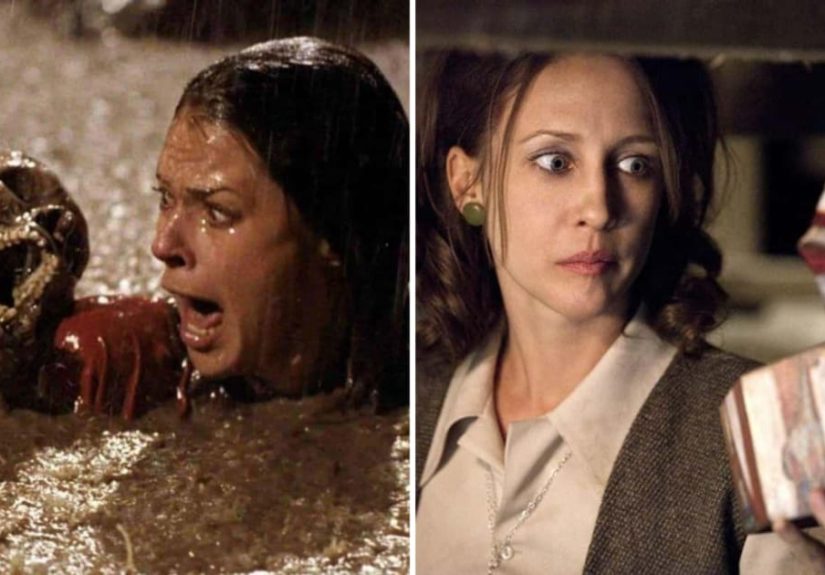
Skeletons used for filmingparticularly in the muddy pool sequencebecame a focal point of the movie’s behind-the-scenes mythology.
What allegedly happened
The film’s curse reputation was reinforced by a string of tragedies connected to cast members in the years surrounding the film’s release.
The combination of “real skeletons” + “later tragedies” is basically a folklore generator with a studio budget.
Why it feels “cursed”
There’s an instinctive boundary people don’t like crossing: using actual human remains for entertainment. Even if you explain it with industry history,
the emotional reaction is immediatelike your brain slams a door and whispers, “That’s not for us.”
7) The Demon Statue and Injury-Prone Rigging (The Exorcist, 1973)
The Exorcist has one of the most famous “cursed set” reputations in film history, and some of its most repeated stories involve specific physical elements:
a demon statue/imagery associated with the film and the brutal reality of stunt rigs and harnesses.
What the props were
Among the memorable objects tied to production stories are demonic set pieces (including a statue intended for use in the film’s globe-spanning sequences)
and the harness/rigging setups used for violent-looking practical effects.
What allegedly happened
Reports from the production’s history include a major set fire, multiple injuries, and deaths connected to individuals associated with the film around the
time of production. There are also well-known anecdotes about injuries sustained during harness pulls and intense practical sequences.
Why it feels “cursed”
The Exorcist didn’t just depict evilit marketed itself as a confrontation with it. Add real accidents, and the human mind does what it always does:
it connects dots. If the film is about demonic chaos, then chaos on set feels like the plot leaking into reality.
Why “Cursed Prop” Stories Never Die
There’s a pattern across all these movies: the more intense the shoot, the more physically risky the effects, and the more emotionally heavy the subject
matter, the more likely people are to interpret normal misfortune as something supernatural. Props become scapegoats because they’re visible, symbolic,
and easy to point at. You can’t blame “production stress,” but you can absolutely blame a doll with dead eyes and a permanent grin.
Also, curse stories are great PRsometimes created intentionally, sometimes accidentally. A rumor that “the prop was haunted” is a free trailer that plays
in your imagination. And imagination is the one thing horror fans will always show up early for.
Real-World Experiences: The Weird Stuff People Remember (Extra)
If you collect horror memorabilia, talk to film crew members, or even hang around prop forums long enough, you’ll notice something: people rarely describe
“haunted props” as full-blown levitation events. The stories are smallercreepier in a slow-burn way. A prop master will tell you the set felt fine until
it didn’t. A makeup artist will mention the day everything went wrong happened to be the day the “evil object” was on the call sheet. A grip will swear the
temperature dropped whenever the doll case opened, then pause and admit, “Or maybe the AC kicked on right then. But it felt… timed.”
One common experience is avoidance. People don’t want to take certain items home, even if they’re just foam and paint. You’ll hear,
“I’m not superstitious, but I’m also not putting that in my trunk.” It’s not fear of the object so much as fear of the story attached to it. A dybbuk-box
prop doesn’t need to move on its own; it only needs to sit quietly while your brain replays every unsettling anecdote you’ve heard about the legend.
Suddenly you’re driving a little faster, not because you believe in demons, but because you don’t want to explain to your roommate why you brought a
“haunted box” into the apartment.
Another shared experience is pattern-locking. Film sets are chaotic ecosystemslights blow, schedules shift, people get hurt, and weird
coincidences happen because a hundred moving parts collide daily. When a cast member hears that a production is “cursed,” the mind starts tagging events.
A bruise becomes “unexplained.” A bad dream becomes “a sign.” A power outage becomes “a warning.” This isn’t stupidity; it’s a normal human response to
stress plus suggestion. Horror productions are basically suggestion machines: you spend all day staging dread, so your senses stay tuned to dread.
Then there’s the experience of emotional residue. Some actors describe going home after filming and feeling like the role won’t fully come off.
That doesn’t require the supernaturaljust intense work, frightening imagery, and the vulnerability of performing fear repeatedly. When your nervous system
is revved up for weeks, the object you handled on set (a doll, a book, a statue) becomes a mental shortcut for the feeling. Later, when you see a photo of it,
your body reacts before your brain has time to roll its eyes.
Finally, there’s the collector’s experience: people love owning a piece of “the legend,” but they also love telling you it’s locked away “just in case.”
It’s half theater, half genuine unease. And that’s the truth at the heart of cursed-prop culture: even skeptics enjoy the little shiver. A haunted-prop tale
is a story you can hold in your handsone that makes the line between fiction and reality feel thinner, even if only for a second.
Conclusion
Haunted horror props are rarely “proof” of anything supernaturalbut they are proof of how powerful stories can be. A prop becomes cursed when it’s present
at the intersection of fear, coincidence, and real-life stress (and sometimes tragedy). If nothing else, these legends remind us that filmmaking is physical,
unpredictable workand that horror, as a genre, has a special talent for turning backstage chaos into mythology.