Table of Contents >> Show >> Hide
If you have ever met a Brown, a Baker, a Brooks, and a Butler before lunch, congratulations: you have experienced the glorious power of B surnames in the wild. Last names that start with B are some of the most recognizable family names in the United States, and many of them carry stories that are much older than the office coffee machine, the family Facebook group, and that one cousin who insists your ancestors were “probably royalty.”
Some B last names came from jobs. Others came from places, landscapes, nicknames, or the given names of long-ago parents. A few have multiple possible roots, because surnames love being dramatic. Immigration, spelling changes, and language shifts also added layers over time, so one modern surname can carry English, Scottish, Irish, German, Spanish, Welsh, or Norman influences all at once.
Below, you will find 50 popular last names that start with B, presented in U.S. popularity order and paired with concise origin notes. Think of it as a family-history sampler platter, minus the awkward reunion seating chart.
Why B surnames are so common
Many popular B surnames come from the four classic surname buckets: occupation, location, personal-name descent, and descriptive nickname. That is why names like Baker, Brewer, Barber, and Butler sound like medieval LinkedIn profiles, while names like Brooks, Banks, Bush, and Blair sound like somebody took a walk outside and turned the scenery into paperwork.
Then you have patronymic or personal-name surnames such as Bennett, Benson, Bryant, Bryan, Bowen, and Benitez, all of which point back to an ancestor’s given name. And of course, descriptive surnames like Brown, Black, Blake, and Ball remind us that medieval communities were not shy about naming people after appearance, coloring, or memorable physical traits. Subtlety was apparently optional.
50 popular last names that start with B and their origins
Ranks 1–10
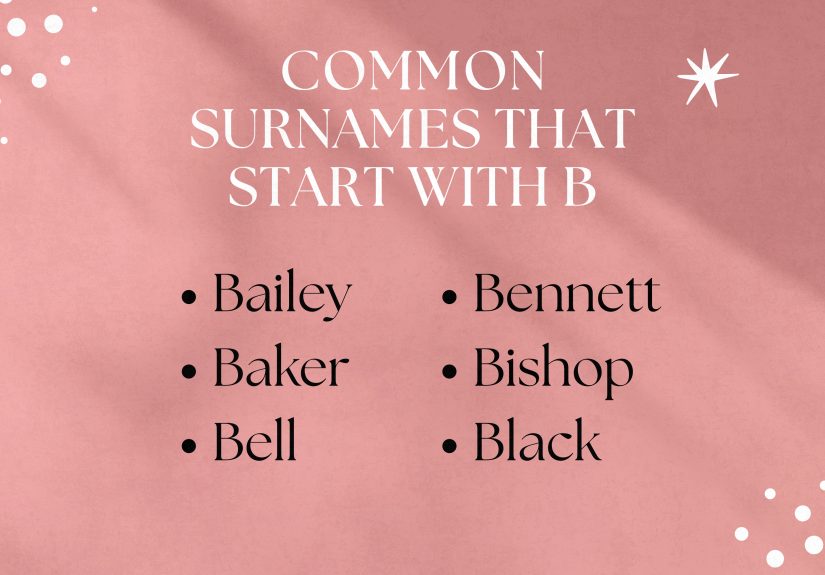
- Brown Usually a descriptive surname tied to brown hair, complexion, or clothing; in some families it also reflects the anglicizing of similar European surnames such as Braun.
- Baker An occupational name for a baker, bread maker, or sometimes the keeper of a communal oven. A deliciously literal surname.
- Bailey Often a status or occupational surname for a steward, administrator, or local official; some lines also connect to place names.
- Brooks A topographic surname for someone who lived near a brook or stream. Geography was doing a lot of naming back then.
- Bennett Derived from the personal name Benedict, from a Latin root meaning “blessed.” Strong meaning, excellent rebrand.
- Bell Usually linked to a nickname or personal name meaning fair, handsome, or beautiful, though some lines may have other local roots.
- Butler An occupational surname for a wine steward or chief household servant in a great medieval home.
- Barnes A habitational or topographic surname for someone who lived near or worked at a barn or grain storehouse.
- Bryant From the personal name Brian, brought into English surname history through Norman and Celtic influence.
- Burns Usually a Scottish or northern English habitational surname connected to a burn, meaning a stream, or to places named for one.
Ranks 11–20
- Black A descriptive nickname, often tied to dark hair or complexion, though historical spellings can blur meanings.
- Boyd Most often Scottish, with roots linked either to the Isle of Bute or to a Gaelic descriptive term, depending on the family line.
- Bradley A habitational name from places meaning “broad clearing” or “broad meadow.”
- Berry Often an English locational surname associated with a manor house or fortified place, though some families trace to the French region of Berry.
- Burke A famous Norman-Irish surname associated with the de Burgo family and place-based roots connected to a fortified settlement.
- Bishop A status or occupational surname that may have referred to someone in a bishop’s service, or occasionally a nickname with churchly flair.
- Burton A place surname usually meaning a settlement or enclosure associated with a fort.
- Banks A topographic surname for someone who lived on or near a bank, ridge, hillside, or riverbank.
- Bowman An occupational surname for an archer, hunter, or soldier armed with a bow.
- Brewer An occupational surname for someone who brewed beer or ale. Medieval society had priorities, and honestly, fair enough.
Ranks 21–30
- Barrett Usually a Norman-derived surname, often explained as a nickname tied to strife or quarrelsomeness. Medieval people could be savage.
- Barnett Commonly a habitational surname from places named with the idea of land cleared by burning; some lines also connect to the personal name Bernard.
- Bates A patronymic-style surname from Bate, a medieval personal name related to longer names like Bartholomew.
- Beck Often topographic for someone living by a stream or brook; in some German lines it can also connect to a baker-related root.
- Byrd A variant of Bird, usually a nickname for a small, quick, lively, or slender person.
- Becker A German and Dutch occupational surname for a baker, and in some traditions also linked to brick or tile baking.
- Barker Most often an occupational surname for a tanner who used tree bark in the tanning process; some lines also reflect shepherd-related roots.
- Benson A patronymic surname meaning, in effect, “son of Ben” or a related given name such as Benedict, Benjamin, or Bernhard.
- Bush A topographic surname for someone who lived near a bush, thicket, or scrubby patch of land.
- Baldwin From an old Germanic personal name meaning “bold friend,” which sounds like an excellent title for a fantasy novel.
Ranks 31–40
- Barber An occupational surname for a barber, and in the Middle Ages that often meant hair cutting, shaving, and some surgery too. Busy schedule.
- Bowen Often Welsh, from ap Owain, meaning “son of Owain”; some Irish lines have separate Gaelic roots.
- Blair A Scottish habitational surname from places named for a field, plain, or sometimes battlefield.
- Burgess A status surname for a freeman or full citizen of a borough, especially someone with municipal rights.
- Blake Closely related to Black, usually a descriptive surname tied to dark coloring, though historical word shifts make it more complicated than it looks.
- Brady An Irish surname from Gaelic roots referring to a descendant of Brádach, a personal name often interpreted as proud or spirited.
- Barton A habitational surname from places meaning a barley farm, grange, or outlying settlement.
- Buchanan A Scottish place surname commonly linked to land in Stirlingshire, often interpreted as “house of the canon.”
- Ball Usually a nickname for a round or compact person, a topographic reference to a rounded hill, or occasionally a cue to baldness.
- Bowers A variant of Bower, linked to a cottage, chamber, or small dwelling; sometimes occupational, sometimes topographic.
Ranks 41–50
- Bauer A German status surname meaning farmer, peasant, or rural neighbor.
- Ballard Often a descriptive nickname for a bald-headed man; in some lines it may come from an older French personal name.
- Brock Sometimes a nickname for someone thought to resemble a badger; in other cases it overlaps with brook- or place-based roots.
- Barrera A Spanish and Catalan topographic or habitational surname tied to a barrier, fence, gate, or place bearing that name.
- Burnett Commonly a Norman-derived descriptive surname connected to brown coloring, essentially a diminutive form related to “brown.”
- Bautista From the personal name meaning “Baptist,” ultimately associated with John the Baptist.
- Beil A German occupational surname tied to an axe maker, axe user, or tradesperson working with similar tools.
- Briggs A topographic surname for someone who lived by a bridge or came from a place named for one.
- Bryan Usually a variant of Bryant or a shortened Anglicized form tied to the Irish name Brian.
- Bass In English lines, often a nickname or occupational surname connected to bass or perch fish, including fish sellers and fishermen.
Common origin patterns behind these B last names
If you step back from the list, the pattern becomes wonderfully clear. Occupational surnames are everywhere: Baker, Brewer, Barber, Butler, Bowman, Becker, and Bishop all preserve the work people did or the social roles they held. These names are little job titles that refused to retire.
Place and landscape surnames are just as common. Brooks, Banks, Bush, Blair, Bradley, Burton, Barton, Briggs, and Barnes all connect people to fields, streams, barns, ridges, and settlements. In other words, if your ancestors stood next to something long enough, that something had a decent chance of becoming the family name.
Then come the personal-name surnames: Bennett, Benson, Bryant, Bryan, Bates, Bowen, Baldwin, Bautista, and Benitez all reflect descent, devotion, or the popularity of a first name in a region. These names often reveal how communities tracked kinship before spreadsheets, databases, and aunties with suspiciously good memory.
Finally, descriptive surnames like Brown, Black, Blake, Ball, Burnett, and Brock remind us that nicknames often became permanent. Hair color, skin tone, body shape, or even an animal comparison could turn into a hereditary identity. Family history can be noble, spiritual, geographic, occupational, and occasionally a little rude.
What researching B surnames feels like in real life
Researching common B last names is a strange mix of excitement, confusion, and the occasional urge to stare dramatically out a window. On the exciting side, these surnames are everywhere in American records. Open an old census, yearbook, immigration list, military roster, city directory, or church register, and chances are a Brown or Bailey or Barnes pops up before you finish your coffee. That is great for finding material. It is less great when there are fourteen John Browns in the same county and every single one appears to have married someone named Mary. Genealogy can be thrilling, but it can also feel like a detective story written by a prankster.
There is also something deeply human about these surnames. A name like Baker instantly conjures labor, skill, and everyday community life. Brooks and Banks sound like landscape. Bowen and Bennett feel ancestral, almost like you can hear the older personal names echoing underneath them. And Bautista, Benitez, and Barrera show how surnames carry language, migration, and cultural continuity into modern American life. One letter may stay the same, but the journeys behind it can be wildly different.
Anyone who has dug into family stories around B surnames knows the experience of discovering that a “simple” last name is not simple at all. Maybe the family always assumed Burke was purely Irish, then records reveal Norman roots. Maybe Beck turns out to be stream-related in one branch and occupational in another. Maybe Burnett has a nickname origin in one place and a spelling shift from another surname somewhere else. The deeper you go, the more you realize surnames are not neat labels. They are history wearing a nametag.
There is also a social side to these names. Common B surnames tend to feel familiar in schools, workplaces, and neighborhoods, which gives them a curious blend of everyday normalcy and hidden depth. A name like Brown sounds instantly recognizable, but the people carrying it may come from English, Scottish, Irish, German, African American, Caribbean, or many other family histories. That is part of what makes surname research so rewarding: the same name can sit at the intersection of multiple stories, none of them boring.
And then there is the emotional payoff. Finding out that your surname once pointed to a baker, a bridge, a field, a borough, or a bold friend can make history feel less abstract. It becomes personal. It becomes dinner-table material. It becomes the kind of story relatives suddenly care about once you start talking. Common last names may look plain on the surface, but often they are the strongest proof that ordinary lives leave extraordinary traces. A surname is not just a label at the end of a form. It is a tiny, stubborn time capsule.
Final thoughts
The most popular last names that start with B are popular for a reason: they are old, adaptable, memorable, and deeply woven into the English, Scottish, Irish, Welsh, German, and Spanish naming traditions that shaped the United States. Some came from work. Some came from land. Some came from ancestors’ first names. Some came from nicknames that probably felt clever at the time and slightly dangerous in retrospect.
Whether your surname is Brown, Bennett, Barrera, or Buchanan, the real magic is not just in what the name originally meant. It is in how that meaning traveled, changed, survived, and landed in the present day. A last name can start as a description, a title, a place marker, or a family link. Over generations, it becomes something bigger: identity, memory, and a portable piece of history.