Table of Contents >> Show >> Hide
- Why Constrained Writing Works So Well for Hidden Messages
- 1. Use an Acrostic to Hide a Message in Plain Sight
- 2. Use a Telestich for a More Subtle Hidden Message
- 3. Use a Mesostic to Hide the Message Down the Middle
- 4. Use a Golden Shovel to Hide a Message in Line Endings
- 5. Use a Lipogram to Turn Absence into a Secret Signal
- How to Choose the Right Method
- Common Mistakes to Avoid
- What I Have Learned from Using Constrained Writing
- Conclusion
Sometimes the best place to hide a message is not inside a spy gadget, a locked app, or a suspiciously dramatic envelope sealed with black wax. Sometimes the best hiding place is a perfectly normal-looking piece of writing. That is the mischievous charm of constrained writing: you give yourself a rule, follow it with monk-like devotion, and somehow end up sounding both clever and slightly unhinged. In the best possible way.
Constrained writing is exactly what it sounds like. Instead of writing with total freedom, you write under a deliberate rule. Maybe you spell a word with the first letters of each line. Maybe you avoid one letter completely. Maybe you hide a phrase down the middle of a poem. These limits do not ruin creativity. They sharpen it. A blank page asks, “What do you want to say?” A writing constraint asks, “How sneaky can you be while saying it?”
That is why constrained writing is so useful for secret messages. It lets you build two layers at once: the surface text that any reader can enjoy, and the hidden text that a more attentive reader can discover. One layer smiles politely. The other winks from behind the curtain.
In this guide, we will look at five smart, playful, and web-friendly ways to use constrained writing to send a secret message. These are literary techniques, not cloak-and-dagger instructions for bad behavior. Think birthday cards, love notes, puzzle hunts, classroom challenges, wedding toasts, and creative online content. In other words: wholesome secrecy. The kind your English teacher might actually applaud.
Why Constrained Writing Works So Well for Hidden Messages
A hidden message works best when the visible message still feels natural. That is the real trick. Anyone can stack random letters down a page and call it mysterious. But constrained writing asks for more. It demands that the visible text make sense on its own while secretly carrying a second meaning underneath. That double duty is what makes the form satisfying.
There is also a psychological reason these forms are so appealing. Readers love patterns. We are wired to notice repetition, symmetry, and little signs that something extra is going on. A secret message hidden in form creates the same pleasure as a puzzle box or an Easter egg in a movie. The text says, “You could just read me.” The hidden pattern says, “Or you could really read me.”
Another advantage is flexibility. Some forms, like acrostics, are easy enough for beginners. Others, like mesostics and lipograms, make you feel as if you are arm-wrestling the alphabet for sport. That range means you can choose a method based on the occasion, your skill level, and how obvious or subtle you want the hidden message to be.
1. Use an Acrostic to Hide a Message in Plain Sight
The acrostic is the classic gateway drug of secret writing. It is simple, elegant, and old enough to have literary credibility. In an acrostic, the first letter of each line spells out a word or phrase when read vertically. That means your poem, note, or paragraph can look innocent while quietly carrying a hidden instruction, dedication, or joke.
Why it works
Acrostics are effective because most readers move horizontally, not vertically. They follow the line, not the edge. Unless someone knows to look at the first letters, the message can sit there like a cat on a bookshelf: visible, but weirdly ignored.
Best uses
Acrostics are perfect for short messages. A name, a date, a joke, a clue, or a phrase like “READ ME” or “CALL MOM” can hide comfortably in a poem, tribute, greeting card, or article intro. They also work beautifully in branded writing, where you want a little extra layer without smashing the reader over the head with it.
How to do it well
Start with the hidden word written vertically. Then draft each line so it begins with the needed letter. The challenge is not the skeleton. The challenge is making the body look alive. If every line sounds forced, the secret message becomes obvious. Good acrostics feel like normal writing first and clever design second.
Quick example idea
If you want to hide the word “SMILE,” write six lines beginning with S, M, I, L, and E. The visible poem might be about spring weather, coffee, or your dog’s deeply unearned confidence. The hidden message sits quietly in the margin, waiting for someone observant enough to earn it.
2. Use a Telestich for a More Subtle Hidden Message
If the acrostic is the show-off cousin, the telestich is the quieter sibling who turns out to be smarter than everyone at the reunion. A telestich spells a word or phrase using the final letters of each line instead of the first. That tiny shift makes the hidden message much harder to detect.
Why it works
Readers are even less likely to inspect the last letter of each line than the first. Most people notice line openings because they align neatly on the left. Endings, meanwhile, are visually messy. They disappear into punctuation, line length, and the general chaos of human attention.
Best uses
Use a telestich when you want the hidden message to be less obvious. It is great for poetry, prose blocks broken into short lines, or social captions written with intentional line breaks. It also works well when you want readers to discover the secret only after a hint.
How to do it well
Write the hidden word first, then build lines that end naturally with each required letter. This can be trickier than an acrostic because English does not always hand you perfect line endings on command. You may need to revise more aggressively and swap out words until the line lands cleanly.
Pro tip
Do not overstuff the lines just to reach the correct final letter. That is how you end up with sentences that sound as if a thesaurus fell down the stairs. Keep the tone natural. A subtle hidden message is only satisfying if the visible writing still feels human.
3. Use a Mesostic to Hide the Message Down the Middle
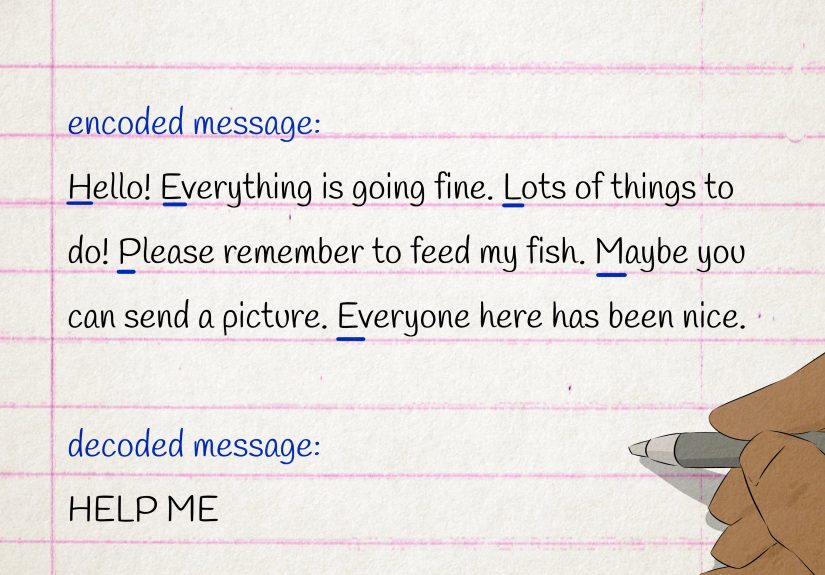
Now we move from clever to deliciously nerdy. A mesostic is similar to an acrostic, except the hidden word runs down the middle of the text rather than along the left edge. Instead of the vertical message living at the start of each line, it appears somewhere inside each line, often aligned around a “spine word.”
Why it works
Mesostics are sneaky because most readers do not scan the middle of lines for vertical structure. The hidden word is literally embedded in the body of the writing. If an acrostic whispers from the doorway, a mesostic hides in the wallpaper.
Best uses
This form is excellent for more artistic projects: literary blog posts, visual poems, printed keepsakes, puzzle zines, or creative writing pieces where the layout matters. It is also ideal when you want the secret message to feel discovered rather than announced.
How to do it well
Choose a short spine word first. Then write lines so each target letter appears in sequence down the middle area of the text. The beauty of a mesostic is that it looks less mechanical than an acrostic. The danger is that it is also harder to balance. Spacing, rhythm, and line length matter. One clumsy line and your hidden word starts wobbling like a shopping cart with one bad wheel.
Example use case
Imagine a short anniversary poem where the letters L-O-V-E appear vertically through the center of four lines. To a casual reader, it is just a romantic note. To the intended reader, it feels like a private room hidden inside a public house.
4. Use a Golden Shovel to Hide a Message in Line Endings
The golden shovel is a more modern poetic form, and it is a fantastic choice if you want your secret message to be structurally elegant. In a golden shovel, each word from a source line becomes the final word of a new line in your poem. This means you can hide a full sentence, quotation, or clue inside the line endings.
Why it works
Unlike a telestich, which relies on letters, the golden shovel hides entire words. That gives you more control and allows for richer secret messages. Your visible poem can go in one direction while the end words create a second message underneath.
Best uses
This is perfect for tribute writing, creative essays, spoken-word pieces, commemorative content, and puzzle-based storytelling. It is especially effective when the hidden message is meant to echo a known phrase, song lyric, motto, or family saying.
How to do it well
Pick a short source line first. Then build one new line for each word. The line must end with the assigned word, but everything before it is yours to shape. The real fun is contrast: the visible poem can speak in a fresh voice while the hidden line quietly carries the old one forward.
Why writers love it
The golden shovel feels less like hiding and more like layering. It gives your message a secret framework without making the piece look gimmicky. Think of it as literary carpentry. Nobody sees the studs in the wall, but the whole house depends on them.
5. Use a Lipogram to Turn Absence into a Secret Signal
A lipogram is a piece of writing that deliberately avoids a specific letter. At first glance, that may not sound like a secret-message technique. After all, omitting a letter is not the same as spelling out a phrase. But in creative communication, absence can be as meaningful as presence.
Why it works
A lipogram creates a code through omission. If two people agree in advance that a missing letter means something, then the visible text becomes a message in disguise. For example, avoiding the letter E might signal one idea, while avoiding A might signal another. You can also use a series of short lipograms, each missing a different letter, to create a sequence.
Best uses
This works best for puzzle games, literary experiments, interactive fiction, and playful exchanges between people who already understand the rule. It is less obvious than an acrostic and more conceptual, which makes it especially fun for readers who enjoy decoding structure rather than spotting a simple word.
How to do it well
Start with a common letter only if you enjoy suffering bravely. Writing without E in English is possible, but it can feel like trying to cook dinner with one hand tied behind your back and the spice rack missing. For beginners, try omitting a less common letter first. Then focus on natural phrasing. The more normal the text sounds, the stronger the effect.
Advanced twist
You can pair a lipogram with another constraint. For example, write an acrostic where each line also avoids a chosen letter. That gives you one message in the structure and another in the omission. At that point, your note is no longer just a note. It is an overachiever.
How to Choose the Right Method
If you want a hidden message that is easy to create and easy to discover, use an acrostic. If you want extra subtlety, use a telestich. If you want visual elegance and a more literary feel, use a mesostic. If you want to hide a whole phrase inside the architecture of a poem, use a golden shovel. If you want your message to live in what is missing rather than what is shown, choose a lipogram.
In practice, the best method depends on your audience. Are they casual readers, puzzle fans, close friends, or poetry nerds who voluntarily know what a sestina is? Choose accordingly. A hidden message is only as good as its intended reader. Too obvious, and the secret is boring. Too obscure, and it dies alone in the margins.
Common Mistakes to Avoid
Making the visible writing sound unnatural
If your lines feel stiff, readers will suspect a trick. Good constrained writing should still read smoothly.
Choosing a message that is too long
Short hidden messages are usually stronger. A compact clue beats a clunky coded paragraph every time.
Forgetting the audience
A secret message should fit the relationship and the occasion. A wedding toast can carry a hidden dedication. A classroom poem can hide a spelling word. A blog post can sneak in a thematic wink. Not every technique suits every moment.
Trying to be clever before being clear
The visible text still matters. If the piece is unreadable, the secret layer loses its charm. First make it good. Then make it sneaky.
What I Have Learned from Using Constrained Writing
The first time I used constrained writing to hide a message, I expected it to feel like a puzzle. It did. But it also felt like a conversation with the page. Every sentence had to do double duty. Every word had to carry both meaning and placement. I stopped treating language like a pile of bricks and started treating it like a lock with moving parts. That change alone made me a better writer.
What surprised me most was how personal the process became. A hidden message creates intimacy. Even if the visible text is public, the buried layer feels private, almost whispered. That is why these forms work so well in notes, poems, tributes, and little pieces of web writing meant to reward close attention. They invite the reader to lean in. They say, “There is more here if you care enough to look.”
I have also learned that constraints do not kill originality. They rescue it. When you cannot use every option, you stop relying on lazy phrasing. You look harder. You revise smarter. You discover unusual word choices, cleaner structure, and sharper rhythm. In that sense, the hidden message is only half the benefit. The other half is the strange magic of being forced to think differently.
Some methods feel generous. Acrostics are friendly and welcoming, like puzzles that want to be solved. Others feel sly. Telestichs and mesostics create that satisfying delayed reveal, where the reader notices the pattern and suddenly sees the whole piece in a new way. Lipograms are different again. They feel like disciplined performance, as if the writer is quietly showing off while pretending not to.
And then there is the emotional side. A hidden message can make a piece memorable in a way ordinary writing often is not. A greeting card with a tucked-away phrase feels more thoughtful. A poem with a secret name inside it feels more intimate. A blog post with an embedded clue turns passive reading into participation. Readers remember the moment they found something that had been there all along.
Of course, not every experiment works. Sometimes the lines become stiff. Sometimes the hidden word is too obvious. Sometimes the piece reads like a hostage note assembled by a very literary raccoon. But even the failed attempts are useful. They teach rhythm, compression, word choice, and patience. They remind you that writing is not only about saying something. It is also about designing how that something appears.
If you want to get better, start small. Hide a first name in an acrostic. End four lines with letters that spell a joke. Write a short paragraph without using one specific letter. Once you feel the pleasure of making language click into place, it becomes addictive. Suddenly you are not just writing. You are engineering delight.
That is the real joy of constrained writing. It turns form into meaning. It makes the page interactive. It gives writers a way to be playful without being sloppy and clever without being cold. And when used well, it lets a simple piece of text carry a second heartbeat underneath the first.
Conclusion
Constrained writing is one of the smartest ways to send a secret message without leaving the world of ordinary language. Whether you choose an acrostic, telestich, mesostic, golden shovel, or lipogram, the goal is the same: create writing that works on two levels. The visible level delivers the surface meaning. The hidden level rewards attention, intimacy, and curiosity.
That double-layer effect is what makes these forms so enduring. They are playful, memorable, and surprisingly practical for creative communication. In a world full of noisy content, a well-hidden message feels handmade. It feels intentional. It feels like somebody cared enough to build a secret room inside a sentence.
So go ahead. Write the obvious message if you must. But every now and then, let the page keep a little secret.