Table of Contents >> Show >> Hide
Every job has its hazards. Construction workers have heavy machinery. Nurses have night shifts.
Baristas have that one espresso machine that screams like a banshee. And almost everyone has to deal with
the most dangerous workplace hazard of all: the overused job joke.
You know the ones. The customer points to an item without a price and says, “Guess that means it’s free!”
The friend who hears you’re a teacher and replies, “Nice, so you get three months of vacation!” Servers,
nurses, accountants, IT folks, designers, and pretty much everyone else have heard the same lines so many
times they could recite them in their sleep.
This article is a loving roast of those tired one-liners. We’ll look at why they’re so persistent,
what they reveal about how people see different professions, and share 45 classic job “jokes” that
workers are begging everyone to retire. Think of this as your friendly PSA: before you crack that
pun at the checkout line, maybe… don’t.
Why Workers Are So Tired of the Same Job Jokes
The emotional labor behind polite laughter
On paper, a joke is just a sentence. In real life, it comes with work. When you repeat the same
joke to a server, nurse, or cashier, you only say it once. They may hear it dozens of times a week,
from people who all believe they’re being charming and original.
That means the worker has to:
- Recognize the joke instantly.
- Pretend it’s brand new.
- Mustering up a smile or laugh so the customer doesn’t feel awkward.
Over time, the “harmless” joke becomes another tiny piece of emotional labor tacked onto a job that’s
already stressful, physical, or underappreciated.
Jokes that lean on tired stereotypes
A lot of these lines are built on simple stereotypes:
- Teachers are lazy and overpaid “babysitters.”
- IT pros just “push a button” and Google everything.
- Accountants are boring number robots who love taxes.
Even when the person joking doesn’t mean any harm, these lines keep reinforcing the idea that some
professions aren’t “real work” or don’t deserve respect. After the hundredth time, it stops feeling like
humor and starts feeling like a dig.
45 Jokes People With Different Jobs Don’t Want To Hear Anymore
Below is a list of 45 overused work jokes and clichés that people in different jobs are beyond tired of.
If you recognize one you’ve used… congratulations, you now have an opportunity for character development.
-
Server: “No price tag? Guess that means it’s free!”
They’ve heard this every single shift since the invention of barcodes. -
Server: “The bill? We didn’t order that!”
Every server has to fake-laugh through this one while silently calculating your tip. -
Barista: “Make mine extra strong, I’m going to need it to deal with my boss!”
They’re already pulling 300 shots before 9 a.m.they know all about difficult bosses. -
Cashier: “If it doesn’t scan, it’s free, right?”
POS systems, inventory tracking, and their manager would all like a word. -
Retail worker: “You must love shopping if you work here!”
Loving clothes and folding the same shirt 47 times a day are very different skills. -
Teacher: “Must be nice getting off work at 3 and having summers off!”
They’re grading, planning, emailing parents, and doing training when you think they’re at the beach. -
Teacher: “Those who can, do; those who can’t, teach.”
One of the fastest ways to tell a teacher you don’t understand what they do at all. -
Nurse: “Wow, so you just give shots all day?”
Try coordinating medications, monitoring vitals, advocating for patients, and documenting every move. -
Nurse: “You’re basically a doctor, right?”
Different profession, different training. Also, nurses are not just “doctors’ assistants.” -
Doctor: “While I’m here, can you just look at this rash?”
At a wedding. In a grocery store. In an elevator. Without gloves. -
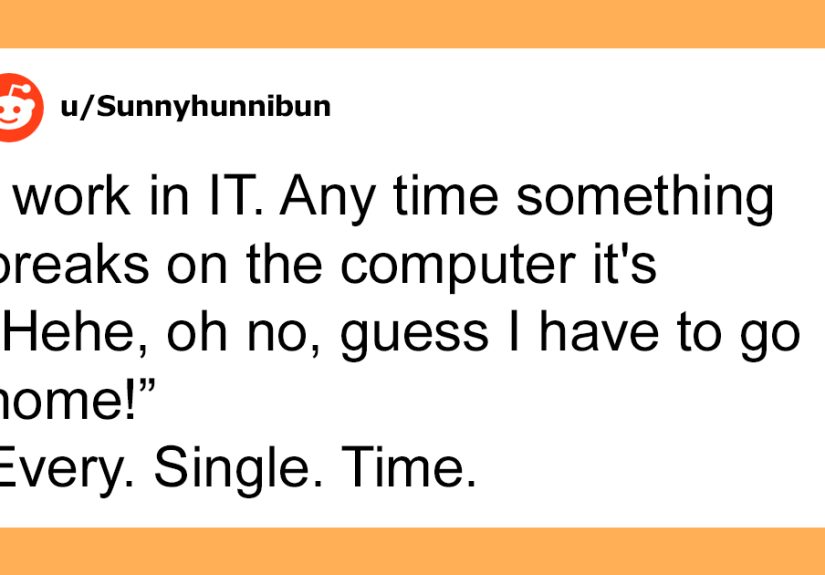
IT support: “Have you tried turning it off and on again? Ha ha, I bet you say that a lot!”
Yes. Because it actually works. And because people don’t restart their computers for six months. -
IT support: “You just push buttons all day, right?”
Sureif by “push buttons” you mean “prevent catastrophic data loss and security breaches.” -
Accountant: “Wow, you must be fun at parties!”
Shy doesn’t mean boring, and someone has to keep the tax man happy. -
Accountant: “Can you take a quick look at my taxes?”
Translation: “Can you do several hours of free work on the spot because we’re acquaintances?” -
Delivery driver: “Been out joyriding all day?”
Sitting in traffic, dodging bad parkers, and hauling boxes is not anyone’s idea of joy. -
Flight attendant: “Are you just a waitress in the sky?”
They’re trained for emergency procedures, medical situations, and crowd control at 35,000 feet. -
Hairdresser: “You can fix this, right? My friend ‘experimented.’”
There are limits to what can be done after a kitchen bleach job and a pair of craft scissors. -
Therapist: “Are you analyzing me right now?”
Honestly, they’re probably just deciding what to have for dinner. -
Therapist: “So you just sit and listen all day?”
Listening is a skill, not a passive activityespecially when trauma and crisis are involved. -
Journalist: “Do you just make things up?”
Good journalism involves verification, ethics, and the constant risk of being yelled at on the internet. -
Journalist: “Must be nice, you get paid to tweet.”
They also chase leads, research, interview, and fact-check until 2 a.m. -
Graphic designer: “Can you just make it pop?”
Nobody knows what this means, including the person saying it. -
Graphic designer: “My nephew has Photoshop, too!”
Owning a knife doesn’t make you a chef; owning design software doesn’t make you a designer. -
Photographer: “Great exposure opportunity for you!”
You can’t pay rent in “exposure,” but people still offer it like it’s currency. -
Photographer: “The camera must be really good.”
Right, and a word processor wrote your favorite novel. -
Customer support agent: “Let me speak to someone who actually knows something.”
They’re literally trained to solve your problem; they just also have to be polite about it. -
Customer support agent: “It’s nothing personal, but…”
Every complaint that starts with this is going to get very personal. -
HR professional: “So you fire people for a living?”
They also help people get hired, get benefits, and avoid lawsuits. -
HR professional: “You must love drama.”
They’d actually like everyone to follow the policy and go home on time. -
Lawyer: “Better call you if I ever kill someone, haha!”
They also handle contracts, family law, and a thousand issues that do not involve murder. -
Lawyer: “You’re probably billing me for this conversation!”
They’re not. But they’re starting to wish they were. -
Real estate agent: “Must be nice just unlocking doors and collecting commission.”
They also do marketing, negotiations, staging, paperwork, and endless showings that never lead anywhere. -
Real estate agent: “You must know all the gossip in the neighborhood.”
They know the price per square foot; the gossip comes free. -
Construction worker: “You guys ever actually work, or just stand around?”
What you’re seeing is usually the five minutes between the last heavy lift and the next one. -
Security guard: “Oh, so you’re a cop wannabe?”
Different job, different authority, same risk when something actually goes wrong. -
Police officer: “Better behave, or they’ll arrest you!” (said to kids)
Most officers are trying to build trust, not scare children for a cheap laugh. -
Social media manager: “So you just post memes all day?”
They also manage strategy, analytics, crisis responses, and comment sections that look like war zones. -
Social media manager: “My teenager could do your job.”
Your teenager is not ready to handle a PR crisis or a brand partnership contract. -
Freelancer: “You’re so lucky; you can sleep all day if you want!”
Sure, if they’re also okay with not eating or paying rent. -
Freelancer: “Can you give me a friends-and-family discount? And pay later?”
Somehow “later” never arrives. -
Librarian: “Shhh! You love shushing people, don’t you?”
They’re running programs, helping with research, managing databasesnot starring in a meme. -
Call center agent: “Let me guess, you’re reading off a script.”
Yes, and also trying to solve your issue while being timed, recorded, and evaluated. -
Warehouse worker: “At least you don’t have to think at your job!”
Logistics, safety, and organization absolutely require thinkingplus, it’s physically demanding. -
Any creative person ever: “Can you whip something up real quick?”
The only thing being “whipped up” is their stress level when you say this.
Why You Should Retire These Job Jokes
Most of these lines started as light-hearted ways to break the ice. But when a joke becomes
a script everyone repeats, it stops being connection and turns into background noise. Workers
can feel reduced to a stereotype or a punchline instead of seen as actual people with skills,
stress, and real expertise.
Retiring these jokes doesn’t mean you have to be serious all the time. It just means choosing humor
that:
- Isn’t built on lazy clichés about someone’s job.
- Doesn’t add to the emotional workload of people already under pressure.
- Makes you laugh with people, not at them.
How to Be Funny Without Being “That” Customer or Coworker
Ask real questions instead of cracking tired jokes
Instead of defaulting to “Must be nice to get summers off,” ask a teacher, “What’s the most rewarding
part of your job?” Instead of “That means it’s free,” ask a cashier, “Is it super hectic during the holidays?”
Genuine curiosity is much more memorable than a line they’ve heard 800 times.
Use humor about shared experience, not their job title
It’s often better to joke about something you’re both experiencinglike the weather, the long line, or the
absurdity of adultingthan a stereotype about their profession. That way, you’re building a little moment of
camaraderie instead of reminding them how many people underestimate their work.
Read the room
If someone looks exhausted, overwhelmed, or just very busy, now is not the time for your tight five on
“funny things people say to bartenders.” A simple, “Thanks for what you do” goes a lot further than a joke
they have to pretend is funny.
Real-Life Experiences with Overused Job Jokes
If you talk to people across different industries, you’ll notice something interesting: almost everybody
can immediately name the one joke that makes their eye twitch. They don’t even have to think about itit’s
just permanently burned into their brain from repetition.
Take service workers. Many servers can remember the exact moment they realized the “Guess it’s free!” line
wasn’t just something one quirky customer saidit was a recurring phenomenon. One former waiter describes his
first summer in a busy restaurant: every single day, someone dropped that line when a barcode didn’t scan.
At first, he laughed genuinely. A week later, the laugh turned into a polite exhale. By the end of the month,
he could feel his face do a strained smile while his soul quietly climbed out the back door.
Teachers have similar stories, especially about the “summers off” myth. A high school teacher might spend
large chunks of their “vacation” in professional development sessions, redesigning curriculum, and catching up
on the grading and planning that fell behind during exam season. Yet at every family gathering, someone will say,
“Must be nice to work nine months out of the year!” The joke doesn’t just miss the reality; it erases all the
invisible labor that happens when no students are in the building.
Healthcare workers, especially nurses, often report that the jokes they hear minimize the emotional weight of
their jobs. A nurse might be coming off a double shift where they coordinated complex care, supported scared
families, and watched someone’s condition rapidly change, only to hear a friend quip, “So how many shots did
you stab people with today?” It might sound lighthearted to the friend, but it turns a deeply human, often
heavy job into a cartoon version of itself.
In tech and IT, there’s a whole separate genre of “you just Google things” jokes. Many IT workers admit, yes,
they look things upthat’s how staying current worksbut they also have years of training that tell them what
to Google, how to interpret what they find, and how to translate it into a safe fix for real systems. When
someone jokes that they’re just “pushing a button,” it undercuts the expertise they’ve built. It’s like telling
a chef they “just follow a recipe.”
Creativesdesigners, writers, photographershave their own recurring nightmares. One designer talks about the
phrase “Can you whip something up real quick?” appearing in emails like a jump scare. It always sounds casual,
but what it really means is: “Can you do a full, thoughtful creative process in 20 minutes, and also maybe for
free?” After years of hearing that, the joke isn’t quirky; it’s a warning sign.
What ties all these stories together is not that people are humorless. Most workers actually appreciate a good
laugh, especially on a rough day. What wears them down is the sense that people are interacting with the idea
of their job instead of the reality of what they do. The same jokes repeat because the same stereotypes repeat.
When someone breaks that patternby asking a real question, by listening, by making a fresh observationit stands
out immediately.
So if you want to be the bright spot in someone’s shift, the answer isn’t a recycled line from a thousand other
customers. It’s noticing the human being in front of you and treating their work like it matters. That’s funnier,
kinder, and far more memorable than the fiftieth “Guess I’ll take it if it’s free” of the day.
Conclusion
Work jokes aren’t going anywherehumor is one of the main ways we survive the chaos of modern jobs. But there’s
a big difference between a shared laugh and a lazy jab that forces someone to perform politeness on command.
When you retire the overused lines on this list and choose humor that respects people’s time and expertise,
you’re not just being “less annoying.” You’re helping build a culture where every job is treated as real work,
worthy of respect…and the occasional original joke.
sapo:
From “Guess it’s free!” at the checkout to “You must be fun at parties” for accountants, workers in every
industry are bombarded with the same corny job jokes on repeat. This article rounds up 45 of the most overused
work one-liners that servers, nurses, teachers, IT pros, creatives, and more are begging people to retire.
Learn why these jokes aren’t as harmless as they seem, how they quietly reinforce stereotypes and emotional
burnout, and how to be genuinely funny and respectful instead. If you’ve ever cracked a joke about someone’s
job, this is your friendly guide to doing better.