Table of Contents >> Show >> Hide
Celebrity culture has always loved a spectacle, but the internet turned that habit into an Olympic sport. One odd Instagram caption, one chaotic interview, one headline-grabbing feud, and suddenly the comments section is acting like it has a PhD in Famous People Falling Apart. That is the energy behind the phrase “completely lost it”a dramatic, meme-friendly label that says more about online reactions than it does about anyone’s actual mental health.
So let’s be clear right up front: this article is about public perception, not diagnosis. Some of these stars were dealing with real stress, addiction, grief, lawsuits, burnout, or the kind of pressure that would make an ordinary person hide under a weighted blanket for six months. Others simply developed a reputation for saying the loud part louder. Either way, these celebrities became the internet’s favorite case studies in chaos, backlash, and modern fame gone weird.
If you have ever watched a celebrity scandal unfold online and thought, “Well, that escalated before I finished my coffee,” this list will feel very familiar. Here are 30 celebs that people online have repeatedly pointed to as examples of public unraveling, image implosion, or full-blown digital mayhem.
Why the Internet Loves a Celebrity Meltdown
There is a reason celebrity meltdowns and social media scandals travel so fast. Fame already magnifies personality. Add livestreams, screenshots, stan wars, and round-the-clock commentary, and every bad decision becomes a franchise. The internet does not just react to celebrity controversy; it serializes it, remixes it, and sells it back as entertainment. One minute a star is trending for an album, the next they are trending because they posted something so baffling that millions of strangers have decided they are one iced coffee away from total collapse.
That is what makes this topic both funny and uncomfortable. Some of these public spirals were undeniably self-inflicted. Others were exaggerated by online pile-ons that treat messy behavior like a spectator sport. The truth, as usual, is somewhere between “What were they thinking?” and “Wow, maybe we should all log off.”
30 Celebs People Online Keep Saying Have “Lost It”
The Serial Chaos Magnets
- Kanye West Few stars have generated more “What is happening?” reactions online. Between inflammatory posts, wild public statements, burned bridges, and repeated controversy, he became the blueprint for celebrity chaos in the social-media era.
- Britney Spears Public concern over her videos, captions, and online behavior has become its own ecosystem. What makes the discourse tricky is that internet speculation often crosses the line from concern into voyeurism.
- Charlie Sheen “Tiger blood” was not just a phrase; it was a whole season of pop culture. His 2011 public spiral remains one of the most iconic celebrity meltdowns because it felt like every interview somehow got stranger than the last.
- Ezra Miller Arrests, allegations, apologies, and a relentless trail of alarming headlines made Miller a lightning rod for online commentary. Even people who never watched a DC movie knew something seemed seriously off.
- Azealia Banks Banks is talented, quick-witted, and perpetually at war with the internet, the industry, or sometimes both before lunch. Her public feuds are so frequent that many online observers treat them like recurring programming.
- Trisha Paytas For years, Paytas built a career out of provocation, trolling, oversharing, and making the internet ask whether any of it was performance art. The result was a reputation for chaos that followed every reinvention.
Stars Who Turned One Moment Into a Reputation
- Will Smith One Oscars slap changed the entire tone of his public image overnight. For a star once associated with effortless likability, that moment made people online rethink everything they thought they knew.
- Roseanne Barr Barr had always been provocative, but the racist tweet that detonated her TV comeback sealed her place on countless “what happened here?” lists. It was less a stumble than a televised self-destruction sequence.
- Mel Gibson Explosive recordings, offensive remarks, and a long trail of controversy gave Gibson one of Hollywood’s most enduring “lost it” reputations. For many online critics, his name is shorthand for spectacular self-sabotage.
- Alec Baldwin Baldwin’s long history of angry public incidents would have been enough for internet discourse on its own. Add the Rust tragedy and the legal saga around it, and the perception of endless turmoil only deepened.
- Nicki Minaj Minaj’s fan loyalty is unmatched, but so is the backlash she can trigger. Between social media feuds, vaccine misinformation controversy, and headline-stealing rants, people online often frame her as permanently one post away from trending for the wrong reason.
- Logan Paul Paul has spent years trying to outrun the legacy of reckless stunts and terrible judgment. The problem is that every new controversy reminds the internet why that reputation exists in the first place.
The Former Sweethearts Who Became Tabloid Fuel
- Lindsay Lohan Long before “messy celebrity” became social content, Lohan was the center of it. Legal trouble, rehab headlines, and career detours made her a staple of internet conversations about fame gone off the rails.
- Bam Margera Margera’s troubles played out in such public, painful ways that online audiences often responded with a mix of shock, frustration, and genuine sadness. He became a symbol of how hard it is to separate entertainment from real-life collapse.
- Justin Bieber Bieber’s rough patch included arrests, public outbursts, and enough cringe for three pop careers. He has since worked hard to steady his image, but the internet has a very long memory and screenshots never retire.
- Miley Cyrus When Cyrus broke away from her Disney image, people online acted like she had personally declared war on innocence. Some called it reinvention; others treated it like cultural evidence that she had fully gone off the deep end.
- Amanda Bynes Bynes became one of the clearest examples of how the internet can turn someone’s difficult period into clickbait. Her story is also a reminder that public mockery often hides real human pain.
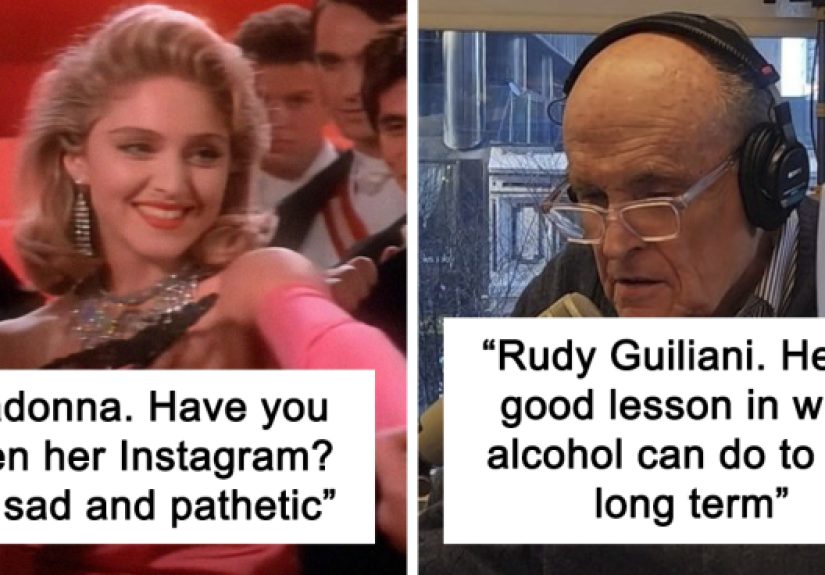
- Britney-era adjunct icon Madonna Madonna has always understood the value of provocation, but in the social-media age, even her smaller stunts can spark outsized reactions. Online commenters often read her posts as proof she is still determined to out-weird everyone in the room.
The Perpetual Backlash Club
- Ellen DeGeneres For years, Ellen’s image was built on kindness, which is exactly why the toxic-workplace backlash landed like a piano from the sky. Once the wholesome mask cracked, online audiences treated every smile like it came with a customer-service complaint form.
- Lea Michele Michele’s reputation took a serious hit when former castmates accused her of deeply unpleasant behavior. The internet, naturally, turned that into both accountability discourse and an endless fountain of memes.
- Sharon Osbourne Loud opinions were always part of the brand, but the fallout from The Talk made her look less blunt truth-teller and more full-time controversy machine. Online reactions were swift, brutal, and very much not subtle.
- Gina Rodriguez Rodriguez once had a highly likable image, but repeated backlash moments made some online observers feel that she kept stepping into the same mess with new shoes on. The perception became: talented, but chronically bad at reading the room.
- Sia The backlash over Music shifted public discussion around Sia almost overnight. What had once looked like eccentric artistry started getting reframed online as tone-deafness wrapped in self-confidence.
- Rachel Zegler Zegler has often faced culture-war outrage that says as much about the internet as it does about her. Still, critics online have treated her interviews, political comments, and Snow White press moments as proof she is somehow “too much” for modern fame.
The Ones Who Make the Internet Ask, “Is This a Bit?”
- Doja Cat Doja can be brilliant, funny, and musically fearless, but her relationship with fans and critics has often looked like a live-fire experiment. She has a gift for turning one post into three days of internet anthropology.
- Lana Del Rey When Lana posts a statement, the internet braces itself like a town hearing a tornado siren. Her essays, feuds, and defensive clarifications often create as much discussion as her music.
- Tom Cruise Cruise’s couch-jumping era still lives rent-free in online memory. Add the endless fascination with Scientology and his hyper-intense public persona, and people still talk about him like he is Hollywood’s most polished mystery box.
- Jared Leto Method acting stories, guru-like vibes, and “is this man secretly running a desert cult?” jokes have followed Leto for years. Even when he is doing ordinary celebrity things, the internet assumes there is probably a velvet robe involved.
- David Dobrik Dobrik’s image once rested on cheerful chaos, but later controversies made that chaos look a lot less cute. For many online viewers, he became an example of how creator culture can hide bad judgment behind a grin.
- Karla Sofía Gascón Her awards-season backlash showed how quickly online admiration can flip into reputational freefall. In the age of resurfaced posts and instant judgment, public favor can vanish faster than a free canapé at an after-party.
What These Celebrity Controversies Actually Reveal
The easiest version of this story is to laugh and say, “Yep, they lost it.” But celebrity controversy is rarely that simple. Public backlash can be justified when stars say or do harmful things. It can also become weirdly addictive, turning ordinary audiences into unpaid crisis managers with Wi-Fi. The internet loves certainty, and “this person has completely lost it” is a very efficient shortcut to certainty.
But fame distortion is real. Some stars on this list damaged their own image through offensive remarks, reckless behavior, or repeated self-sabotage. Others were flattened into memes because they were awkward, overexposed, politically divisive, or simply too easy to mock. The crowd often treats all of those situations as the same thing, even when they are absolutely not.
That is why celebrity meltdowns remain such potent SEO fuel and pop-culture catnip. They combine scandal, psychology, power, image-making, and the universal comfort of thinking, “At least my group chat is calmer than theirs.” In a digital world built on reaction, stars who seem to be unraveling become irresistible content. Fairly or unfairly, they stop being people and become plotlines.
The Experience of Watching a Celebrity “Lose It” Online
There is a very specific feeling that comes with watching a celebrity scandal unfold in real time. First comes confusion. You open your phone expecting recipes, sports scores, or maybe a dog in rain boots, and instead the entire internet is yelling about an actor’s podcast clip, a singer’s late-night rant, or a baffling Instagram Live that looks like it was filmed inside a haunted candle shop. Then comes the avalanche. Think pieces. Fan edits. Apology analysis. “I have a thread.” “Here’s what you missed.” “Actually, as someone who has followed this since 2016…” Before long, you are ten tabs deep into a full cultural autopsy on a person you did not think about yesterday.
What makes the experience so gripping is not just the scandal itself. It is the speed of collective storytelling. The internet is incredibly good at taking fragmentsa clip, a quote, a screenshot, one badly punctuated captionand turning them into a complete narrative. Suddenly, everyone agrees that a celebrity is spiraling, washed, doomed, unwell, unserious, or secretly in their villain era. It is a group project with terrible boundaries and suspiciously high participation.
There is also a strange emotional whiplash in it. Sometimes the scandal feels ridiculous, and people treat it like entertainment with extra GIFs. Other times, the tone shifts and you realize you are watching real pain flattened into meme format. That is the uncomfortable part of celebrity culture online: the audience is rarely just observing. It is participating, escalating, rewarding, and remixing. The comments become part of the event. In a lot of cases, the public reaction is not just a response to the meltdown. It is one of the reasons the meltdown keeps expanding.
And yet people keep watching, because celebrity controversy offers a weird mix of morality play and improv comedy. It lets audiences judge bad behavior, defend favorites, roast hypocrisy, and perform cultural intelligence all at once. Everyone gets to be critic, therapist, publicist, and stand-up comic. It is deeply modern and a little absurd. Watching a celebrity “lose it” online often says as much about us as it does about them: our appetite for spectacle, our love of instant conclusions, and our confidence that a trending topic equals total understanding.
Maybe that is why these stories stick. They are not just about famous people behaving badly or strangely. They are about how the internet processes fame itselfmercilessly, theatrically, and with the patience of a caffeinated squirrel. One misstep becomes a personality. One scandal becomes a brand. One rough season becomes a meme that follows someone for years. And the audience, pretending to be shocked every time, somehow always shows up early for the next episode.
Conclusion
The internet loves declaring that a celebrity has “completely lost it,” but that phrase is usually a cocktail of truth, exaggeration, boredom, outrage, and algorithmic chaos. Some stars genuinely torched their reputation. Others became lightning rods because modern fame turns every mistake into a global spectator event. Either way, the public keeps coming back for celebrity meltdowns, online backlash, and social media scandals because they are messy, dramatic, and impossible to ignore.
The funniest part? Today’s “they’re done forever” headline is often tomorrow’s comeback trailer. In celebrity culture, chaos is rarely the end of the story. Sometimes it is just the loudest chapter.