Table of Contents >> Show >> Hide
- Before You Start: The 5-Minute Shelf Reset That Makes Everything Easier
- 19 Effortless Ways to Style Your Bookshelves
- 1) Start with a mini purge (yes, even if it hurts a little)
- 2) Pick a “shelf color story” (so your bookcase decor stops arguing with itself)
- 3) Mix vertical and horizontal book stacks
- 4) Use the “stack + topper” move
- 5) Group decor in odd numbers (the “Rule of Three” that saves you from awkward pairs)
- 6) Give each shelf one “anchor” piece
- 7) Layer front-to-back (not just left-to-right)
- 8) Add something living (or at least convincingly green)
- 9) Lean art instead of hanging it (effortless and renter-friendly)
- 10) Mix textures for a collected look
- 11) Use bookends as punctuation marks
- 12) Hide small clutter in pretty boxes or baskets
- 13) Create one “spotlight shelf” with your favorites
- 14) Flip a few books around (spines in, pages out) for a calmer look
- 15) Leave breathing room (negative space is a design tool)
- 16) Repeat one material to make everything feel cohesive
- 17) Vary heights on purpose (so shelves don’t look like a lineup)
- 18) Add lighting for instant “wow” (and to make your shelves feel expensive)
- 19) Rotate items seasonally (without redecorating your entire life)
- Common Bookshelf Styling Mistakes (and Quick Fixes)
- Room-by-Room Mini Styling Recipes
- Real-World Bookshelf Styling Experiences That Tend to Work (and Why)
- Conclusion
A bookshelf can be many things: a personal library, a memory wall, a “look at me, I read” flex, andlet’s be honestsometimes a very organized dust-catcher.
The good news? Styling bookshelves isn’t about buying a truckload of trendy objects or arranging books by the emotional arc of your life.
It’s mostly about balance, variety, and breathing roomplus a few easy tricks that make your shelves look curated instead of chaotic.
Below are 19 effortless bookshelf styling ideas you can use on built-in bookshelves, a bookcase, open shelving, or that one lonely shelf you keep meaning to “do something with.”
Each tip is quick, practical, and designed to help you decorate a bookcase in a way that feels lived-in (in a good way).
Before You Start: The 5-Minute Shelf Reset That Makes Everything Easier
If you try to “style” shelves while everything is still piled on them, you’ll just rearrange clutter into a new and exciting shape.
Do this quick reset first:
- Clear one shelf at a time. Don’t empty the entire bookcase unless you enjoy chaos as a hobby.
- Make three piles: Keep, Move Elsewhere, Donate/Store. (Be brave. Your shelves can’t breathe through guilt.)
- Pick a simple palette. Choose 2–3 main colors plus one “metal” (brass/black/chrome) to keep the display cohesive.
- Choose a few anchors. Big pieces first (a bowl, vase, framed art, basket). Small pieces come later.
- Leave space on purpose. Negative space is not “unfinished.” It’s the design equivalent of taking a deep breath.
19 Effortless Ways to Style Your Bookshelves
1) Start with a mini purge (yes, even if it hurts a little)
The fastest way to make shelves look stylish is to remove what doesn’t belong there. Toss obvious strays (random cords, mystery keys, a single sock)
and relocate items that don’t support your shelf’s job: storage + display. A less crowded shelf instantly looks more intentionaland it’s easier to clean.
2) Pick a “shelf color story” (so your bookcase decor stops arguing with itself)
Choose a simple color direction: neutral + one accent, warm earth tones, black-and-white with one pop, or soft monochrome.
This doesn’t mean everything must matchjust that the overall bookshelf arrangement feels coordinated. If the room already has a strong color, borrow it for the shelves.
3) Mix vertical and horizontal book stacks
Alternating upright books with a few horizontal stacks adds rhythm and breaks up “library wall” stiffness. Horizontal stacks also create platforms for decor
(a small bowl, candle, or framed photo). If your shelves look flat, this is the easiest fixno new purchases required.
4) Use the “stack + topper” move
A simple formula designers love: stack 2–4 books horizontally, then place one object on top (a small sculpture, lidded box, candle, or souvenir).
It instantly creates a mini vignette and gives your bookshelf styling a deliberate, layered looklike you meant to do it all along.
5) Group decor in odd numbers (the “Rule of Three” that saves you from awkward pairs)
Odd-number groupingsespecially threestend to look more natural and less staged. Try a trio with varied heights (tall, medium, low),
or keep the shapes similar but change textures (glass + ceramic + wood). It’s a quick way to create balance without measuring anything.
6) Give each shelf one “anchor” piece
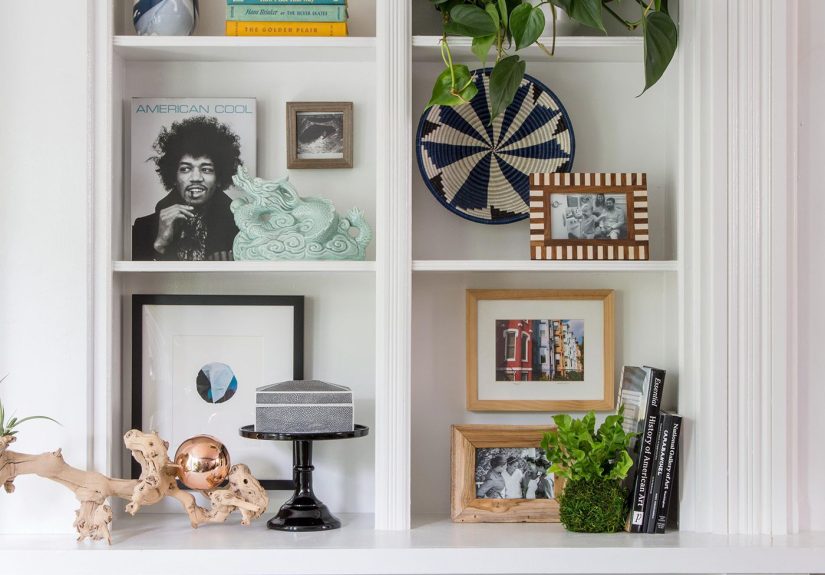
Anchors are larger items that visually ground a shelf: a vase, basket, framed art, or chunky object. Place an anchor first, then build around it with books and smaller pieces.
Without anchors, shelves can look like a bunch of tiny objects having a meeting with no agenda.
7) Layer front-to-back (not just left-to-right)
Depth makes shelves look designer-level. Lean a frame or small artwork at the back, place a shorter object in front, and tuck a book stack to the side.
Even an inch of overlap creates dimensionlike your shelves graduated from “flat display” to “styled moment.”
8) Add something living (or at least convincingly green)
Plants soften hard lines and make bookcase decor feel fresh. A trailing pothos, small snake plant, or a simple vase of greenery works wonders.
If you’re not into plant care, faux can still look greatjust pick realistic stems and avoid anything that screams “plastic salad.”
9) Lean art instead of hanging it (effortless and renter-friendly)
Bookshelves are perfect for “leaned” frames, small canvases, or prints. This adds height, breaks up book spines, and gives your shelves a gallery-like feel.
Bonus: no nails, no measuring, no existential dread over crooked wall art.
10) Mix textures for a collected look
Texture is what turns shelves from “stored items” into “styled shelves.” Combine smooth (glass), matte (ceramic), warm (wood), and woven (basket/box).
Even if your palette is neutral, texture keeps the shelf interestinglike a quiet outfit with really good accessories.
11) Use bookends as punctuation marks
Bookends add structure and stop books from slumping like they just heard bad news. Choose bookends that match your style:
stone for modern, brass for classic, wood for cozy, or sculptural for artsy. They’re functional decoraka the holy grail of shelf styling.
12) Hide small clutter in pretty boxes or baskets
Not everything on a bookshelf needs to be visible. Use lidded boxes, bins, or baskets for cords, remotes, notebooks, or kids’ small toys.
This keeps the shelf clean while still being practicalespecially in living rooms and home offices.
13) Create one “spotlight shelf” with your favorites
Pick one shelf and make it the star: your best photo, a special object, a small art piece, and maybe a tiny stack of books.
This gives the eye a destination and makes the whole bookcase feel intentional, even if other shelves are more storage-heavy.
14) Flip a few books around (spines in, pages out) for a calmer look
If your book spines feel visually noisy, try turning a small section backward so the page edges face out. Do it sparingly (think: one short group per shelf),
so it reads as a styling choice, not a publishing industry protest.
15) Leave breathing room (negative space is a design tool)
A well-styled shelf isn’t packed edge-to-edge. Aim to leave some open space so objects can “stand alone” and feel special.
If you’re not sure how much space to leave, remove one item per shelf and see if the whole bookcase looks instantly calmer. It usually does.
16) Repeat one material to make everything feel cohesive
Repetition is the cheat code for cohesion. Repeat a metal finish (like brass), a ceramic color (white), or a natural element (wood) across multiple shelves.
Your decor doesn’t need to matchjust “rhyme” visually.
17) Vary heights on purpose (so shelves don’t look like a lineup)
Too many items at the same height looks stiff. Mix tall objects (vase, frame) with medium items (stacked books) and smaller accents (a bowl).
Height variation is one of the quickest ways to make built-in bookshelves look professionally styled.
18) Add lighting for instant “wow” (and to make your shelves feel expensive)
A small picture light, battery puck lights, or subtle LED strips can transform shelves at night. Lighting adds depth and highlights your favorite pieces,
turning “book storage” into “design feature.” It’s the easiest way to make a bookcase feel like it belongs in a magazine spread.
19) Rotate items seasonally (without redecorating your entire life)
Instead of buying more, rotate what you already own. Swap out a few objects every season: a small vase in spring, a textured bowl in fall,
framed family photos for holidays, or travel souvenirs after a trip. Your shelves stay freshand you don’t end up with 14 decorative owls for no reason.
Common Bookshelf Styling Mistakes (and Quick Fixes)
- Mistake: Only books, no breaks. Fix: Add 1–2 decor pieces per shelf and vary stacking directions.
- Mistake: Everything is tiny. Fix: Add one larger anchor per shelf (basket, vase, framed art).
- Mistake: No depth. Fix: Layer items front-to-back with leaned art and overlapping objects.
- Mistake: Too many competing colors. Fix: Choose a simple palette and repeat one material/finish.
- Mistake: Shelves feel cluttered. Fix: Add breathing room and hide small items in boxes/baskets.
Room-by-Room Mini Styling Recipes
Living Room Built-Ins
Start with two anchors (a basket and a large vase), add mixed book stacks, lean one framed piece, then sprinkle in 3–5 smaller objects.
Keep at least one shelf more open so the whole wall feels relaxednot like it’s trying too hard.
Home Office Bookcase
Mix reference books with practical storage: two matching boxes for paperwork, one plant for softness, and one personal item (photo, award, souvenir)
to keep the space from feeling purely transactional.
Bedroom Shelves
Keep it calm: a small stack of books, a candle or diffuser, a framed photo, and one textural element (woven box, ceramic bowl).
Bedrooms look best when shelves feel restfulnot like a retail display shouting “BUY MORE PILLOWS.”
Real-World Bookshelf Styling Experiences That Tend to Work (and Why)
In real homes (not showroom-perfect ones), bookshelf styling usually succeeds when it respects how people actually live. One common scenario is the
family-room shelf that has to multitask: books, board games, school papers, and a few sentimental items all competing for space.
The most effective approach is to blend open display with hidden storage. A couple of baskets or lidded boxes instantly “quiet” the visual noise,
while leaving one or two shelves for the good-looking stuff (framed photos, a plant, a sculptural object). The shelf feels curated, but it still functions.
Another frequent situation: the renter bookcaseoften an affordable, modular shelf that’s doing its best. In these setups, styling looks best when you
create a clear rhythm: alternating vertical books and horizontal stacks, repeating one color family, and adding a few larger items so the shelf doesn’t feel
like a grid of small things. People often find that one “hero” moment (leaned art + stack + topper) makes the entire unit look more intentionaleven if the
rest is simple.
Then there’s the home office shelf problem: lots of necessary items that are not naturally photogenic (binders, printers, cables).
The fix that consistently helps is “containment.” When paper goods go into matching boxes and cables hide behind a basket, the shelf stops looking like an
IT department and starts looking like decor. A small plant or a piece of art softens the functional vibe, and suddenly the office feels like a roomnot a task list.
In kids’ rooms, the most successful bookshelf arrangement usually accepts reality: books will be pulled out, toys will migrate, and perfection will not
survive bedtime. Styling works best when the bottom shelves are sturdy and easy (bins for toys, board books in stacks), while the upper shelves hold lighter decor
and a few “special” items. This makes the shelf look cute while staying kid-proof.
Finally, in small apartments, shelves often become identity spacethe place where someone shows what they love. That’s where the “collected over time”
look shines. Mixing books with souvenirs, artwork, and meaningful objects tends to feel warmer than a strict color-coded setup. The trick is to keep breathing room
and repeat one element (a shared wood tone, consistent frames, or a recurring ceramic color) so personal collections look curated rather than cluttered.
Across all these real-life setups, the pattern is the same: shelves look best when they have anchors, variety, and space.
You don’t need more stuffyou need clearer choices. Curate what you already have, contain what you must store, and let a few favorite pieces actually stand out.
That’s the difference between “I own things” and “I styled this.”
Conclusion
If you remember only three things, make it these: mix your stacks, vary your heights, and leave breathing room.
Bookshelf styling isn’t about perfectionit’s about making your shelves feel like they belong to you. Start with one shelf, try two or three tips, and stop
the moment it looks better than it did 15 minutes ago. That’s not quitting. That’s efficient decorating.