Table of Contents >> Show >> Hide
- Why Future Predictions Go Off the Rails So Easily
- 15 Really Inaccurate Predictions About The Future
- 1. Human Flight Was Still Ages Away
- 2. Television Would Not Hold People’s Attention
- 3. Shopping by Computer Would Be a Flop
- 4. The Paperless Office Would Arrive Quickly
- 5. The House of the Year 2000 Would Be Basically Self-Washing
- 6. Robot Housemaids Would Handle Domestic Life by 2001
- 7. Flying Cars Would Be Normal by Now
- 8. Moon Colonies Would Be a Routine Part of Life
- 9. Newspapers Would Evolve in Very Weird but Very Wrong Ways
- 10. The Internet Would Not Change Much
- 11. The Internet’s Economic Impact Would Be No Greater Than the Fax Machine
- 12. The Internet Would Collapse Under Its Own Weight
- 13. Video Stores, Mailmen, and Other Everyday Fixtures Would Vanish Exactly on Schedule
- 14. Computerized Schools Would Replace Traditional Learning Environments
- 15. Productivity Would Give Us a 15-Hour Workweek
- What These Failed Forecasts Really Teach Us
- Experiences of Living Through Predictions That Never Came True
- Conclusion
- SEO Tags
Predicting the future is one of humanity’s favorite hobbies. Right up there with arguing about pizza toppings and pretending we understand what “synergy” means in a meeting. We love forecasts because they make the chaos of tomorrow feel manageable today. The trouble is, tomorrow has a nasty habit of showing up wearing a completely different outfit.
For more than a century, inventors, economists, media executives, scientists, and professional Very Serious People have tried to tell us what was coming next. Sometimes they nailed it. More often, they swung hard, missed badly, and left behind a wonderfully awkward trail of confidence. That is what makes failed predictions so fascinating: they do not just reveal what people got wrong. They reveal what each era hoped for, feared, and wildly misunderstood.
This article looks at 15 famously inaccurate predictions about the future, from airplanes that supposedly would not arrive anytime soon to internet forecasts that aged like milk left on a radiator. Along the way, we get a fun reminder that the future rarely arrives in the neat, shiny package people expect. It usually barges in through the side door, carrying a smartphone, a food delivery app, and a problem nobody saw coming.
Why Future Predictions Go Off the Rails So Easily
Most bad forecasts fail for one simple reason: people assume tomorrow will behave politely. They expect technology to evolve in a straight line, consumers to act rationally, and society to adopt inventions exactly on schedule. Real life, of course, is more like a raccoon in a grocery store. It moves fast, ignores the plan, and somehow gets into everything.
Some predictions fail because they underestimate change. Others fail because they overestimate how quickly humans will embrace something new. And many fail because they focus on the flashy part of innovation while ignoring the boring stuff that actually decides everything, such as cost, infrastructure, convenience, habits, laws, and whether anybody wants the thing in the first place.
15 Really Inaccurate Predictions About The Future
1. Human Flight Was Still Ages Away
One of the most deliciously wrong forecasts in history came just before the Wright brothers proved powered flight was real. In the early 1900s, influential skeptics argued that practical flying machines were still far in the future. Then Orville and Wilbur Wright did what history’s best disruptors always do: they ignored the memo and changed the world anyway.
The lesson here is timeless. Experts are often great at explaining why a breakthrough should not work right up until the second it does. Aviation did not take millions of years to develop. It took persistence, engineering, and two brothers who were apparently allergic to being told “not yet.”
2. Television Would Not Hold People’s Attention
There was once real skepticism that television would amount to much. The logic sounded reasonable at the time: why would people spend night after night staring at a box in their living room? As it turns out, they absolutely would. They would also later stare at smaller boxes in their bedrooms, kitchens, cars, and palms.
This failed prediction is a classic case of misunderstanding behavior. People were not buying television because it was technically impressive. They were buying convenience, entertainment, routine, and the ability to consume stories without leaving the couch. Humanity did not reject the screen. Humanity upgraded the addiction.
3. Shopping by Computer Would Be a Flop
Mid-century visions of the future loved the idea of futuristic commerce, but even later commentators doubted electronic shopping would become a major habit. That skepticism now looks adorable. Online shopping did not just survive. It rewired retail, logistics, advertising, customer reviews, and the modern meaning of the phrase “I’m just browsing.”
The error was assuming shopping was only about physical presence. In reality, plenty of consumers were happy to trade store aisles for speed, selection, home delivery, and not having to listen to bad mall music under fluorescent lights.
4. The Paperless Office Would Arrive Quickly
Ah yes, the paperless office: one of the most persistent fantasies of the digital age. For decades, office automation was supposed to eliminate paper. Instead, printers multiplied like rabbits with management titles. Digital systems made it easier to create documents, which often meant people printed even more of them.
This prediction failed because it treated technology as a replacement when it often acts like an amplifier. Computers did not kill paper overnight. They made producing, editing, sharing, and yes, printing information dramatically easier. The office became more digital, but not nearly as paper-free as the prophets promised.
5. The House of the Year 2000 Would Be Basically Self-Washing
Popular visions of the future home once imagined a domestic paradise full of miracle materials and effortless cleaning. One especially memorable concept imagined interiors you could clean by simply hosing everything down. Furniture, rugs, walls, and floors were expected to shrug off water like a duck in a raincoat.
It was optimistic, strange, and somehow both futuristic and deeply inconvenient. Most people, it turns out, did not dream of turning their homes into indoor car washes. We did get better appliances, smart devices, and robotic vacuums. We did not get a living room designed like a public swimming pool.
6. Robot Housemaids Would Handle Domestic Life by 2001
Mid-century future media loved robot servants. The assumption was simple: household labor would soon be delegated to obedient machines that cooked meals, cleaned rooms, and quietly made human life more elegant. Instead, we got Roombas bumping into chair legs and smart speakers occasionally mishearing us with stunning confidence.
This is not total failure so much as a reminder that automation tends to arrive in fragments. The future rarely gives us one glamorous robot butler. It gives us fifty annoying little tools, five useful apps, and a vacuum that gets trapped under the couch like a metal turtle.
7. Flying Cars Would Be Normal by Now
Few retro-future ideas are as famous as the flying car. Films, magazines, TV shows, and futurists all treated airborne personal transportation as a near-inevitable upgrade from the family sedan. The image was irresistible: every driveway doubled as a launch pad, and traffic jams migrated vertically.
In practice, flying cars ran into a few tiny complications, such as safety, noise, regulation, cost, infrastructure, energy use, and the uncomfortable fact that many people are already alarming enough in two dimensions. We did not get a flying car in every garage. We got better navigation apps and more realistic expectations.
8. Moon Colonies Would Be a Routine Part of Life
The Space Age produced a tidal wave of optimism. Once astronauts reached the moon, many people assumed permanent lunar bases, large-scale colonies, and ordinary civilian activity in space were just around the corner. Some visions imagined that by the turn of the century, living off-world would feel like a natural next step.
Instead, space exploration proved far more expensive, politically fragile, and logistically brutal than glossy visions suggested. The moon did not become suburbia with craters. The future of space turned out to be less “family vacation on Lunar Street” and more “careful funding debate followed by engineers sweating politely.”
9. Newspapers Would Evolve in Very Weird but Very Wrong Ways
People have long tried to imagine the newspaper of tomorrow. Some thought it would arrive via home printers, special broadcast systems, or futuristic devices that looked like props from a science fiction movie. While digital news absolutely transformed the industry, many detailed predictions about format and delivery now look wonderfully off-target.
The broader idea of digital news was not wrong. The exact shape of it was. The future did not care much about our lovingly designed fantasy gadgets. It preferred the brutally simple model of phones, apps, feeds, and links shared at unreasonable speed.
10. The Internet Would Not Change Much
In the 1990s, several public skeptics dismissed the internet as overhyped. One especially famous argument insisted that online databases would not replace newspapers, digital tools would not replace teachers, and computer networks would not fundamentally change government or commerce. The internet then responded by changing nearly everything it touched.
To be fair, not every early concern was foolish. The web did create noise, scams, misinformation, and a glorious mountain of nonsense. But as a prediction, the idea that the internet would remain a marginal curiosity was spectacularly wrong. The network did not stay niche. It became the nervous system of modern life.
11. The Internet’s Economic Impact Would Be No Greater Than the Fax Machine
This is one of those quotes that keeps resurfacing because it remains such a perfect monument to underestimation. In the late 1990s, the claim was that the internet’s impact on the economy would be modest, roughly comparable to the fax machine. That did not happen. Not even close. Not in the same galaxy. Not in the same postal code.
The internet reshaped labor, media, software, retail, finance, marketing, communication, entertainment, and global business models. Fax machines, meanwhile, mostly became symbols of offices that still smell faintly like toner and despair.
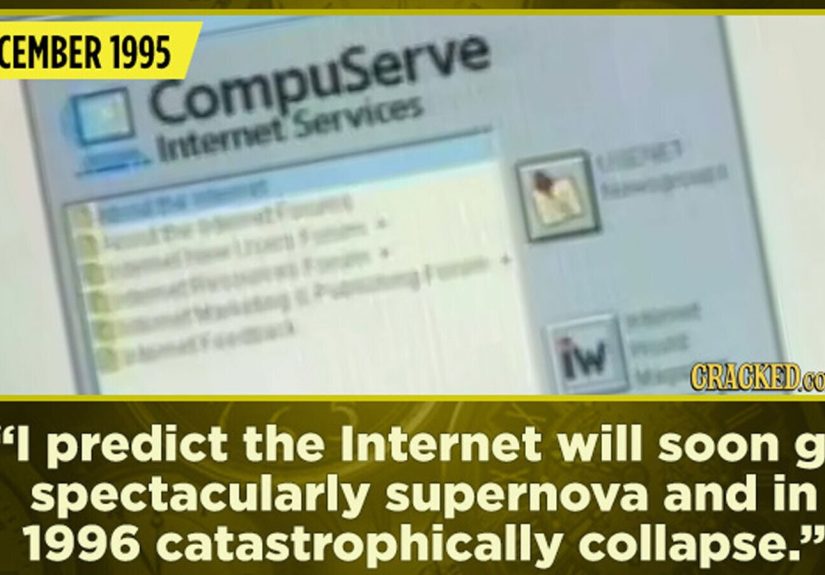
12. The Internet Would Collapse Under Its Own Weight
Another bold internet forecast predicted a catastrophic collapse as traffic volumes exploded. It is an understandable fear in hindsight. Early internet infrastructure was messy, growth was intense, and nobody had a perfect view of how the system would scale. Still, the dramatic collapse never arrived.
What happened instead was more boring and more important: infrastructure improved, protocols matured, investment expanded, and engineers did what engineers do best when civilization starts leaning too hard on cables. They kept patching the ship while everyone else was busy inventing memes.
13. Video Stores, Mailmen, and Other Everyday Fixtures Would Vanish Exactly on Schedule
Late-1980s future features loved to predict which familiar parts of daily life would disappear by the year 2000. Some guesses were directionally smart but hilariously premature. Yes, video stores eventually declined. Yes, many forms of media went digital. But the future did not follow the published timetable with obedient precision.
This is another common forecasting failure: confusing “eventually” with “very soon.” A trend can be real and still arrive late, unevenly, or in a form nobody initially imagined. History is full of correct instincts paired with terrible calendars.
14. Computerized Schools Would Replace Traditional Learning Environments
For decades, futurists imagined classrooms run largely by machines, automated systems, and highly individualized computer instruction. Some of that vision was not absurd. Educational technology did grow dramatically. Digital tools, remote learning, and online resources became central in many places.
But the idea that teachers, classrooms, and human-centered instruction would fade quickly was badly off. Education is not just content delivery. It is social structure, guidance, emotion, discipline, mentorship, and community. A machine can quiz you. It is much worse at noticing you are confused, bored, anxious, or secretly trying to open another tab.
15. Productivity Would Give Us a 15-Hour Workweek
One of the most appealing failed predictions came from economic optimism: as productivity rose, work hours would shrink dramatically, eventually giving people much shorter workweeks. On paper, it sounded plausible. If machines and systems made labor more efficient, surely people would work less and live more.
What actually happened was more complicated. Productivity gains did not automatically become leisure. They became profits, expectations, email, side hustles, performance dashboards, and the bizarre cultural achievement of making people reachable at all times. We were promised more free time. We got calendar invites.
What These Failed Forecasts Really Teach Us
The funniest thing about bad predictions is that they are often made by smart people using logical assumptions. That is why they are worth studying. They show how hard it is to anticipate second-order effects. People may predict the gadget correctly but miss the culture around it. They may foresee the trend but misjudge the timing. Or they may focus on what is technically possible while forgetting what is socially tolerable, economically viable, and humanly desirable.
In other words, the future is not just an engineering problem. It is a people problem. A flying car is not merely an invention. It is also insurance paperwork, urban planning, legal standards, maintenance costs, public fear, and one guy who absolutely should not be piloting anything over your roof.
Experiences of Living Through Predictions That Never Came True
If you have lived through even one decade of aggressive future-hype, you know the feeling. You grow up hearing that adulthood will arrive with moon vacations, robot maids, instant healthy meals in pill form, and a life so efficient you will barely need to fold a shirt again. Then the actual future arrives and hands you forty passwords, three subscriptions, a charger that only works at one angle, and a coffee maker with software updates.
There is a strange emotional arc to these missed predictions. At first, they are exciting. They make the future sound glamorous and organized, like humanity is heading toward a sleek chrome finish. Then time passes. The date in those predictions comes and goes. Nobody is commuting in a bubble dome to a lunar office park. Nobody is cleaning the den with a built-in wall hose. And nobody has been liberated into a blissful 15-hour workweek unless they are a very lucky cat.
But there is also something oddly comforting about these failed forecasts. They remind us that every generation is a little ridiculous about tomorrow. People in the 1950s pictured push-button perfection. People in the 1990s imagined the internet as either a toy or a total meltdown machine. People in the 2000s thought certain gadgets would instantly replace old habits that had far more staying power than expected. We all do this. We all assume history is about to become cleaner, simpler, and more dramatic than it really is.
Living through the gap between prediction and reality can be funny, but it can also be useful. You start noticing that technological change is rarely a neat swap. The old and the new overlap for years. Paper survives the paperless revolution. Stores survive online retail. Teachers survive software. Cars stay on roads even while people keep trying to yeet them into the sky. The future is less like a sudden costume change and more like a closet explosion where every era keeps wearing part of the last one.
There is also the personal side of it. Plenty of people built careers, investments, and expectations around what they thought was inevitable. Some prepared for a totally digital world that stayed stubbornly physical. Some dismissed inventions that later became essential. Some expected automation to free up time and instead found themselves working faster, longer, and under more digital supervision than ever. The future was not fake, exactly. It was just badly translated.
And maybe that is the most human experience of all. We do not simply predict the future. We project ourselves into it. Our hopes, anxieties, class assumptions, blind spots, and favorite toys all get packed into those forecasts. That is why old predictions feel like time capsules with ego attached. They tell us what people valued, what they feared losing, and what they thought progress should look like.
So when a modern expert confidently explains what life will definitely look like in 2045, enjoy it. Listen carefully. Take notes if you want. Then leave a little room for humility, because history suggests the future is already warming up in the hallway, preparing to ignore half the script and improvise the rest.
Conclusion
The future has always been a terrible listener. That is why inaccurate predictions are more than historical bloopers. They are clues about how humans think, dream, and overestimate their own certainty. From flying cars to paperless offices to internet skepticism, the biggest misses usually happen when people confuse possibility with inevitability, or trend lines with destiny.
So the next time someone says they know exactly what the future will look like, smile politely. They may be right. But history suggests there is an excellent chance the future is about to do something far stranger, far messier, and much more interesting.