Table of Contents >> Show >> Hide
- Why Ancient Cosmic Discoveries Matter
- 1. The Cosmic Microwave Background: The Oldest Light We Can See
- 2. The Hubble Ultra Deep Field: A Tiny Patch of Sky Packed With Ancient Galaxies
- 3. JADES and the Flood of Early Galaxies
- 4. MoM-z14: A Galaxy From Just 280 Million Years After the Big Bang
- 5. JADES-GS-z13-1 and the Galaxy That Seemed to Clear the Fog
- 6. Zhúlóng: A Spiral Galaxy That Grew Up Ridiculously Early
- 7. The Earliest Monster Black Holes
- 8. Hubble’s Ancient White Dwarfs: The Milky Way’s Old Clockwork Stars
- 9. The Methuselah Star: A Neighbor From the Universe’s Early Years
- 10. Ancient Planetary Systems: Kepler-444 and the Surprise of Early Planets
- What These Ancient Discoveries Are Really Telling Us
- Conclusion
- Human Experiences Inspired by Ancient Cosmic Discoveries
Space has a funny habit of making humans feel both wildly important and hilariously tiny at the same time. One minute we are arguing over phone chargers; the next, a telescope shows us a galaxy whose light started traveling before Earth even existed. That is the magic of ancient cosmic discoveries. They are not just pretty pictures with dramatic captions. They are time machines, evidence lockers, and reality checks rolled into one. When astronomers find the oldest light, the earliest galaxies, or stars that formed not long after the Big Bang, they are not simply collecting cosmic antiques. They are reconstructing the universe’s baby photos, awkward teenage years, and everything in between.
What makes these discoveries so compelling is that “ancient” in astronomy is not a marketing adjective. It is measurable. The farther away an object is, the longer its light has taken to reach us. That means looking deeper into space is also looking farther back in time. So yes, astronomers are technically historians with much better equipment and fewer dusty archives. Below are ten of the most amazingly ancient cosmic discoveries that continue to reshape what we know about the early universe, the oldest stars, and the surprisingly early arrival of complex cosmic structures.
Why Ancient Cosmic Discoveries Matter
Ancient discoveries tell us how the universe went from a hot, dense beginning to a place filled with galaxies, stars, planets, and eventually people who use phrases like “galactic vibes” without irony. Every early object that astronomers detect helps answer big questions. How quickly did galaxies form? When did the first stars ignite? How early did black holes become enormous? Could rocky planets have existed billions of years before Earth? These findings matter because the early universe was not supposed to be so busy, bright, and structurally ambitious quite so fast. Yet again and again, observations have shown that the cosmos apparently does not enjoy being underestimated.
What Scientists Mean by “Ancient”
In this article, “ancient” refers to light or objects that date back to the universe’s earliest eras, as well as stars and planetary systems that formed astonishingly early in cosmic history. Some of these discoveries come from when the universe was only a few hundred million years old. Others are nearby objects that survived for more than 12 or 13 billion years. Together, they form a kind of cosmic archaeological record.
1. The Cosmic Microwave Background: The Oldest Light We Can See
If the universe had a baby picture, this would be it. The cosmic microwave background, or CMB, is the oldest light astronomers can directly observe. It was imprinted on the sky when the universe was about 370,000 years old, which in cosmic terms is practically infancy. Before that, the universe was too hot and crowded for light to move freely. Once things cooled enough for atoms to form, light finally escaped and began its 13.8-billion-year road trip to us.
Maps of the CMB revealed tiny temperature differences across the sky. Those fluctuations may sound unimpressive, but they are the seeds of everything that came later: stars, galaxies, clusters, and eventually us. Without them, the universe would have been a remarkably boring soup. The CMB remains one of the greatest ancient cosmic discoveries because it gives scientists a direct look at the universe before stars existed and long before galaxies put on their show.
2. The Hubble Ultra Deep Field: A Tiny Patch of Sky Packed With Ancient Galaxies
The Hubble Ultra Deep Field proved that the universe is not empty just because a patch of sky looks dark to our eyes. In one famous long exposure, Hubble stared at a tiny region of space for about a million seconds and uncovered a staggering number of distant galaxies. Many of them existed when the universe was relatively young, including some of the first galaxies to emerge from the cosmic “dark ages.”
This discovery changed how people visualize deep space. That tiny patch of apparent nothing turned out to be crowded with ancient galactic neighborhoods. Even better, the image showed that galaxy formation was already underway not long after the first stars began reheating the universe. The Ultra Deep Field became a landmark in astronomy because it turned an abstract idea into something visible: when you look deep enough, the universe starts handing over its oldest secrets.
3. JADES and the Flood of Early Galaxies
Once the James Webb Space Telescope joined the cosmic detective squad, things got even more interesting. The JADES survey uncovered hundreds of galaxies in the early universe, including hundreds at very high redshift and some seen when the cosmos was only a few hundred million years old. This was not just one discovery. It was a whole parade of ancient galaxies marching out of the dark saying, “Actually, we got here early.”
Why is that a big deal? Because earlier models suggested that the first galaxies would be faint, scarce, and hard to find. Instead, astronomers found many more than expected. That means galaxy formation may have gotten underway faster or more efficiently than theorists predicted. JADES did not just push the frontier outward. It made the frontier crowded. For anyone who likes scientific humility, this was a great moment. For theoretical models, it was a slightly awkward performance review.
4. MoM-z14: A Galaxy From Just 280 Million Years After the Big Bang
MoM-z14 is one of the most ancient galaxies ever confirmed, seen as it appeared only about 280 million years after the Big Bang. That is shockingly early. At that time, the universe was still in what astronomers call cosmic dawn, when the first generations of stars and galaxies were beginning to transform the primordial darkness.
What really made MoM-z14 buzzworthy was not just its age, but its brightness and chemistry. Webb data suggested a galaxy that seemed more evolved than many researchers expected for such an early time. In plain English, this object looked like the universe had skipped a few steps in the instruction manual. If galaxies this bright and chemically developed existed that early, then the timeline of early galaxy growth may need revising. Ancient cosmic discoveries are always fun, but the ones that make scientists mutter “well, that’s odd” are especially delicious.
5. JADES-GS-z13-1 and the Galaxy That Seemed to Clear the Fog
Another Webb standout, JADES-GS-z13-1, is seen just 330 million years after the Big Bang. That alone earns it a seat at the ancient-universe table. But the real surprise was its bright hydrogen emission, including Lyman-alpha light that should have been much harder to see at that time because the young universe was still filled with neutral hydrogen fog.
That finding suggests the galaxy may have created or occupied a surprisingly clear bubble in the early universe. In other words, it may provide a glimpse of reionization in action, the era when the first stars and galaxies transformed the cosmos from opaque to transparent. This matters because reionization is one of the great turning points in cosmic history. Discoveries like JADES-GS-z13-1 help astronomers pin down not just when the fog lifted, but who was holding the cosmic leaf blower.
6. Zhúlóng: A Spiral Galaxy That Grew Up Ridiculously Early
Ancient galaxies are often expected to look messy, clumpy, and mildly chaotic, like the universe had not yet found its interior designer. That is why Zhúlóng, identified as the most distant known spiral galaxy, is such a stunner. This galaxy showed clear spiral structure at a remarkably early point in cosmic history.
Spiral galaxies are elegant. They suggest organization, settled motion, and substantial evolutionary development. Finding one so far back in time means that some galaxies became structured much sooner than expected. In the same general spirit, astronomers have also identified barred spiral structures in a universe only a couple of billion years old. Together, these findings suggest that the cosmos was capable of building mature-looking galactic architecture faster than many models once allowed. Apparently, the early universe was not all chaos. Some parts were already serving full design language.
7. The Earliest Monster Black Holes
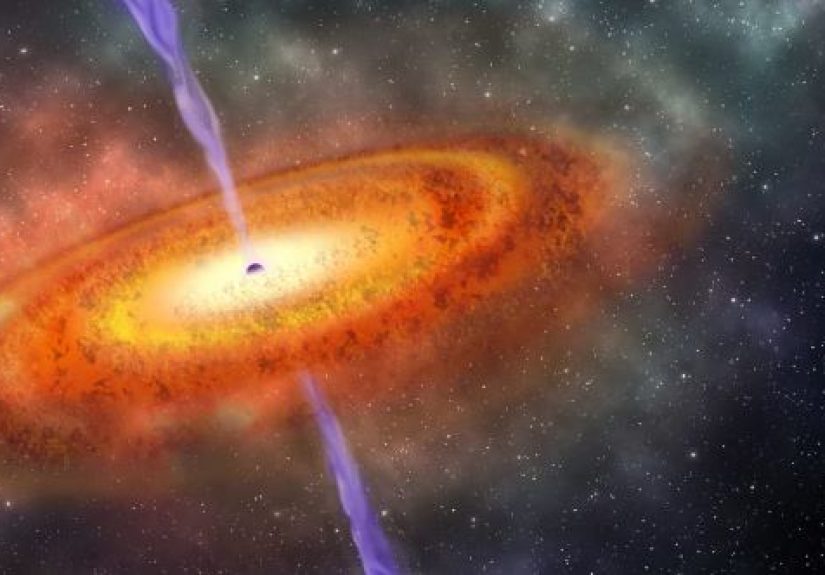
Supermassive black holes are dramatic enough without adding impossible timing to the story. Yet astronomers have found quasars powered by enormous black holes from when the universe was under a billion years old. One especially famous example is a faraway supermassive black hole seen just 690 million years after the Big Bang. Another ancient quasar discovered in the early universe showed that monster black holes were already thriving by about 900 million years after the beginning.
This is a major puzzle. Black holes can grow by swallowing matter and merging with other black holes, but doing so fast enough to become enormous that early is difficult under standard assumptions. That is why ancient black hole discoveries are so valuable. They force astronomers to rethink black hole seeds, growth rates, and the relationship between black holes and their host galaxies. In short, these monsters showed up to the universe’s opening act already looking like headliners.
8. Hubble’s Ancient White Dwarfs: The Milky Way’s Old Clockwork Stars
Not every ancient cosmic discovery lies at the edge of the observable universe. Some are much closer and just incredibly old. Hubble identified ancient white dwarf stars in the globular cluster Messier 4 that were estimated to be around 12 to 13 billion years old. These dim stellar remnants are valuable because they cool predictably over time, which makes them excellent cosmic clocks.
That predictability gives astronomers an independent way to estimate the ages of very old stellar populations and, by extension, place constraints on the age of the universe itself. White dwarfs do not have the glamour of a headline-grabbing galaxy at redshift 13, but they are the quiet geniuses of cosmic archaeology. Think of them as the universe’s retired librarians: faint, patient, and somehow in possession of absolutely crucial information.
9. The Methuselah Star: A Neighbor From the Universe’s Early Years
HD 140283, nicknamed the Methuselah star, is one of the oldest known stars with a well-measured age. It sits relatively nearby in our galactic neighborhood, yet it appears to have formed not long after the Big Bang. Estimates have placed it at roughly 13.2 billion years old, give or take the usual scientific caution tape.
What makes this star so important is not just that it is old, but that astronomers could measure its distance and properties precisely enough to pin down that age far better than before. It contains very few heavy elements, which is exactly what you would expect from a star formed early in cosmic history, before many generations of stars had time to forge richer chemistry. The Methuselah star is a reminder that not all ancient discoveries require a giant leap across the universe. Sometimes one of the oldest witnesses is practically in the neighborhood, quietly minding its own business.
10. Ancient Planetary Systems: Kepler-444 and the Surprise of Early Planets
For a long time, it was easy to imagine that rocky planets like Earth would be a relatively late luxury in cosmic history. Then Kepler-444 showed up and ruined that tidy assumption in the best possible way. This system, home to five small terrestrial-sized planets, formed about 11.2 billion years ago, when the universe was less than 20 percent of its current age.
That discovery was huge because it showed that rocky planets could form astonishingly early. In other words, the ingredients for planet-building were on the table far sooner than many casual skywatchers might guess. Add in the age estimate for the TRAPPIST-1 system, which appears to be older than our solar system, and a bigger picture begins to emerge: planets are not late extras in the cosmic script. They have been part of the story for a very long time. That raises thrilling questions about how early habitable environments might have existed in the galaxy.
What These Ancient Discoveries Are Really Telling Us
The universe matured fast
One theme runs through nearly all of these discoveries: the early universe may have been more productive, more structured, and more chemically adventurous than scientists once expected. Bright galaxies appeared early. Spiral structure showed up early. Huge black holes appeared absurdly early. Even rocky planets arrived early enough to make Earth look fashionably late.
Cosmic history is still being rewritten
That does not mean older models were useless. It means the story is getting sharper. Astronomy advances by confronting theory with observation, and the latest telescopes are handing theorists a long list of fascinating inconveniences. Ancient cosmic discoveries matter because they do not just fill in blanks. They expose where the blanks were in the wrong place to begin with.
Conclusion
The most amazing thing about these ancient cosmic discoveries is not just their age. It is their power to connect us to deep time in a way almost nothing else can. The oldest light shows us the universe before stars. The oldest galaxies show structure forming out of darkness. The oldest stars and planetary systems prove that the ingredients for complexity arrived early and stuck around. Together, these discoveries reveal a cosmos that got to work fast and still holds countless secrets in reserve.
And that may be the most beautiful part. Every time astronomers think they have pushed close to the beginning, the universe responds by opening another door, revealing another earlier object, another stranger structure, another reminder that reality is under no obligation to be simple. Ancient cosmic discoveries do not just tell us where the universe has been. They tell us how much wonder is still left to find.
Human Experiences Inspired by Ancient Cosmic Discoveries
There is a very specific feeling that comes from learning about ancient cosmic discoveries, and it is hard to replicate anywhere else. It is part awe, part dizziness, part joy, and part the sudden suspicion that your daily to-do list may not be the center of creation after all. Reading about a galaxy whose light began traveling toward Earth more than 13 billion years ago has a way of shrinking ordinary anxieties down to a manageable size. Not because problems disappear, but because perspective arrives like a cool breeze through a stuffy room.
For many people, the first real encounter with cosmic time happens at a planetarium, under a dark sky, or while scrolling through a jaw-dropping telescope image late at night instead of sleeping like a responsible person. At first, the reaction is simple amazement. Then comes the emotional whiplash. You realize that the stars above are not just decorations. They are archives. Some of the light you are seeing left its source long before human civilizations existed. Some of it started traveling before Earth was even capable of hosting anything with opinions about coffee.
That realization can make the universe feel cold, but for a surprising number of people it does the opposite. It creates connection. Ancient cosmic discoveries remind us that we live inside a story already billions of years in progress. The atoms in our bodies were forged by earlier stars. The heavier elements on Earth exist because previous generations of cosmic objects lived, changed, and died. Suddenly astronomy stops being a distant academic subject and becomes family history on the largest possible scale.
There is also something deeply human about the act of looking back. Archaeologists dig into the ground. Historians dig through documents. Astronomers dig through time itself using light. That shared instinct matters. People want to know where things came from, including themselves. Ancient galaxies, old stars, and early planetary systems answer that need in a way that feels both scientific and emotional. They do not flatter us, but they do include us. We are not outside the cosmic story. We are one of its late chapters, reading earlier pages by starlight.
These discoveries can even reshape everyday experiences. A clear night sky becomes less of a background and more of a conversation. A science headline becomes an invitation rather than a wall of jargon. Even silence feels different when you understand that space is not empty in the ordinary sense. It is full of history in transit. That can inspire wonder, humility, creativity, and sometimes a very healthy sense of humor. After all, it is hard to stay too self-important when the universe keeps casually revealing objects older than nearly everything you can name.
In the end, the experience of ancient cosmic discovery is not only about science facts. It is about orientation. It helps people locate themselves in time, in matter, and in mystery. It encourages patience. It rewards curiosity. It reminds us that reality is bigger, older, and more imaginative than human assumptions usually are. And maybe that is why these discoveries resonate so strongly. They do not merely tell us that the universe is ancient. They let us feel, for a moment, what it means to belong to something that vast.