Table of Contents >> Show >> Hide
- What Is Wet Age-Related Macular Degeneration?
- How Wet AMD Affects Your Vision
- Early Wet AMD Symptoms: Subtle but Serious
- Advanced or Sudden Wet AMD Symptoms You Shouldn’t Ignore
- Wet AMD Symptoms vs. Dry AMD Symptoms
- How Wet AMD Symptoms Are Checked and Diagnosed
- Other Conditions That Can Mimic Wet AMD Symptoms
- Living With Wet AMD Symptoms Day to Day
- When Wet AMD Symptoms Are an Emergency
- Real-Life Experiences With Wet AMD Symptoms
- When to Talk With an Eye Doctor
If you’ve recently noticed that straight lines look like roller coasters, faces seem a little “off,” or there’s a smudge in the middle of your vision that your glasses just can’t fix, your eyes might be trying to tell you something important. One possible cause is
wet age-related macular degeneration (often shortened to wet AMD), a serious eye condition that can quickly affect central vision.
Wet AMD is the less common but more aggressive sibling of dry AMD. It can sneak up on you, transforming pretty good reading vision into frustrating blur or distortion in a matter of weeks or even days. The good news: recognizing wet AMD symptoms early and getting prompt treatment can help protect your sight and maintain your independence.
In this guide, we’ll walk through what wet AMD is, the symptoms to watch for, how they feel in daily life, and what people living with the condition often experience. Think of it as a clear, friendly roadmap for understanding what’s going on with your eyes—without the medical jargon overload.
What Is Wet Age-Related Macular Degeneration?
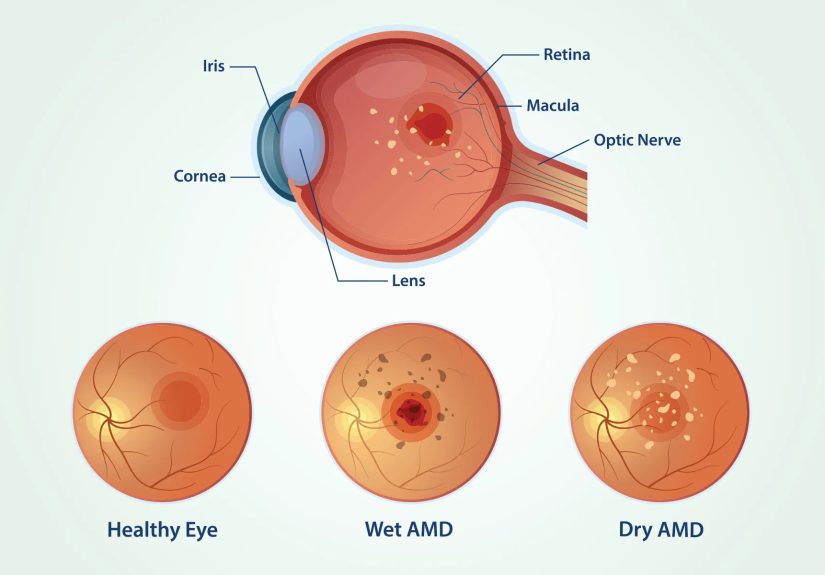
Age-related macular degeneration is an eye disease that affects the macula, the tiny central part of the retina that lets you see fine details, read small print, recognize faces, and drive. As the name suggests, it’s more common as people get older, especially after age 50.
There are two main types of AMD:
- Dry AMD: The more common form, which usually progresses slowly over years.
- Wet AMD: Less common, but responsible for the majority of severe vision loss related to AMD because it can worsen quickly.
Wet AMD happens when fragile, abnormal blood vessels grow under or within the macula. These vessels can leak blood and fluid, causing swelling, damage, and scarring in the central retina. That leakage is what leads to many of the classic wet AMD symptoms like distortion and dark spots in the center of vision.
Importantly, wet AMD usually does not affect side (peripheral) vision. People don’t typically go totally blind from AMD, but central vision—the part you rely on for reading and detailed tasks—can be significantly affected if it isn’t treated.
How Wet AMD Affects Your Vision
To understand the symptoms, it helps to picture what’s happening inside the eye. The macula is like the “high-resolution” area of your camera sensor. When abnormal blood vessels leak under that area, the surface becomes uneven and damaged, almost like a warped screen.
That damage leads to a few key changes:
- The macula can swell, causing blurred or hazy central vision.
- Irregular surfaces and scarring cause distortion, so straight edges no longer look straight.
- Dead or badly damaged cells can create blind spots (scotomas) right in the center of your vision.
The result? Everyday tasks begin to feel strangely difficult. People often describe it as if someone erased or smudged the center of what they’re looking at, while everything around the edges still looks fairly normal.
Early Wet AMD Symptoms: Subtle but Serious
Wet AMD symptoms can appear suddenly, especially compared with the slow changes of dry AMD. Early signs may seem minor at first, which is why they’re easy to blame on “getting older” or “needing new glasses.” But catching these early is critical.
1. Straight Lines Appear Wavy or Bent
One of the classic early wet age-related macular degeneration symptoms is distortion. A straight door frame, window edge, or line of text may appear wavy, bent, or “melted.” People sometimes notice this while:
- Looking at tiles, blinds, or floorboards.
- Reading lines of print that seem to dip or curve.
- Using an Amsler grid (a checkerboard-style chart used to monitor macular function).
If you cover one eye at a time and notice that straight lines look crooked in just one eye, that’s a big red flag that deserves a prompt eye exam.
2. Blurry or Hazy Central Vision
Another early symptom is a persistent blur in the center of your vision. Instead of crisp letters or sharp faces, the center looks foggy or smeared, even when your glasses are clean and your prescription is up to date.
This can show up as:
- Difficulty reading fine print, even with good lighting.
- Needing more time to focus when you look directly at something.
- Central blur that doesn’t move when you blink or rub your eyes.
3. Colors Look Duller or Washed Out
Because the macula is also responsible for color and contrast, wet AMD can make colors seem less vibrant. Reds, blues, and greens might look faded compared with how you remember them, or one eye may see colors less vividly than the other.
On their own, these color changes might not be obvious. But when combined with distortion or central blur, they add to the overall sense that “something isn’t right” with your vision.
Advanced or Sudden Wet AMD Symptoms You Shouldn’t Ignore
In some people, wet AMD progresses abruptly. In others, early signs are missed and more advanced symptoms are the first thing they notice. Either way, these changes should be treated as urgent.
4. Dark or Empty Spots in the Center of Vision
People with more advanced wet AMD often describe:
- A gray, dark, or black area right in the middle of what they’re looking at.
- Missing letters or pieces of words when reading.
- A “hole” in the center of faces or objects when they look directly at them.
These central blind spots, called scotomas, can make reading, cooking, recognizing faces, and driving extremely challenging. Because side vision usually remains intact, the world doesn’t go completely dark, but the crucial central detail is missing.
5. Rapid Vision Loss in One or Both Eyes
Unlike dry AMD, which usually progresses slowly, wet AMD symptoms can worsen over days to weeks. For some people, vision that was acceptable one month can become severely blurred or distorted the next.
Red flags for rapid progression include:
- Sudden difficulty reading familiar text sizes.
- Quickly worsening distortion of lines and shapes.
- An expanding dark or blurry area in the center of vision.
If you notice these changes, especially in just one eye, you should contact an eye care professional immediately. In the world of wet AMD, time really is vision.
Wet AMD Symptoms vs. Dry AMD Symptoms
Because many people start with dry AMD and then progress to the wet form, it’s helpful to understand how symptoms differ.
- Dry AMD often causes slowly progressive central blur and trouble reading, especially in low light.
- Wet AMD is more likely to cause sudden distortion, dark spots, or rapid central vision loss.
You can think of dry AMD as a long, slow fade, while wet AMD is more like a quick spill on the camera sensor. Both are serious, but wet AMD typically requires urgent treatment to prevent permanent damage.
Also keep in mind that many patients have dry AMD in both eyes and then suddenly develop wet AMD in just one eye. That’s why regular monitoring and paying attention to subtle changes are so important.
How Wet AMD Symptoms Are Checked and Diagnosed
If you or a loved one notice possible wet AMD symptoms, the only way to know for sure what’s going on is through a comprehensive eye exam with an ophthalmologist or optometrist who evaluates the retina.
Evaluation typically includes:
- Visual acuity testing to measure how clearly you see letters on a chart.
- A dilated eye exam, so the eye doctor can look directly at the retina and macula.
- Amsler grid testing, where you look at a grid of straight lines to check for wavy or missing areas.
- Optical coherence tomography (OCT), a noninvasive imaging test that shows cross-sections of the retina and can reveal swelling or fluid.
- Fluorescein angiography, in some cases, where a dye is injected into a vein and photos are taken to show abnormal blood vessels and leakage.
These tests don’t just confirm the diagnosis; they also help guide treatment and track how the disease responds over time.
Other Conditions That Can Mimic Wet AMD Symptoms
Here’s the catch: wet AMD isn’t the only condition that can cause wavy lines, central blur, or blind spots. Other problems, such as a macular hole, macular edema, or macular pucker, can create very similar visual distortions.
That’s why self-diagnosing based on symptoms alone is risky. The same “wavy line” experience on an Amsler grid could mean:
- Wet AMD.
- Swelling from another retinal condition.
- Scar tissue tugging on the macula.
- Other macular diseases that require different treatments.
Only a detailed retinal exam and imaging can sort out the exact cause and make sure you receive the right therapy.
Living With Wet AMD Symptoms Day to Day
Living with wet age-related macular degeneration symptoms can affect almost every part of daily life, from reading menus to recognizing your neighbor across the street. The impact often depends on:
- Which eye is affected (or if both are).
- How advanced the damage is.
- How quickly treatment was started and how well you respond.
People often report frustrations like:
- Needing brighter light and magnifiers to read.
- Having trouble seeing faces on TV or in-person unless they are close.
- Difficulty with tasks like threading a needle, sewing, or reading prices at the store.
- Feeling less confident driving, especially at night or in unfamiliar areas.
But it’s not all bad news. Many individuals with wet AMD find that with treatment, visual aids, and a few adjustments, they can still do many of the things they love. Large-print books, high-contrast settings on devices, audio books, and low-vision specialists can make a big difference.
Emotionally, it’s normal to feel worried, frustrated, or even angry when your central vision changes. Connecting with support groups, counselors, or others living with AMD can help you feel less alone and more hopeful about adapting.
When Wet AMD Symptoms Are an Emergency
Any new or rapidly worsening wet AMD symptoms should be treated as urgent. You should contact an eye care provider right away if you notice:
- Sudden distortion of straight lines that wasn’t there before.
- A new dark or blank spot in the center of your vision.
- Quickly worsening blur affecting reading or recognizing faces.
- A big difference in central vision between your two eyes.
Many treatments for wet AMD, especially anti-VEGF injections, aim to stop or slow the leakage from abnormal blood vessels. The sooner that leakage is controlled, the better the chance of preserving functional vision.
If you already know you have AMD and notice a sudden new change in one eye, call your eye doctor’s office and explain the symptoms clearly. They will usually try to see you promptly because timing matters.
Real-Life Experiences With Wet AMD Symptoms
Medical descriptions are helpful, but it can be even more powerful to hear how wet AMD symptoms show up in everyday life. While everyone’s experience is unique, many stories share common themes.
“My Reading Glasses Just Stopped Working”
One woman in her late 60s described her first symptom as “my reading glasses suddenly becoming useless.” She had always been able to read her favorite mystery novels, but over a few weeks the words started to blur and break apart in the center of the page. She kept cleaning her lenses and moving the book closer and farther away, but nothing helped.
Covering each eye separately, she realized her right eye was the troublemaker. The center of every page looked like a haze or smudge, even though the edges still seemed fairly clear. Her eye doctor later confirmed wet AMD in that eye and started treatment. Because she acted quickly, her reading vision improved after injections and magnification aids.
“The Kitchen Tiles Looked Like a Funhouse Mirror”
Another person noticed something odd while standing in the kitchen: the tiles on the floor and the lines between them looked warped. At first, he joked that the house must be crooked. But when he looked with one eye at a time, he saw that the distortion was coming from just one eye.
When his ophthalmologist tested him with an Amsler grid, the straight lines on the chart appeared wavy and parts of the center looked faded. Imaging showed abnormal blood vessels and fluid under the macula—classic wet AMD. Because he had regular visits and caught the changes early, treatment helped reduce the distortion.
“I Couldn’t See My Granddaughter’s Face Clearly”
For many people, the emotional impact of wet AMD symptoms hits hardest when they can’t clearly see faces. One grandfather described how his granddaughter’s face looked like it had a soft gray cloud in the middle whenever he tried to look directly at her. If he looked slightly to the side, he could see her better, but then her features didn’t seem centered.
That experience is typical of central scotomas. The central blind spot makes it difficult to look straight at someone and see them clearly, even though side vision is still reasonably intact. Learning to use “eccentric viewing” (looking slightly off-center) and working with a low-vision specialist helped him adapt so he could still enjoy time with his family.
“I Thought It Was Just Old Age”
A common theme across many stories is that people initially blamed their symptoms on aging, eye strain, or bad lighting. Many said they wished they’d known how serious sudden distortion, central blur, or dark spots could be.
That’s why awareness matters. Understanding wet age-related macular degeneration symptoms doesn’t mean you should panic at every bit of eye strain, but it does mean you’ll know when something feels different enough to call a doctor. In eye health, you’re never overreacting by getting a sudden change checked out.
Practical Tips From People Living With Wet AMD
People with wet AMD often share practical strategies that make life easier, including:
- Checking each eye separately every few days using an Amsler grid or a simple piece of graph paper on the fridge.
- Boosting lighting at home with bright, glare-free lamps.
- Using high-contrast settings on phones, tablets, and e-readers to make text easier to see.
- Embracing magnifiers, large-print books, and audiobooks rather than struggling and straining.
- Bringing a friend or family member to appointments to help remember details and ask questions.
Many people also talk about the emotional journey. It’s normal to feel anxious at first, but it often gets easier once treatment starts and a routine is in place. Support groups, whether in person or online, can offer reassurance and practical advice from people who genuinely understand what you’re going through.
When to Talk With an Eye Doctor
If you notice any of the following, it’s a good idea to schedule an appointment with an eye care provider soon:
- Persistent central blur in one or both eyes.
- Straight lines that look wavy, bent, or broken.
- Dark, gray, or empty spots in the center of your vision.
- Sudden worsening of central vision over days or weeks.
- Big differences in how each eye sees text, faces, or colors.
And if symptoms come on suddenly or worsen quickly, call your eye doctor’s office and tell them exactly what you’re seeing. Wet AMD is a medical condition that requires professional diagnosis and treatment; no article, no matter how detailed, can replace an in-person eye exam.
This article is for general information only and is not a substitute for medical advice, diagnosis, or treatment. If you have concerns about your vision, please consult an eye care professional promptly.