Table of Contents >> Show >> Hide
- First, confirm that it was actually delivered to the wrong address
- What to do in the first 15 minutes
- When to contact UPS directly
- How long should you wait before escalating?
- How UPS claims usually fit into the process
- Should you ask the seller for a refund or replacement first?
- What if the seller is unhelpful?
- Common scenarios and the smartest response
- What not to do
- How to reduce the odds of this happening again
- The bottom line
- Common experiences people have after a wrong-address UPS delivery
- Final takeaway
Nothing ruins the thrill of online shopping quite like seeing Delivered on your tracking page while your porch is emptier than the office snack drawer after a Monday meeting. If UPS delivered your package to the wrong address, do not panic, do not rage-refresh the tracking page 47 times, and definitely do not start a neighborhood detective drama before checking the basics.
The good news is that a wrong-address delivery does not always mean your package is gone for good. Sometimes it was left with a neighbor, dropped at a front desk, routed to a mailroom, or placed somewhere surprisingly “secure” that is only secure because nobody would ever think to look there. Other times, it really did land at the wrong house. Either way, the fastest fix usually comes from acting quickly, gathering the right information, and knowing whether to contact UPS, the seller, or your payment provider.
This guide walks you through exactly what to do next if your UPS package was delivered to the wrong address, how to improve your odds of recovery, when to file a claim, and how to protect your money if the package never shows up.
First, confirm that it was actually delivered to the wrong address
Before you assume your package has wandered off to start a new life, slow down and verify what the tracking record is actually telling you. “Delivered” does not always mean “sitting proudly in the middle of your doormat.” It can also mean delivered to a leasing office, reception desk, side entrance, neighbor, mailroom, building package locker, or another location connected to your address.
Check these things right away
Start with the shipping address on your order confirmation. If the seller shipped it to the wrong place because of a typo, old saved address, or autofill gone rogue, that matters. A UPS error and a seller-entry error can look similar on the surface, but the path to fixing them can be different.
Next, review the UPS tracking details carefully. Look for delivery notes, proof of delivery, or a delivery photo if one is available. If you can see where the package was left, you may solve the mystery in about 30 seconds and save yourself a customer-service marathon.
Also check around your property more thoroughly than feels emotionally reasonable. Look behind columns, gates, planters, side doors, garage areas, package boxes, and anywhere a driver might use to keep a package out of sight. Drivers are often trying to avoid theft, but sometimes their idea of “hidden” becomes your idea of “apparently vanished into another dimension.”
What to do in the first 15 minutes
If the package is not there, move fast. The first hour matters because the sooner you report a possible wrong-address delivery, the easier it is for everyone involved to retrace what happened.
1. Ask the people closest to the delivery point
Check with neighbors on both sides, across the street, and in any unit with a similar number. Apartment buildings are especially good at creating address chaos. Unit 206 becomes 260, Building B becomes Building D, and suddenly your blender is having a better weekend than you are.
If you live in a complex, ask the front desk, package room staff, security desk, or leasing office. In offices and mixed-use buildings, ask reception or the mailroom before assuming the worst.
2. Save your evidence immediately
Take screenshots of the tracking page, delivery confirmation, delivery photo, and estimated delivery date. Save your order confirmation, invoice, and any messages from the seller. If you later need to file a UPS claim, request a replacement, or dispute the charge, this documentation helps prove that you acted promptly and that the package was not received as expected.
3. Contact the seller or shipper
If you bought something from an online store, contact the seller right away and explain that UPS marked the package delivered, but you did not receive it. In many cases, the seller can see more shipment details, open an investigation, send a replacement, or advise whether they need to initiate the claim on their end. This is often the fastest path because the merchant has the commercial relationship tied to the shipment.
When to contact UPS directly
You should contact UPS as soon as you have checked the obvious spots and confirmed the delivery still appears wrong. Be ready with your tracking number, delivery address, phone number, and a simple timeline of what happened.
What to ask UPS
Ask whether the package shows a delivery photo, proof of delivery, or location detail that you cannot see clearly. Ask whether it was left at an Access Point, alternate location, with a neighbor, or in a building common area. If the issue looks like a true misdelivery, ask what the next step is for opening a missing package or wrong-delivery investigation.
Be specific but calm. “The tracking shows delivered at 2:14 p.m., I have checked all entrances, neighbors, building staff, and the package is not here” works better than “Your driver launched my package into the abyss.” Fair? Maybe not. Effective? Usually yes.
If you are the accidental recipient
If UPS delivered someone else’s package to your home, do not open it and do not play freelance logistics manager by shipping it yourself. Contact UPS and report that you received a package that was incorrectly addressed or misdelivered. That gives the carrier a chance to arrange pickup and attempt delivery to the correct address.
How long should you wait before escalating?
You do not need to wait forever. A brief waiting period on the day of delivery can make sense if there is a chance the parcel was left in a nearby secure place or the scan posted before the package reached your door. But if several hours have passed, you checked nearby locations, and nothing turns up, treat it as a real problem.
By the next business day, you should already have contacted the seller and UPS if the package still has not appeared. The biggest mistake people make is assuming it will sort itself out while the paper trail quietly goes cold.
How UPS claims usually fit into the process
If the package is missing after your initial checks, a claim may be the next step. UPS allows claims for lost or damaged packages, but the details can vary depending on the shipment, the account, and whether the shipper restricts who can start the claim. In some cases, the receiver can begin the process. In others, the seller or shipper may need to do it.
What you may need for a claim
Have these items ready:
Tracking number, delivery address, product description, order value, invoice or receipt, screenshots of the tracking record, photos if relevant, and your communications with the seller. Keep all of it organized in one folder. Future You will be grateful, and Future You deserves a win.
Do not wait too long
Claims have deadlines. If you think the package was truly misdelivered or lost, do not let the issue age into a “why did I wait three weeks?” problem. Prompt action gives you more options with UPS, the merchant, and your payment method.
Should you ask the seller for a refund or replacement first?
Usually, yes. If the seller can replace the item quickly, that is often easier than turning your life into a claims-management hobby. Many retailers would rather reship the order, refund it, or open their own carrier investigation than lose a customer over one bad delivery.
When you contact the seller, give them a clean, short summary:
“UPS tracking shows delivered, but the package is not at my address. I checked all entrances, neighbors, and building staff, and it has not been found. Please investigate and advise whether you will replace or refund the order.”
That message is clear, professional, and easy for a support agent to escalate. It also creates a written record, which is helpful if the issue drags on.
What if the seller is unhelpful?
If the merchant gives you the digital equivalent of a shrug, you still have options.
Credit card purchase
If you paid by credit card and the order never arrives as agreed, you may be able to dispute the charge. Start by contacting your card issuer quickly and follow its dispute instructions. Keep your written communications, tracking screenshots, and order receipt. For a non-delivery problem, this documentation matters.
Debit card purchase
If you paid by debit card, contact your bank or card issuer as soon as possible. Debit-card protections can work differently from credit-card protections, so speed matters.
PayPal purchase
If you paid through PayPal, open a dispute through the Resolution Center if the seller does not resolve the issue. For eligible “item not received” cases, PayPal has a formal dispute process and deadline, so do not sit on it.
Still stuck?
If the seller will not help and the payment route does not resolve things, you can escalate through your state consumer protection office, your state attorney general, or the FTC if the situation appears deceptive or scam-related. If the seller is outside the United States, a cross-border complaint route may be appropriate.
Common scenarios and the smartest response
The tracking photo shows the wrong porch
This is one of the strongest signs of misdelivery. Save the image immediately, send it to the seller, and report it to UPS. A wrong-door photo is not subtle evidence. It is basically your package filing its own witness statement.
The address on the order is wrong because of autofill
If the mistake happened on the order itself, contact the seller first. The carrier may have delivered exactly where it was instructed to deliver. The seller can tell you whether an intercept, replacement, or refund is still possible.
The package went to an old address
Contact the current occupant if you can do so safely and politely. Also contact the seller. Then review your saved addresses on the retailer account, browser autofill, payment wallet, and UPS account settings so it does not happen again.
The package was expensive or sensitive
If the missing parcel contained electronics, medication, legal documents, or high-value goods, escalate faster. Gather your evidence, contact the seller immediately, and ask whether signature confirmation was required. Do not let a high-value delivery sit in the “maybe it will turn up” category for days.
What not to do
Do not accuse neighbors without evidence. Do not trespass onto private property because a blurry delivery photo “kind of looks like that house on the corner.” Do not throw away your packaging records or emails. And do not click random text-message links claiming there is a delivery issue unless you independently verify the message through the carrier’s real website.
Delivery scams often show up exactly when people are already stressed about a missing package. That timing is not an accident. It is bait.
How to reduce the odds of this happening again
Use delivery controls
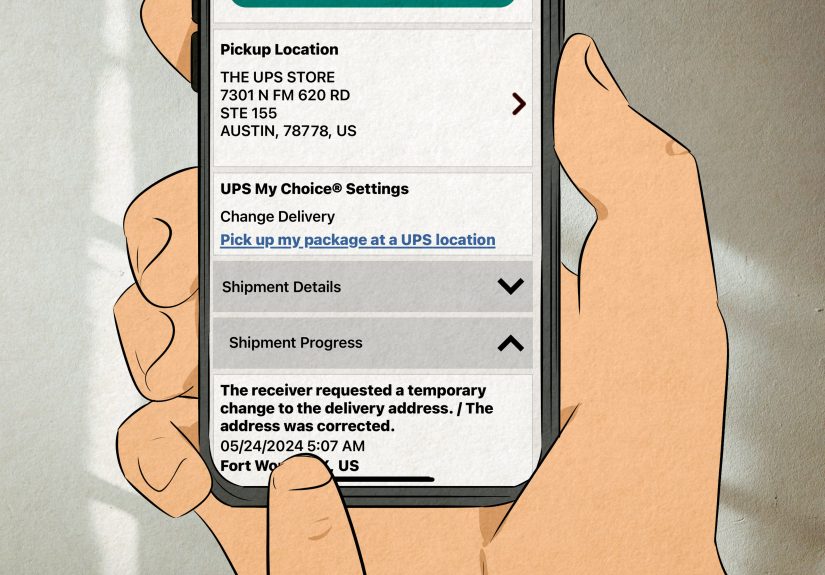
If available for your shipment, use UPS My Choice to track incoming packages, receive alerts, and adjust delivery options. In some cases, you may be able to redirect or reschedule a delivery, though fees or restrictions can apply.
Add clearer address details
Include apartment numbers, building names, gate codes, landmarks, or delivery instructions when the seller allows it. “Blue house with side porch” may sound quaint, but it can be surprisingly useful.
Choose a more secure delivery option
For valuable orders, consider signature confirmation, a staffed business address, a secure package room, or pickup options when available. Convenience is great, but not as great as actually receiving the thing you bought.
The bottom line
If UPS delivered to the wrong address, the best response is quick, organized, and boringly methodical. Check the tracking details, proof of delivery, and your physical surroundings. Ask neighbors and building staff. Contact the seller immediately. Then contact UPS if the parcel is still missing and be ready to escalate through a claim or payment dispute if necessary.
The key is not heroic panic. It is documentation, timing, and using the right channel at the right moment. That may not sound glamorous, but it is how missing-package problems get solved in real life.
Common experiences people have after a wrong-address UPS delivery
One of the most common experiences is the “delivered but nowhere” moment, where the tracking page says the package has arrived, yet the front door looks untouched. People often spend the first few minutes assuming they must have missed something obvious. They circle the house, check behind furniture, look near the garage, peek behind planters, and briefly question their own eyesight. In many cases, that search is worth doing because packages do sometimes turn up in unusual but well-meaning hiding spots.
Another very common experience happens in apartment buildings and condo complexes. A package is marked delivered to one unit, but it was actually left in a package room, with a concierge, outside the wrong building entrance, or at a unit with a similar number. This is why residents of large buildings often solve the mystery faster by checking with staff and neighbors before doing anything else. The issue is not always dramatic theft or permanent loss. Sometimes it is plain old building confusion.
Then there is the wrong-photo experience, which can be oddly validating. A customer opens the delivery confirmation photo and realizes, “That is not my porch, not my mat, not my railing, and definitely not my aggressively overwatered fern.” In those cases, people often feel a mix of relief and annoyance. Relief, because they now have proof that the issue is real. Annoyance, because they now have to become the project manager of a parcel that should have arrived correctly in the first place.
Some people find that the seller is incredibly helpful. A good retailer may apologize, open a carrier trace, and send a replacement without much friction. Others have the opposite experience: canned replies, a request to “wait a little longer,” or an unhelpful suggestion to ask around the neighborhood again after they have already done that. That gap in support is often what pushes customers toward filing a formal claim or disputing the charge through their card issuer.
There is also the scam-text experience, which tends to show up at exactly the wrong time. Someone is already worried because a package appears to be missing, and then a text arrives claiming there is an address problem or a tiny redelivery fee. Under stress, that message can look believable. Many people only realize it was fake after clicking, or after noticing the strange web address. This is why it is so important to go directly to UPS or the seller through a browser you opened yourself, instead of trusting a message that lands in your texts at the perfect dramatic moment.
Finally, many people walk away from a wrong-address delivery with the same lesson: shipping problems are easier to fix when your accounts are tidy and your evidence is organized. Old addresses saved in a retailer account, outdated wallet settings, missing apartment numbers, and deleted emails all make a frustrating problem harder. The people who get the fastest results are usually the ones who can quickly produce the tracking number, screenshots, order receipt, address used, and timeline of what happened. It is not flashy, but it works.
Final takeaway
A UPS wrong-address delivery feels personal when it happens to you, but the solution is surprisingly practical. Verify, document, contact the seller, contact UPS, and escalate through the right payment or complaint channel if needed. Stay calm, stay organized, and do not let a missing package turn into a missing refund too.