Table of Contents >> Show >> Hide
- Who Is Jay Levy, and Why Should Founders Listen to Him?
- What Investor Relations Really Means for Startups
- Building Your Investor Relations Playbook
- Running Investor Meetings and Board Sessions that Build Trust
- Common Investor Relations Mistakes (and How to Avoid Them)
- Bringing It All Together: A Sample Investor Relations Flow
- Why Great Investor Relations Is a Competitive Advantage
- Experiences and Lessons from Applying Jay Levy’s Investor Relations Playbook
- Turning Investor Updates from “Homework” into a Dashboard
- How Radical Honesty Kept a Bridge Round Alive
- The Founder Who Started Investor Relations Before Incorporating
- When Investor Relations Highlights a Strategy Problem Early Enough to Fix It
- The Takeaway: Investor Relations Is a Skill You Can Learn
- Conclusion
Fundraising used to feel like a sprint: build a deck, take a roadshow, sign a term sheet, celebrate with bad champagne.
In today’s market, it’s more like an ultra-marathon through the desert. Capital is tighter, rounds take longer, and
investors are far more selective about which founders they back. In this world, “investor relations” stops being a
corporate buzzword and becomes a survival skill.
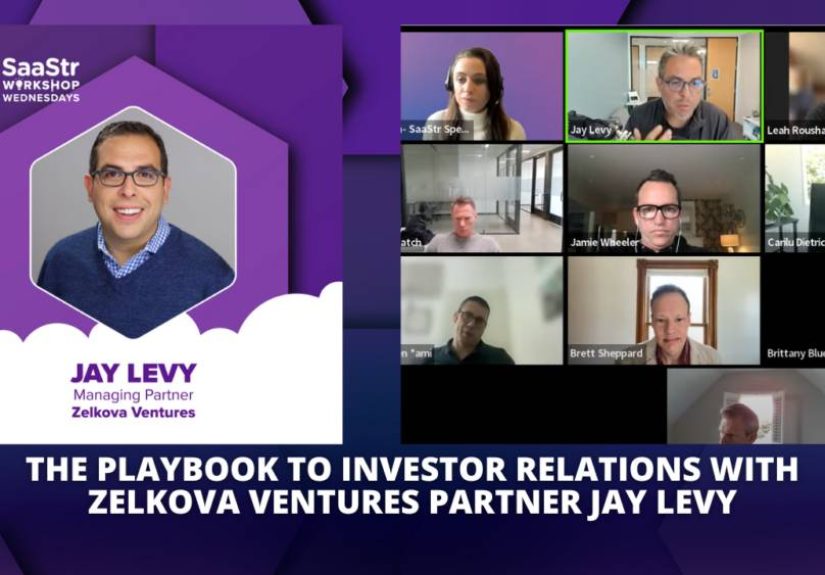
That’s exactly the message behind “The Playbook to Investor Relations”, a SaaStr Workshop Wednesday session
led by Jay Levy, managing partner at Zelkova Ventures, an early-stage B2B SaaS-focused VC firm.
Drawing on years of data, dozens of portfolio companies, and surveys of angels and venture funds, Levy lays out how
thoughtful, consistent communication can literally double your odds of getting follow-on checks.
This guide distills the key insights from Levy’s playbook and blends them with best practices from modern investor
update research, leading VC firms, and startup operators across the U.S.
Think of it as your practical, founder-friendly handbook to investor relations minus the corporate jargon and
with a little more honesty than you’ll find in most pitch decks.
Who Is Jay Levy, and Why Should Founders Listen to Him?
Before we dive into tactics, it helps to know who’s holding the playbook. Jay Levy is co-founder and partner at
Zelkova Ventures, an early-stage venture firm that’s invested in dozens of startups since 2008, with a focus
on B2B SaaS and repeat, follow-on investing. Over multiple funds, Zelkova has wired money into
more than 90 companies and seen dozens of exits, giving Levy a front-row seat to what separates “update once a year”
founders from those who keep investors engaged and backing them round after round.
Levy has also gone deep on investor relations data, surveying angels and VCs on how frequently they want to hear
from startups, what they care about in updates, and the impact of communication on follow-on funding. One standout
stat from his work: investors who feel “up to date” are about 200% more likely to re-invest.
In other words, silence isn’t just awkward it’s expensive.
What Investor Relations Really Means for Startups
In big public companies, investor relations is often an entire department. In a startup, it’s usually… you, a spreadsheet,
and a monthly panic about your burn rate. Levy frames investor relations much more simply: it’s the art and science of
managing expectations with the people who already believed in you enough to write a check.
Done right, investor relations should help you:
- Build trust through consistent, honest communication.
- Avoid surprises by surfacing issues early instead of hiding them until the board deck is due.
- Win follow-on capital because investors already understand your story, metrics, and momentum.
- Unlock help on demand intros, hiring, strategy feedback by telling investors exactly what you need.
A great investor update is not a marketing brochure. It’s a clear, sometimes uncomfortably honest snapshot of where the
business really stands. That’s what Zelkova, SaaStr, and many other U.S. investors consistently emphasize: clarity over spin.
Building Your Investor Relations Playbook
1. Start Before You Need the Money
A recurring theme across SaaStr content and founder advice is simple: don’t wait until you’re out of runway to build
relationships. Start talking to potential investors 6–12 months before you think you’ll raise.
Levy and other VCs often view “pre-relationship” founders ones they’ve already seen in their inbox, at events, or on
update threads as significantly less risky. They’ve watched you set goals, miss some, hit others, and adjust. By the
time you’re formally raising, you’re not a stranger; you’re a known quantity.
Practically, that means:
- Keeping a mini-update list of “not yet investors” who are interested in your progress.
- Sending light quarterly or product milestones before any fundraising process officially begins.
- Showing progress over time rather than a single “ta-da!” fundraising story.
2. Set a Communication Cadence and Stick to It
If investor updates are sporadic, they’re stressful for everyone. Levy’s data and other modern IR guides converge on a
simple rule of thumb:
- Pre-seed / seed: Monthly updates are ideal the company changes fast and so does risk.
- Series A+: Quarterly updates can work once the business has more predictable rhythms.
- Active fundraising or crisis: Bi-weekly or even weekly touchpoints are reasonable to maintain momentum and trust.
Cadence matters more than perfection. Your investors would rather see a short update on time than an epic novel three
weeks late. Levy’s core message: “Don’t surprise your investors.” Bad news ages like milk, not wine.
3. Use a Simple, Repeatable Investor Update Format
Many founders overcomplicate their updates. Modern IR guides from platforms like Carta, OpStart, and visible update
templates all recommend variations of the same simple structure.
A battle-tested structure inspired by Levy’s playbook and these templates looks like this:
- Header: Month, high-level summary (“Good but noisy month,” “Challenging quarter, improved retention”).
- Key metrics: 3–5 numbers that truly matter (MRR/ARR, churn, cash, runway, maybe DAU for product-heavy businesses).
- What went well: Wins, launches, hires, key customer stories.
- What didn’t: Missed targets, churn events, product delays, and what you’re doing about them.
- Pipeline & fundraising: Major deals in-flight, round status, and timing.
- Asks: 2–3 very specific things investors can help with (intros, hiring, co-marketing, expert feedback).
The power of this format is that it’s easy to skim and compare over time. Your Series A lead won’t read every word, but
they’ll absolutely notice that your churn stabilized or that your pipeline doubled over three months.
Running Investor Meetings and Board Sessions that Build Trust
Investor relations is more than email. Levy and SaaStr emphasize the importance of structured, serious board and investor
meetings especially in the early days.
Key practices include:
-
Schedule recurring board meetings every 8–10 weeks when you’re early-stage. Waiting for a “big moment”
usually means you delay hard conversations until they’re painful. -
Send materials 2–3 days ahead. This allows investors to digest numbers in advance so the meeting can focus
on decisions, not reading a spreadsheet together. -
Bring your leadership team. Let your head of product and head of sales present their own areas; it builds
confidence and surfaces issues more honestly. -
End with clear owners and next steps. Your board isn’t just there to nod; they should leave with specific
actions they’ve agreed to take.
Founders often underestimate how much credibility they gain simply by being organized. Investors see hundreds of companies;
the ones with crisp decks, clean numbers, and consistent updates stand out as “fundable adults in the room.”
Common Investor Relations Mistakes (and How to Avoid Them)
1. Only Sending Updates When Things Are Great
If your investors only hear from you during record months or active fundraising, they’ll reasonably assume you’re hiding
something the rest of the time. Levy’s research and other modern IR reports stress the importance of consistency in good
times and bad.
The fix: commit to a cadence and stick to it even if the update is: “We missed target this month; here’s what we’re
changing.”
2. Flooding Investors with Vanity Metrics
Many founders mistake volume for transparency. Sending 40 KPIs and a dozen screenshots doesn’t make you look data-driven;
it makes you look unfocused. Modern guidance from Carta and other investor tooling companies is clear: pick one north-star KPI
and track progress relentlessly.
Example: for a B2B SaaS startup, that might be net new ARR or net revenue retention. For a consumer app, it might be
DAUs or time in app. The point is to anchor your story around a small set of numbers that actually move the needle.
3. Hiding Bad News Until It’s Irreversible
Every investor has horror stories of founders who waited until there were six weeks of runway left to mention that sales
had stalled. Levy’s message echoed by other VCs and founder resources like YC’s seed fundraising guides is direct:
bad news early is manageable; bad news late is fatal.
Practically, this means:
- Flagging missed goals as soon as you see a pattern, not after a disastrous quarter.
- Owning mistakes clearly (“We over-hired in sales before proving the motion”).
- Coming with a plan (“We cut headcount by X%, narrowed focus to Y ICP, and now have Z months of runway”).
Bringing It All Together: A Sample Investor Relations Flow
Imagine you’re a seed-stage B2B SaaS company targeting mid-market customers. You raised $2.5 million 10 months ago, you’re
at $40K MRR, and you’d like to raise a Series A in 12–18 months.
A practical investor relations playbook inspired by Levy’s session and modern IR best practices might look like this:
-
Monthly investor email using a consistent template: top-line MRR, net new ARR, churn, runway, highlights,
lowlights, and 2–3 specific asks. -
Quarterly board meeting with a short deck shared ahead of time, leadership team presenting, and clear
decisions on hiring, runway, and product bets. -
Light quarterly updates to “future investors” you’re building relationships with ahead of your Series A
think of these as “warm-up” updates. -
During fundraising, you tighten the loop: weekly email or Loom-style updates with pipeline, committed
capital, and key milestones to keep momentum high.
Across that entire flow, you’re doing what Levy and other investors care about most: communicating clearly, regularly,
and honestly. You stop treating investor updates as a chore and start using them as a strategic tool.
Why Great Investor Relations Is a Competitive Advantage
In a crowded fundraising environment, you don’t control the macroeconomy, interest rates, or whether AI is soaking up half
the capital in your category. What you do control is how easy you make it to understand your business and act on your behalf.
That’s the central promise of Levy’s investor relations playbook and similar frameworks from modern startup platforms: by
being disciplined about communication, you:
- Reduce friction when raising the next round.
- Increase the odds of follow-on checks from existing investors.
- Attract new investors who see a clean communication trail and mature execution.
- Get more out of your cap table intros, strategy, hiring because you regularly tell people what you need.
Investor relations won’t magically fix a broken business, but it will absolutely give a strong business a fair shot at
being understood, funded, and supported.
Experiences and Lessons from Applying Jay Levy’s Investor Relations Playbook
Theory is nice; founders live in reality. So what does this playbook look like when it leaves the SaaStr stage and collides
with messy startup life?
Turning Investor Updates from “Homework” into a Dashboard
Founders who adopt Levy’s investor relations approach often start by changing one simple thing: they treat the monthly
investor update as a business operating ritual, not just a reporting obligation.
Instead of scrambling at the end of the month to pull numbers together, they build a lightweight internal dashboard that
mirrors their update format same KPIs, same sections, same narrative structure. Every month, the leadership team reviews
this dashboard first for themselves, then uses it to generate the investor update.
The result? The investor email becomes a natural byproduct of how they already run the company. It stops being “extra work”
and starts being the visible layer of the decision-making they’re doing anyway. Several founders report that this simple
shift cut their update-writing time from half a day to under an hour, and it also forced their metrics to be much cleaner.
How Radical Honesty Kept a Bridge Round Alive
One founder of a SaaS tools startup went through what Levy would call a “test of investor relations.” The company missed
revenue targets three months in a row, lost a marquee customer, and mis-hired a senior sales leader. Classic “hide from
your investors” territory.
Instead of ghosting the cap table, the founder leaned into Levy’s philosophy: no surprises. The next update spelled out
exactly what went wrong, what had been learned, and what changes were being made including cutting burn and refocusing on a
more specific ideal customer profile.
That email wasn’t fun to write, but it set up a surprisingly constructive board meeting. Because the investors had seen the
problems early and understood the plan, they were willing to support a small bridge round while the new strategy played
out. Communication didn’t erase the mistakes, but it did keep the company alive long enough to correct them.
The Founder Who Started Investor Relations Before Incorporating
Another founder inspired by SaaStr and Zelkova’s emphasis on relationship-building began sending lightweight progress
notes to a handful of potential investors before the startup even had a formal entity. These weren’t full updates, just
short emails: what they were building, early customer conversations, and product milestones.
By the time the founder formally kicked off their pre-seed round, those “future investors” had already seen six months of
execution, pivots, and learning. Several committed quickly not because the deck was flashy, but because they had already
watched the founder do the hard, unglamorous work of talking to customers and shipping.
This approach aligns perfectly with Levy’s view and broader fundraising advice from YC and SaaStr: fundraising is much easier
when your round is just the next step in a story investors already know, instead of a cold open with no backstory.
When Investor Relations Highlights a Strategy Problem Early Enough to Fix It
Consistent updates also have a way of exposing strategic drift. One founder realized, while preparing three months of
updates in a row, that the company kept celebrating feature releases while their north-star metric retained revenue
barely moved.
Seeing this pattern laid out in investor communications forced some uncomfortable internal conversations: Were they building
for existing customers or chasing shiny objects for new ones? Why did churn remain stubbornly high? The founder ended up
scrapping an entire line of “nice-to-have” features to focus on onboarding and activation instead.
Six months later, net revenue retention improved enough that their next fundraising process was driven by hard numbers
instead of pitch-deck optimism. In that sense, investor relations became a feedback mirror: a way to see whether the story
they were telling actually matched the outcomes they were delivering.
The Takeaway: Investor Relations Is a Skill You Can Learn
If there’s one big lesson from Levy’s workshop and the experiences of founders who’ve put his ideas into practice, it’s
this: great investor relations isn’t about personality; it’s about process.
You don’t need to be the most charismatic storyteller in your market. You need:
- A consistent cadence.
- A simple, repeatable format.
- The courage to share the bad alongside the good.
- The discipline to keep going when things are messy, not just when they’re impressive.
That’s the real heart of The Playbook to Investor Relations with Zelkova Ventures Partner Jay Levy: a reminder that the
best founders treat investors not as occasional judges, but as long-term partners in the hardest game they’ll ever play. And
like any good game, you’ll do better when everyone knows the score.
Conclusion
Investor relations isn’t about performing for your cap table; it’s about building a durable, transparent relationship with
the people who’ve committed capital to your vision. Levy’s playbook and the wider body of investor-update research offer
an unusually practical path forward: start early, communicate consistently, focus on a few critical metrics, and never let
your investors find out the news on Twitter before they hear it from you.
In a market where capital is cautious and founders are under more scrutiny than ever, excellent investor relations is one
of the few edges you can fully control. Treat it like a core part of your go-to-market strategy, and your next SaaStr
story might be the one other founders are reverse-engineering.