Table of Contents >> Show >> Hide
- How Valuable Dollar Coins Are Judged
- The 25 Most Valuable Dollar Coins
- 1794 Flowing Hair Dollar
- 1795 Flowing Hair Dollar, Silver Plug
- 1795 Flowing Hair Dollar, Three Leaves
- 1804 Draped Bust Dollar
- 1836 Gobrecht Dollar
- 1838-O Liberty Seated Dollar
- 1851 Liberty Seated Dollar
- 1852 Liberty Seated Dollar
- 1859-O Liberty Seated Dollar
- 1866 No Motto Liberty Seated Dollar
- 1870-S Liberty Seated Dollar
- 1871-CC Liberty Seated Dollar
- 1872-CC Liberty Seated Dollar
- 1873-CC Liberty Seated Dollar
- 1884 Trade Dollar
- 1885 Trade Dollar
- 1889-CC Morgan Dollar
- 1893-S Morgan Dollar
- 1894 Morgan Dollar
- 1895 Morgan Dollar
- 1895-O Morgan Dollar
- 1901 Morgan Dollar
- 1921 High Relief Peace Dollar
- 1976 No S Proof Eisenhower Dollar
- 2000-P Cheerios Sacagawea Dollar
- What Makes These Rare Dollar Coins So Important?
- How to Tell If Your Dollar Coin Might Be Valuable
- Collector Experiences: What Chasing Valuable Dollar Coins Actually Feels Like
- Final Thoughts
- SEO Tags
If you have ever looked at a dusty old dollar coin and thought, “Neat, maybe this can buy me half a sandwich,” welcome to the wonderful world of rare coin collecting, where a single silver dollar can be worth far more than a new car, a down payment, or in a few jaw-dropping cases, the kind of money that makes your accountant blink twice. The most valuable dollar coins are not just pieces of metal. They are tiny time machines tied to early American history, mint experiments, political shifts, silver booms, collector mania, and the occasional mint mystery that still makes numismatists argue like sports fans in overtime.
This guide covers 25 of the most valuable dollar coins in United States history, from the legendary 1794 Flowing Hair dollar to modern-era sleepers like the 2000-P Cheerios Sacagawea dollar. Some are famous because only a handful exist. Others are prized because surviving high-grade examples are astonishingly rare. And a few became stars because collectors discovered that a seemingly ordinary coin was actually a major variety hiding in plain sight.
One quick reality check before we dive in: a coin’s value depends on grade, authenticity, originality, surface quality, and provenance. So yes, one 1794 dollar can live in the stratosphere while another might “only” be worth the price of a luxury SUV. That is how this hobby works. It is part scholarship, part treasure hunt, and part learning to say, “No, honey, this is not just an old dollar.”
How Valuable Dollar Coins Are Judged
When experts evaluate rare dollar coins, they usually focus on five things: rarity, demand, condition, historical importance, and market performance. A coin with low mintage is not automatically king of the hill if many examples survived. On the flip side, a coin with a decent mintage can become extremely valuable if top-grade pieces are almost impossible to find. That is why collector favorites such as the 1901 Morgan dollar or 1972 Type 2 Eisenhower dollar can command serious premiums even though they are not ultra-rarities in the classic “only five known” sense.
For this article, the coins below are ranked as the most valuable and most collectible members of the U.S. dollar-coin family overall. Think of this as a practical collector’s guide, not a courtroom transcript. Values are described in broad tiers so the information stays useful even when the market gets a little caffeinated.
The 25 Most Valuable Dollar Coins
-
1794 Flowing Hair Dollar
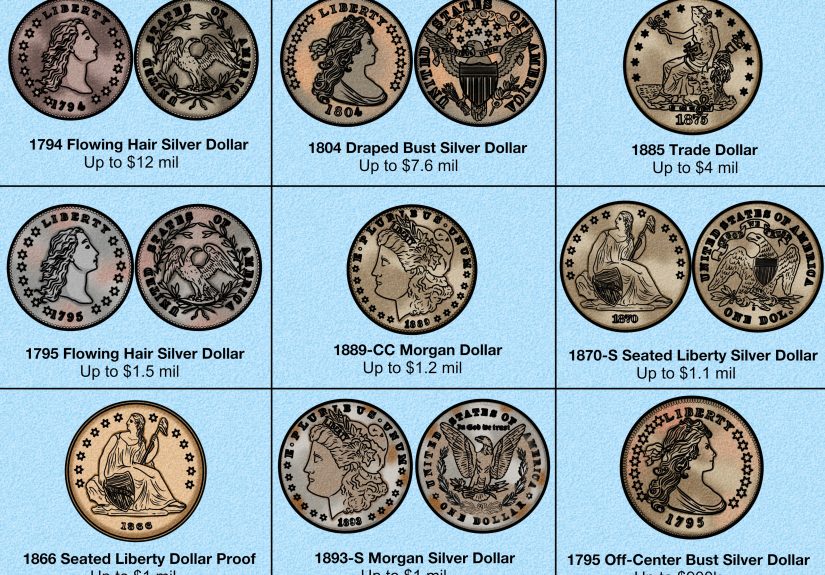
The 1794 Flowing Hair dollar is the rock star of American silver dollars. It represents the first official U.S. silver dollar design, and elite examples have sold for astonishing sums. Even lower-grade survivors are major rarities, while the finest-known pieces belong in the “call your insurer first” category. Value snapshot: six figures in lower grades, millions for elite examples, and record-level money for special pedigree coins.
-
1795 Flowing Hair Dollar, Silver Plug
Collectors love this issue because the silver plug used to adjust the coin’s weight is visible on many examples, giving the coin a built-in conversation starter. It is rare, historically fascinating, and much scarcer than a regular 1795. Value snapshot: strong six figures for premium coins and far more for exceptional certified pieces.
-
1795 Flowing Hair Dollar, Three Leaves
This is one of the most famous early dollar varieties, and it is prized by both type collectors and specialists. It is not just “an old dollar.” It is one of the classic early federal issues that collectors chase for decades. Value snapshot: from five figures in collectible grades to high six figures and beyond in top mint-state preservation.
-
1804 Draped Bust Dollar
The 1804 dollar has long been called the “King of American Coins,” and it absolutely earned the nickname. Despite the date, these coins were not actually struck in 1804 for circulation. They were later presentation pieces, and the famous census rose to 16 known examples after a newly surfaced specimen became public in 2025. Value snapshot: multi-million-dollar territory, full stop.
-
1836 Gobrecht Dollar
The Gobrecht dollar feels like a bridge between early America and the silver-dollar revival that followed. It was a transitional masterpiece, and advanced collectors adore it for both its artistry and its historical importance. Value snapshot: usually five figures and up, with elite pieces moving well into six figures.
-
1838-O Liberty Seated Dollar
As the first dollar coin struck at the New Orleans Mint, the 1838-O is a landmark issue. It combines branch-mint history, strong collector demand, and limited availability. This is one of those coins that makes specialists smile in a slightly dangerous way. Value snapshot: typically strong five figures and significantly more for original, high-grade examples.
-
1851 Liberty Seated Dollar
The 1851 Seated Liberty dollar is a celebrated low-mintage issue from a series that can look deceptively calm until you start checking prices. Then your eyebrows go up. Quickly. Value snapshot: valuable in all grades, with high-end pieces firmly in five-figure territory and beyond.
-
1852 Liberty Seated Dollar
This date is another major Seated Liberty key that attracts serious money because supply is thin and demand from advanced dollar collectors never really goes away. Nice examples do not linger. Value snapshot: mid-to-high five figures for premium coins and higher for standout certified pieces.
-
1859-O Liberty Seated Dollar
The 1859-O from New Orleans is a favorite among collectors who love branch-mint coinage. It is scarcer than many casual collectors realize, and attractive examples with problem-free surfaces can bring impressive premiums. Value snapshot: often four to five figures, with top examples pushing dramatically higher.
-
1866 No Motto Liberty Seated Dollar
After the Civil War, the “With Motto” change reshaped many silver denominations, so the 1866 No Motto dollar stands out as a fascinating transitional rarity. It is one of those coins that specialists remember instantly. Value snapshot: usually high five figures to six figures depending on quality and certification.
-
1870-S Liberty Seated Dollar
The 1870-S is one of the most famous rarities in all American numismatics. Only a tiny number of examples are known, and it occupies true trophy-coin territory. If one appears, the hobby pays attention. Everybody pays attention. Even people pretending not to pay attention. Value snapshot: six figures at minimum for genuine examples, with elite coins reaching seven figures.
-
1871-CC Liberty Seated Dollar
Carson City issues carry built-in romance, and the 1871-CC delivers in a big way. The CC mintmark, western history, and scarcity make this a premium target for both type collectors and branch-mint specialists. Value snapshot: generally five figures and up, with top-end coins worth much more.
-
1872-CC Liberty Seated Dollar
If you enjoy rare Western silver with a side of legend, the 1872-CC is for you. It is a genuinely scarce Carson City dollar with strong demand and thin supply. Value snapshot: usually solid five figures for problem-free examples, with exceptional pieces moving higher.
-
1873-CC Liberty Seated Dollar
The 1873-CC is another headline Carson City dollar because the entire Seated Liberty dollar series was winding down. That gives this issue extra historical drama, which collectors happily convert into extra dollars. Value snapshot: from five figures upward, with premium examples reaching into very serious money.
-
1884 Trade Dollar
Now we enter pure mystery-and-rarity territory. Only 10 examples of the 1884 Trade dollar are known, which makes it one of the rarest regular U.S. dollar issues. It was never a coin for casual collecting; it was built for legend status. Value snapshot: comfortably in the seven-figure conversation for notable pieces.
-
1885 Trade Dollar
The 1885 Trade dollar is one of the great monsters of American coin collecting. Only five examples are known, and none sit around waiting for bargain hunters. When one sells, the entire hobby leans forward. Value snapshot: deep seven figures for the very best, with iconic specimens selling for millions.
-
1889-CC Morgan Dollar
If the Morgan dollar series had a celebrity wing, the 1889-CC would have its own velvet rope. It is one of the most famous CC Morgans and a mandatory key date for serious set builders. Value snapshot: four and five figures in circulated grades, then climbing fast into six figures for top mint-state examples.
-
1893-S Morgan Dollar
The 1893-S is widely regarded as the king of the Morgan business strikes. Its mintage was only 100,000, and collector demand has never cooled. Even worn examples are expensive, which is a terrible feature if you are shopping and a fantastic feature if you already own one. Value snapshot: five figures in many circulated grades and six figures for high-end mint-state coins.
-
1894 Morgan Dollar
The 1894 Morgan is overshadowed by the 1893-S in casual conversation, but knowledgeable collectors know this date can be very tough, especially in better grades. It is a classic key with real bite. Value snapshot: strong premiums in all collectible grades, with high-grade coins commanding major money.
-
1895 Morgan Dollar
The 1895 Morgan is the famous “proof-only” issue in the eyes of most collectors. That alone makes it a cornerstone rarity. If you want a complete Morgan set, this coin is the locked front door, the alarm system, and the expensive key. Value snapshot: six figures for desirable proofs, with superb pieces going far higher.
-
1895-O Morgan Dollar
The 1895-O is conditionally rare and notoriously difficult in attractive grades. It may not always steal the spotlight from the proof-only Philadelphia issue, but advanced Morgan collectors respect it deeply. Value snapshot: noticeable premiums in circulated condition and substantial five- to six-figure value for superior uncirculated examples.
-
1901 Morgan Dollar
The 1901 Morgan dollar is the poster child for conditional rarity. Millions were struck, yet genuinely high-grade pieces are extremely difficult to find. This is the coin that teaches new collectors a brutal lesson: mintage is not the whole story. Value snapshot: modestly collectible when worn, but extremely valuable in higher mint-state grades.
-
1921 High Relief Peace Dollar
The first Peace dollar is a beauty, and the 1921 high-relief issue is the one that keeps collectors coming back. It has artistic flair, historical significance, and a very different look from later Peace dollars. Value snapshot: generally four and five figures depending on grade, with exceptional pieces moving much higher.
-
1976 No S Proof Eisenhower Dollar
This coin is modern numismatic lightning. The proof Bicentennial Eisenhower dollar without the San Francisco mintmark is considered one of the rarest non-error modern dollar coins, and it has developed near-mythic status. Value snapshot: six figures and beyond, because rarity plus mystery equals collector chaos.
-
2000-P Cheerios Sacagawea Dollar
The 2000-P Cheerios Sacagawea dollar is proof that modern coins can still surprise the hobby. Some promotional coins distributed in cereal boxes were struck from prototype reverse dies featuring enhanced tail-feather detail. That sentence alone sounds fake, but it is real, and collectors love it. Value snapshot: thousands to tens of thousands depending on grade, attribution, and eye appeal.
What Makes These Rare Dollar Coins So Important?
The most valuable dollar coins are not all valuable for the same reason. Early Flowing Hair and Draped Bust dollars are historic because they stand at the beginning of the federal coinage story. Gobrecht and Seated Liberty dollars reflect the experimental, expanding, and often chaotic middle years of U.S. silver coinage. Trade dollars show how American money was used to compete in global commerce. Morgan dollars capture the silver politics of the late nineteenth century. Peace dollars symbolize America’s attempt to mark the end of World War I with a coin that looked, frankly, glorious.
Then you get the modern wild cards. A missing mintmark. A prototype reverse hidden in a cereal promotion. A variety struck from a single reverse die. These coins remind collectors that valuable dollar coins are not trapped in the nineteenth century. Sometimes a rarity is old enough to have ridden in a stagecoach. Sometimes it was hiding in a kitchen drawer next to expired coupons and a mystery key.
How to Tell If Your Dollar Coin Might Be Valuable
Start with the date and mintmark. If you see 1794, 1804, 1870-S, 1884, 1885, 1889-CC, 1893-S, or 1895, do not clean it, do not polish it, and do not hand it to your cousin who “knows about coins” because he once watched a documentary at 1:00 a.m. Next, look for major varieties, including the 1972 Type 2 Eisenhower dollar, 1976 No S proof Ike, and 2000-P Cheerios Sacagawea dollar. After that, check condition. Original luster, clean surfaces, and minimal wear can make an enormous difference.
Authentication is critical. High-value dollar coins should be evaluated by a leading third-party grading service. Counterfeits exist, altered mintmarks exist, and wishful thinking exists in industrial quantities. A genuine coin in a respected holder is easier to value, easier to sell, and much easier to brag about responsibly.
Collector Experiences: What Chasing Valuable Dollar Coins Actually Feels Like
Reading about the most valuable dollar coins is exciting, but owning, hunting, or even just studying them is a very different experience. Ask almost any collector and they will tell you the same thing: the thrill does not begin when you buy the coin. It begins much earlier, usually with curiosity. Maybe you inherit a few old silver dollars from a grandparent. Maybe you spot a Carson City mintmark at a coin show and suddenly understand why other collectors hover over display cases like cats around a fish tank. Maybe you learn that a 1972 Eisenhower dollar has multiple reverse types, and that is all it takes. One small detail opens the door, and before long you are comparing lettering, researching die varieties, and explaining to friends why one “old dollar” is worth lunch money and another is worth a semester of tuition.
The experience of chasing rare dollar coins is part detective story and part emotional roller coaster. There is the joy of recognition, when you finally understand why a certain coin matters. There is the pain of near misses, when you almost buy a key date but hesitate for one day too long. There is the education that comes from handling many ordinary pieces before you can truly appreciate an extraordinary one. A cleaned coin teaches you what not to like. A bright, original coin teaches you patience. A low-grade key date teaches you that history can survive rough treatment and still command respect.
Coin shows add another layer to the experience. A collector might spend three hours looking at slabs, price guides, and dealer inventories just to find one coin that feels right. Not the cheapest. Not the flashiest. Just right. That is a big part of the hobby that non-collectors do not always understand. Valuable dollar coins are not simply purchased; they are chosen. The right strike, the right toning, the right surfaces, the right story, the right moment. When all of those line up, the coin becomes more than an object. It becomes a milestone.
There is also a very human side to the hobby. Collectors remember where they were when they first saw a real 1794 dollar, an 1889-CC Morgan, or a proof-only 1895 Morgan under proper lighting. They remember the dealer who taught them how to spot original skin. They remember the first time they held a Peace dollar and realized coin design could actually be beautiful. They remember the sting of selling too soon and the pride of buying carefully. In a world that moves fast, rare coin collecting forces people to slow down and pay attention to details that most others miss. That is surprisingly satisfying.
And then there is the hunt itself, which may be the most addictive part of all. You might search estate sales, auctions, online listings, coin clubs, or family boxes that have not been opened in decades. Most of the time, you find common coins. Sometimes you find damaged ones. Occasionally you find something interesting. Very rarely, you find something that makes your pulse jump. That possibility keeps collectors engaged. Not because everyone expects to discover an 1804 dollar in a cookie tin, but because every serious collection is built on the same quiet hope: that knowledge, patience, and attention will eventually be rewarded.
That is why the most valuable dollar coins matter beyond the price tags. They connect people to history, craft, memory, and pursuit. They teach restraint. They reward research. And every now and then, they turn a one-dollar object into a life story with silver edges.
Final Thoughts
The most valuable dollar coins occupy a unique place in American collecting. Some are legendary because they are nearly unobtainable. Others are beloved because they blend beauty, scarcity, and historic importance. Whether your favorite is the 1794 Flowing Hair dollar, the mysterious 1885 Trade dollar, the kingly 1804, or a modern surprise like the Cheerios Sacagawea, the lesson is the same: value comes from context. Date matters. Variety matters. Condition matters. Story matters.
If you collect dollar coins, you do not need to start with a million-dollar trophy to enjoy the hobby. You just need curiosity, a sharp eye, and the patience to learn what makes one coin ordinary and another unforgettable. And if you do happen to discover a rare key date in an inherited box of old coins, please try to remain calm. Or at least spill your coffee away from the coin.