Table of Contents >> Show >> Hide
- Who Is Valentin Hirsch?
- What Makes His Symmetrical Tattoos So Distinct?
- Why Nature and Geometry Work So Well Together
- Dotwork, Blackwork, and the Craft Behind the Look
- Signature Motifs in Valentin Hirsch’s Tattoo Portfolio
- What Hirsch’s Work Says About Modern Tattoo Culture
- Why the Best Hirsch-Inspired Tattoos Depend on Placement
- How to Borrow the Idea Without Copying the Artist
- Why These Tattoos Stay in Your Head
- Extended Reflection: The Experience of Seeing and Wearing Symmetrical Tattoos
- Final Thoughts
Some tattoo artists chase color. Some chase realism. Some chase trends so fast you half expect them to arrive at your appointment carrying a ring light and a hashtag strategy. Valentin Hirsch does something much more interesting. He builds tattoos that feel calm and precise on the surface, then quietly wild once you really look at them. His symmetrical compositions fuse animal portraits, skulls, sharp geometric framing, and dotwork shading into pieces that feel equal parts natural history illustration, graphic design, and wearable fine art.
That balancing act is the reason his work stands out. Hirsch’s tattoos do not treat nature and geometry as opposites. He treats them like dance partners. A tiger’s face can be split by a triangular void. An owl can become a mirrored emblem. A skull can sit inside a rigid structure without losing its eerie humanity. The result is a body of work that feels modern, disciplined, and strangely alive all at once.
For readers who love tattoo culture, visual design, or simply the idea that skin can become a moving canvas, Hirsch’s work is a fascinating case study. His pieces are technically sharp, visually memorable, and smart about how they use the body itself. They are not just tattoos placed on arms or legs. They are tattoos designed with arms and legs in mind. That difference matters, and it is a huge part of why his symmetrical tattoos hit so hard.
Who Is Valentin Hirsch?
Valentin Hirsch is a Berlin-based tattoo artist and visual artist known for black-ink compositions that blend animals, skulls, mirrored forms, and geometric structures. His published monograph, Symmetries, presents tattooing as a natural extension of his drawing practice, which helps explain why his work often feels closer to printmaking or illustration than conventional flash. Even when the subject is fierce or primal, the execution is controlled, measured, and exacting.
That background matters because Hirsch’s tattoos do not read like random mashups of cool motifs. They read like considered compositions. You can see the hand of someone who understands how an image behaves on paper, then pushes that understanding onto skin without losing clarity. That is not easy. Skin moves, stretches, ages, and refuses to behave like a flat sheet. Hirsch’s work embraces that challenge instead of fighting it.
What Makes His Symmetrical Tattoos So Distinct?
He Uses the Human Body as Part of the Illusion
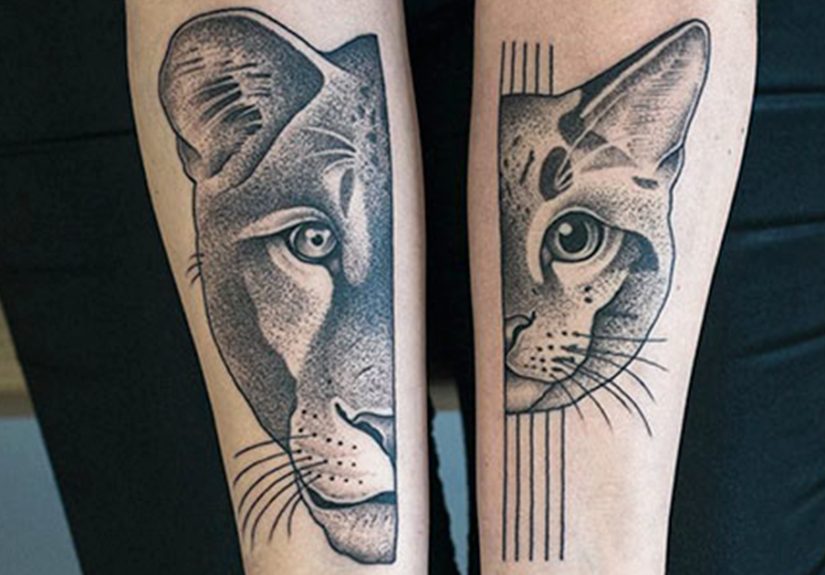
One of the smartest things about Hirsch’s work is how often the tattoo is divided across separate limbs or mirrored body areas. At rest, the design can look fragmented, abstract, or deliberately interrupted. Bring the limbs together, though, and the image suddenly resolves. A complete face appears. A symmetrical animal emerges. The wearer becomes part of the reveal.
This is more than a gimmick. It is a deeply thoughtful design choice. Human bodies are already built around bilateral symmetry, so Hirsch’s split compositions echo the structure of the body itself. The tattoo is not merely sitting on top of anatomy; it is collaborating with anatomy. That makes the final effect more dynamic, more memorable, and frankly more fun. It is body art with a small plot twist.
He Lets Nature Stay Wild While Geometry Keeps It in Check
Hirsch often works with living subjects that already carry emotional weight: wolves, owls, tigers, foxes, birds, skulls, and hybrid forms that sit somewhere between dream and specimen. These are not soft, decorative animal tattoos designed only to be cute. They are sharp, watchful, almost heraldic. Then he adds geometry: bars, circles, triangles, mirrored axes, and clean structural cuts.
That tension is the whole game. Nature brings instinct, motion, and symbolic energy. Geometry brings order, logic, and restraint. One side growls; the other side measures. Put them together and the image gains complexity. Hirsch’s art feels powerful because it never fully chooses between organic chaos and controlled design. It insists on both.
He Makes Black Ink Look Luxurious
Plenty of tattoo artists use black ink. Not all of them make it sing. Hirsch’s pieces rely on black and gray values, crisp linework, and patient dotwork shading to create depth without depending on color for drama. That gives the tattoos a print-like quality. Some feel like etchings. Others feel like old scientific plates that wandered into a modern design studio and came back with better posture.
The lack of color is a strength, not a limitation. It keeps the focus on contrast, composition, and texture. It also suits the conceptual push-and-pull in his work. Bright color would make many of these pieces louder. Hirsch does not need louder. He needs cleaner, sharper, more deliberate. Black ink delivers exactly that.
Why Nature and Geometry Work So Well Together
Hirsch’s tattoos feel intuitive because nature and geometry have never really been strangers. Symmetry appears throughout the natural world, from bilateral animal bodies to repeating plant structures and crystalline forms. Geometry, meanwhile, has long been used in art and design to create harmony through repetition, mirroring, and proportion. When Hirsch fuses the two, he is not forcing an awkward marriage. He is revealing a relationship that was already there.
That helps explain why his tattoos can feel both ancient and contemporary. On one level, the work echoes age-old human fascination with pattern, duality, and mirrored form. On another, it speaks to modern design language: minimal contrast, disciplined composition, strong negative space, and a clear respect for how an image occupies physical space. You could imagine one of his tattoos hanging as a framed print in a gallery, and you could also imagine it moving down a client’s forearm like it was born there. That crossover is rare.
There is also a psychological reason these tattoos are satisfying. Balanced images tend to feel intentional. Mirrored forms are easier for the eye to organize. Repetition creates rhythm. Even when Hirsch introduces unsettling material like skulls or hybrid beasts, the structure keeps the design from collapsing into visual noise. In other words, he gives the viewer enough order to stay engaged, then enough mystery to keep staring.
Dotwork, Blackwork, and the Craft Behind the Look
Hirsch’s style depends heavily on control. Dotwork is not simply a trendy texture thrown onto a design because someone thought it looked cool on social media. It is a method of building tone through repeated points, allowing a tattoo to develop softness, texture, and gradient without turning muddy. In Hirsch’s hands, dotwork helps fur look tactile, feathers look layered, and skulls look dimensional while still keeping the overall piece clean.
Blackwork does another important job. It anchors the composition. Dense black shapes, dark bars, and graphic interruptions create contrast and keep the eye moving through the design. Geometric tattooing often works best when it follows the body’s natural curves, and Hirsch seems keenly aware of that. His structures do not just frame the subject; they guide how the piece travels across skin.
Of course, highly precise tattoos also demand good planning. Clean lines, dot-heavy shading, and geometric edges can be unforgiving over time if placement, scale, and execution are not right. That is part of why Hirsch’s work feels so professional. The pieces are not only visually clever; they are built with enough discipline to support that cleverness.
Signature Motifs in Valentin Hirsch’s Tattoo Portfolio
Split Animal Portraits
This may be the clearest Hirsch signature. A face is halved, mirrored, or divided across separate limbs so the design becomes whole only when the body moves into alignment. The effect is immediate and memorable. It turns still imagery into interactive design without needing anything flashy.
Animal-Human Hybrids and Skull Pairings
Another recurring theme is the collision of species or states of being. Hirsch often places a human skull beside an animal face, or merges different creatures into one visual statement. That choice makes the work feel symbolic rather than merely decorative. These tattoos are not just portraits of animals. They are meditations on instinct, mortality, and identity.
Geometric Frames and Strategic Interruptions
Triangles, bars, lines, and mirrored axes appear constantly in Hirsch’s work, but they never feel like filler. They are structural. They divide space, create tension, and make the organic subject feel newly designed. The interruption is the point. A face that is too complete can feel familiar. A face sliced by geometry feels reinterpreted.
Large-Scale Compositions With Breathing Room
Hirsch’s aesthetic especially shines in pieces that have room to unfold. Larger limbs, backs, and chests give his symmetry and spacing the air they need. That does not mean every tattoo has to be enormous, but it does mean his style benefits from scale. Tiny versions would lose some of the architecture, and architecture is a big part of the charm.
What Hirsch’s Work Says About Modern Tattoo Culture
Modern tattoo culture is broad, fast-moving, and increasingly design-conscious. Trends cycle through florals, fine script, micro realism, ornamental work, nostalgic references, and all sorts of aesthetic micro-seasons. Hirsch’s work intersects with some of those conversations, especially black-and-gray, geometric realism, and ornamental structure, but it does not feel trapped by trend logic. It feels authored.
That is important. The best contemporary tattoos are not just attractive. They reflect a point of view. Hirsch’s point of view is unmistakable: symmetry matters, structure matters, the body matters, and nature becomes more powerful when it is filtered through an intelligent graphic system. This is the sort of work that appeals to people who want more than “a cool tattoo.” They want a piece with identity.
It also reflects a larger shift in how many people think about tattoos today. Tattoos are no longer viewed only as rebellious marks or sentimental souvenirs. They are increasingly treated as commissioned visual art. Clients research artists carefully, study portfolios, and choose styles that align with their aesthetics as much as their symbolism. Hirsch fits perfectly into that world because his work rewards close looking. It feels curated, not casual.
Why the Best Hirsch-Inspired Tattoos Depend on Placement
If there is one lesson artists and collectors can take from Hirsch, it is that placement is not an afterthought. In symmetrical tattooing, placement is part of the concept. A mirrored design on calves will communicate differently than one spread across forearms. A chest piece has different emotional force than a hand tattoo. A split design only works if the body can help complete it.
That means anyone inspired by this style should think beyond the image itself. Ask where the natural axis of symmetry lives on the body. Ask how the tattoo will look at rest versus in motion. Ask how much negative space is needed. Ask whether the composition still reads when the viewer catches only one half at a time. Those are the questions that separate a real design from a decent Pinterest imitation.
How to Borrow the Idea Without Copying the Artist
Hirsch’s work is distinctive enough that direct copying would feel lazy. A better move is to borrow the principles, not the exact images. Start with an animal or natural symbol that has personal meaning. Decide whether the design should be mirrored, split, or interrupted. Choose one or two geometric forms that reinforce the image rather than overcrowd it. Prioritize black and gray if you want that print-like gravity. Most importantly, work with an artist who truly understands dotwork, blackwork, and composition on the body.
That approach respects Hirsch’s influence while still creating something original. Inspiration should open a door, not photocopy the wallpaper.
Why These Tattoos Stay in Your Head
Great tattoos are memorable for different reasons. Some overwhelm you with detail. Some charm you with color. Hirsch’s tattoos linger because they feel resolved yet unsettled. They are balanced, but not boring. Natural, but not loose. Geometric, but not cold. You look once and admire the order. You look twice and notice the tension. You look a third time and start wondering why an owl suddenly feels like architecture.
That is the sweet spot his art lives in. He gives the viewer symmetry, but never pure predictability. He gives the wearer something visually disciplined, but still emotionally charged. It is almost like Mother Nature hired a very serious graphic designer, handed over a stack of skull references, and said, “Let’s make this weird, but elegant.” Mission accomplished.
Extended Reflection: The Experience of Seeing and Wearing Symmetrical Tattoos
Seeing a Valentin Hirsch-style tattoo in person is different from seeing it on a screen. Online, the work already looks impressive. In real life, the effect is stronger because the body changes the image every few seconds. A split animal face on two forearms can look abstract while the wearer is relaxed, then suddenly become complete when they bring their arms together. That small transformation gives the tattoo a sense of movement and theater. It is not animated, exactly, but it is not fixed either. The body keeps editing the composition in real time.
That experience also changes how people around the tattoo respond. A symmetrical tattoo tends to create a double take. At first, people notice the clean lines, the black ink, or the animal subject. Then they realize the design is playing a larger game with placement and mirroring. That second moment is usually where admiration kicks in. The tattoo stops being just an image and starts becoming an idea. It invites curiosity without needing loud color or oversized lettering to announce itself.
For the person wearing the tattoo, the experience can be even more personal. Symmetry has a grounding quality. It feels stable. It can turn an emotional symbol into something visually calm. An animal that represents protection, instinct, grief, resilience, or transformation can feel less chaotic when framed through order. That matters because tattoos often hold meaning people do not fully explain out loud. Hirsch’s visual language gives those meanings a structure. It says, yes, life is wild, but the story can still have form.
There is also a very physical pleasure in wearing a tattoo that was clearly designed for the body instead of simply placed on it. The limbs feel intentional. The angles make sense. The negative space is part of the rhythm. When a composition follows anatomy well, the wearer tends to feel that harmony every time they catch the tattoo in a mirror or in a passing reflection. It becomes familiar in a satisfying way, almost like a favorite object in your home that keeps looking better at different times of day.
Another part of the experience is patience. Symmetrical, detail-heavy blackwork is not usually the domain of impulse decisions. It rewards planning. You think about subject, balance, scale, artist compatibility, and how the tattoo will read years down the line. That slower approach often creates a deeper bond with the final piece. The tattoo feels chosen rather than collected in a rush.
And then there is the emotional afterlife of a tattoo like this. Good symmetrical work often ages well in the mind because it is based on strong composition, not gimmicks. Even when the wearer changes, the logic of the design remains satisfying. It still feels deliberate. It still feels intelligent. It still feels like a meeting point between instinct and structure. That may be the most impressive part of Hirsch’s aesthetic. These tattoos are dramatic, yes, but they are not disposable drama. They are built on ideas sturdy enough to last.
Final Thoughts
Valentin Hirsch’s symmetrical tattoos work because they understand a truth many artists spend years chasing: nature and geometry are not enemies. They are two different languages describing the same search for order, beauty, rhythm, and meaning. Hirsch turns that idea into tattoos that feel alive on the body and disciplined on the eye. His animals are not softened into decoration, and his geometry is not reduced to sterile pattern. Each side sharpens the other.
That is why his portfolio feels so balanced. The work has instinct without mess, precision without boredom, symbolism without cliché, and beauty without trying too hard. In a tattoo landscape full of noise, that kind of balance is not just refreshing. It is unforgettable.