Table of Contents >> Show >> Hide
- The Story: When “We’re Doing a Thesis Together” Becomes “I’m Doing a Thesis Alone”
- Why This Situation Feels So Unfair
- Is Reporting a Thesis Partner “Ratting Them Out”?
- The Academic Integrity Problem Nobody Likes to Say Out Loud
- Why Thesis Partnerships Are Especially Risky
- Social Loafing: The Fancy Term for “Someone Else Will Do It”
- What the Student Did Right
- What Could Have Been Done Earlier
- How Advisors Should Handle a Non-Contributing Thesis Partner
- Empathy Does Not Mean Academic Free Credit
- Was the Student Too Harsh?
- Lessons for Students Stuck With a Bad Thesis Partner
- Experiences Related to This Topic: What Students Learn the Hard Way
- Conclusion
Group projects are supposed to teach teamwork, communication, shared responsibility, and maybeif the academic gods are feeling generoushow to use Google Docs without accidentally deleting three pages at 2 a.m. But sometimes, a “team project” becomes one exhausted student dragging the entire assignment across the finish line while the other person contributes the emotional equivalent of a decorative paperclip.
That is exactly why the online story titled “She Won’t Graduate”: Student Fed Up With Thesis Partner Doing Nothing, Rats Her Out To The Advisor struck such a nerve. It is not just campus drama. It is a painfully familiar academic nightmare: one thesis partner does the interviews, transcription, coding, writing, editing, and presentation rescue mission, while the other partner repeatedly promises to help and then vanishes like a Wi-Fi signal in a basement classroom.
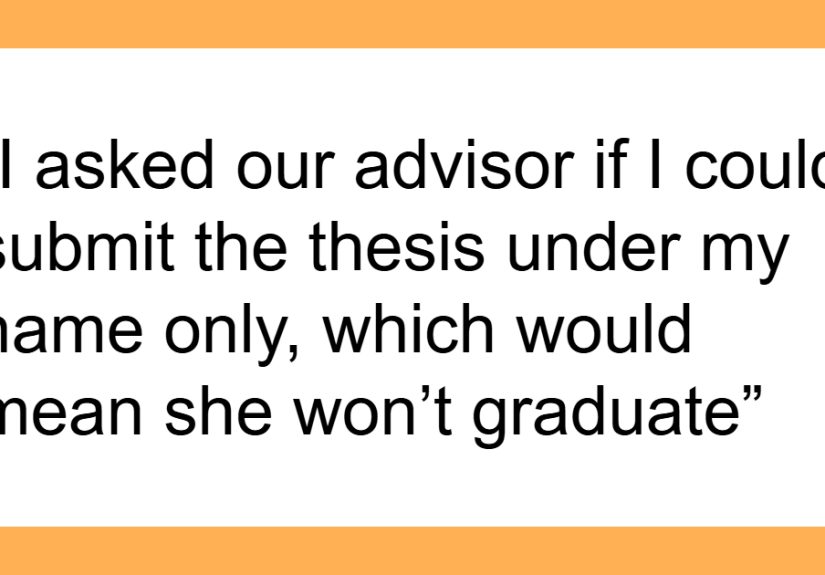
The frustrated student eventually went to the thesis advisor and asked to submit the work under his name only. That decision could prevent the partner from graduating on time. Naturally, people had opinions. Some said he was too harsh. Others said he was simply refusing to hand someone a degree wrapped in a bow and labeled “free delivery.”
This article looks at the bigger issue behind the viral story: when is reporting a non-contributing thesis partner fair, and how should students protect themselves when collaboration turns into academic hostage-taking?
The Story: When “We’re Doing a Thesis Together” Becomes “I’m Doing a Thesis Alone”
According to the widely discussed account, the student was paired with a classmate for a thesis project. At first, he knew she had a habit of working at the last minute, but he assumed she would eventually show up. Many students know this kind of optimism. It usually appears right before disaster, like saying, “I’m sure the printer will work five minutes before class.”
The pair had to conduct interviews, transcribe them, code the research data, write thesis chapters, and prepare for a defense. These are not small chores. A thesis requires sustained attention, evidence, organization, revision, and enough caffeine to make a coffee machine file a labor complaint.
The problem was that the partner repeatedly failed to complete her assigned work. The student said he handled the interviews, completed transcription that had been split between them, carried the coding process, fixed an unfinished defense presentation, and continued messaging her for updates after the defense. Her replies were vague. Her work still did not appear.
Eventually, he contacted the thesis advisor and requested permission to submit the thesis under his own name. That move could mean the partner would not graduate with him. It sounds dramatic, but so is being expected to donate months of unpaid academic labor to someone else’s transcript.
Why This Situation Feels So Unfair
The emotional core of the story is not just laziness. It is accountability. In a thesis partnership, each person’s work affects the other’s grade, graduation timeline, stress level, and reputation with faculty. When one partner disappears, the responsible student is left with two bad choices: carry the project alone or report the imbalance and risk being seen as ruthless.
That is why stories like this explode online. Most students have lived some version of it. Maybe it was a lab report where one person “made the title slide” and called it leadership. Maybe it was a business presentation where someone appeared on presentation day holding an iced coffee and absolutely no knowledge of the topic. Maybe it was a senior project where the group chat became a museum of unread messages.
The unfairness grows because group work can hide unequal effort. A finished paper does not automatically show who wrote it. A polished presentation does not reveal who stayed up all night fixing broken slides. A successful defense can make everyone look competent, even when one person has been quietly bailing water out of the academic boat for months.
Is Reporting a Thesis Partner “Ratting Them Out”?
The phrase “rats her out” makes the action sound sneaky or cruel. But in academic work, reporting a serious contribution problem is not the same as tattling over a minor inconvenience. It is a formal attempt to correct the record.
There is a difference between a partner who struggles and communicates honestly, and a partner who repeatedly avoids work while expecting the same credit. A student dealing with illness, family responsibilities, job pressure, or personal hardship should be encouraged to talk to the advisor early. Universities often have processes for extensions, accommodations, revised timelines, or adjusted responsibilities. Silence, however, creates chaos for everyone else.
In this case, the reporting student appeared to have tried multiple times to involve the partner before escalating. He assigned tasks, followed up, completed urgent work when she did not, and involved the advisor earlier when the imbalance became obvious. That matters. Escalation should not be step one, but it also should not be forbidden until the responsible student collapses into a pile of citations and resentment.
The Academic Integrity Problem Nobody Likes to Say Out Loud
If someone graduates based on work they did not meaningfully complete, the issue becomes bigger than hurt feelings. It touches academic integrity. A thesis is supposed to demonstrate that a student can conduct research, analyze information, write clearly, defend decisions, and meet program standards. If one student barely contributes, giving both students equal credit misrepresents who actually met those standards.
That does not mean every uneven group project is academic misconduct. People contribute in different ways. One student might be stronger at writing, another at statistics, another at design, another at presenting. Good teamwork is not identical labor; it is fair, visible, and agreed-upon labor.
But when the same person repeatedly fails to do assigned sections, misses deadlines, arrives late, and leaves core work to the other partner, the imbalance becomes hard to defend. At that point, “teamwork” turns into academic freeloading with better branding.
Why Thesis Partnerships Are Especially Risky
Group projects are stressful in any class, but thesis work raises the stakes. A thesis often affects graduation, honors, graduate school applications, professional references, and confidence. Students are not just trying to pass a weekly assignment. They are proving they can complete a major academic project.
Pairing students on a thesis can work when expectations are clear and both partners are committed. It can also be a practical choice in programs where research tools, participant access, or faculty supervision are limited. However, forced thesis partnerships can create serious risks when one person’s progress depends on another person’s discipline.
A thesis is not like splitting pizza. You cannot simply say, “You take the crust, I’ll take the cheese.” Research work is interconnected. If one person fails to transcribe interviews, coding gets delayed. If coding is delayed, analysis suffers. If analysis suffers, chapters become weaker. If the presentation is unfinished, the defense becomes a live-action panic attack.
Social Loafing: The Fancy Term for “Someone Else Will Do It”
Researchers and teaching experts often describe this problem as social loafing: the tendency for some people to put in less effort when they believe the group will absorb the consequences. In plain English, it is the “surely somebody else will handle it” disease.
Social loafing thrives when individual contributions are hard to measure. If a professor only grades the final group product, a low-effort member may still receive the same grade as the student who did most of the work. That system practically sends an engraved invitation to free-riders: “Dear Student, please enjoy this group grade buffet.”
The best group assignments reduce this risk by making contributions visible. Instructors can require progress logs, version histories, individual reflections, peer evaluations, separate research memos, meeting notes, and milestone check-ins. These tools are not just bureaucratic confetti. They protect students from being punished for someone else’s disappearing act.
What the Student Did Right
The reporting student’s strongest move was documentation. In any serious academic dispute, receipts matter. Screenshots, timestamps, edit histories, drafts, email threads, file ownership records, and meeting notes can show who did what and when.
Documentation changes the conversation from “I feel like I did everything” to “Here is the work record.” That difference is huge. Advisors are not mind readers. They may see a completed thesis and assume both students contributed unless someone provides evidence otherwise.
The student also tried to redistribute tasks. After doing much of the earlier work, he asked the partner to handle the defense presentation and script. That was a reasonable attempt to give her a clear role. When even that was not completed properly, the pattern became more obvious.
Finally, he contacted the advisor rather than simply removing her name without permission. That matters. Students should not make unilateral decisions about authorship, grading, or thesis submission. Those decisions belong within the program’s academic process.
What Could Have Been Done Earlier
Even though the student had a strong case, this situation also shows why early intervention matters. The longer a responsible student waits, the harder it becomes to separate compassion from resentment.
Ideally, students should raise concerns after the first major missed deadline, not after months of damage. The message does not have to be dramatic. Something like this works: “We agreed that you would complete the transcript by Friday. It is now Monday, and I do not have it. I’m worried this will affect our timeline. Can we set a firm deadline and update our advisor if it is not done?”
That kind of message does three things. It states the agreement, identifies the missed deadline, and creates a record. It also gives the partner a chance to respond before the issue becomes formal.
If the pattern continues, the next step is to contact the advisor with facts, not insults. Avoid writing, “My partner is useless and has the work ethic of a decorative houseplant.” Tempting? Yes. Professional? Not quite. A better approach is to list missed tasks, dates, attempts to follow up, and the impact on the project.
How Advisors Should Handle a Non-Contributing Thesis Partner
Advisors have a difficult role in these situations. They must be fair to both students while protecting academic standards. The solution should not automatically be “the hardworking student must carry the project because graduation is close.” That may feel convenient, but it rewards the wrong behavior.
A strong advisor should review documentation, meet with both students, clarify remaining requirements, and determine whether contributions can be fairly separated. If one student has completed nearly all core research and writing, it may be appropriate to allow individual submission or require the non-contributing student to complete a separate project, revision, or delayed defense.
Programs can also prevent these conflicts by requiring written agreements at the beginning of thesis partnerships. A simple thesis contract can identify roles, deadlines, communication expectations, procedures for missed work, and consequences for repeated nonparticipation.
Empathy Does Not Mean Academic Free Credit
One reason the story became emotionally complicated is that the non-contributing partner reportedly had major responsibilities outside school. That matters. Students are human beings, not productivity robots wearing backpacks. Work schedules, childcare, financial pressure, and health issues can make school brutally difficult.
But empathy has limits when another student’s future is also on the line. Compassion might mean giving flexibility, adjusting deadlines, helping a partner communicate with the advisor, or supporting a realistic plan. It does not have to mean doing someone else’s thesis and pretending they earned equal credit.
In fact, carrying someone through a thesis can create a new unfairness. The responsible student loses time, sleep, and peace of mind. The non-contributing student receives a credential without demonstrating the required skills. Future classmates, employers, and patients, clients, or communities may eventually rely on that credential. Academic standards exist for a reason, even when enforcing them feels uncomfortable.
Was the Student Too Harsh?
Based on the facts described, the student was not too harsh. He reached a point where continuing to cover for his partner would be unfair to himself and dishonest to the academic process. Asking the advisor to submit under his own name was not revenge. It was boundary-setting with documentation.
The key point is that he did not make her fail. Her own lack of contribution created the risk. That distinction matters. If a student misses the bus every day, the bus driver is not “too harsh” for continuing the route. At some point, adults are responsible for showing up.
Still, the advisor should make the final decision. The partner deserves a chance to explain, provide evidence, or complete separate requirements if the program allows it. Fairness is not a popularity contest in the group chat. It is a process.
Lessons for Students Stuck With a Bad Thesis Partner
1. Put Everything in Writing
Verbal agreements disappear quickly when deadlines arrive. Use email, shared documents, or project management tools to record who is responsible for each task. Keep messages polite and specific.
2. Use Version History
Google Docs, Microsoft Word, shared drives, and research software often show edit history. This can be powerful evidence when contribution levels are disputed.
3. Set Micro-Deadlines
Do not wait for one giant final deadline. Break the project into smaller tasks: interview scheduling, transcription, coding, outline, draft, revision, presentation, and defense prep.
4. Escalate Early
If a partner misses repeated deadlines, contact the advisor before the project becomes an emergency. Early escalation sounds scary, but late escalation is usually messier.
5. Stay Professional
Do not insult, threaten, or publicly shame your partner. Focus on tasks, timelines, evidence, and academic requirements. The goal is resolution, not a courtroom drama with footnotes.
Experiences Related to This Topic: What Students Learn the Hard Way
Many students enter group projects with innocent optimism. They imagine brainstorming sessions, equal effort, organized folders, and maybe even a color-coded spreadsheet. Then reality arrives wearing sweatpants. One person disappears. Another says, “I’m almost done,” which somehow means “I have opened the document once.” Someone else suggests meeting at midnight. Suddenly, the group project becomes a sociology experiment with grades attached.
The most common experience is the silent partner problem. This person rarely says no. In fact, they often sound very cooperative. They reply with “Sure,” “Got it,” or “I’ll do it tonight.” Then nothing happens. Their optimism is magnificent. Their output is imaginary. This is especially frustrating because the responsible student keeps waiting, hoping the work will appear. It does not.
Another familiar experience is the last-minute hero act. A non-contributing partner may suddenly appear near the deadline and offer to “help polish things.” Translation: they want to adjust fonts, add a stock image, and receive equal credit for a project they barely understand. While formatting matters, it is not the same as designing the research, analyzing data, or writing chapters. A thesis is not rescued by changing the heading from Arial to Calibri and calling it teamwork.
Some students also face guilt pressure. When they finally complain, others say, “Just help them this once,” or “Don’t ruin their graduation.” That sounds kind until you realize the responsible student has already been helping for weeks or months. There is a point where helping becomes enabling. Carrying a partner once during a rough week is generous. Carrying them through an entire thesis is academic weightlifting without consent.
Students who have survived bad group projects often learn to become extremely organized. They save screenshots. They keep dated drafts. They create task lists. They confirm agreements after meetings. At first, this feels overly cautious. Later, it feels like building a life raft before the ship hits the iceberg.
The best experiences happen when groups discuss expectations early. A team that agrees on deadlines, communication rules, and backup plans is much less likely to explode near submission week. For example, a group might agree that if someone cannot finish a task, they must notify the team at least 48 hours before the deadline. They might also agree that missed work will be reported to the advisor after two repeated failures. This may sound strict, but it is actually kinder than letting resentment grow in silence.
Another valuable lesson is that fairness does not always feel nice. Reporting a partner can feel awful, especially when the partner has real-life struggles. But fairness includes the hardworking student too. Their time matters. Their grade matters. Their graduation matters. Their mental health matters. Academic compassion should not require one student to become another student’s unpaid ghostwriter.
In the end, the thesis partner story became popular because it reveals a truth many students already know: group work is only educational when accountability exists. Without accountability, it becomes a lottery where the prize is extra labor. A good collaboration can build confidence, sharpen ideas, and teach professional skills. A bad collaboration can teach the same lesson in a much harsher way: document everything, speak up early, and never confuse silence with teamwork.
Conclusion
The viral thesis partner story is not just about one student “ratting out” another. It is about the limits of patience, the importance of academic honesty, and the need for fair systems in collaborative education. A thesis is supposed to represent earned knowledge and real contribution. When one partner repeatedly fails to do the work, the other student should not be forced to sacrifice their own future to preserve an illusion of teamwork.
Good collaboration requires communication, accountability, and visible effort. When those disappear, involving an advisor is not cruelty. It is often the only responsible move left.
Note: This article is an original SEO-focused analysis based on the reported online story and broader best practices in academic teamwork, thesis supervision, peer evaluation, collaborative writing, and student accountability.