Table of Contents >> Show >> Hide
- Why Realistic Cartoon Characters Feel So Creepy
- The Creepiest Realistic Famous Cartoon Character Versions
- Mickey Mouse: America’s Favorite Rodent Becomes a Tiny Menace
- SpongeBob SquarePants: From Lovable Sponge to Porous Sea Nightmare
- Patrick Star: The Starfish Best Friend You Should Not High-Five
- Bugs Bunny: A Six-Foot Trickster Rabbit Is Not Your Friend
- Homer Simpson: Yellow Skin, Huge Eyes, and Too Much Reality
- Scooby-Doo: A Talking Great Dane With Human Panic
- Tom and Jerry: Slapstick Becomes a Crime Scene
- Pikachu: Cute Electric Mouse or Portable Thunderstorm?
- Donald Duck: A Sailor Suit Cannot Save This Situation
- Goofy: The Tall Dog-Man With Too Much Confidence
- What Realistic Cartoon Fan Art Gets Right
- Why We Still Love These Creepy Versions
- The Real-Life Experience: What It Would Feel Like To Meet Them
- Conclusion
Cartoons are supposed to be safe. That is the deal. A talking mouse can drive a steamboat, a yellow sponge can flip burgers under the sea, and a rabbit can outsmart a hunter while chewing a carrot like he has tenure at Sarcasm University. We accept all of it because animation gives our brains a friendly contract: “Relax, none of this obeys real-world biology.”
But the moment someone turns a famous cartoon character into a realistic version, that contract catches fire. Suddenly, those giant eyes need eyelids. That tiny nose needs nostrils. That cheerful grin needs gums, saliva, and teeth arranged by nature rather than a storyboard artist. A character who once looked adorable now appears to have crawled out of a laboratory, a taxidermy shop, or a dream you regret having after eating nachos at midnight.
That is why realistic famous cartoon character versions are so fascinatingand so unsettling. They sit somewhere between nostalgia and nightmare. We recognize the character, but the realistic details make us ask questions we never wanted answered. What would Mickey Mouse’s teeth really look like? Would SpongeBob have pores, slime, or actual sponge tissue? Would Bugs Bunny still be funny if he were a six-foot rabbit standing upright in your kitchen at 2 a.m.? Absolutely not. You would move. Possibly to another state.
Why Realistic Cartoon Characters Feel So Creepy
The magic of animation depends on exaggeration. Classic character design often uses oversized eyes, simplified bodies, smooth shapes, and clear silhouettes so viewers instantly understand emotion and personality. A cartoon face does not need realistic anatomy; it needs to communicate joy, panic, confusion, or “I just dropped an anvil on my own foot.”
When artists make cartoon characters look realistic, they often add skin texture, fur, pores, wrinkles, veins, wet eyes, real teeth, and animal-like anatomy. Those details can be technically impressive, but they also push the character toward the uncanny valleya strange psychological zone where something looks almost real, but not quite real enough. The result is not cute. It is “please stop blinking at me.”
Another reason these designs feel disturbing is anthropomorphism. Cartoons regularly give human traits to animals, objects, foods, toys, and sea creatures. That works beautifully in a simple drawing. A sponge wearing pants is hilarious. A sponge with human lips, damp pores, and expressive eyeballs is a different business entirely. That is less “Saturday morning cartoon” and more “marine biology incident.”
The Creepiest Realistic Famous Cartoon Character Versions
Below are famous cartoon characters that become deeply uncomfortable once their charming animated designs are translated into real-world anatomy. Some would be awkward. Some would be terrifying. A few would require a signed waiver before meeting them.
Mickey Mouse: America’s Favorite Rodent Becomes a Tiny Menace
Mickey Mouse is one of the most recognizable cartoon characters ever created. His round ears, red shorts, white gloves, and cheerful face are visual comfort food. In simple cartoon form, Mickey is friendly, optimistic, and instantly readable. In realistic form, however, he raises several concerns.
Real mice are small, quick, sharp-toothed rodents with whiskers, claws, and continuously growing incisors. Now imagine those traits scaled up and mixed with Mickey’s human posture. His big circular ears would no longer be clean black shapes; they would be thin, veiny, warm pieces of cartilage. His nose would twitch. His whiskers would move. His gloves, once cute, would start to look like someone trying very hard to hide tiny rodent hands.
The scariest part would be the smile. Mickey’s animated grin is charming because it is graphic and simple. A realistic version would need lips, gums, cheek muscles, and actual teeth. The result might still say, “Oh boy!” but your body would hear, “There is a six-pound mouse-person in the room, and he knows where the snacks are.”
SpongeBob SquarePants: From Lovable Sponge to Porous Sea Nightmare
SpongeBob is funny because he is impossible. He is a square yellow sea sponge with a face, legs, sleeves, socks, shoes, and a career in fast food. His world runs on cartoon logic: underwater fires happen, snails meow, and a squirrel lives in a dome wearing a spacesuit. In animation, it all feels normal after about twelve seconds.
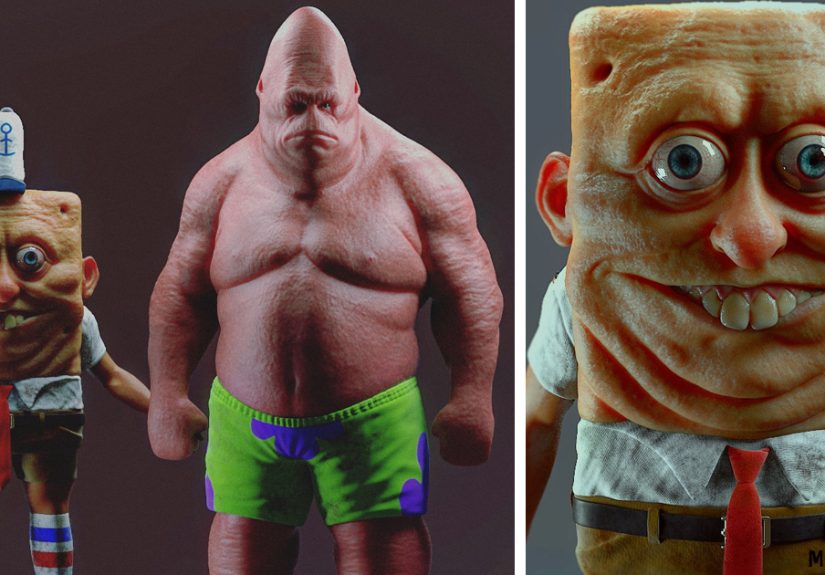
Make SpongeBob realistic, though, and things get slimy fast. Real sea sponges are animals with porous bodies that filter water for food and oxygen. They do not have brains, human-style faces, or cheerful little knees. A realistic SpongeBob would likely be full of holes, wet textures, soft tissue, and tiny channels where water moves through his body. His square shape would make him look less like a sea creature and more like a kitchen sponge that achieved consciousness and immediately got a job.
His laugh would also become a problem. In cartoon form, it is silly. In realistic form, a porous yellow organism giggling while walking toward you in polished shoes would be the final scene before you decide the ocean should keep its mysteries.
Patrick Star: The Starfish Best Friend You Should Not High-Five
Patrick Star is simple, pink, round, and wonderfully clueless. As SpongeBob’s best friend, he works because he looks soft and harmless. But a realistic sea star does not have a cartoon face in the middle of a smooth pink head. It has a body structure built for life on the ocean floor, often with textured skin, tube feet, and a mouth located on the underside.
A realistic Patrick would probably not waddle like a toddler in swim trunks. He would creep. Slowly. Quietly. With many tiny tube feet doing their job under his body. That detail alone turns a lovable goofball into something you would avoid stepping near at low tide.
The real horror is emotional. Patrick’s cartoon stupidity is adorable because he has soft eyes and perfect comic timing. A realistic starfish with a human-like face, blank expression, and slow movement would not look innocent. It would look ancient, patient, and possibly aware of secrets from the bottom of the sea.
Bugs Bunny: A Six-Foot Trickster Rabbit Is Not Your Friend
Bugs Bunny is cool because he is always in control. He leans on a tree, munches a carrot, and verbally dismantles anyone foolish enough to chase him. His design is elegant: long ears, expressive eyes, big feet, and a relaxed posture. He is a masterpiece of cartoon confidence.
Now imagine him as a realistic rabbit-human hybrid. Rabbits and hares have powerful hind legs, large ears, fast reflexes, and prominent incisors. Scale that up to human height and add Bugs’s personality. You no longer have a charming trickster. You have a tall, fur-covered creature who can hear you whisper from across the house, leap over furniture, and smile with long front teeth while asking, “What’s up, doc?”
The realistic ears alone would be unsettling. Instead of smooth gray shapes, they would be warm, flexible, and lined with visible blood vessels. His feet would not be cute; they would be massive biological equipment designed for explosive movement. Meeting realistic Bugs Bunny in real life would not feel like meeting a celebrity. It would feel like being evaluated by a woodland lawyer who already knows you are guilty.
Homer Simpson: Yellow Skin, Huge Eyes, and Too Much Reality
Homer Simpson is not an animal or object; he is a stylized human. That makes a realistic version even more uncomfortable. The Simpsons design language uses yellow skin, round eyes, simplified mouths, and exaggerated body shapes so characters are instantly recognizable. It is not trying to mimic real human anatomy. It is trying to create a world where a man can survive decades of workplace accidents, donut abuse, and emotional shouting.
If Homer were realistic, the yellow skin would be alarming rather than iconic. His large eyes would need wet surfaces and tiny blood vessels. His overbite, stubble, and famous dome-shaped head would become medical mysteries. Even his “D’oh!” would feel different coming from a flesh-and-blood person whose head is shaped like a cartoon lightbulb.
Realistic Homer is creepy because he is almost human. A realistic Mickey or SpongeBob can be dismissed as fantasy. Realistic Homer would look like someone who might actually stand behind you in line at a convenience store, holding six donuts and breathing heavily. That is too close to home.
Scooby-Doo: A Talking Great Dane With Human Panic
Scooby-Doo is lovable because he is both a dog and a cowardly best friend. He talks, eats giant sandwiches, runs from ghosts, and somehow helps solve mysteries despite having the survival instincts of a nervous marshmallow. His cartoon design softens everything about him: the spots, the collar, the goofy grin, the rubbery expressions.
But a realistic Scooby-Doo would be a very large Great Dane with human-like speech. That sounds fun until you picture the mechanics. A dog’s mouth is not built for clear human language. A realistic talking Scooby would need strange tongue movements, altered lips, and facial muscles that shift somewhere between canine behavior and human expression. The result would be fascinating for three seconds and deeply upsetting for the rest of your life.
Also, Scooby is enormous. If a realistic Great Dane-sized cartoon dog jumped into your arms during a ghost scare, you would not laugh. You would visit urgent care. His appetite would be expensive, his fear response would destroy furniture, and his ability to say your name in a shaky voice would haunt you forever.
Tom and Jerry: Slapstick Becomes a Crime Scene
Tom and Jerry are built on impossible violence. They smash, stretch, burn, flatten, explode, and recover instantly. In cartoon form, this is classic slapstick. The characters are elastic symbols of conflict. Nobody worries about medical bills because cartoon physics resets everything by the next scene.
Realistic versions would ruin the joke immediately. A real cat chasing a real mouse is not a symphony of clever traps and musical timing. It is predator and prey behavior. Add realistic fur, claws, teeth, injuries, and panic, and the comedy disappears. Suddenly, a frying pan to the face is not a punchline. It is evidence.
Tom would be frightening because cats are already skilled hunters. Jerry would be unsettling because a mouse with human intelligence would be almost impossible to catch. He would understand doors, wires, poison labels, and your schedule. A realistic Jerry living in your walls would not be cute. He would be a tiny tactical genius with access to your cereal.
Pikachu: Cute Electric Mouse or Portable Thunderstorm?
Pikachu is one of the most beloved animated creatures in pop culture. Its round body, bright yellow color, red cheeks, and small voice make it feel like a plush toy with feelings. But the character is also famously associated with electricity. In a cartoon or game, that is exciting. In your living room, it is an insurance claim.
A realistic Pikachu would likely combine rodent-like traits with specialized electric organs or cheek sacs capable of producing shocks. The adorable red circles on its face would become biological equipment. Its fur might stand up with static. Its teeth would be sharper than the merchandise suggests. Its tail, shaped like lightning in animation, would become an anatomical question nobody at the vet wants to answer.
Even if realistic Pikachu were friendly, you would still avoid hugging it during a thunderstorm. One sneeze, one startled jump, one bad dream, and your phone, toaster, and nervous system are all having a very bad afternoon.
Donald Duck: A Sailor Suit Cannot Save This Situation
Donald Duck works because he is expressive, loud, emotional, and dressed like a sailor for reasons everyone accepts without paperwork. His cartoon bill is smooth, his feathers are clean, and his anger is funny because it is wrapped in comedy timing.
A realistic Donald Duck would be far less charming. Ducks have textured bills, webbed feet, feathers that can look oily or damp, and eyes positioned for a very different kind of animal awareness. Add human arms, speech, rage, and a sailor shirt, and you get something that feels less like a classic character and more like a furious wet bird demanding respect at a marina.
The voice would be the real danger. Donald’s cartoon speech is iconic because it is stylized. A realistic duck-human hybrid trying to shout through an actual bill would create a sound somewhere between a boat horn, a tantrum, and a haunted kazoo. You would not argue with him. You would hand over the bread and leave.
Goofy: The Tall Dog-Man With Too Much Confidence
Goofy is one of animation’s great contradictions. He is dog-like, human-like, clumsy, kind, and oddly resilient. His long face, floppy ears, buck teeth, vest, gloves, and laugh make him harmless in cartoon form. But realistic Goofy is a different beast.
Picture a tall, lanky dog-man standing upright, wearing clothes, laughing loudly, and falling down stairs without serious injury. His snout would be long. His teeth would be visible. His ears would swing with weight. His posture would make no biological sense, yet he would insist on acting casual. That is unsettling because Goofy’s design depends on simplification. Once rendered realistically, every feature becomes too much: too tall, too dog, too human, too cheerful.
Meeting realistic Goofy would not be dangerous in the traditional sense. He seems friendly. But the psychological effect would be severe. You would spend the entire interaction wondering whether he is a dog, a man, a cryptid, or a customer service mascot who escaped into the suburbs.
What Realistic Cartoon Fan Art Gets Right
Realistic cartoon fan art is popular because it answers a question fans secretly love asking: “What if this character existed in our world?” The best versions do not simply add pores and call it a day. They translate the character’s visual identity into believable anatomy while preserving what makes the character recognizable.
For example, a strong realistic Mickey keeps the round ears and cheerful energy but considers real rodent structure. A strong realistic SpongeBob keeps the square silhouette but introduces sponge texture and underwater biology. A strong realistic Bugs Bunny keeps the relaxed attitude but uses rabbit anatomy to make the design feel grounded.
The problem is that grounding these characters often makes them less friendly. Cartoons are designed to remove threatening details. Realism puts those details back. Fur has direction. Teeth have roots. Eyes need moisture. Skin has pores. Muscles pull faces into expressions. Once those details appear, our brains stop reading the character as a symbol and start reading it as a living thing. That is when nostalgia begins nervously checking the exits.
Why We Still Love These Creepy Versions
Even when realistic cartoon characters are horrifying, we keep looking at them. Why? Because they create a perfect collision between childhood memory and adult curiosity. We know the original characters. We feel emotionally connected to them. Seeing them reimagined with real-world textures gives us a strange thrill, like opening a familiar door and finding a completely different room behind it.
There is also genuine artistry involved. Turning a two-dimensional character into a believable realistic creature requires knowledge of anatomy, lighting, texture, proportion, and storytelling. It is not easy to make a sponge with pants recognizable, or a rabbit with human attitude believable, or a yellow cartoon dad disturbing without losing the joke.
That tension is the appeal. Realistic cartoon characters are funny, scary, clever, and uncomfortable at the same time. They remind us that cartoons are not just simplified reality. They are carefully designed illusions. The moment we remove the simplification, the illusion becomes something else entirely.
The Real-Life Experience: What It Would Feel Like To Meet Them
Imagine walking into a themed exhibition called “Cartoons in Real Life.” At first, you are excited. The lobby plays cheerful music. The walls are painted in bright colors. A sign promises “beloved childhood icons reimagined with lifelike detail.” You think, “Great, this will be nostalgic.” That confidence lasts until the first animatronic Mickey turns his head.
He is small, glossy-eyed, and breathing. His ears are no longer perfect circles; they flex slightly under the lights. His whiskers twitch when you move. He waves with a gloved hand, but the glove wrinkles like it contains real fingers. Suddenly, every happy memory becomes a legal document your brain refuses to sign.
You continue into the underwater room. There stands SpongeBob, damp and porous, smiling with lips that should not exist. Water trickles through tiny openings in his body. His shoes squeak. A realistic Patrick slowly creeps beside him, using dozens of tiny tube feet hidden under his pink body. You laugh because the alternative is screaming in front of families.
Next comes Bugs Bunny. He leans against a fake tree, taller than expected, ears warm and veined, front teeth bright under the exhibit lights. He looks relaxed, but every part of his body suggests he could leap across the room in one movement. “What’s up, doc?” he asks. You immediately confess to things you did not do.
The sitcom room is worse. Realistic Homer Simpson sits on a couch with yellowish skin, damp eyes, and stubble that looks painfully real. He reaches for a donut. You hear the small wet sound of his fingers touching frosting. This is when you understand why cartoons have four fingers and clean outlines. Reality adds too much information.
In the mystery hallway, Scooby-Doo appears from behind a curtain. He is enormous. His collar jingles. His mouth moves almost like a dog’s, almost like a person’s, and completely like something you will describe badly to a therapist. He says your name because the ticket system told him. You do not appreciate the personalization.
By the final room, you are no longer nostalgic. You are humbled. Tom and Jerry dart across the floor with realistic speed. Pikachu crackles gently behind reinforced glass. Donald Duck shouts from a pond enclosure while Goofy waves from a doorway that suddenly feels too narrow.
You leave the exhibit with one clear lesson: cartoons belong in cartoons. Their simple lines, bright colors, and impossible proportions are not limitations. They are protection. Animation knows exactly how much reality we can handle. Realistic famous cartoon character versions may be brilliant works of imagination, but meeting them in real life would turn childhood joy into a very fast walk back to the parking lot.
Conclusion
Realistic famous cartoon character versions are fun because they let us test the border between fantasy and reality. They also prove why classic character design works so well. Mickey’s circles, SpongeBob’s square body, Bugs Bunny’s smooth charm, Homer’s yellow simplicity, and Scooby-Doo’s rubbery expressions are not random choices. They are carefully exaggerated designs that help us accept impossible characters without fear.
Once those designs become realistic, the charm changes. Some characters become strange. Others become funny in a darker way. A few become creatures you would absolutely not want to meet after sunset, before coffee, or frankly ever. Still, these realistic versions keep attracting attention because they reveal the hidden genius of cartoons: the less real they look, the more emotionally believable they can be.