Table of Contents >> Show >> Hide
- Why Old Hardware Holes Can’t Just “Be Filled and Forgotten”
- Before You Start: Identify Your Drawer Front and Your Finish Plan
- Tools and Materials
- The Best Fix: Drill-and-Dowel Plug Method (Strong + Clean)
- Step 1: Remove hardware and inspect the holes
- Step 2: Choose a dowel size and matching drill bit
- Step 3: Protect the surface to prevent tear-out
- Step 4: Drill the hole clean and straight
- Step 5: Prep the dowel for a better glue bond
- Step 6: Glue and insert
- Step 7: Let it cure, then trim flush
- Step 8: Sand flatwithout creating a “repair crater”
- Make It Look Invisible: Grain-Matching (The “Nice Cabinet” Upgrade)
- Homemade Wood Filler: Sawdust + Glue (Perfect for Micro-Gaps)
- The Power Combo: Dowels for Strength + Homemade Filler for Perfection
- Re-Drilling for New Pulls: Layout Tips That Prevent Regret
- Paint-Grade Finish: The Easiest Path to “What Holes?”
- Stain-Grade Finish: How to Reduce Patch Visibility
- Common Mistakes (So You Don’t Join the “Oops Club”)
- FAQ: Quick Answers for Real-Life Drawer Pull Problems
- Experiences & Lessons DIYers Learn the Hard Way (So You Don’t Have To)
- Conclusion
Changing drawer pulls sounds like a quick glow-up… until you remove the old hardware and your drawer fronts stare back with
two sad little holes like, “So… we’re just leaving these?” Whether you’re swapping knobs for modern pulls, changing
center-to-center spacing, or fixing a “DIY from 2009” situation, plugging drawer pull holes the right way matters for both
looks and strength.
This guide walks you through a reliable, furniture-friendly method: wood dowels for structure plus
homemade wood filler (sawdust + glue) for a smooth, paint- or finish-ready surface. It’s a simple combo,
but it delivers the kind of results that make people say, “Wait… where were the old holes?”
Why Old Hardware Holes Can’t Just “Be Filled and Forgotten”
Drawer pull holes aren’t just tiny cosmetic blemishes. They’re often drilled clean through the drawer front, and the new
hardware may land close enough to the old holes that the wood becomes weak or crumbly. If you only smear on filler, you
might get a patch that looks okay todaythen shrinks, cracks, or fails when you tighten screws tomorrow.
The goal is to rebuild the wood, not just mask it. That’s why dowels (or plugs) are the MVP: they replace
missing material with real wood, so the area can be drilled again and still hold hardware securely.
Before You Start: Identify Your Drawer Front and Your Finish Plan
1) What is the drawer front made of?
- Solid wood: Best-case scenario. Dowels and filler blend well when prepped carefully.
- Plywood: Works great, but watch the veneer layeravoid tear-out and over-sanding.
- MDF / particleboard: Use dowels cautiously; you’ll want clean holes, solid glue coverage, and gentle drilling.
- Laminated / thermofoil fronts: These can be trickierrepairs may need specialty fillers, careful edge sealing, and a paint-first mindset.
2) Are you painting or staining?
- Painting: Much more forgiving. Your main enemy is surface unevenness (and that one spot that flashes under light).
- Staining or clear-coating: Tougher. End grain drinks stain differently, and glue-based fillers can telegraph through the finish.
Tools and Materials
Must-haves
- Drill (corded or cordless)
- Drill bits: brad-point or Forstner bits for clean holes; a small pilot bit for re-drilling
- Wood dowel rod (choose a diameter you can drill cleanlycommonly 1/4″, 5/16″, or 3/8″)
- Wood glue (PVA/yellow glue)
- Flush-cut saw or a sharp chisel
- Sandpaper (typically 120/150 and 180/220)
- Putty knife or flexible scraper
- Tack cloth or a vacuum + microfiber cloth
- Painter’s tape (helps prevent tear-out and protects surrounding finish)
For homemade wood filler
- Fine sanding dust (ideally from the same wood species and the same project area)
- More wood glue
- A scrap of cardboard or mixing cup + a stir stick
Nice-to-haves
- Center punch or awl (for accurate hole starts)
- Depth stop collar (prevents drilling too deep on veneered fronts)
- Hardware installation template/jig (for consistent alignment across drawers)
The Best Fix: Drill-and-Dowel Plug Method (Strong + Clean)
If you want a repair that can be drilled again and hold new pulls without drama, this is your method. Think of it as
“wood restoration,” not “wood makeup.”
Step 1: Remove hardware and inspect the holes
Take off the old pull/knob and check the hole condition. Are the edges crisp? Splintered? Oval? If the hole is ragged,
doweling is even more important because you’re rebuilding a clean cylinder of wood.
Step 2: Choose a dowel size and matching drill bit
Pick a dowel diameter that comfortably “eats” the old hole. For most drawer pull holes, a larger dowel (like 1/4″ to 3/8″)
makes life easier because it removes damaged edges. Use a bit the same size as the dowel for a snug fit.
Step 3: Protect the surface to prevent tear-out
- Apply painter’s tape over the hole area on the front face.
- If the hole goes through, tape the back side too (especially on veneer).
- If possible, drill from the show face inward to keep the exit cleanor drill halfway from each side for ultra-clean results.
Step 4: Drill the hole clean and straight
Use a brad-point or Forstner bit for a cleaner cut than a standard twist bit. Drill slowly, keep the drill square to the
surface, and let the bit do the work. If you wobble, you’ll create a slightly oversized holeand the dowel will spin when
you try to glue it in (which is the woodworking version of a sitcom slip-and-fall).
Step 5: Prep the dowel for a better glue bond
- Cut the dowel slightly longer than the hole depth (or thickness if it goes through).
- Lightly chamfer the dowel end (a quick sand or knife bevel helps it start cleanly).
- Dry-fit first. It should be snug but not “need a sledgehammer and a prayer.”
Step 6: Glue and insert
Coat the hole walls lightly with wood glue and add a thin coat to the dowel. Insert the dowel and tap gently until seated.
Wipe squeeze-out immediately with a damp cloth (glue left on the surface can mess with stain and finish later).
Step 7: Let it cure, then trim flush
Once the glue is fully cured, trim the dowel close to flush using a flush-cut saw or a sharp chisel. If using a chisel,
work carefully and take thin paring cuts to avoid denting the surrounding wood.
Step 8: Sand flatwithout creating a “repair crater”
Sand the patch level using a sanding block (blocks keep surfaces flat; fingers create surprise topography). Start with
120/150 if needed, then finish with 180/220. Stop as soon as the patch feels perfectly flush.
Make It Look Invisible: Grain-Matching (The “Nice Cabinet” Upgrade)
If your drawer fronts will be stained or clear-coated, a plain dowel can still show because dowels often expose end grain
that absorbs stain differently. For the most seamless look, consider a face-grain plug cut from similar
wood using a plug cutter. If you’re painting, you can skip this whole section and live happily ever after.
Face-grain plugs vs. dowel rod
- Dowel rod: Fast, strong, widely available, great under paint, acceptable under some stains with careful finishing.
- Face-grain plug: Best visual match for stain-grade work, especially on flat drawer fronts in good lighting.
If you go the plug route, align the grain direction before gluing so the “patch” blends with surrounding wood instead of
looking like a tiny wooden bullseye.
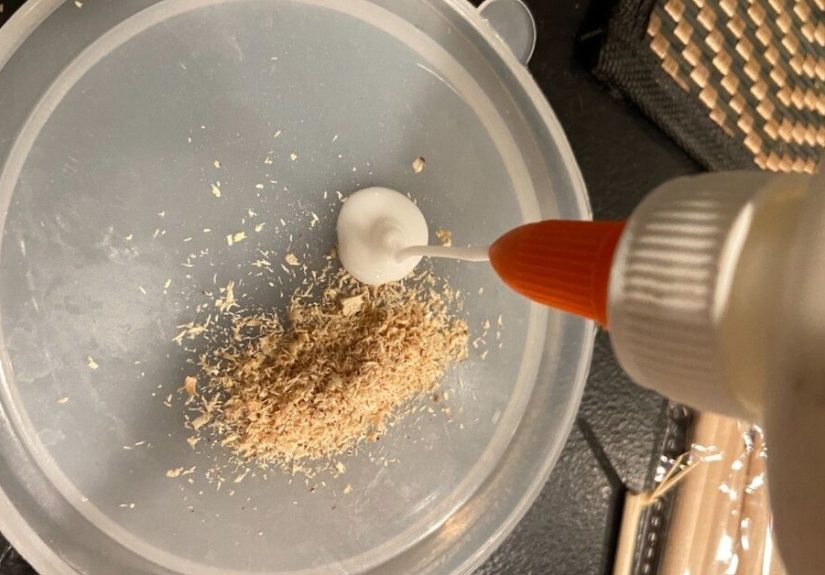
Homemade Wood Filler: Sawdust + Glue (Perfect for Micro-Gaps)
Homemade wood filler is fantastic for tiny voidslike the hairline gap around a dowel, a chipped edge, or a small divot
that would otherwise show after priming. It’s cheap, quick, and weirdly satisfying.
How to make it
- Collect fine sanding dust. The finer the dust, the smoother the filler. Dust from the same wood is best for color.
- Clean it. Pick out grit or chips. (If you’ve been drilling, keep metal shavings out.)
- Mix small batches. Add a little glue, then dust, stirring until it becomes a thick puttythink “cookie dough,” not “pancake batter.”
- Press it in firmly. Use a putty knife to force it into gaps and scrape excess.
- Let it dry completely. Then sand lightly to level.
What homemade filler is best at (and what it’s not)
- Best for: tiny gaps, paint-grade repairs, small surface imperfections, edge chips, dowel halo gaps.
- Not ideal for: large voids, structural repairs by itself, stain-critical surfaces where perfect color match matters.
A reality check: glue-based fillers can take stain differently than surrounding wood. If you’re staining and the repair
must vanish, lean on wood plugs/dowels for bulk and use commercial stainable filler sparinglyor plan your hardware
placement to “cover the crime scene.”
The Power Combo: Dowels for Strength + Homemade Filler for Perfection
This is where the magic happens. Use the dowel to rebuild the missing wood, then use homemade filler to erase tiny gaps.
The result is stronger than a filler-only patch and smoother than a dowel-only patch.
Quick workflow
- Drill and glue in the dowel.
- Trim flush and sand level.
- Inspect under angled light (the “truth spotlight”).
- Apply homemade filler to any pinholes or hairline gaps.
- Sand lightly again and dust off thoroughly.
Re-Drilling for New Pulls: Layout Tips That Prevent Regret
Most drawer pull disasters come from one thing: “eyeballing.” Even if your eyes are great, your drill bit is not a mind
reader. For consistent results across a kitchen or dresser:
- Use a template. A hardware jig keeps spacing consistent across multiple drawers.
- Mark centerlines. Measure drawer width, mark the center, then mark hole spacing from that center.
- Start with an awl. A tiny divot prevents the bit from skating on finished surfaces.
- Drill pilot holes. Especially important near patched areaspilot holes reduce splitting and wandering.
Example: switching from a knob to a 5-inch pull
Say your old knob hole is centered, but your new pull needs two holes 5 inches apart. You plug the center hole with a dowel,
sand it flush, then lay out two new holes equidistant from center. Drilling into fresh dowel wood is totally finejust
pilot first and drill straight. Your new pull won’t know there was ever a knob there (and it doesn’t need to).
Paint-Grade Finish: The Easiest Path to “What Holes?”
- Prime the repaired spot (or the entire drawer front for best uniformity).
- Sand lightly after primer dries to remove texture.
- Spot-check with light from the side; fill micro-voids if needed.
- Paint in thin coats for a smooth finish that doesn’t highlight patches.
Stain-Grade Finish: How to Reduce Patch Visibility
- Prefer plugs over filler: real wood (with grain) blends better than putty under stain.
- Control absorption: sand end-grain areas carefully and consistently.
- Test first: stain your repair method on scrap so you don’t discover “surprise dark circles” on the final piece.
- Consider timing: some finishing systems use stain first, then topcoat, then color-matched putty for tiny defects.
Common Mistakes (So You Don’t Join the “Oops Club”)
1) Rushing dry time
If glue or filler isn’t fully cured, sanding can tear the repair or create low spots. Patience here looks like skill later.
2) Over-sanding around the patch
Over-sanding can dish the surrounding wood and make the repair visible under paint. Use a block and stop as soon as it’s flat.
3) Leaving glue smears on the surface
Dried glue can block stain penetration and create lighter patches. Wipe squeeze-out immediately and sand any residue fully.
4) Using filler alone for through-holes
Filler-only patches can shrink or crackespecially in deeper holes. Dowels (or plugs) are the correct “rebuild,” filler is the “fine-tune.”
FAQ: Quick Answers for Real-Life Drawer Pull Problems
Can I just use toothpicks and glue?
Toothpicks are a classic trick for stripped screw holes where you need the screw to bite againlike a loose hinge.
For clean, visible drawer pull holes (especially through-holes), a dowel repair is stronger and cleaner.
What if my new holes overlap the old holes?
Plug first with a dowel so you’re drilling into solid wood. If overlap is extreme, consider shifting hardware placement
slightly, using a backplate, or choosing a pull with a different center-to-center spacing.
Do I need store-bought wood filler?
Not always. Homemade filler works great for small gaps and paint-grade work. For stain-grade repairs, commercial stainable
fillers can be more predictablebut plugs are still the gold standard for visibility and strength.
Experiences & Lessons DIYers Learn the Hard Way (So You Don’t Have To)
Plugging drawer pull holes is one of those projects that looks simple on papertwo holes in, two holes out, done. In real
life, it teaches a handful of oddly specific lessons that every DIYer seems to collect at some point (like souvenir magnets,
but with more sanding dust).
First lesson: the light will expose everything. You can run your fingers over a patch and think it’s
perfectly smooth, then tilt the drawer under a lamp and suddenly the repair is doing the wave. This is why pros check
surfaces with “raking light”light coming from the side. It’s not being dramatic; it’s being honest. If the patch is even
slightly proud or slightly dished, paint and glossy finishes love to highlight it like it’s on a red carpet.
Second lesson: the drill wants to wander the second you look away. If you’ve ever started drilling on a
finished drawer front without a center punch or awl mark, you know the feeling: the bit skates, you whisper “no no no,”
and suddenly your “perfectly centered” hole is now “artistically adjacent.” A tiny starter divot changes everything. So
does a templatebecause repeating a measurement 12 times is how people end up with 12 slightly different “centers.”
Third lesson: glue squeeze-out is sneaky. It shows up right when you’re feeling proud. You tap the dowel
in, wipe the obvious glue, and think you’re a responsible adult. But a thin glue smear can still dry on the surface and,
later, stain won’t absorb there. The result is a patch that’s not just visibleit’s visible in a way that makes people
squint. The practical habit is simple: wipe immediately, then do a final inspection after it sets. If you see a shiny spot
or feel something slick, sand it back to clean wood before finishing.
Fourth lesson: homemade wood filler is amazing… and also a bit moody. Sawdust + glue can match color
surprisingly well for tiny gaps, but it’s not a magic invisibility pasteespecially under stain. DIYers often notice that
glue-based filler can dry darker or absorb stain differently than surrounding wood. That doesn’t make it “bad.” It just
means it’s best used like seasoning: a little, in the right place, not poured over the whole dish. Many people get the
best results using dowels for the main repair, then homemade filler only to erase micro-gaps around the edges.
Fifth lesson: the “perfect flush cut” takes practice. A flush-cut saw is great, but it still helps to
leave the dowel just a hair proud, then sand down to level. Going too aggressive with a chisel can dent the drawer front.
Going too aggressive with sanding can dish the area around the repair. The sweet spot is patience: trim close, then sand
flat with a block. If you’re painting, you’ll feel like a genius. If you’re staining, you’ll feel like a scientist
testing on scrap, adjusting sanding, and learning how wood grain has opinions.
Finally, the most satisfying “experience” is the moment you install the new pulls and realize the old holes are basically
a myth now. The drawer looks intentional, aligned, and updated. And the best part? The repair isn’t fragile. You can snug
the screws without fear, because you rebuilt the wood with dowels instead of hoping filler would do the job of lumber.
It’s one of those small projects that quietly upgrades your whole piecelike giving your furniture a fresh haircut and
watching it suddenly act more confident.
Conclusion
Plugging drawer pull holes is a small job with big visual payoff. For the best results, rebuild the hole with a properly
sized dowel (or face-grain plug when staining), then use homemade wood filler for tiny gaps and surface perfection. Take
your time, drill straight, sand flat, and plan your new hardware layout with a template. Your drawers will look like they
were born with the new pullsand the old holes will be nothing but a funny memory (for you, not the furniture).