Table of Contents >> Show >> Hide
- A Destroyer That Looks Like Tomorrow
- Why People Call It the Warship That Runs on Linux
- The Ship Is Basically a Floating Power Plant
- Weapons, Firepower, and the Famous Gun Problem
- From Coastal Gunship Dream to Hypersonic Strike Platform
- The Automation Advantage and the Human Factor
- What the USS Zumwalt Says About the Future of Warships
- What It Feels Like to Picture Life Around a Linux-Driven Stealth Destroyer
- Conclusion
Most warships look like warships. The USS Zumwalt looks like a rumor somebody launched into the ocean just to see if radar would notice. With its sloped sides, eerie silhouette, and enough electrical muscle to make engineers grin like kids in a candy store, the Navy’s stealth destroyer has spent years bouncing between “future of naval warfare” and “very expensive science project.” Yet for all the headlines about its radical hull and monster power system, one detail keeps stealing the show: deep in its digital nervous system, Zumwalt runs on Linux.
That does not mean a sailor is down below updating the ship with a gaming laptop and a coffee-stained terminal window. It means the Zumwalt class was built around an open-architecture computing backbone that uses Linux-based infrastructure as part of the system that ties together sensors, weapons, controls, and the ship’s internal operations. In plain English, this destroyer is not just armed with missiles and automation. It is also a floating network, a stealthy power station, and a lesson in how modern warships increasingly behave like giant software platforms that happen to carry serious hardware.
This is what makes the Zumwalt so fascinating. It is not merely a ship you sail. It is a ship you compute.
A Destroyer That Looks Like Tomorrow
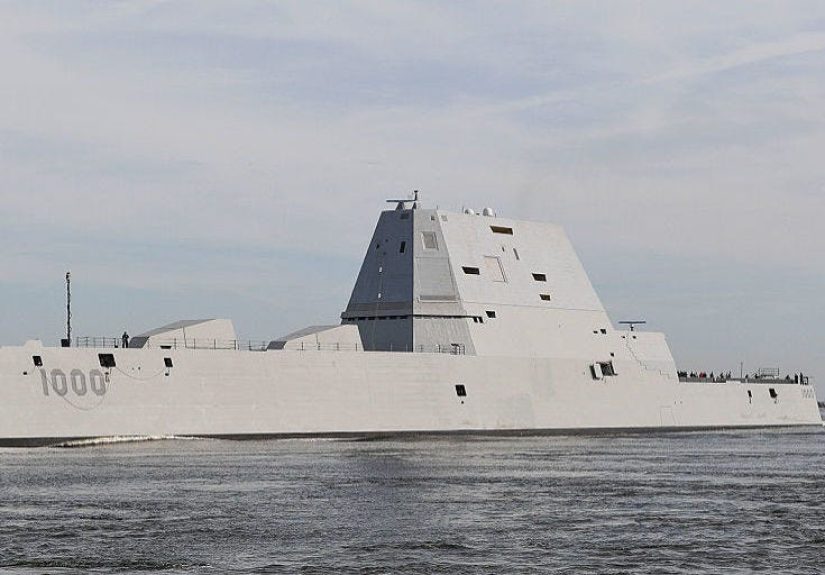
The USS Zumwalt, hull number DDG-1000, is the lead ship of the Navy’s Zumwalt-class destroyers. It was designed as a next-generation surface combatant with a remarkably low radar signature, a highly automated crew setup, and an integrated electric power system that broke from the mechanical habits of older warships. The class was meant to be bold, fast-moving, and a little revolutionary. In Navy terms, that usually translates to “packed with new tech and followed by spirited budget hearings.”
At more than 15,000 tons full load, the Zumwalt is enormous for a destroyer, closer in size to some cruisers than to the traditional image people have in mind when they hear the word “destroyer.” Its design is dominated by a tumblehome hull, meaning the sides angle inward as they rise above the waterline. This shape helps reduce radar reflections, giving the ship a cleaner stealth profile than conventional warships with outward-flaring hulls. The result is a vessel that looks less like a traditional gray Navy ship and more like a villain’s yacht from a very expensive movie.
But the stealth story is only half the fun. The real magic is in what the ship can do once you stop staring at it.
Why People Call It the Warship That Runs on Linux
The line is catchy because it is true in an important sense. The Zumwalt’s digital core was built around the Total Ship Computing Environment Infrastructure, often shortened to TSCEI. This computing environment forms the backbone for the ship’s software ecosystem, supporting applications that help manage everything from mission systems to onboard services. Raytheon described TSCEI as a standardized, open-architecture suite of hardware, operating system, middleware, and infrastructure services. One early release specifically supported IBM blade servers running the Red Hat Linux operating system.
That is a big deal. Traditional naval vessels often relied on more fragmented control and combat systems, with many subsystems acting like stubborn relatives at a holiday dinner: technically related, but not especially eager to communicate. The Zumwalt’s design aimed for deeper integration. By using a more unified computing architecture, the ship could fuse information, automate functions, and streamline operations across systems that would once have lived in separate technical neighborhoods.
So when people say the USS Zumwalt runs on Linux, they are talking about the operating environment that underpins a major part of its computing architecture. Linux is not there as a party trick. It is there because open, adaptable, enterprise-grade software makes sense in a platform expected to evolve over time. On a ship designed to absorb new capabilities, software flexibility matters almost as much as steel.
Why Linux Fits a Modern Warship
Linux has long been attractive in mission-critical environments because it is stable, customizable, and well suited to open-architecture systems. For a ship like Zumwalt, that means developers can build and maintain complex applications on a common framework rather than reinventing the wheel every time a new capability comes along. If a warship is a machine, then Zumwalt is also a platform for updates, integration, and future upgrades. Linux helps make that possible.
It is a strangely poetic idea: one of the most futuristic warships ever built relies in part on the same operating-system family that powers servers, laboratories, and a great many very determined sysadmins. Somewhere, a penguin mascot is quietly feeling very patriotic.
The Ship Is Basically a Floating Power Plant
Another reason the Zumwalt feels different from older destroyers is its Integrated Power System. Instead of treating propulsion and ship services like separate kingdoms, the class uses a shared electrical architecture. Power generated onboard can be distributed where it is needed, whether for propulsion, onboard systems, or future high-demand technologies. That gives the ship tremendous flexibility.
Installed power for the class is commonly described at around 78 megawatts, which is an eye-catching number because it gives the Navy room to support advanced sensors, computing loads, and possible future weapons. This electrical abundance helped make the Zumwalt famous in defense circles as a ship that might someday support power-hungry systems such as directed-energy weapons. Even when those ambitions shifted, the underlying engineering remained impressive.
That power architecture also fits neatly with the ship’s software-heavy identity. The Zumwalt was designed in an era when naval combat was increasingly about networked sensors, digital control, long-range precision, and modular upgrades. In other words, the ship was built for a world where electricity and software are not side features. They are the plot.
Weapons, Firepower, and the Famous Gun Problem
Originally, the Zumwalt class was supposed to be a beast at naval surface fire support. It carried two 155 mm Advanced Gun Systems, and those guns were meant to fire the Long-Range Land Attack Projectile, or LRLAP. On paper, it sounded terrific: long-range precision fire from offshore, supporting troops with a level of reach and accuracy that looked futuristic at the time.
Then came the kind of plot twist defense programs dread. The Zumwalt program was cut from a much larger planned fleet to just three ships. Once the production scale shrank, the special ammunition became wildly expensive. Reports pegged the price of each LRLAP round at roughly $800,000 to $1 million. That is a lot of money for something whose job description begins with “be a shell.” At that point, the Navy had a powerful gun system and no practical ammo plan. That is a little like buying a luxury espresso machine and discovering every coffee pod costs as much as a motorcycle payment.
The cancellation of LRLAP left the Advanced Gun Systems without their intended purpose and turned the Zumwalt into a ship searching for a clearer mission. For critics, this became the symbol of everything that had gone wrong: too much new technology, too much cost, not enough production scale, and a concept that changed as the strategic environment shifted. For supporters, the ship still held enormous promise, especially because its underlying power, stealth, and digital architecture remained valuable.
From Coastal Gunship Dream to Hypersonic Strike Platform
If the first act of the Zumwalt story was about radical design, the second act is about reinvention. The Navy eventually decided the class could serve a different role: long-range strike, including integration of the Conventional Prompt Strike hypersonic weapon system. That decision effectively gave the Zumwalt a new reason to exist in a Navy focused on high-end deterrence and major-power competition.
The plan calls for replacing the ship’s dormant gun systems with missile tubes capable of handling hypersonic weapons. Public reporting and official statements have described a configuration of four missile tubes, each able to carry three hypersonic missiles, for a total of 12 weapons per ship. That turns the Zumwalt from an awkward overachiever with identity issues into something much more strategically useful: a stealthy surface combatant built to deliver fast, hard-to-intercept strikes at long range.
In 2025, the Defense Department announced a successful sea-based hypersonic launch test using the Navy’s cold-gas launch approach, the same general method intended for future sea-based deployments, including aboard the Zumwalt. That does not mean the ship instantly transformed into a science-fiction boss battle, but it does show the Navy is moving from concept to concrete capability.
Why the Navy Still Cares About Zumwalt
Because war changes, and so does the value of a platform. A destroyer optimized for one mission can become awkward if strategy changes around it. But a ship with unusual power, space, stealth, and software flexibility can be repurposed. That is exactly what happened here. The Zumwalt may have stumbled through development, but it also ended up with the kind of built-in margin that lets planners ask, “What else can we make this thing do?” In military procurement, that question is half the game.
The Automation Advantage and the Human Factor
One of the less flashy but genuinely important features of the Zumwalt class is automation. Compared with large warships of earlier generations, the ship was designed to operate with a relatively small crew for its size. Automation affects damage control, system monitoring, maintenance support, and internal management. That matters because personnel costs, training demands, and crew workload are huge factors in naval operations.
Of course, automation is not magic. It can reduce manpower needs, but it also raises the stakes for software reliability and systems integration. On a ship like Zumwalt, where digital infrastructure is central to operations, software is not just support staff. It is part of the combat ecosystem. If a valve, sensor, mission display, propulsion function, or electrical management tool is linked into a highly networked architecture, then computing resilience becomes mission resilience.
That is another reason the Linux angle matters. The ship’s reputation as a warship that runs on Linux is really shorthand for something bigger: modern naval power increasingly depends on software architecture, not just hull shape and missile count.
What the USS Zumwalt Says About the Future of Warships
The Zumwalt is not a perfect ship, and nobody should pretend otherwise. It became a case study in how ambitious defense programs can run into trouble when requirements shift, production scales shrink, and revolutionary technology arrives all at once like uninvited guests. But it is also a case study in something else: how even flawed programs can push naval design forward.
The class helped demonstrate ideas about stealth shaping, integrated power, reduced manning, open-architecture software, and digital control at a scale few warships had attempted. Some of those lessons are cautionary. Some are brilliant. Most are both at the same time, which is honestly how progress usually works.
For future surface combatants, the Zumwalt offers a simple message: a warship is no longer just a collection of engines, steel, and launchers. It is a hardware-and-software ecosystem. The winning designs of the future will not merely float well and shoot far. They will also integrate faster, update easier, compute smarter, and adapt more gracefully. In that sense, the Zumwalt may have arrived early to a party the rest of the fleet is still preparing for.
What It Feels Like to Picture Life Around a Linux-Driven Stealth Destroyer
Even without serving aboard one, it is easy to imagine why the USS Zumwalt leaves such a strong impression on anyone who studies it. This is not the romance of an old battleship with polished brass and loud stories in the mess. The Zumwalt represents a different kind of naval experience, one shaped by screens, automation, systems awareness, and the strange calm that comes from knowing a ship’s real muscles are not always visible from the deck.
Picture walking through a vessel that feels less like a floating museum of mechanical grit and more like a controlled, humming network wrapped in steel. The visual drama outside is obvious enough: the sharp, angular hull, the stealthy lines, the way the ship seems to refuse the classic silhouette of a destroyer. But inside, the experience would be defined by integration. Consoles talk to each other. Data feeds merge. Power is not simply generated and consumed; it is managed intelligently across a platform built to think in electrical terms.
For sailors, that likely changes the rhythm of daily life. The heroics are still there, because every warship demands discipline, readiness, and problem-solving under pressure. But the flavor is different. On a platform like Zumwalt, technical literacy matters in a big way. Operators and maintainers are not just caring for pipes, engines, and weapons in isolation. They are working within a digital environment where software health and system integration are tied directly to combat readiness. It is less “turn the wrench and hope” and more “understand the architecture, watch the data, and fix the right thing before it becomes the wrong crisis.”
For defense enthusiasts, the Zumwalt is irresistible because it feels like a glimpse into a transitional era. You can see the old Navy and the next Navy occupying the same hull. The ship still carries the traditions of seamanship, watchstanding, and warfighting, but it also hints at a future where vessels behave more like secure networks with propulsion attached. That tension makes the ship fascinating. It is not just a destroyer. It is an argument about where naval warfare is headed.
And emotionally, there is something oddly satisfying about the Linux connection. Maybe it is because Linux symbolizes practicality under the hood: adaptable, resilient, serious, and not overly interested in flashy branding. That mirrors the best version of military technology. The most effective systems are often the ones that quietly work, scale, and endure. The Zumwalt’s public image is dramatic, but its underlying lesson is wonderfully nerdy: modern military power depends on architecture, integration, and software choices that most people never see.
That is why the ship sticks in the imagination. It combines the cinematic and the technical, the stealth silhouette and the server-rack reality. It is a destroyer that looks like the future and computes like the future too. Even if its path has been messy, the experience of studying it leaves a clear impression: the age of the software-defined warship is not coming. It is already here, and the USS Zumwalt has been sailing through it for years.
Conclusion
The USS Zumwalt remains one of the most unusual warships the United States has ever built. It arrived with giant expectations, drew criticism for cost and mission drift, and then found new life as a platform for next-generation strike capability. Along the way, it became famous for something delightfully unexpected: its identity as the stealth destroyer that runs on Linux.
That phrase survives because it captures the ship’s real significance. Zumwalt is not just a stealthy hull with a stack of missiles. It is a deeply digital combatant built around integrated power, open computing architecture, and a design philosophy that treated software as central rather than secondary. The gun mission may have faltered, but the ship’s electrical and computing DNA kept it relevant.
In the end, the USS Zumwalt is a reminder that the future of naval warfare is not only about who has the biggest weapons. It is also about who can connect systems, manage power, integrate software, and adapt faster when strategy changes. Steel still matters. So do missiles. But in the age of the networked fleet, the code matters too.