Table of Contents >> Show >> Hide
- What Is the Country Two-Step, Exactly?
- Before You Start: The 60-Second Setup
- The Two-Step Rhythm: Quick, Quick, Slow, Slow
- Basic Two-Step: Step-by-Step (Beginner Friendly)
- How to Travel: The Line of Dance (AKA Dance Floor Traffic Laws)
- Connection & Frame: The “Secret Sauce” That Makes It Look Good
- Your First Add-Ons: Easy Variations That Still Feel Like Two-Step
- Choosing Music for Two-Step Without Guessing Wrong
- Common Beginner Mistakes (and How to Fix Them Fast)
- Two-Step Etiquette: How to Be Everyone’s Favorite Dance Partner
- A 15-Minute Practice Plan (That Actually Works)
- Conclusion: You’re One Rhythm Away from the Dance Floor
- Extra: Real-World Two-Step Experiences (So You Feel Ready)
So you want to learn the country two-step. Excellent choice. It’s the dance equivalent of a
reliable pickup truck: it gets you where you’re going, looks good doing it, and doesn’t ask you
to own rhinestones (unless you want to).
This guide will teach you the classic country two-stepoften called the Texas two-stepin a way
that actually works in real life: crowded dance floors, questionable DJ transitions, and that one
friend who thinks “spinning” means “launching.”
What Is the Country Two-Step, Exactly?
The country two-step is a partner dance you’ll see everywhere from honky-tonks to weddings to
“I swear I’m only here for the brisket” bars. It’s a traveling dance, meaning couples generally
move around the floor together, usually counterclockwise (more on that in a second). The vibe is
smooth and glidy, not bouncythink “floating down a hallway,” not “jogging after the ice cream truck.”
The magic ingredient is the timing: Quick, Quick, Slow, Slow (often written QQSS).
Once you can keep that rhythm, you’re basically in business. Everything elseturns, wraps, fancy
stylingis just adding toppings to the pizza.
Before You Start: The 60-Second Setup
1) Shoes, space, and a tiny reality check
You don’t need cowboy boots. You do need shoes that won’t glue you to the floor. A little slip is
your friend; a lot of slip is a lawsuit waiting to happen. On a sticky floor, take smaller steps.
On a slick floor, take smaller steps and keep your center balanced.
2) Ask like a grown-up (and accept “no” like one)
Two-step is social. That means invitations matter. A simple “Want to two-step?” is perfect.
If someone says no (or “Maybe later”), smile and move on. Consent is part of the dance, not an optional
accessory.
3) Choose your “position”
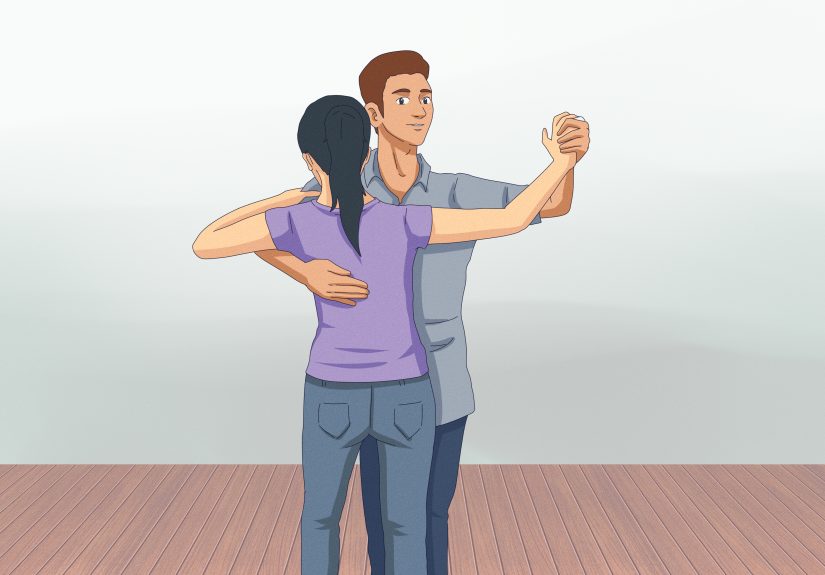
Most beginners start in closed position: you’re facing each other, connected at the hands,
and the leader’s right hand is placed on the follower’s shoulder blade area. You can also dance in a more
open hold (one hand) once you’re comfortable.
The Two-Step Rhythm: Quick, Quick, Slow, Slow
Let’s make QQSS feel less like a secret code and more like a friendly recipe.
In most country music used for two-step, you’ll hear a steady beat in 4/4 time. The dance pattern is
commonly counted as six counts:
- Quick = 1 beat
- Quick = 1 beat
- Slow = 2 beats
- Slow = 2 beats
If you like numbers, think: 1, 2, 3-4, 5-6. The “slows” stretch out and give the dance that
easy, rolling feel. If you rush the slows, you’ll look like you’re power-walking through a Target aisle
with five minutes left before closing.
Pro tip: hum “quick-quick-sloooow-sloooow” while you practice. Yes, you will feel silly. No, the dance floor
does not care. The dance floor is a judgment-free zone until you start doing dips in traffic.
Basic Two-Step: Step-by-Step (Beginner Friendly)
This is the most common beginner pattern because it’s simple and it travels well:
it’s essentially three walking steps plus a close (or a hold) on the last slow.
Leader footwork (QQSS)
- Quick: Step forward with the left foot.
- Quick: Step forward with the right foot.
- Slow: Step forward with the left foot (take two beats).
- Slow: Close the right foot to the left (or hold if space is tight).
Translation: walk, walk, walk… together. Keep it smooth. No stomping.
You’re not squashing a spider; you’re gliding past it with confidence.
Follower footwork (QQSS)
- Quick: Step back with the right foot.
- Quick: Step back with the left foot.
- Slow: Step back with the right foot (take two beats).
- Slow: Close the left foot to the right (or hold).
Followers: your job is not to predict the futureit’s to keep your own balance, maintain timing,
and respond to the lead. (If you can predict the future, please use your powers for lottery tickets,
not dance floors.)
What your upper body should be doing
The feet are only half the story. Keep your chest lifted, shoulders relaxed, and steps underneath you.
Imagine there’s a string gently pulling the top of your head up. Now imagine the string is paid hourly and
cannot handle your slouching for free.
How to Travel: The Line of Dance (AKA Dance Floor Traffic Laws)
Country two-step usually moves counterclockwise around the outside of the floor. This flow is
called the line of dance. The idea is simple: everyone moves the same direction so nobody gets
surprise-sandwiched.
- Outside lane = faster traveling couples (the “fast lane”).
- Inside lane = slower travel, beginners, smaller steps.
- Center = often used for dances that stay more in one place (or for fancy stuff when it’s safe).
Beginner win: stay in the inside lane, take compact steps, and don’t pass other couples. If you need to stop,
exit the floor like you would leave a freewaycarefully and without panic.
Connection & Frame: The “Secret Sauce” That Makes It Look Good
Closed position basics (without the awkwardness)
Think “comfortable hug distance,” not “strangers on an elevator.” A classic beginner frame:
- Leader’s right hand rests on follower’s shoulder blade area (supportive, not pushy).
- Leader’s left hand holds follower’s right hand at about eye level (comfortable height).
- Follower’s left hand rests on leader’s shoulder/upper arm area (stable, not dangling).
Your hands should be connected with gentle tonefirm enough to communicate, soft enough that nobody’s fingers
go numb. If your partner’s hand turns purple, congratulations: you are now teaching “survival grip,” not two-step.
Lead with your body, not your biceps
A clean lead comes from weight shifts and torso direction, not arm yanks. Leaders, think of steering with your
center: where your body goes, the partnership goes. Followers, keep your core engaged and your steps honestdon’t
“help” by guessing turns early, because that’s how you both end up facing the snack bar.
Your First Add-Ons: Easy Variations That Still Feel Like Two-Step
1) The Promenade “Open and Close”
Promenade is a fancy word for “we open up slightly like a V, travel, then come back to face.”
It keeps the dance moving and sets you up for turns later.
- Start in closed position, moving down the line of dance.
- On a slow, rotate slightly so you’re both angled in the same direction (a gentle V shape).
- On the next counts, rotate back to closed as you keep your QQSS timing.
Keep it subtle. If you open so far you can read the bartender’s name tag from across the room, you’ve gone
from promenade to “lost at sea.”
2) The Follower Underarm Turn (the classic starter spin)
Once you can keep QQSS without thinking too hard, try a simple underarm turn for the follower.
The safest beginner version uses the slows for the rotation (because you have time).
- Dance a basic or two to build momentum and spacing.
- Leader raises the connected hand slightly (no wrenching) to create a “doorway.”
- Follower turns under the hand on the slow counts while keeping the QQSS rhythm.
- Leader stays grounded, takes small steps, and helps re-connect smoothly at the end.
Safety note: do spins toward the inside when possible, and keep them compact. Spinning into the outer lane is how
you become a story people tell for years (not always kindly).
3) The Couple’s Turn (both rotate together)
The couple’s turn is a shared rotation where you both turn as a unit while staying connected. The key is
keeping the steps small and the rotation controlledthink “lazy Susan,” not “tornado drill.”
Start it gently on a slow, continue through the next counts, and finish by re-establishing your travel direction
down the line of dance.
Choosing Music for Two-Step Without Guessing Wrong
The easiest songs for learning have a clear, steady beat and a tempo that doesn’t make you feel like you’re
sprinting. Many dancers like two-step music in a roughly 160–200 BPM neighborhood, but plenty of
“teaching tempo” songs sit slower (around 140–160 BPM) so beginners can breathe and think.
Some dancers also “double-time” certain songscounting in a way that makes the rhythm fit comfortably.
When you’re picking songs, listen for:
- Strong groove: you can clearly feel the pulse (that “boom-chick” drive).
- Consistency: fewer tempo changes, fewer dramatic pauses.
- Not too fast: at first, you want control more than cardio.
If you want examples that dancers commonly use for two-step practice, you’ll find playlists built around
two-step tempos and song lists that include modern and classic pickseverything from George Strait staples
to pop-country crossovers that still have a danceable beat.
Common Beginner Mistakes (and How to Fix Them Fast)
Taking huge steps
Big steps feel powerful… right up until you run out of floor. Fix: shrink everything by 30%.
If it feels “too small,” you’re probably finally dancing the size that works in public.
Rushing the slows
Remember: slows take two beats. Fix: on each slow, think “step… and hold.” Feel the stretch.
Arm wrestling your partner
Two-step is not a strength contest. Fix: soften the elbows, keep tone, lead with your body.
You’re guiding, not dragging.
Staring at your feet like they owe you money
Looking down kills balance and connection. Fix: keep your gaze up and use peripheral vision.
If you must check your feet, do it like a polite glance, not a full interrogation.
Two-Step Etiquette: How to Be Everyone’s Favorite Dance Partner
Good etiquette isn’t about being fancyit’s about being safe and considerate. Follow these and you’ll be welcome
everywhere:
- Stay in your lane: beginners inside, faster travel outside.
- Keep moving: don’t park on the highway. If you need to stop, exit the floor.
- No drinks on the floor: nobody wants a surprise slip-and-slide.
- Save big tricks for open space: dips, big spins, and dramatic stuff belong where you’re not blocking traffic.
- Respect boundaries: adjust hand placement if asked, and keep it comfortable.
A 15-Minute Practice Plan (That Actually Works)
- 2 minutes: Clap and count QQSS (say “1,2,3-4,5-6”).
- 4 minutes: Practice leader and follower footwork solo (walk-walk-walk-together).
- 4 minutes: Practice in closed position without traveling (tiny steps, smooth timing).
- 3 minutes: Add gentle travel counterclockwise (inside lane mentality).
- 2 minutes: Try one simple underarm turnonly if timing stays clean.
Do this a few times a week and you’ll feel the difference fast. Consistency beats marathon practice.
(Also, your knees will send you a thank-you note.)
Conclusion: You’re One Rhythm Away from the Dance Floor
The country two-step is one of the most useful dances you can learn because it’s simple, social, and it shows up
everywhere. Nail the quick-quick-slow-slow timing, keep your steps compact, and respect the line
of dance. Then sprinkle in a promenade or a turn when it’s safeand suddenly you look like you know what you’re
doing (even if you’re still counting in your head like a very brave accountant).
Most importantly: keep it fun. The point isn’t perfection. The point is to enjoy the music, connect with your partner,
and glide like you absolutely meant to do that.
Extra: Real-World Two-Step Experiences (So You Feel Ready)
Let’s talk about what actually happens when you take your shiny new two-step out into the wildbecause the dance floor
is not a quiet practice studio. It’s more like a friendly ecosystem with its own weather patterns, migration routes,
and the occasional rogue spinner.
Experience #1: The “Where do we start?” moment. You and your partner step onto the floor and suddenly
it feels like everyone else received a memo titled “How to Look Effortlessly Cool.” Here’s the secret: they’re counting too.
The smooth couples aren’t doing complicated maththey’re doing the basics with confidence. Start in the inside lane,
take tiny steps, and let the music settle into your body before you try anything flashy. The first 20 seconds are just
you syncing up, and that’s normal.
Experience #2: The “traffic is real” surprise. In your living room, you can travel like you’re crossing
Texas. In a real venue, you might have six inches and a prayer. This is where two-step becomes a skill, not just steps:
you learn to scale the dance. Keep the QQSS timing, but shorten the stride. You can two-step almost in place by
making the “walks” more like weight shifts. If you can stay on rhythm without bulldozing anyone, you’re winning.
Experience #3: The “accidental slingshot” turn. Many beginners think a turn happens because the leader
uses more arm. Then the follower spins like a bottle rocket, the leader looks guilty, and the couple behind you performs
an unplanned evasive maneuver. The fix is wonderfully boring: lead the turn earlier, keep the hand path gentle, and let
the follower turn on their own feet. A good turn feels like opening a door, not launching a frisbee.
Experience #4: The “song is faster than my soul” scenario. A great two-step song comes on and suddenly
everyone doubles their speedexcept your legs. Totally fine. Step smaller. Focus on staying relaxed and on time rather
than “keeping up.” If the tempo is truly spicy, you can sit that one out or watch how others interpret it. On many floors,
you’ll also see dancers adjust by counting differently (double-time or half-time ideas) to keep the movement comfortable.
The goal is always the same: match the rhythm, not the panic.
Experience #5: The confidence bump. This is the best part: one night, halfway through a song, your brain
stops screaming “What count is this?” and you just… move. Your partner feels lighter. The travel feels smoother. You smile
without forcing it. That’s two-step clicking into place. It doesn’t usually happen all at onceit arrives in little moments
when your timing stays steady and your connection feels easy.
If you take anything from these real-world moments, let it be this: the two-step is forgiving. You can dance it small or
big, simple or fancy, slow-ish or fast-ish. Keep your QQSS clean, respect the line of dance, and treat your partner like a
teammate. Do that and you’ll fit in on almost any country dance floorboots optional, good attitude required.