Table of Contents >> Show >> Hide
- Why Desk Chairs Sink (And Why It’s Not Your Imagination)
- What You’ll Need
- The 11-Step Fix (Temporary + Permanent Options)
- Step 1: Confirm the “sink” is real (and not a floor/mat issue)
- Step 2: Check warranty, weight rating, and whether repair is worth it
- Step 3: Identify the likely cause: cylinder failure vs. lever/mechanism issue
- Step 4: Prepare your workspace and flip the chair safely
- Step 5: Expose the metal cylinder (the “shiny culprit”)
- Step 6: Quick fix option A Lock the height with a hose clamp
- Step 7: Quick fix option B Use a PVC spacer for a sturdier lock
- Step 8: Permanent fix Separate the chair base from the cylinder
- Step 9: Remove the cylinder from the seat mechanism (the under-seat plate)
- Step 10: Measure and choose the correct replacement gas lift cylinder
- Step 11: Install the new cylinder, reassemble, and fine-tune
- Troubleshooting: If Your Chair Still Sinks
- When You Should Replace the Whole Chair
- Conclusion
- Real-World Experiences: What It’s Like Fixing a Sinking Desk Chair (500+ Words)
Your desk chair isn’t “adjusting itself.” It’s slowly surrendering to gravityone sad inch at a timeuntil you’re typing from a posture that looks like a
shrimp trying to file taxes. The good news: in most cases, you can stop the sinking with a quick DIY fix, or you can repair it properly by replacing the
gas lift cylinder (the part that actually holds your height).
This guide walks you through both: a fast, inexpensive lock-in-place fix and a more permanent repair. You’ll also learn how to diagnose the real cause,
choose the right replacement parts, and avoid turning your chair into a wobbly carnival ride.
Why Desk Chairs Sink (And Why It’s Not Your Imagination)
Most modern office chairs use a pneumatic gas lift cylindera sealed mechanism that uses pressurized gas and a valve to raise and lower
the seat. When you pull the height lever, a valve opens so the chair can move; when you release it, the valve is supposed to seal and hold your seat at
the chosen height. Over time, internal seals can wear out, pressure can leak, and the cylinder can’t resist your weight like it used to.
That’s the #1 culprit. But not the only one. A chair can also sink because the height adjustment mechanism is loose, the lever isn’t
fully returning to the locked position, the seat plate hardware is wobbling, or the chair is consistently used beyond its weight rating.
Quick reality check
- If it sinks only when you sit, suspect the gas lift or the valve/lever not locking.
- If it sinks even when nobody is on it, suspect a failing cylinder (or a lever stuck in “open” mode).
- If it wobbles and sinks, tighten hardware firstwobble can exaggerate the “sinking” feeling.
What You’ll Need
You won’t necessarily need everything belowyour “shopping list” depends on whether you’re doing a temporary lock or a permanent repair.
For the fast lock-in-place fix (temporary)
- Flathead screwdriver (or Phillips, depending on your chair)
- Hose clamp (or a purpose-made chair cylinder clamp)
- Duct tape (optional, for extra grip)
- PVC pipe (optional alternative to a clamp)
- Measuring tape
For the permanent repair (recommended)
- Replacement gas lift cylinder (correct size and activation type)
- Pipe wrench (or large adjustable wrench)
- Rubber mallet (or hammer with a block of wood)
- Penetrating lubricant (optional but often helpful)
- Work gloves and eye protection
Safety note: Gas lift cylinders are pressurized. Don’t drill into them, heat them, cut them open, or try to “refill” them. Your goal is
to remove and replacenot invent a new category of home fireworks.
The 11-Step Fix (Temporary + Permanent Options)
These 11 steps are designed to work like a decision tree: you’ll diagnose first, try the quick fix if you just need the chair to stop sinking today, and
then move to cylinder replacement if you want the chair to behave like a chair again.
-
Step 1: Confirm the “sink” is real (and not a floor/mat issue)
Put your chair on a hard, flat surface. Set it to your preferred height. Sit down and time it for 5 minutes. If you drop noticeably (even 1–2 inches),
you’ve got a sinking chair. If the chair only feels low when you roll onto a thick carpet or squishy mat, you may be dealing with surface compression,
not a failing gas lift. -
Step 2: Check warranty, weight rating, and whether repair is worth it
Before you touch tools, look for a manufacturer label (often under the seat). Higher-end chairs sometimes have long warranties that cover cylinders.
If the chair is still under warranty, repairs might be free or discounted, and you won’t accidentally void coverage.Also consider the chair’s overall condition. If the seat plate is cracked, the base is damaged, or multiple mechanisms are failing, it might be smarter
to replace the chair rather than rebuild it part by part. -
Step 3: Identify the likely cause: cylinder failure vs. lever/mechanism issue
Do a quick under-seat inspection:
- Wiggle the height leverdoes it feel loose, stuck, or sloppy?
- Look for missing bolts around the seat plate.
- Raise the chair to max height, then sitdoes it immediately drop? That often points to a worn cylinder seal.
If hardware is loose, tighten it first. A surprisingly large number of “my chair is dying” complaints are actually “my bolts are on vacation.”
-
Step 4: Prepare your workspace and flip the chair safely
Clear space. Put down a towel or cardboard so you don’t scratch the floor or the chair base. If you’re replacing the cylinder, wear eye protection and
glovesold chairs love shedding mystery grit at the worst time.Flip the chair on its side or upside down. If it’s heavy, get help. This is not the moment to discover your chair has the balance of a sleepy giraffe.
-
Step 5: Expose the metal cylinder (the “shiny culprit”)
Most chairs have a telescoping plastic cover (sometimes called a skirt) around the gas lift. Slide it upward or remove it to reveal the metal cylinder.
Wipe the cylinder cleangrease and dust can make clamps slip and can make cylinder removal harder later. -
Step 6: Quick fix option A Lock the height with a hose clamp
If you need the chair to stop sinking today, this is the fastest route. It won’t restore height adjustment, but it will stop the slow drop.
- Set the chair to your ideal sitting height.
- Wrap a couple layers of duct tape around the cylinder where the clamp will sit (optional, but it helps grip if the surface is smooth).
- Place a hose clamp around the cylinder so it acts like a “stop” between the chair mechanism and the basepreventing downward movement.
- Tighten the clamp firmly with a screwdriver, then test by sitting.
Tip: Tighten gradually and re-test. Over-tightening can deform softer covers or cause the clamp to sit crooked.
-
Step 7: Quick fix option B Use a PVC spacer for a sturdier lock
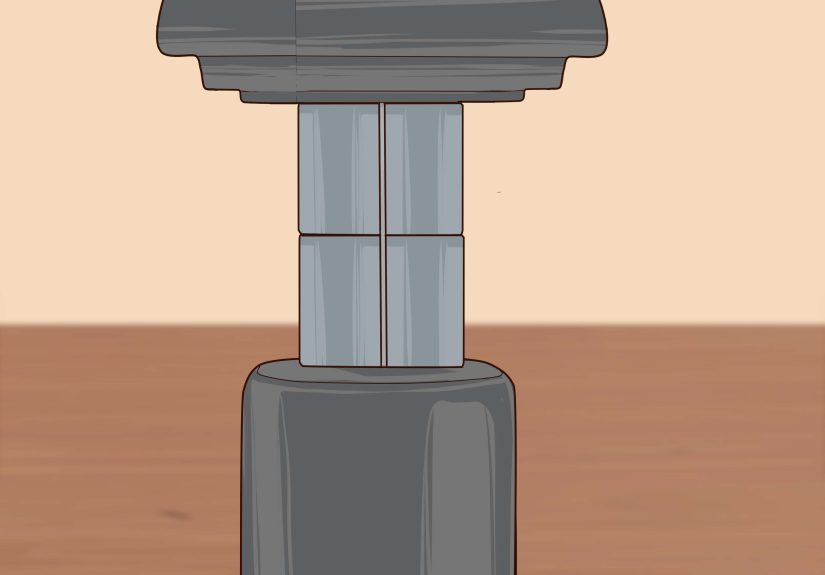
The PVC method is often more stable than a clamp alone because it creates a solid “collar” around the cylinder.
- Measure the gap you need to fill to hold your ideal height (from base to underside of the chair mechanism).
- Cut a PVC pipe section to that length (then cut it lengthwise so it can snap around the cylinder).
- Clip it around the cylinder, then lower the chair mechanism onto it.
This fix is still temporary (you’re essentially turning your chair into a fixed-height chair), but it’s surprisingly effective for many peopleespecially
if you’re waiting for a replacement cylinder to arrive. -
Step 8: Permanent fix Separate the chair base from the cylinder
Ready for the real repair? The gas lift cylinder is typically held in place by a friction/taper fit. That means it can be stubbornlike a jar lid that
knows you’re late for something.With the chair upside down, hold the base firmly and strike the outer rim area near where the cylinder seats into the base (not the
inner rod). Use a rubber mallet if possible. If it won’t budge, apply a little penetrating lubricant where the cylinder meets the base and wait a bit,
then try again. -
Step 9: Remove the cylinder from the seat mechanism (the under-seat plate)
Now you need to detach the cylinder from the mechanism under the seat. Often, a pipe wrench clamped tightly onto the cylinder works:
- Clamp the pipe wrench around the cylinder near the top.
- Twist to break the friction fit (steady force beats frantic rage).
- Pull the cylinder free from the seat mechanism.
If it’s still stuck, add lubricant at the joint, wait, and repeat. Some chair brands also reference cylinder removal tools and hammer-tap methods to
separate componentsuse what’s appropriate for your chair model. -
Step 10: Measure and choose the correct replacement gas lift cylinder
Not all cylinders are interchangeable. To avoid buying a cylinder that fits your chair about as well as a banana fits a USB port, measure:
- Outer diameter of the cylinder tube
- Stroke (travel): the distance between fully compressed and fully extended positions
- Overall lengths when compressed and extended (helpful for matching seat height range)
- Activation type: many chairs use a top-activated or side-activated style
If you have a premium brand chair, look up the model-specific service instructions and part numbers. For general chairs, match measurements and choose a
quality cylinder (often described by class ratings, like “Class 4” in some product descriptions). -
Step 11: Install the new cylinder, reassemble, and fine-tune
Installation is usually the easy part:
- Insert the new cylinder into the base.
- Attach the seat mechanism onto the top of the cylinder.
- Reinstall the plastic cover (if you removed it).
- Set the chair upright and sit gently to “seat” the taper fit.
- Test height adjustment and confirm it holds under your normal sitting posture.
Finally, tighten all visible bolts under the seat, and consider a drop of lubricant on the lever pivot if the lever feels sticky. A smooth lever helps
the valve close fullymeaning it’s less likely to “half-open” and slowly sink.
Troubleshooting: If Your Chair Still Sinks
The clamp slips
Clean the cylinder with rubbing alcohol, add a layer of duct tape (or lightly roughen the surface with sandpaper), and reposition the clamp so it sits
squarely. Two smaller clamps can sometimes hold more reliably than one.
The chair won’t raise after you install a new cylinder
Double-check that the activation type matches your chair (top-activated vs. side-activated designs). Also confirm the lever is properly aligned to press
the activation pin when you want to adjust heightand not pressing it constantly.
The chair wobbles, leans, or feels unstable
A sinking chair problem often travels with friends: loose seat plate bolts, worn casters, or a cracked base. Tighten bolts first. If the base or seat plate
is cracked, replacement is safer than improvising.
When You Should Replace the Whole Chair
Replacing a cylinder is usually cost-effective, especially if the chair frame and mechanism are solid. But you should consider replacing the whole chair if:
- The base is cracked or the chair feels unsafe.
- The seat plate is bent, stripped, or missing key hardware.
- Multiple features have failed (tilt lock, recline tension, arm adjustments) and repairs add up.
- The chair is very low quality and parts are difficult to match or source reliably.
Translation: if your chair has more issues than a soap opera, a new chair might be the healthiest boundary you can set.
Conclusion
Fixing a sinking desk chair doesn’t require mystical handyman powersjust the right approach. If you need a quick win, a hose clamp or PVC spacer can stop
the sinking immediately (at the cost of adjustability). For a real, long-term fix, replacing the gas lift cylinder restores proper height control and saves
you from slowly melting toward your keyboard every afternoon.
Once your chair holds its height again, take 30 seconds to set an ergonomic sitting position: feet flat, knees roughly at a right angle, and elbows relaxed.
Your back will notice. Your shoulders will notice. Even your mood might notice. Gravity will still be undefeatedbut your chair doesn’t have to help it.
Real-World Experiences: What It’s Like Fixing a Sinking Desk Chair (500+ Words)
The first time I dealt with a sinking desk chair, I didn’t notice it as “sinking.” I noticed it as “why do I feel like I’m slowly being lowered into a
trapdoor?” It was subtle at firstmaybe half an inch over a few minutes. But by the end of the day, I was basically typing from a position normally reserved
for toddlers at a coffee table.
The clamp method was my gateway fix. It’s the chair equivalent of putting a bandage on something that probably needs stitches, but it works. The trick was
figuring out where to place it. Too low and it didn’t stop the sink. Too high and it interfered with how the chair’s inner components moved.
I learned quickly that cleaning the cylinder mattered more than I expecteddust and a slick finish can make a clamp slide just enough to undo all your hard
work. Once I wiped it down and added a small wrap of duct tape, it held like a champ.
Then came the “I miss being able to adjust my chair” phase. That’s where the PVC spacer became my favorite temporary upgrade. The experience is oddly
satisfying: measure the gap, cut the pipe, slice it lengthwise, snap it on, and suddenly your chair stops drifting downward like it’s trying to escape a
performance review. The downside is obvious: you’re committing to one height. If you share your chair with someone taller (or shorter), they will not find
this charming.
Replacing the cylinder is the real rite of passage, and it’s also where most people hit the “why won’t this part come off?” wall. The cylinder is often
wedged in place by friction and time. The first few taps with a mallet can feel like you’re doing nothing. Then, suddenly, the joint breaks free and you
get that little victory momentlike opening a jar without asking anyone for help. If you use a pipe wrench, clamp it tight and twist with controlled force.
The temptation is to yank and shake, but steady rotation is usually what breaks the bond.
The most practical lesson from the whole process? Measure carefully before buying a replacement. I’ve seen people order cylinders that are “close enough”
and end up with a chair that sits too high, too low, or doesn’t activate correctly. A few extra minutes with a tape measure saves you a lot of hassle (and
a lot of return labels). And once you install the new cylinder, sitting gently to seat it into the base feels almost ceremoniallike you’re officially
welcoming your chair back into productive society.
After fixing a sinking chair, you also start noticing how much posture affects everything. When the seat height is right, your feet stop dangling, your hips
feel more stable, and you don’t creep forward toward the desk. It’s not just comfortit’s focus. A chair that holds steady stops distracting you every time
you shift your weight. And honestly, not sliding downward all day feels like a small but meaningful personal win. Which is exactly the kind of energy a desk
chair should bring to the relationship.