Table of Contents >> Show >> Hide
- Why Addressing a Business Envelope Correctly Matters
- The 8 Steps to Address a Business Envelope Effectively
- Step 1: Choose the Right Envelope for the Job
- Step 2: Gather the Full Recipient Information Before You Start
- Step 3: Add the Return Address in the Upper-Left Corner
- Step 4: Start the Delivery Address with the Right Person or Business Name
- Step 5: Write the Street Address and Secondary Details Correctly
- Step 6: Finish with City, State, and ZIP Code
- Step 7: Place the Address Block and Postage in the Correct Spots
- Step 8: Proofread Before You Seal and Send
- Business Envelope Address Examples
- Common Mistakes to Avoid
- Real-World Experiences: What Businesses Learn the Hard Way
- Conclusion
Addressing a business envelope sounds easy until you are staring at a blank #10 envelope like it just asked you to solve a tax problem without coffee. Where does the company name go? Do you put “ATTN” first? Should the suite number get its own line? And why does one tiny comma suddenly feel like a federal offense?
The good news is that it is not complicated once you know the system. A properly addressed business envelope looks professional, helps automated mail sorting work smoothly, and reduces the odds of your letter taking a scenic vacation through the postal system. That matters whether you are sending invoices, contracts, checks, marketing pieces, HR paperwork, or a politely worded letter that begins with “Per my last email.”
In this guide, you will learn exactly how to address a business envelope in eight clear steps, plus a few business-specific examples and common mistakes to avoid. By the end, you will know how to format the address block, place each line correctly, and make your envelope look like it has its life together.
Why Addressing a Business Envelope Correctly Matters
In business mail, neatness is not just about appearances. It is about deliverability, speed, and credibility. A clear address helps postal equipment scan the mailpiece faster. A complete address helps the carrier route it correctly. And a polished envelope quietly tells the recipient, “Yes, we are organized. No, this is not chaos in paper form.”
When you address a business envelope well, you make it easier to:
- Get the letter to the right company, department, or person
- Avoid returns caused by missing suite numbers or bad formatting
- Look more professional to clients, partners, vendors, and customers
- Prevent delays when sending time-sensitive documents
- Keep outgoing mail consistent across your business
Consistency is especially important for companies that send a lot of mail. Even if you only mail a few envelopes a week, following a standard format saves time and reduces mistakes.
The 8 Steps to Address a Business Envelope Effectively
Step 1: Choose the Right Envelope for the Job
Before you write anything, make sure you are using the right envelope. For standard business correspondence, the classic choice is the #10 business envelope. It is the familiar long envelope most offices use for folded letters, invoices, notices, and statements.
If you are mailing a standard letter-size document folded into thirds, a #10 envelope is usually the easiest and most professional option. If you are sending thicker materials, multiple pages, brochures, or documents that should not be folded, a larger flat or booklet-style envelope may be a better fit.
In other words, do not try to force a stack of paperwork into a tiny envelope like you are wrestling leftovers into a lunch container. Choose a size that protects the contents and still meets mailing requirements.
Step 2: Gather the Full Recipient Information Before You Start
This step seems boring, but it saves the most trouble. Before addressing the envelope, confirm every part of the recipient’s mailing information:
- Recipient’s full name
- Company name
- Department, mailstop, or attention line if needed
- Street address
- Suite, floor, room, or unit number
- City, state, and ZIP Code
Do not guess. A missing suite number can send your letter into the office-building void, where it may live forever beside abandoned lunch bags and mystery toner cartridges. If you know the recipient works in a large building or corporate office, verify the suite, floor, or department.
This is also the time to decide whether you need extra routing details such as:
- ATTN for a specific person
- C/O if mail is going through another individual or business
- Mailstop code for large organizations
- PO BOX if that is the official mailing address
- PMB or # for a private mailbox, when applicable
Step 3: Add the Return Address in the Upper-Left Corner
Your return address belongs in the top left corner of the envelope. This is the sender address, and it should be complete and easy to read. If the letter cannot be delivered, this is how it finds its way back to you instead of disappearing into postal folklore.
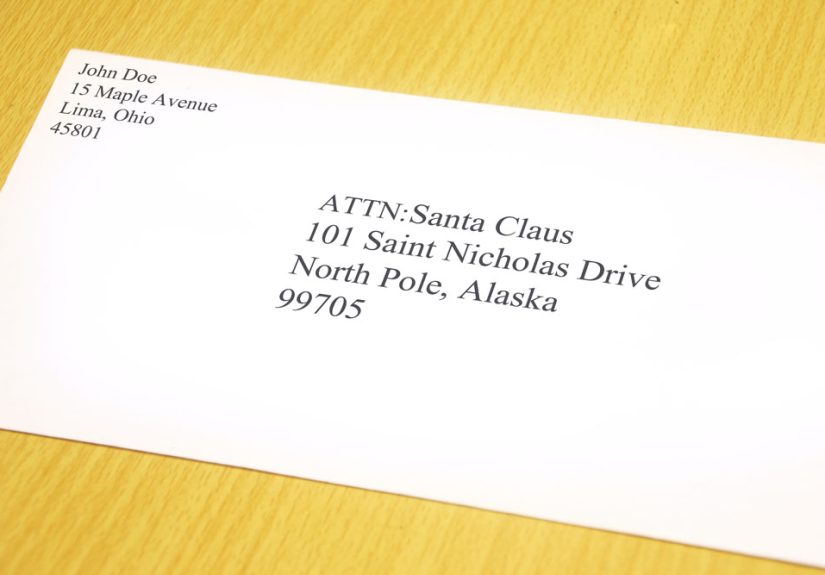
A business return address usually looks like this:
Keep it simple. Include your business name, full street address, and city, state, and ZIP Code. If your company has a suite or floor number, include it. If you use printed company envelopes, make sure the preprinted return address is still current. An outdated return address is the paper-mail version of leaving the wrong phone number on your résumé.
Step 4: Start the Delivery Address with the Right Person or Business Name
The delivery address belongs in the center-lower area of the envelope. Start with the person or company that should receive the mail.
If you are mailing directly to a company without naming a specific person, you can begin with the company name. If the letter is for a particular employee, it is often best to include both the recipient and the business name.
For example:
If you need to route the mail to a specific individual inside a company, add an attention line above the company name. That can look like this:
This is especially useful for large businesses, universities, hospitals, government offices, and corporate headquarters where one building may contain half the population of a small town.
Step 5: Write the Street Address and Secondary Details Correctly
The street address line is where many business envelopes go slightly off the rails. A complete business address needs the street number, street name, and any directional details. If there is a suite, apartment, room, floor, or department number, include it using a standard abbreviation when appropriate.
Common business abbreviations include:
- STE for suite
- FL for floor
- RM for room
- DEPT for department
- BLDG for building
Whenever possible, place the suite or unit information at the end of the delivery address line, like this:
If the line becomes too long, you can move the secondary unit information to the line above the street address line. That is better than cramming everything together until the envelope looks like it is whispering for help.
If you are using a private mailbox through a commercial mailbox service, follow the assigned PMB or number format exactly. And if the address is a PO Box, use the PO Box address rather than mixing it with a street address unless the postal provider specifically instructs otherwise.
Step 6: Finish with City, State, and ZIP Code
The final line should contain the city, the two-letter state abbreviation, and the ZIP Code. If you have the ZIP+4 version, even better. It adds precision and can help with automated sorting.
The format should look like this:
A few best practices here:
- Use the official two-letter state abbreviation
- Do not spell out the state name on business mail if you want a USPS-style format
- Keep the city, state, and ZIP on one line
- Avoid extra punctuation if you want the cleanest postal-style appearance
Can you use punctuation? In many cases, yes. But clean, minimal formatting is often preferred for readability. Think less decorative flourish, more “I know where this envelope is going, and I would like it to arrive this century.”
Step 7: Place the Address Block and Postage in the Correct Spots
Even a perfectly written address can become a problem if it is floating around the envelope like it lost its map. Placement matters.
Use this layout:
- Return address: upper-left corner
- Delivery address: centered in the lower-middle area
- Postage: upper-right corner
The delivery address should be the most prominent block on the front of the envelope. Keep it away from unnecessary graphics, stamps, labels, or slogans. Logos are fine when used tastefully, but do not crowd the address area. Postal equipment wants clarity, not a design competition.
If you are using a window envelope, make sure the complete address appears clearly in the window and stays visible when the contents shift. Window envelopes are convenient, but they are also sneaky. If the insert slides down and hides the suite number, your convenient shortcut may become a very official detour.
Step 8: Proofread Before You Seal and Send
The final step is simple: check everything before mailing.
Look for:
- Misspelled recipient or company names
- Missing suite or unit numbers
- Wrong ZIP Code
- Bad placement
- Smudged ink or hard-to-read handwriting
- Old return address information
If you print envelopes, review the preview before you hit print. If you hand-address them, use neat block lettering or a permanent pen. Dark ink on a light envelope is your friend. Pale ink, cursive experiments, and “close enough” handwriting are not.
Business Envelope Address Examples
Standard Business Envelope
With Attention Line
Business Addressed to a PO Box
Business Mail Sent in Care Of Another Party
Common Mistakes to Avoid
Even smart people make avoidable envelope mistakes. Usually because they are in a hurry, multitasking, or trying to address mail while also answering emails, reheating lunch, and pretending they are definitely not behind schedule.
The most common errors include:
- Putting the company name and recipient name in a confusing order
- Leaving out the suite or department number
- Using the wrong ZIP Code
- Crowding the delivery address too close to the bottom edge
- Using fancy fonts or light-colored ink that scanners hate
- Adding too much punctuation or unnecessary wording
- Using “PO BOX” for a private mailbox when the correct format is PMB or #
- Forgetting the return address altogether
If your business sends mail often, it helps to create a standard envelope template. That way, every piece of mail follows the same layout, and nobody has to reinvent the envelope every Tuesday.
Real-World Experiences: What Businesses Learn the Hard Way
One of the most common experiences people have with business mail is discovering that “almost correct” is not the same as correct. A small company might send out ten invoices and never notice a problem. Then, one month later, two checks come back late, one letter is returned, and another goes missing because the suite number was skipped. Suddenly, the envelope is no longer just an envelope. It is a tiny paper decision with a surprisingly large impact.
Office managers often learn this first. They are the ones who notice patterns. Mail to small businesses usually arrives just fine with a simple company name and street address. But mail to large office towers, hospitals, schools, and government agencies is much less forgiving. Without “ATTN: HR” or the right mailstop code, the envelope may arrive at the building and still fail at the final lap. It reached the stadium but never found its seat.
Another common experience comes from businesses that switch locations and forget to update preprinted envelopes. Everything looks polished until undeliverable mail starts boomeranging back. This happens more often than people admit. Boxes of beautiful custom envelopes become expensive souvenirs because the address in the upper-left corner is from a place the company left six months ago.
Small businesses also learn fast that typed addresses usually save headaches. Handwritten envelopes can work, but once volume increases, printing becomes the hero of the story. A printed envelope looks cleaner, reads faster, and creates consistency. It also spares employees from deciphering whether that handwritten line says “STE 210” or “SITE ZIO,” which sounds less like a suite number and more like a tech startup.
Then there is the window-envelope adventure. In theory, it is efficient. In practice, it depends on the insert behaving itself. Anyone who has mailed statements in window envelopes has probably had that moment of dread: hold the envelope up, tilt it, shake it gently, and hope the address still shows correctly. If the paper shifts and hides the city or ZIP Code, the convenience disappears instantly.
Mailing checks, legal notices, and signed contracts teaches another lesson: details matter more when the stakes are high. A casual typo in marketing mail is annoying. A typo on a payment envelope can delay money, paperwork, or a deadline. That is why experienced teams build a habit of proofreading every address, especially when the mail is time-sensitive or tied to revenue.
And finally, there is the brand experience. People absolutely notice envelopes. A clean, well-addressed business envelope signals professionalism before the recipient even opens it. A crooked label, missing department line, or sloppy handwriting sends the opposite message. It is subtle, but real. In business correspondence, the envelope is the handshake before the conversation.
The takeaway from all these experiences is simple: addressing a business envelope effectively is not old-fashioned busywork. It is a practical skill that affects delivery, presentation, and results. Get the format right, and your mail has a much better chance of arriving quickly, looking professional, and reaching the exact person who needs it.
Conclusion
If you want business mail to look professional and arrive without drama, follow a clear system. Use the right envelope, verify the recipient details, include the correct attention or department line, format the street address properly, and finish with a clean city-state-ZIP line. Then place the address block where postal equipment expects it, proofread everything, and send it off with confidence.
That is really the secret. Not magic. Not guesswork. Just a dependable format that keeps your mail from wandering around like it forgot why it left the office in the first place.