Table of Contents >> Show >> Hide
- The Birth of Radar: Teaching the Sky to Talk Back
- Radar Cross Section: How Big Do You Look to Radar?
- Stealth 101: Shape First, Everything Else Second
- Radar-Absorbent Materials: Turning Radar into Heat
- Beyond Radar: Infrared, Sound, and the Human Eye
- The Story of Radar vs. Stealth: An Ongoing Arms Race
- Common Myths About Stealth Technology
- Experiences and Perspectives: Living in the World of Stealth
- Conclusion: Not Invisibility, but an Edge
- SEO Meta Data
Stealth aircraft look like something out of science fiction: bat-shaped bombers,
needle-nosed fighters, and flying wedges that seem to slip past radar like ghosts.
But nothing in the sky is truly invisible. Stealth technology is really the
art of making an airplane look, to radar, more like a small bird than a big
metal machine. To understand how that works, we have to start with the invention
of radar and the long cat-and-mouse game between “seers” and “sneakers” in the air.
The Birth of Radar: Teaching the Sky to Talk Back
Radarshort for Radio Detection and Rangingwas born in the 1930s,
when engineers discovered that you could bounce radio waves off distant objects
and measure how long they took to return. That time delay tells you how far away
the object is. Combine that with the direction your antenna is pointing, and you
get a rough picture of where an aircraft is in the sky.
By the start of World War II, Britain had already built the famous
Chain Home radar network along its coastline. Those tall towers could spot
incoming German bombers about 80 miles away, giving Royal Air Force pilots time
to take off and intercept them. Radar didn’t just help; it arguably changed the
entire course of the war by turning surprise air raids into scheduled
disappointments.
Early radar used long wavelengths and enormous antennas. It was good at seeing
big metal airplanes but not great at pinpoint accuracy. The breakthrough came
with the development of the cavity magnetron, which could generate
powerful microwaves with much shorter wavelengths. That allowed radar sets to
shrink, improve resolution, and move into aircraft, ships, and smaller ground
stations. Once radar became sharper, aircraft designers had a clear message:
“If you want to survive, stop being such an easy target.”
Radar Cross Section: How Big Do You Look to Radar?
To radar, an aircraft isn’t defined by its wingspan or length. It’s defined by its
radar cross section (RCS)—a measure of how big it appears on a radar
screen. You can think of RCS as the size of an imaginary metal sphere that would
reflect the same amount of energy as the real object.
A large airliner might have an RCS of tens or even hundreds of square meters.
A conventional fighter might be a few square meters. A modern stealth fighter?
Its RCS can be closer to that of a small bird, depending on the radar and the
direction it’s viewed from.
RCS depends on several factors:
- Size: Bigger usually means brighter on radar.
- Shape: Flat plates and right angles reflect energy straight back.
- Material: Metal reflects strongly; special composites can absorb energy.
- Frequency: Some features light up at specific radar wavelengths.
- Aspect: How the aircraft is oriented relative to the radar beam.
The core goal of stealth technology is to sculpt and “tune” all these factors so
that the radar cross section is dramatically reduced. The aircraft is still there,
but radar has to get much closer before it notices.
Stealth 101: Shape First, Everything Else Second
Faceting: The Strange Geometry of the F-117
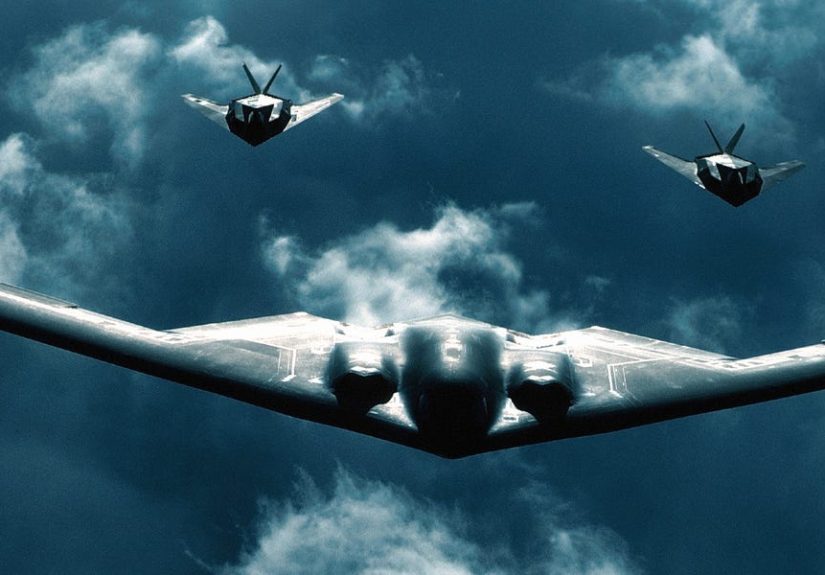
The first operational stealth aircraft, the F-117 Nighthawk, looked like
a flying piece of origami. Its exterior surfaces were made up of flat facets
carefully angled so that radar waves would reflect away from the radar source
instead of bouncing straight back. It was designed in the 1970s and 1980s when
computers were just powerful enough to crunch the math needed for this odd shape.
Faceting works well against high-frequency radar. When a radar beam hits a facet,
it gets reflected off in some unhelpful direction—great if you’re the pilot,
less great if you’re the radar operator trying to see what’s coming.
Smooth Curves: The B-2 and the Rise of “Blended” Stealth
As computing power improved, designers moved from faceted shapes to smooth,
blended curves. The B-2 Spirit bomber is a classic example: a giant flying
wing with carefully sculpted surfaces that avoid sharp corners, vertical fins,
and other radar-bright details.
These curved designs don’t just reflect radar away; they manage reflections from
many angles, making the bomber harder to track as it turns or banks. It’s the
difference between bouncing light off a disco ball versus a perfectly smooth,
dark marble.
Edge Alignment and Hidden “Trouble Spots”
Certain features on aircraft are naturally loud in radar terms: engine inlets,
cockpit canopies, fins, and weapon pylons. Stealth design hides or reshapes these:
-
Edge alignment: Panel lines, doors, and edges are all oriented in a
small number of directions, so radar reflections go in predictable, controlled
directions. -
Internal weapon bays: Instead of hanging missiles and bombs outside,
stealth aircraft hide them inside the fuselage to avoid creating shiny radar
hotspots. -
Curved or “S-shaped” intakes: These hide the engine’s compressor
blades—a big radar reflector—from direct view.
Take a look at an F-22 or F-35 and you’ll see these tricks everywhere. They’re
stealth aircraft, but also very carefully curated art projects in metal and
composite.
Radar-Absorbent Materials: Turning Radar into Heat
Shape does a lot of the heavy lifting, but it’s not enough by itself. Radar waves
will still hit the aircraft, and some will want to bounce back. That’s where
radar-absorbent materials (RAM) come in.
RAM coatings are usually specialized paints or composite layers that contain
materials tuned to the radar frequencies they’re expected to face. When radar
energy enters these coatings, it gets converted into tiny amounts of heat instead
of reflecting back. Think of it as fuzzy acoustic foam for radio waves.
These coatings can be finicky. They add weight, require careful maintenance,
and can be sensitive to weather and handling. Modern designs aim to integrate
wave-absorbing behavior directly into structural materials, reducing the need
for constant repainting while maintaining low observability.
Beyond Radar: Infrared, Sound, and the Human Eye
Stealth is often talked about as if it’s only about radar, but aircraft give
themselves away in many other ways:
-
Infrared (IR): Hot engines and exhaust plumes glow in IR. Designers
flatten nozzles, mix in cool air, and place exhaust over the wings to reduce
the heat signature. -
Acoustic: Jet noise travels far. Stealth aircraft can fly higher or
use specific routes to minimize how often they’re heard. -
Visual: Paint schemes and flight profiles reduce contrast against the
sky. At night, even a non-stealth aircraft can be very hard to see if lights
are managed properly. -
Electronic emissions: Using your own radar is like turning on a
flashlight in a dark room. Many stealth aircraft rely on passive sensors and
data from offboard sources instead of broadcasting their position.
A truly stealthy mission manages all these signatures together. Radar is just the
loudest channel in a very noisy orchestra of detection methods.
The Story of Radar vs. Stealth: An Ongoing Arms Race
From Early Jets to the First Stealth Aircraft
In the early Cold War, aircraft defense was mostly about flying higher and faster.
But as radar and missiles improved, speed alone stopped being enough. The idea of
low-observable aircraft gained traction: instead of outrunning radar, why
not simply be much harder to see?
Experimental work in the 1960s and 1970s refined the math behind radar reflections.
Engineers turned obscure electromagnetics research into actual shapes and coatings.
The result was the F-117, which became publicly known in the late 1980s and proved
its worth in combat by slipping through dense air defenses that would have shredded
conventional aircraft.
Modern Stealth: F-22, F-35, and the B-2
Today’s stealth aircraft, like the F-22 Raptor, F-35 Lightning II, and B-2 Spirit,
represent a more mature philosophy. They balance low observability with agility,
sensors, weapons, and maintainability.
These aircraft typically:
- Have extremely low RCS from critical front and side aspects.
- Use advanced RAM and carefully tailored shapes.
- Carry weapons internally to stay “clean” on radar.
- Rely heavily on sensor fusion to build a picture of the battlespace while
staying as quiet as possible themselves.
The result isn’t invisibility but time: they can approach closer, strike
first, and leave before the defender’s radar picture becomes clear.
Counter-Stealth: Radar Fights Back
Of course, no technology goes unanswered. Radar designers have been busy, too.
Several approaches help detect stealth aircraft:
-
Low-frequency radar: Long-wavelength radar is less affected by fine
shaping tricks, though it’s usually less precise in locating targets. -
Multistatic radar: Systems where one transmitter and multiple receivers
share information can catch reflections from angles the aircraft isn’t optimized
to hide from. -
Infrared search and track (IRST): Sensitive IR sensors can spot the heat
plume of engines over long ranges, especially against cold backgrounds. -
Data fusion: Combining radar, IR, passive RF listening, and even satellite
data improves the chances of finding a stealthy intruder.
The bottom line: stealth makes detection harder and slower, but not impossible.
It tips the odds. The other side will spend enormous money, time, and creativity
trying to tip them back.
Common Myths About Stealth Technology
Myth 1: Stealth Aircraft Are Completely Invisible
If stealth jets were truly invisible, they’d be more at home in fantasy novels
than in hangars. In reality, stealth reduces detection range. A radar that
could see a conventional jet at, say, 200 miles might not pick up a stealth aircraft
until 30 or 40 miles, or even less. That reduction matters enormously in combat,
but it’s not magic.
Myth 2: One Stealth Design Works Against All Radars
Stealth is always designed with specific threats and frequencies in mind. An aircraft
optimized for high-frequency fire-control radars might still be visible on a
long-wavelength early-warning radar. Designers prioritize the radars that pose the
most lethal threat and accept trade-offs elsewhere.
Myth 3: Stealth Is Only About the Airframe
The airplane’s shape and skin are only half the story. How pilots fly, how often
they transmit on radios and radars, what routes they choose, and how they coordinate
with other assets are all part of a stealth strategy. A perfectly designed aircraft
used with sloppy tactics can still be found and engaged.
Experiences and Perspectives: Living in the World of Stealth
To really feel how stealth technology works, imagine you’re an air-defense radar
operator late at night. The scope is mostly quiet: a few civil aircraft on known
routes, maybe some weather returns. You know the theory of stealth jets, but most
of the time they’re just briefing slides and grainy photos from intelligence reports.
Then something odd appears at the edge of your radar’s range—not a bright,
confident blip like a cargo plane, but a faint, intermittent smear. It pops in and
out as the radar scans. The track is inconsistent, like a small flock of birds
or a glitch. Your software doesn’t raise a high-priority alert because the signal
strength and size don’t match a typical threat profile.
A few minutes later, your colleague monitoring passive sensors notices a subtle
RF anomaly. It’s not a clear radar emission, just a hint that something metallic
might be reflecting distant signals differently. On yet another console, an infrared
sensor shows a faint, moving hot spot far above normal airline cruising altitude.
Individually, none of these clues scream “stealth aircraft.” Together, though,
they start to form a pattern.
This is where modern stealth and modern air defense really meet: in the fusion
of imperfect, noisy data. Stealth technology is doing its job by making each
individual signature marginal, ambiguous, and late to appear. The defenders are
doing their job by cross-checking multiple sensors, looking for correlations that
suggest something more dangerous than a misbehaving flock of geese.
Now flip perspectives. Imagine you’re planning a mission in a stealth aircraft.
You don’t assume invisibility; you assume time and opportunity. The route you
fly is designed to minimize exposure to the most capable radars. You cruise at an
altitude that balances fuel efficiency with a smaller infrared footprint. You rely
on offboard sensors and data from other platforms so you can avoid turning on your
own radar as much as possible.
You know that somewhere out there, a patchwork of radars, satellites, and infrared
scanners is trying to build a picture of the sky. Your aircraft’s shaping and RAM
coatings are not a force field, but a delay mechanism. The longer it takes the
other side to notice and track you, the more freedom you have to reach your target,
release your weapons, and exit before they can react effectively.
Engineers who work on stealth like to say they are in the business of “buying down
risk” rather than creating invisibility. Their work shows up in small details:
the angle of an access panel, the composition of a coating, the precise routing
of a cable to avoid unexpected reflections. Each detail might shave a fraction off
the radar cross section. Added together, those fractions turn into real tactical
advantages.
For aviation enthusiasts watching from the ground, stealth technology can feel
almost anti-climactic. The most advanced aircraft often look smooth and subdued,
with fewer dramatic intakes, external weapons, or bright markings. But behind
that clean silhouette is an incredibly complex story of electromagnetics, materials
science, and decades of trial and error in the dance between radar and aircraft.
In the end, the story of stealth is really the story of radar itself. Every new
radar breakthrough creates incentives for better stealth; every stealth advance
pushes radar designers to think of new tricks. It’s a technological conversation
happening at the speed of light, and every aircraft that slips quietly through
the night sky is a reminder that, for now, the stealth side of that conversation
is still being heard a little less clearly.
Conclusion: Not Invisibility, but an Edge
Stealth technology works by shrinking an aircraft’s radar cross section, smoothing
and shaping the airframe, absorbing and redirecting radio waves, and carefully
managing other signatures like heat and noise. It grew out of radar’s own evolution,
from crude early-warning sets to precise microwave and multi-sensor systems, and
it continues to adapt as new counter-stealth technologies emerge.
In practical terms, stealth doesn’t make aircraft vanish; it buys time, distance,
and options. That’s enough to transform how air campaigns are planned and fought.
The story of radar and aircraft is far from over, but for now, stealth remains
one of the most fascinating examples of physics, engineering, and strategy all
wrapped into a single shape cutting silently through the sky.