Table of Contents >> Show >> Hide
- Why So Many Sharks Are Extinct (And Why Teeth Matter)
- Meet the Meg: Otodus megalodon
- The Otodus Lineage: From Otodus obliquus to the Meg
- Other Famous Extinct Sharks You Should Know
- How Scientists Reconstruct Extinct Sharks
- Why Extinct Sharks Still Matter
- Experiences Inspired by Extinct Sharks
- Conclusion: From Fossil Teeth to Big Lessons
Shark week might last only a few days on TV, but in Earth’s history, it stretched over
hundreds of millions of years. Long before the great white started photobombing nature
documentaries, ancient sharks with buzzsaw jaws, anvil-shaped dorsal fins, and teeth the
size of your hand cruised the oceans. Many of these prehistoric heavyweights are now
extinctbut their teeth, fossils, and a few terrifying reconstructions still keep us
wonderfully uneasy at the beach.
In this guide, we’ll walk through a complete, easy-to-digest list of some of the most
important extinct sharksfrom the headline star Otodus megalodon (“the
Meg”) to its relatives in the genus Otodus, plus other bizarre and
fascinating species that once ruled the seas. We’ll also look at how scientists actually
know what these ancient sharks were like, and finish with practical, real-world experiences
you can have today if you’re obsessed with extinct sharks.
Why So Many Sharks Are Extinct (And Why Teeth Matter)
Sharks have been around for more than 420 million years, surviving multiple mass
extinctions and dramatic climate shifts. But plenty of shark lineages disappeared along the
way. One big reason we even know about them is their teeth. Unlike bones, shark skeletons
are mostly cartilage, which doesn’t fossilize well. Teeth, however, are hard, enamel-coated,
and shed continuously during a shark’s life. That’s why we have enormous fossil collections
of shark teeth stretching from the Devonian period to the Pliocene.
These fossil teeth (and occasionally vertebrae) allow paleontologists to estimate a shark’s
size, figure out roughly what it ate, and place it in a family tree. For giants like
megalodon, scientists use the relationship between tooth size and body length seen in modern
sharks to estimate total length, often landing in the jaw-dropping 50–60-foot range.
Meet the Meg: Otodus megalodon
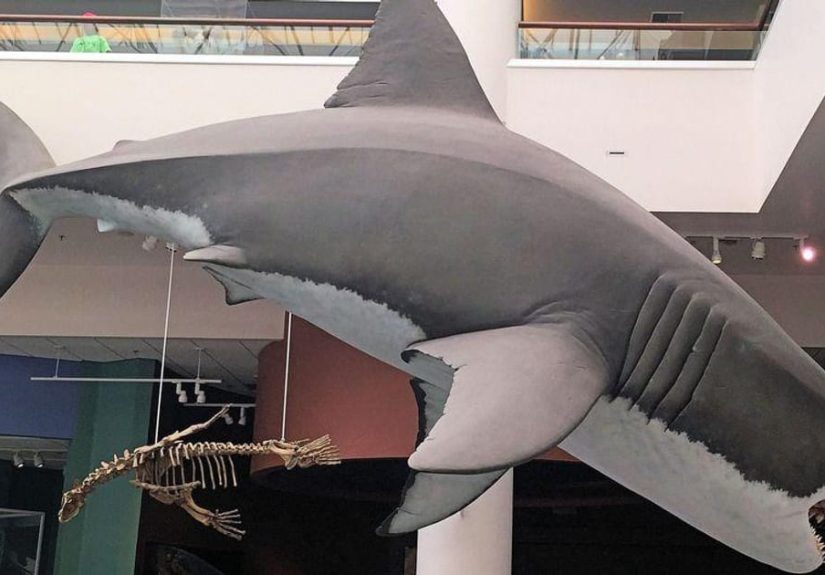
Let’s start with the celebrity: Otodus megalodon, usually just called
megalodon or “the Meg.” This extinct giant lived roughly from about
23 million to 3.6 million years ago, from the early Miocene to the early Pliocene.
Size, Power, and Lifestyle
Estimates vary, but most recent studies suggest megalodon reached lengths of up to
around 60 feet (18 meters). That’s roughly the length of a bowling laneand several times
larger than most great whites. Its teeth, often 4–5 inches long and sometimes over 7 inches,
were thick, triangular, and finely serrated, ideal for slicing through whale bone and
blubber.
Megalodon was an apex predator in warm seas around the globe and likely preyed on large
marine mammals such as early whales, seals, and giant sea turtles. Bite marks on fossil
whale bonesdeep gouges that match megalodon teethsupport the idea that it targeted the
rib cage and shoulders to quickly disable prey.
Extinction of a Giant
Despite movie rumors, megalodon is very much extinct. Fossil evidence indicates it
disappeared by about 3.6–2.6 million years ago. Researchers suspect a combination of global
cooling, changes in ocean circulation, and the decline of the large whales it hunted helped
push it over the edge. At roughly the same time, new competitors like early orcas and
toothed whales were evolving, possibly stealing its food niche.
The Otodus Lineage: From Otodus obliquus to the Meg
Megalodon didn’t appear out of nowhere. It was part of a long-running lineage of large,
fast lamniform sharks within the family Otodontidae. Many scientists now
place megalodon inside the genus Otodus, reflecting its evolutionary ties
to earlier species like Otodus obliquus.
Otodus obliquus – The Early Giant
Otodus obliquus swam the seas from roughly 60 to 40 million years ago, in
the Paleocene and Eocene. This shark reached around 30–33 feet long, making it the largest
shark of its time. Its teeth have tall, triangular crowns with small side cusps, and can
reach around 4 inches in height.
Fossils of O. obliquus teeth show up in phosphate deposits in Morocco, as well as in parts
of the eastern United States. Over time, descendants in the Otodus line gradually developed
broader crowns and stronger serrations, while losing the side cusps. These changes reflect a
shift from catching large fish to slicing into bulky marine mammalsan evolutionary journey
that culminated in O. megalodon.
Other Otodus Species
Paleontologists recognize several intermediate species between O. obliquus and O. megalodon,
including O. angustidens and O. chubutensis. Each step in this sequence
shows teeth becoming more triangular and heavily serrated. These extinct sharks are crucial
for understanding how one lineage went from “big and scary” to “top marine predator in Earth
history.”
Other Famous Extinct Sharks You Should Know
While the Meg hogs the spotlight, plenty of other extinct sharks deserve a little
appreciation. Here’s a tour of some of the most iconic prehistoric shark species you’re
likely to encounter in books, museums, and fossil shops.
Cretoxyrhina mantelli – The “Ginsu Shark”
Cretoxyrhina mantelli lived about 107–73 million years ago in the Late
Cretaceous. It’s often nicknamed the “Ginsu shark” because its sharp, non-serrated teeth
sliced through prey like a famous kitchen knife.
Estimates put Cretoxyrhina at up to 6–8 meters (20–26 feet) long. Fossils from Kansas and
elsewhere show it was an apex predator that dined on marine reptiles like mosasaurs,
plesiosaurs, large bony fish, and even the occasional dinosaur that ventured too far
offshore. Stomach-content fossils with partially digested prey found alongside its vertebrae
paint a vivid picture of this shark’s menu.
Helicoprion – The Buzzsaw “Shark”
If there were awards for weirdest extinct shark relative, Helicoprion would
win by a mile. Technically, it’s more closely related to modern chimaeras than to typical
sharks, but it often gets grouped with prehistoric sharks. Helicoprion lived roughly
290–270 million years ago. Its claim to fame is a lower jaw that carried a spiral
“tooth whorl” resembling a buzzsaw or a rolled-up bandsaw blade.
For years, scientists weren’t sure where to put that tooth spiralon the nose, the tail,
even the back of the jaw. Modern reconstructions place it curling inside the lower jaw,
where new teeth grew at the center of the spiral while older ones moved outward. It likely
used this whorl to grab and slice soft-bodied prey like cephalopods.
Hybodus – The Long-Running “Generalist”
Hybodus is an extinct genus that first appeared in the Late Permian and
stuck around until the Late Cretaceousan impressive run of more than 200 million years.
Hybodus sharks usually reached a few meters in length and had two types of teeth: sharp,
pointed ones for catching fish and flatter, grinding teeth for crushing shells.
That combination suggests a very flexible diet, which probably helped them survive so long
through changing environments. Eventually, more specialized modern shark groups replaced
them, but Hybodus is a great example of a “classic” Mesozoic shark.
Cladoselache – One of the Earliest Sharks
Go back more than 360 million years to the Late Devonian and you’ll find
Cladoselache, one of the best-known early sharks. Fossils from North
America show a slim, torpedo-shaped body with a deeply forked tail and relatively smooth
skin. Unlike many later sharks, Cladoselache didn’t have rows and rows of replacement teeth
and apparently swallowed smaller prey more or less whole.
Though not huge by shark standards, Cladoselache helps record the early stages of shark
evolution and shows how some classic shark featureslike streamlined bodies for fast
swimmingwere already in place.
Stethacanthus – The Anvil-Backed Oddball
Another early shark relative, Stethacanthus, lived during the Late Devonian
and early Carboniferous. It’s instantly recognizable thanks to a bizarre, anvil-shaped
dorsal fin covered in tooth-like scales. The top of this “anvil” looked like a rough
polishing pad. Scientists still debate what it was forcourtship displays, species
recognition, or something more sinister like making the shark look bigger to potential
predators.
How Scientists Reconstruct Extinct Sharks
Because shark skeletons are mostly cartilage, paleontologists are often working from
frustratingly incomplete data. Most of the time, they have isolated teeth or maybe
vertebrae. On rare occasions, like with Cretoxyrhina, they get partially articulated
skeletons that reveal more about body shape, jaw structure, and how the teeth were
arranged.
To turn these fragments into life-like reconstructions, researchers:
- Compare fossil teeth with those of living sharks to estimate body size and proportions.
- Use biomechanical models to estimate bite force and swimming efficiency.
- Study fossilized stomach contents or associated bones to see what a shark was eating.
-
Consider the age and location of the rocks surrounding the fossils to reconstruct ancient
environments.
New research on megalodon, for instance, uses 3D modeling and comparisons with modern
lamniform sharks to refine estimates of body length, fin size, and swimming style. Results
suggest a streamlined but muscular shark built for long-distance cruising and powerful
bursts of speeda sort of supersized, marathon-swimming predator.
Why Extinct Sharks Still Matter
Extinct sharks aren’t just cool monsters from the past. They’re critical for understanding
how marine ecosystems respond to climate change, sea-level shifts, and the rise and fall of
different animal groups. For example, the extinction of megalodon seems tied to the decline
of large baleen whales and the restructuring of marine food webs.
Studying prehistoric sharks also provides a baseline for what “big predators” used to look
like. When we see modern shark populations shrinking due to overfishing, we’re not just
losing charismatic animalswe’re chipping away at a long legacy of apex predators that has
shaped ocean life for hundreds of millions of years.
Experiences Inspired by Extinct Sharks
Reading about extinct sharks is fun, but getting hands-on experiences makes them feel
realand adds engaging, experiential depth to everything you’ve just learned. Here are some
realistic, shark-obsessed experiences people often pursue, and how they connect back to the
extinct species on our list.
1. Stand Inside a Megalodon Jaw at a Museum
Many natural history museums, especially in the United States, feature walk-through
megalodon jaw replicas built from real and cast teeth. Visitors can literally stand inside
the reconstructed bite radius of a 50- or 60-foot shark. Exhibits at institutions like the
Florida Museum of Natural History and various aquariums across the country pair these jaws
with educational panels explaining the Otodus lineage, bite strength, and how tooth size
translates into body length.
The experience is oddly humbling: you’re the size of a snack. It helps audiences grasp just
how different prehistoric oceans looked when a predator of that scale was common in warm
coastal waters.
2. Go Fossil Shark Tooth Hunting
Fossil shark teeth are some of the most accessible fossils in the world, and many coastal
regions in the U.S. allow recreational collecting. In Florida, people wade in rivers with
sieves, pulling up Miocene and Pliocene teeth that may include smaller cousins of O.
megalodon. On the East Coast, beachcombers in places like North Carolina or Maryland
sometimes find teeth from extinct makos, sand tigers, and occasionally fragments from
larger Otodus species.
Modern collectors quickly learn to distinguish between tooth shapesbroad, serrated crowns
hint at megalodon or its close relatives, while slender, hooked teeth might belong to
smaller lamniform sharks. This simple hobby echoes exactly how paleontologists build the
bigger picture of shark evolution: one tooth at a time.
3. Explore Otodus Fossil Sites (Even If Only Virtually)
Places like the phosphate mines of Morocco or marine deposits in the southeastern U.S. are
famous for producing vast numbers of Otodus teeth. While most people won’t get to walk
through Moroccan quarries in person, virtual tours, documentaries, and online fossil shops
give a window into how these ancient marine sediments are mined and studied.
Seeing trays piled high with O. obliquus teeth drives home just how numerous these sharks
once wereand how completely their line vanished when environmental conditions changed.
4. Use Extinct Sharks as a Classroom Hook
Teachers frequently use megalodon and its extinct cousins as a gateway into earth science.
A lesson might start with a dramatic photo of a megalodon jaw, then shift into activities
where students measure tooth replicas, calculate estimated body size, or plot extinction
dates on a timeline alongside changing sea levels and climate.
Extinct sharks also inspire creative projects: designing “missing” shark species, making
paper models of Helicoprion’s tooth whorl, or scripting mock interviews with a
paleontologist studying Cretoxyrhina. These activities help students connect big ideas
about evolution and extinction with concrete, memorable visuals.
5. Reflect on Modern Shark Conservation
Learning about extinct sharks naturally raises questions about the ones still hanging on
today. While megalodon and Hybodus are long gone, modern sharks face their own existential
threats from overfishing, finning, and habitat loss. Comparing the slow, climate-driven
extinction of ancient sharks to the rapid, human-driven declines today can be a powerful,
sobering experience.
Many aquariums now pair their megalodon or “prehistoric shark” exhibits with conservation
campaigns, emphasizing that while we can’t bring back the Meg, we can choose whether great
whites, hammerheads, and whale sharks end up in future fossil galleries labeled “extinct.”
Conclusion: From Fossil Teeth to Big Lessons
The story of extinct sharksfrom Cladoselache in the Devonian seas to
Otodus megalodon in the Plioceneshows how dynamic ocean life has always
been. Lineages rise, diversify, dominate, and sometimes vanish entirely, leaving behind
scattered teeth and a lot of scientific detective work.
By piecing together fossils of giants like megalodon, early giants like Otodus obliquus,
and oddballs such as Helicoprion and Stethacanthus, scientists reconstruct ancient food
webs and track how changing climate and competition reshape entire ecosystems. For the rest
of us, extinct sharks offer a mix of awe, curiosity, and just enough fear to make the next
beach trip more interesting.
Whether you’re standing inside a replica jaw, sifting for fossil teeth in a river, or just
binge-reading about prehistoric oceans online, these long-gone sharks still have plenty to
teach us about evolution, extinction, and our responsibility to the oceans we share today.
meta_title: Complete List Of Extinct Sharks, From the Meg to the Otodus
meta_description: Discover extinct sharks from Otodus megalodon to early
Otodus species and other prehistoric sharks, plus real-world ways to explore their legacy.
sapo: Extinct sharks didn’t just vanish quietly; they once ruled prehistoric
oceans with buzzsaw jaws, anvil-shaped fins, and teeth the size of your hand. From the
towering Otodus megalodon to earlier giants like Otodus obliquus and fierce hunters such as
Cretoxyrhina, this guide breaks down who these sharks were, how scientists piece them
together from scattered teeth, and why their disappearance still matters today. You’ll also
find practical, shark-obsessed experiencesfrom museum jaws you can stand inside to fossil
hunts and classroom ideasthat bring these ancient predators thrillingly to life.
keywords: extinct sharks, Otodus megalodon, prehistoric sharks, Otodus obliquus, megalodon extinction, Cretoxyrhina, Helicoprion