Table of Contents >> Show >> Hide
- Why This Utah Pterosaur Discovery Matters
- Meet Caelestiventus hanseni: The Ancient Flyer with Attitude
- A Desert, an Oasis, and a Remarkably Lucky Fossil
- What Scientists Learned from the New Utah Pterosaur
- How This Discovery Fits into the Bigger Pterosaur Story
- Why Readers Love Stories Like This
- Experience the Story: What It Feels Like to Stand in the Shadow of an Ancient Flyer
- Conclusion
- SEO Tags
Every so often, paleontology delivers the kind of headline that makes your inner 10-year-old throw down a juice box and yell, “Wait, they found what in the desert?” This is one of those stories. In Utah, researchers uncovered the remains of a remarkably ancient pterosaur, a flying reptile from the Late Triassic that lived more than 200 million years ago. It was not a bird. It was not a dinosaur. It was a leathery-winged sky specialist with a dramatic grin full of teeth, the sort of creature that sounds like it was designed by a screenwriter who had too much coffee and a grudge against insects.
The fossil belongs to Caelestiventus hanseni, a name that roughly means “heavenly wind.” Poetic? Absolutely. Accurate? Also yes. This animal soared over an ancient landscape in what is now Utah, back when North America looked nothing like the postcard version we know today. Instead of ski resorts, highways, and road-trip diners, the region featured dunes, desert, and oasis-like pockets of life. That setting alone makes the discovery a blockbuster, because early pterosaurs are rare, and desert pterosaurs from that deep in time are even rarer.
For scientists, this Utah fossil is more than a cool prehistoric mugshot. It helps explain how early pterosaurs lived, where they could survive, and just how diverse they were near the dawn of vertebrate flight. For readers, it is proof that Earth once hosted animals that were equal parts elegant and slightly terrifying. In other words, nature has always had range.
Why This Utah Pterosaur Discovery Matters
The headline-grabbing part is the age. Caelestiventus hanseni lived roughly 210 million years ago during the Late Triassic, making it one of the earliest pterosaurs ever described from North America and one of the most important early pterosaur fossils ever studied. Even better, the specimen is unusually well preserved. That may sound like a small technical point, but in paleontology, preservation is everything. A fossil with real three-dimensional structure is like finding a complete recipe instead of one burned index card that only says “add salt.”
Early pterosaur fossils are notoriously frustrating because their bones were lightweight and delicate, which is perfect for flight and terrible for surviving millions of years underground. Most Triassic examples are flattened, crushed, or represented by just a lonely fragment. This Utah fossil broke that pattern. Researchers were able to study parts of the skull, jaws, and wing in exceptional detail, using modern imaging and 3D reconstruction methods to better understand the animal’s anatomy.
That level of preservation changed the conversation around early pterosaur evolution. Instead of viewing the first pterosaurs as limited to a narrow range of coastal or marine environments, scientists gained stronger evidence that these animals were already geographically widespread and ecologically flexible. In plain English: early pterosaurs were not one-trick ponies. They were already trying out different habitats, including harsh desert settings, much earlier than many researchers once assumed.
Meet Caelestiventus hanseni: The Ancient Flyer with Attitude
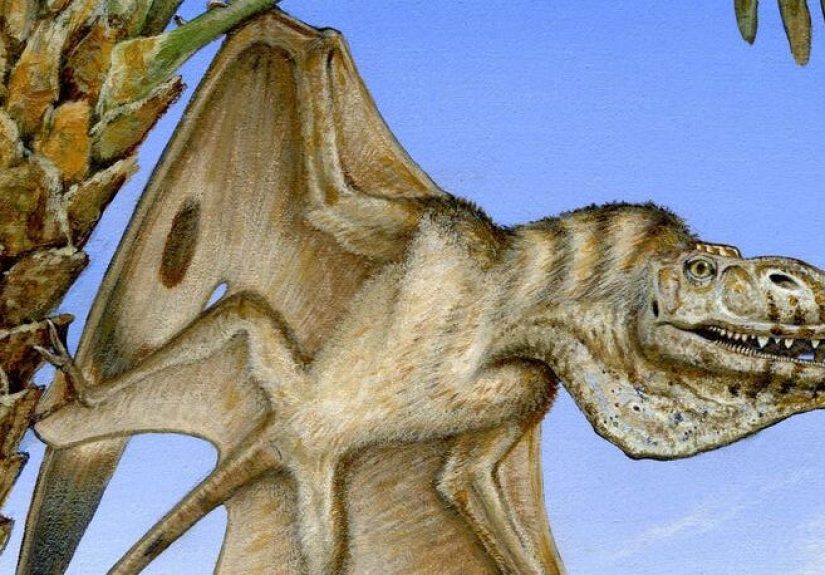
Let’s talk about the star of the show. Caelestiventus hanseni was not enormous by later pterosaur standards, but it was no featherweight wallflower either. Estimates place its wingspan at around five feet, which made it a sizable flier for its time. And then there were the teeth. Lots of them. This pterosaur has been described as having around 110 teeth, including four long, fang-like ones that give the skull a wonderfully villainous look.
If you are picturing a flying reptile with the smile of a very angry zipper, you are on the right track. Its skull suggests a capable predator adapted for grabbing prey in a challenging environment. Some reconstructions also point to soft-tissue features around the jaw and throat that may have supported a throat pouch or display structure, which makes the animal even more fascinating. Ancient, airborne, toothy, and possibly pouch-equipped? Utah really did not come to play.
Not a Dinosaur, Not a Bird, and Definitely Not Boring
One of the most useful clarifications in any article about pterosaurs is this: they were not dinosaurs. They were close relatives within the broader archosaur family tree, but they were their own branch. They also were not birds, though both groups conquered the skies in different ways. Pterosaurs were actually the first vertebrates to evolve powered flight, beating birds to the airborne lifestyle by a very long stretch of geologic time.
That matters because Caelestiventus shows that the story of flight was already getting complicated very early. These animals were not experimental gliders awkwardly wobbling through the Triassic like badly thrown paper airplanes. They were specialized fliers with lightweight skeletons, modified skulls, and highly distinct feeding adaptations. They were built for the job.
A Desert, an Oasis, and a Remarkably Lucky Fossil
The fossil came from the Saints and Sinners Quarry in northeastern Utah, a site with a name so cinematic it feels legally required to have a soundtrack. During the Late Triassic, this area was part of a desert system with oasis-like habitats that drew animals in. When conditions turned severe, drought likely transformed those life-saving watering spots into death traps. Later, shifting sand and returning water helped bury bones and preserve them.
That environment is a big reason the discovery stands out. For years, many of the best-known early pterosaur fossils came from marine or near-marine deposits in Europe. Utah offered a completely different ecological picture. This was not a seaside flier cruising over gentle waves. This was a desert-dwelling pterosaur navigating a hot, sandy world with scarce water and a rotating cast of other Triassic reptiles nearby.
The sandstone preservation turned out to be a scientific gift. Unlike fine sediments that crush fragile bones flat, sand can hold structure more gently. That helped preserve parts of Caelestiventus in three dimensions, allowing researchers to scan the fossil and reconstruct details that are often lost in older pterosaur discoveries. It is one of those rare cases where geology practically leaned over and whispered, “You’re welcome.”
What Scientists Learned from the New Utah Pterosaur
1. Early Pterosaurs Were More Diverse Than Expected
The Utah fossil helped confirm that early pterosaurs were not confined to one narrow body plan or one narrow lifestyle. They were already experimenting with size, diet, habitat, and skull structure. That means the evolutionary story of pterosaurs likely became rich and varied very quickly, instead of creeping along at a modest, boring pace.
2. Desert Life Was Not Off Limits
One of the most striking findings tied to Caelestiventus hanseni is that it pushed the known record of desert-dwelling pterosaurs back by tens of millions of years. This was a major surprise. It showed that these early flying reptiles were tougher and more adaptable than many people imagined. The ancient skies above Utah were not empty. They were already occupied by a skilled flier with a mouthful of hardware.
3. The Skull Changed the Game
Because the skull and jaws are so well preserved, researchers gained rare insight into the head anatomy of an early pterosaur. That matters for everything from sensory interpretation to feeding behavior to evolutionary relationships. The fossil also showed pneumatic features, spaces associated with air-filled bones, which fit the broader pattern of lightweight, flight-adapted anatomy.
4. Utah’s Fossil Sites Still Have Serious Secrets
Utah is already famous for dinosaur discoveries, but this pterosaur reminded the scientific world that the state’s fossil record is not a one-genre franchise. Its ancient rock layers preserve ecosystems that can reshape what we know about life before, during, and after major turning points in Earth’s history. The desert did not just keep secrets. It curated them.
How This Discovery Fits into the Bigger Pterosaur Story
Pterosaurs would eventually evolve into an astonishing range of forms, from small early species to giant later flyers with wingspans that make modern birds look like they missed leg day. But the Utah fossil captures a much earlier chapter, when pterosaurs were still near the beginning of their long run through the Mesozoic.
Caelestiventus appears closely related to Dimorphodon, a Jurassic pterosaur from Britain. That relationship is important because it helps scientists connect the evolutionary dots between early pterosaur groups and later, better-known forms. It also reinforces the idea that some pterosaur lineages were already established before the end-Triassic extinction reshaped ecosystems around the world.
There is also a useful modern footnote here. Later research has added even older North American pterosaur material from Arizona, which means the Utah specimen is no longer the last word on continental “firsts.” But that does not diminish its importance. Caelestiventus hanseni remains a landmark fossil because of its completeness, its desert setting, and the way it illuminated early pterosaur anatomy. In science, being revised is not a failure. It is proof the field is alive and doing its job.
Why Readers Love Stories Like This
Let’s be honest: part of the appeal is that pterosaurs are cool in a way that does not require explanation. Flying reptiles with fangs are excellent branding. But the deeper reason this story resonates is that it makes deep time feel tangible. It takes a world that sounds abstract, “the Late Triassic,” and gives it shape, teeth, wings, weather, and drama.
Suddenly, ancient Earth stops being a timeline in a textbook and becomes a real place. You can imagine the wind over dunes, the shrinking waterline of an oasis, the hush before a predator passes overhead. That is what good fossil discoveries do. They restore texture to vanished worlds.
This discovery also carries a nice scientific lesson: the fossil record is incomplete, but it is not silent. Every now and then, a specimen appears that does more than fill a gap. It rewrites the map. Utah’s ancient flyer did exactly that.
Experience the Story: What It Feels Like to Stand in the Shadow of an Ancient Flyer
There is something uniquely powerful about imagining Caelestiventus hanseni not as a diagram in a paper but as a living animal in motion. Picture yourself in northeastern Utah, where modern silence can feel so wide it almost has an echo. Now subtract the highways, buildings, fences, and all the ordinary clutter of modern life. Replace them with dunes, heat, wind, and a stubborn patch of water that every creature in the neighborhood desperately needs. That is the emotional doorway into this fossil story.
The experience of reading about this pterosaur is really an experience of scale. Human life is short, cities feel permanent until they are not, and then a fossil turns up and calmly reminds us that entire ecosystems came and went long before our first sidewalk. That can be humbling in the best possible way. It also makes paleontology feel less like dusty trivia and more like time travel with evidence.
Museum visitors often have a similar reaction when they encounter pterosaur reconstructions. At first, there is the instinctive, “Whoa, look at the teeth.” Then the second thought arrives: “This thing really lived.” That shift matters. It turns prehistoric life from cartoon material into biological reality. The bones, the jaw shape, the preserved structure, all of it tells you that this was not a dragon invented for a fantasy novel. It was an animal that hunted, flew, drank, rested, and died in a real landscape.
There is also a strange thrill in knowing the fossil was hidden inside stone for millions of years and then revealed piece by piece through patient work. Not by magic, not by a dramatic movie montage with one brush stroke and a trumpet blast, but by cutting blocks, scanning fragile remains, isolating details, and asking careful questions. That process adds a human experience to the story. Scientific discovery is not just about fossils; it is about curiosity with grit on its boots.
For students, this Utah pterosaur can be an entry point into a much bigger fascination. A single fossil can spark interest in geology, anatomy, climate history, evolution, digital imaging, and museum science all at once. For families, it is the kind of topic that can turn a casual park visit or museum afternoon into a full-on obsession with prehistoric flight. For writers and readers, it offers the rare gift of a true story that already sounds like fiction.
And maybe that is the real experience tied to this ancient flyer: wonder with receipts. The facts are solid, the fossil is real, and the world it points to was gloriously weird. A desert oasis once hosted a fang-faced flier with a five-foot wingspan, and now, millions of years later, we get to reconstruct that world from bone, stone, and stubborn scientific patience. That is not just interesting. That is the kind of story that keeps people looking up, looking back, and looking more closely at the ground beneath their feet.
Conclusion
The discovery of Caelestiventus hanseni in Utah was a major moment in the study of ancient pterosaurs. It revealed an early flying reptile that was impressively preserved, ecologically unexpected, and anatomically informative. More than a flashy fossil, it expanded our understanding of where early pterosaurs lived and how advanced they already were during the Late Triassic.
In a field where many early pterosaur fossils arrive as flattened puzzles, this one showed up like a plot twist with teeth. It helped scientists rethink desert habitats, refine pterosaur relationships, and appreciate how quickly vertebrate flight became diverse. That is why the Utah discovery still matters. It did not just add a species to the list. It made the list much more interesting.