Table of Contents >> Show >> Hide
- Bill Nye’s Core Point: We’re One Species, Not Separate “Kinds” of People
- So Why Do People Look Different?
- Race Is Socially Real, Even If It Is Not Biologically Natural
- Why Racism Survives Even When Science Rejects It
- What Science Says Racism Gets Wrong
- Why This Still Matters Right Now
- A Better Way to Think About Human Difference
- Conclusion
- Related Experiences That Show How Irrational Racism Becomes Real in Everyday Life
- SEO Metadata
Bill Nye has a talent for doing something a lot of people wish the internet would do more often: taking a loud, messy argument and shrinking it down to one clear, testable idea. On the topic of racism, his explanation is wonderfully blunt. Human beings are not separate species, not separate subspecies, and not neatly boxed biological categories. We are one species. Full stop. That alone does not solve racism, of course. Bigotry is stubborn, creative, and annoyingly good at ignoring facts. But science does make one thing painfully obvious: racism is not just cruel, it is intellectually flimsy.
That is the heart of Bill Nye’s point. If racism depends on the belief that visible human differences reflect deep biological hierarchies, science has already pulled the rug out from under it. Skin color, hair texture, and facial features are real traits, but they do not divide humanity into tidy natural ranks. They are variations within one species, shaped by migration, ancestry, environment, and adaptation. In other words, racism tries to build a mansion out of a paint chip.
This article breaks down the science in plain English, explains why Bill Nye’s argument still matters, and looks at how a false idea about race keeps producing very real harm. The short version is simple: biology does not support racism, history explains how the myth was built, and everyday life shows why the myth remains so destructive.
Bill Nye’s Core Point: We’re One Species, Not Separate “Kinds” of People
Bill Nye’s explanation works because it starts where science starts: classification. In biology, species are groups that share a common evolutionary history and can reproduce with one another. Human beings belong to one species, Homo sapiens. We are remarkably alike at the genetic level, even though we look different on the surface. That visible variation is real, but it does not sort us into natural human castes. It just makes the family photo more interesting.
When Nye says there is “no such thing as race” in the biological sense, he is not claiming that race does not matter in society. He is saying that race is not a scientifically valid way to divide humanity into separate natural groups with built-in rankings. That distinction matters. Race is socially powerful, politically loaded, and historically deadly. But biologically, it is a poor map of human variation.
Think of it this way: if aliens landed tomorrow and examined humanity with modern genetics, they would not conclude that the social categories humans invented are the obvious biological ones. They would see overlapping populations, continuous variation, shared ancestry, and a species that is far more alike than different. They would probably also wonder why we turned melanin into a personality test.
So Why Do People Look Different?
Skin Color Is About Adaptation, Not Human Value
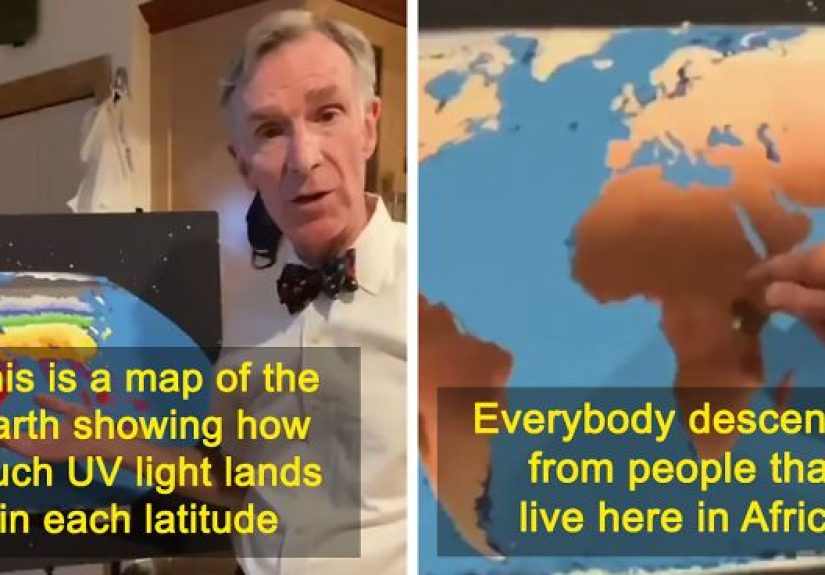
One of the simplest scientific explanations behind visible difference is skin color. Human skin tone is strongly related to melanin, a pigment that helps protect the body from ultraviolet radiation. Over long stretches of time, populations living closer to the equator tended to evolve darker skin because stronger UV exposure made that protective pigmentation advantageous. Populations in regions with lower UV levels often evolved lighter skin, which helped support vitamin D production in different environmental conditions.
That is not a hierarchy. That is adaptation. The sun is not awarding moral medals. It is just being the sun.
This is one of the reasons Bill Nye’s explanation lands so well. A trait people have used for centuries to justify prejudice turns out to be a practical example of evolution and environment. Skin color tells a story about geography, sunlight, and human movement. It does not tell you who is smarter, kinder, harder working, more civilized, or more deserving of dignity. Biology is many things, but it is not a gossip columnist.
Human Variation Is Continuous, Not Neatly Boxed
Another reason racism makes no scientific sense is that human variation does not fall into sharp, natural boundaries. Traits blend across populations. They overlap. They shift gradually across geography and through migration. Scientists sometimes describe this as a cline, meaning a gradual change in a trait across space rather than a hard border between one “type” of human and another.
That matters because racism loves hard lines. Science keeps handing it gradients.
Even genetic variation works this way. There is often more variation within a socially defined racial group than between groups. That means two people placed in the same racial category may be genetically more different from each other than either is from someone in a different category. Once you understand that, racist ideas start looking less like biology and more like bad filing.
Race Is Socially Real, Even If It Is Not Biologically Natural
Here is where the conversation gets more serious. Saying race is a social construct does not mean it is imaginary in its effects. Money is a social construct too, and nobody laughs when the rent is due. Race is socially created, historically enforced, and institutionally embedded. It has shaped law, housing, schooling, medicine, employment, policing, and political power. That is why Bill Nye’s simple science lesson is only the first step.
The false belief that humanity can be divided into ranked biological groups was used to justify slavery, segregation, colonial rule, forced displacement, eugenics, and unequal treatment under the law. Over time, those ideas hardened into systems. So while biology does not support race as a natural hierarchy, society has spent centuries acting as if it does. The result is a world where a bad theory became a brutal operating system.
That is also why modern experts are careful with language. They do not say racism is fake just because race lacks a biological basis. They say the opposite: race is socially constructed, and because societies built institutions around it, its effects are very real. A category invented by people can still change people’s lives.
Why Racism Survives Even When Science Rejects It
Because Humans Are Not Always Rational
It would be comforting if facts alone could retire bad ideas. Sadly, humanity has a long-standing habit of keeping its worst beliefs in climate-controlled storage. Racism persists because it is not sustained by science; it is sustained by fear, power, tribalism, habit, and systems that reward inequality. Science can disprove the logic, but it cannot automatically dismantle the incentives.
People often sort themselves into groups quickly and emotionally. We form identities around family, nation, religion, language, sports teams, neighborhoods, and politics. That tendency can be harmless or even healthy. But when social differences get fused to myths of biological superiority, things go off the rails fast. Racism offers a fake sense of order: it turns historical inequality into “nature,” prejudice into “common sense,” and exclusion into “tradition.”
Because Bad History Leaves Long Shadows
Scientific racism left a deep mark on public culture. For generations, people were taught that visible differences reflected natural ranks of intelligence, morality, and worth. Those claims have been thoroughly challenged and rejected by modern genetics, anthropology, and evolutionary biology. But old myths linger because they were baked into institutions, textbooks, media, and policy for a very long time.
Once a society builds neighborhoods, wealth gaps, school systems, and legal norms around racist assumptions, the original lie can keep producing consequences long after people stop saying the quiet part out loud. That is one reason Bill Nye’s explanation remains useful. It cuts through centuries of nonsense with a line simple enough for a middle school classroom and sharp enough for a boardroom.
What Science Says Racism Gets Wrong
It Mistakes Appearance for Essence
Racism looks at visible traits and assumes they reveal something essential and permanent about a person’s intellect, character, or ability. Science does not support that leap. A visible trait is just that: visible. It may reflect ancestry, adaptation, or family inheritance, but it does not establish human value.
It Confuses Ancestry with Hierarchy
Ancestry is real. Family history is real. Migration patterns are real. Population history is real. But none of that creates a ladder of human worth. Human populations have moved, mixed, adapted, and changed over time. The story of our species is connection, not separation into natural ranks.
It Treats Social Categories Like Biological Law
The racial categories used in one country or century are not always the same in another. They shift across time and place, which is a clue that they are social systems, not fixed biological truths. If the boundaries move, the idea is not biology wearing a lab coat. It is society wearing one.
Why This Still Matters Right Now
If racism were just a bad theory from the past, this would be a history lesson. It is not. Racism continues to affect housing, health, education, workplace opportunities, policing, and exposure to chronic stress. Public-health experts have repeatedly pointed out that racism operates not only through individual bias but through structures and conditions that shape daily life. That means the damage is not only emotional or moral. It can be measurable in safety, access, and health outcomes.
So Bill Nye’s explanation is not some feel-good science slogan. It matters because it removes one of the oldest excuses for inequality. If there is no biological logic supporting racial hierarchy, then what remains is the social machinery that people built and can choose to change. That is both inconvenient and hopeful. Inconvenient because nobody can hide behind “nature.” Hopeful because systems made by people can be remade by people.
A Better Way to Think About Human Difference
The smarter alternative is not pretending difference does not exist. Human beings differ in ancestry, culture, language, history, and lived experience, and those differences matter. The better approach is understanding them without turning them into myths of superiority and inferiority.
Science gives us a more honest frame: one species, shared origins, meaningful variation, no natural racial hierarchy. Ethics gives us the companion rule: equal dignity is not something people earn by matching a preferred shade card. And ordinary common sense adds the final note: a society obsessed with ranking people by superficial traits is not displaying wisdom. It is displaying insecurity with extra paperwork.
Conclusion
Bill Nye’s explanation is powerful because it is simple without being simplistic. Racism does not make sense because the biology behind it falls apart under scrutiny. Human beings are one species. Skin color is an adaptation, not a verdict. Visible traits do not encode moral worth. And the categories societies built around those traits are historically loaded social inventions, not natural human divisions.
That does not mean racism disappears once the science is understood. But it does mean one of its favorite disguises no longer works. It cannot honestly present itself as objective truth or biological common sense. It is prejudice dressed up in old lab language. Bill Nye, in his usual style, strips off the costume and leaves the idea looking exactly as sturdy as it is: not very.
And maybe that is the best place to start. Not with a grand speech, but with a clear sentence. We are one species. If more people truly absorbed that, racism would still be evil, but it would also be a lot harder to pretend it is logical. And frankly, that would be a nice upgrade for the human project.
Related Experiences That Show How Irrational Racism Becomes Real in Everyday Life
To understand why Bill Nye’s explanation matters, it helps to move from the lab to ordinary life. Imagine a classroom where two kids are equally curious, equally funny, and equally capable of turning a simple group project into a minor disaster involving glue. One is seen as naturally gifted, the other as “surprisingly articulate.” Same species, same age, same assignment, but different assumptions arrive before either child says a word. That is how a false biological story sneaks into everyday expectations. It attaches itself to tone of voice, discipline, praise, and opportunity.
Now picture a job interview. Two candidates walk in with similar qualifications. One gets the benefit of the doubt. The other gets extra scrutiny for being “not quite the right fit,” a phrase so vague it could cover anything from office culture to the fact that bias has learned how to wear business casual. No gene is doing that. No chromosome whispered a hiring recommendation. A social myth is doing the work, quietly and efficiently.
Or think about a doctor’s office. A patient explains pain and is not taken seriously enough, or a family’s concerns are brushed aside, or a person’s stress is treated like an individual weakness instead of a response to layered discrimination. Again, the problem is not biology sorting people by value. The problem is that society keeps acting as if invented categories reflect natural truths. The consequences can show up in delayed treatment, mistrust, and worse health over time.
Neighborhood life offers its own examples. A person walking a dog in one area is seen as a neighbor. In another body, the same person may be treated as suspicious. A family shopping for a home may be welcomed in one place and steered away in another. A teenager hanging out with friends may be described as energetic, rowdy, threatening, or promising depending less on behavior than on who is doing the hanging out. When that happens over and over, the lie of racism becomes built into daily weather. People start preparing for it the way they prepare for rain.
Even small social moments can reveal the absurdity. Someone touches another person’s hair like they are examining a museum exhibit. Someone says, “Where are you really from?” as if the first answer came with missing paperwork. Someone praises one person’s features as exotic and dismisses another person’s as unprofessional. None of this comes from science. It comes from habit, stereotype, and a culture that keeps assigning value to physical traits that biology treats as variation within one human family.
These experiences matter because they show the gap between what is true and what is practiced. Bill Nye’s point is scientifically simple, but the lived world often ignores simple truths when power is involved. That is why explaining the science still matters. It gives people a way to name the nonsense. It reminds students, parents, teachers, managers, doctors, and neighbors that visible difference is not a rational basis for unequal treatment. When the myth is exposed, the behavior becomes harder to excuse. And once excuses get weaker, accountability gets stronger. That is not the whole solution, but it is a meaningful start.