Table of Contents >> Show >> Hide
- Who Is Ted Chin, Really?
- Why The Photoshop 2021 Splash Photo Was Such A Perfect Match
- What Makes These 78 Surreal Digital Manipulations So Addictive?
- Recurring Themes Across Ted Chin’s Surreal World
- How Ted Chin Makes Surreal Art Feel Believable
- Why This Gallery Resonates So Strongly Online
- What Creators Can Learn From Ted Chin
- Final Thoughts
- A Longer Reflection: The Experience Of Moving Through These 78 Images
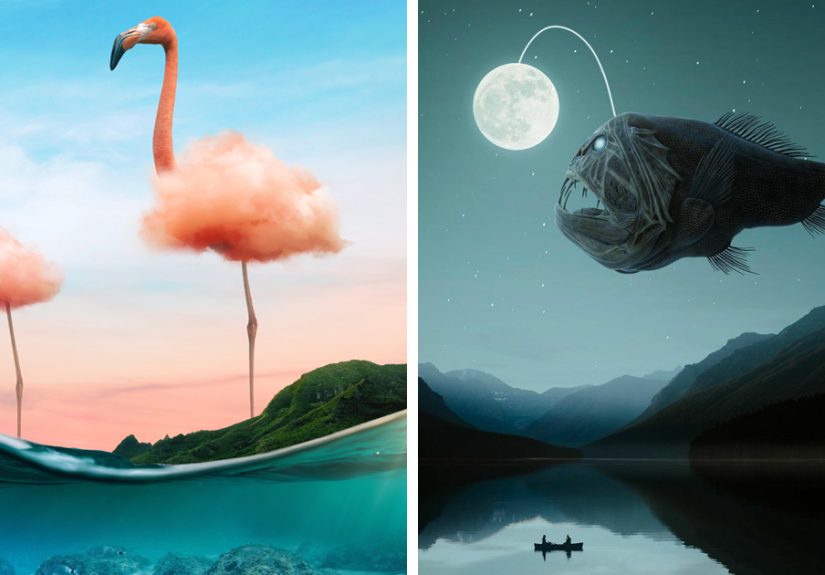
If you opened Photoshop in 2021 and were greeted by two elegant flamingos whose bodies looked suspiciously like fluffy pink clouds, congratulations: you had already met Ted Chin. Even if you did not know his name yet, you knew his vibe. It was dreamy, weird, polished, and just believable enough to make your brain pause and say, “Hang on… why does this impossible thing look so real?”
That reaction is exactly why Ted Chin’s surreal digital manipulations hit so hard. His images do not feel like random internet oddities tossed together for shock value. They feel like tiny visual storiesquiet, cinematic, and a little mischievous. A cloud becomes a flamingo. The sky behaves badly. Landscapes stop following the rules. Fish, moons, deserts, oceans, and architecture all seem to agree to one strange contract: reality can stay, but only after it loosens its tie.
In a gallery built around 78 surreal works, that creative signature becomes impossible to miss. The collection is not memorable simply because it is surreal. The internet is full of surreal images. What makes Ted Chin stand out is that his work feels controlled rather than chaotic, emotional rather than gimmicky, and imaginative without losing craft. He is not just making fantasy art. He is building convincing lies, and frankly, they are gorgeous lies.
Who Is Ted Chin, Really?
Ted Chin is a digital surrealist and photographer best known online as the artist behind Ted’s Little Dream. His story matters because it explains why his images feel less like technical exercises and more like invitations to travel somewhere impossible. Chin has spoken about wanting to see more of the world while having limited time and resources during school, and that tension shaped his creative direction. Instead of waiting for reality to cooperate, he used photography and Photoshop to invent the places he wanted to experience.
That origin story says a lot. His work is not built on spectacle alone. It is built on longing, curiosity, and the old artistic habit of turning limitations into style. Some people keep a travel journal. Ted Chin makes the sky leak jellyfish, turns landscapes into dream logic, and calls it a day. Honestly, that seems more efficient.
His project name, Ted’s Little Dream, also says plenty. The word “little” makes the whole thing sound modest, even sweet, but the images are anything but small. They often feel expansive and cinematic, like stills from a movie your subconscious binge-watched at 3 a.m. The emotional tone is important: even when the compositions are strange, they rarely feel cold. There is wonder in them. Sometimes mystery. Sometimes loneliness. Often delight.
Why The Photoshop 2021 Splash Photo Was Such A Perfect Match
“Flamingo Cloud” is weird in the best possible way
The Photoshop 2021 splash image worked because it summarized Chin’s artistic instincts in one clean visual idea. A pink cloud becomes a flamingo’s body. The waterline, the light, the pastel color palette, and the elegant proportions all help sell the illusion. It is surreal, yes, but not messy. The image reads immediately. That matters.
Great splash art has to do two jobs at once. It has to be visually striking enough to represent a creative tool used by millions, and it has to be simple enough to register in seconds. “Flamingo Cloud” nails both. It is a concept piece, but it is also branding. It feels playful, technically impressive, and instantly memorable. In other words, it is exactly the kind of image that makes someone think, “Yep, Photoshop can do that.”
More importantly, the piece reflects how Chin works. He often merges animals, natural elements, and dreamlike environments in ways that feel imaginative rather than arbitrary. The flamingo-cloud hybrid is clever, but it is also elegant. That balance is difficult to achieve. A lesser artist might have made the image louder. Chin made it cleaner.
It captures the spirit of digital compositing
The best digital manipulations do not just show off software features. They express a point of view. Chin’s work reminds viewers that compositing is not only about technical wizardry. It is about storytelling, symbolism, and visual rhythm. The flamingo cloud image feels iconic because it distills those ideas into one frame. It says that digital art can be playful without being sloppy, surreal without becoming nonsense, and polished without losing personality.
What Makes These 78 Surreal Digital Manipulations So Addictive?
1. They tell stories instead of just showing tricks
A lot of photo manipulation online is basically a flex. “Look, I masked this well.” “Look, I added a moon where a moon should absolutely not be.” Ted Chin’s work usually goes further. His images suggest a before and after. They imply a mood. They raise a question. Why is that creature there? Where does that path lead? Why does this impossible scene feel oddly calm?
That narrative pull keeps people scrolling. In one image, a giant marine creature might float through a dreamlike sky. In another, a strange environmental mashup makes the natural world feel sentient. Even when the premise is bizarre, the picture feels intentional. You are not looking at a pile of cutouts. You are looking at a scene with emotional direction.
2. He makes the impossible look physically plausible
This is where craft takes over. Surrealism works best when at least part of the image behaves like reality. Chin pays close attention to scale, perspective, edges, lighting, and color harmony. The fantasy element may be impossible, but the shadows often make sense. The tones feel unified. The atmosphere matches. Your eye stops arguing long enough for the illusion to settle in.
That is why viewers tend to linger on his work. At first glance, the composition feels natural. At second glance, your brain realizes it has been politely ambushed.
3. Nature is not a backdrop in his work; it is a co-star
One of the most appealing things about Chin’s surreal composites is how often they involve landscapes, oceans, skies, animals, and weather. These are not sterile studio experiments. They feel airy, open, and alive. Even when an image is heavily manipulated, it still carries the emotional charge of landscape photography.
That natural beauty helps soften the surrealism. A floating fish or impossible cloud-form creature lands differently when the water, horizon, and light are gorgeous. The scene becomes inviting rather than alienating.
4. He knows when to stop
Digital artists sometimes fall in love with complexity for its own sake. You can almost hear the software sweating. Chin’s better works avoid that trap. Many of his images center one bold idea and let it breathe. There is room for negative space, soft atmosphere, and visual silence. That restraint makes the fantasy stronger.
In practical terms, it means the compositions often feel editorial and polished rather than overloaded. The viewer has a clear place to look. The concept lands fast. The image stays with you longer.
Recurring Themes Across Ted Chin’s Surreal World
Dream travel and impossible destinations
Many of Chin’s works feel like postcards from a place that does not exist but somehow should. That makes sense, given how often he frames art as a way to explore beyond physical limits. His images let him travel through imagination, and that same energy reaches the audience. You are not just viewing a manipulation; you are visiting a destination.
Transformation in nature
Clouds become creatures. Water becomes a visual boundary between worlds. Objects carry double meanings. This theme of transformation gives his work a distinctly surreal pulse. It is not destruction. It is metamorphosis. The world is not breaking apart in his images; it is revealing a hidden version of itself.
A calm, cinematic mood
Even his strangest pieces often feel peaceful. That is a big reason they are so shareable. They do not scream at the audience. They invite them in. The mood is often contemplative, like a dream you almost remember from childhood. It is fantasy with good manners.
How Ted Chin Makes Surreal Art Feel Believable
Lighting, perspective, and color do the heavy lifting
According to Chin’s public talks and tutorials, strong compositing depends on core visual fundamentals, not just flashy software features. Lighting has to agree across elements. Perspective has to feel coherent. Color has to unify the frame. That sounds simple until you try to merge multiple photos into one seamless image and discover that your “masterpiece” looks like five unrelated vacations crashed into each other.
Chin’s success comes from respecting those basics. His composites do not work because they are surreal. They work because they are structured. The fantasy rides on top of solid visual problem-solving.
Masking and blending matter more than magic
He has also highlighted practical tools like masks, blend modes, and content-aware features as part of his workflow. That matters for readers who assume surreal digital art is all mystery and genius lightning bolts. Inspiration matters, of course, but so does the unglamorous work of refining edges, balancing textures, cleaning backgrounds, and making transitions feel natural. Photoshop may be powerful, but it still rewards patience over chaos.
Story comes before software
Perhaps the biggest lesson from Chin’s portfolio is that software is not the idea. It is the delivery system. The image has to mean somethingor at least feel like it means somethingbefore the technical process becomes memorable. That is why his work lands with both casual viewers and design-minded audiences. People respond to the concept first, then admire the execution.
Why This Gallery Resonates So Strongly Online
The internet loves an image that makes people stop mid-scroll. Ted Chin’s work does that, but it also survives the second look. That is the difference between viral novelty and lasting visual appeal. His images are instantly readable, emotionally accessible, and technically satisfying. They work on social media, but they also hold up as crafted visual art.
There is also a broader reason these 78 manipulations resonate: they arrive at the intersection of fantasy, travel, nature, and digital mastery. Those are all highly shareable themes on their own. Chin combines them into images that feel both escapist and polished. They offer the emotional lift of imagination without abandoning the logic of photography.
For fans of Photoshop, the appeal is even stronger. These works are a reminder that the software is not just for fixing blemishes, swapping skies, or rescuing the family photo where someone blinked at exactly the wrong moment. It can also be a portal for building original visual worlds.
What Creators Can Learn From Ted Chin
First, a strong visual identity beats random experimentation. Chin’s work is recognizable because he returns to a clear set of interests: dreamlike nature, surreal transformations, cinematic calm, and emotionally readable concepts.
Second, technical skill matters most when it serves an idea. A perfect cutout is nice. A perfect cutout that helps tell a memorable story is better.
Third, limitations can become a style engine. Chin’s project grew partly out of not being able to travel or create in conventional ways as often as he wanted. Instead of treating that as a dead end, he used it as creative fuel. That is the kind of artistic pivot that separates hobby-level tinkering from lasting voice.
Final Thoughts
“78 Surreal Digital Manipulations From The Artist Behind The Photoshop 2021 Splash Photo” is more than a catchy headline. It points to something real about Ted Chin’s appeal. He represents the version of digital art that still feels human: imaginative, crafted, emotional, and curious. His work shows that surrealism does not have to be loud to be unforgettable. Sometimes all it takes is a pink cloud, a flamingo silhouette, and the confidence to let impossible things look graceful.
That is why these images stick. They do not just ask what Photoshop can do. They ask what imagination can do once technique finally catches up.
A Longer Reflection: The Experience Of Moving Through These 78 Images
Spending time with Ted Chin’s surreal gallery feels a little like walking through a museum designed by a travel-loving daydreamer who accidentally discovered a portal inside a photo editor. The first few images make you smile because they are clever. The next few make you slow down because they are oddly beautiful. Then, somewhere in the middle, you realize you are no longer reacting to them as “Photoshop art.” You are reacting to them as places, moods, and stories. That shift is important.
Most viewers begin with the obvious question: “How did he make this?” But after a while, the better question becomes: “Why does this feel familiar?” That is one of the quiet powers of Chin’s work. Even when the subject is impossible, the emotional texture is recognizable. Wonder, loneliness, curiosity, escape, calm, and playful confusion all show up in these images. They do not feel like technical demonstrations pinned to a digital corkboard. They feel like memories from a parallel universe that somehow shares our weather.
There is also a strangely relaxing quality to his surrealism. Some fantasy art tries to overwhelm the viewer. Bigger scale, louder color, more effects, more drama, more everything. Chin often goes the other direction. He gives impossible subjects room to breathe. A strange cloud creature stands in open air. A surreal animal appears in a wide landscape. Water, sky, and light do a lot of emotional work. The result is that the viewer is not pushed away by the weirdness. They are eased into it. It is surrealism with a soft landing.
For artists, the experience can be even more layered. Looking through these pieces can trigger equal parts inspiration and mild professional jealousy, which is honestly a classic creative combo. You notice the concepts first, then the discipline. The edges are clean. The tones are controlled. The compositions are readable. The fantasy is not fighting the frame. That can be motivating because it reminds you that imagination alone is not the finish line. Taste, patience, and editing judgment matter just as much.
For general audiences, though, the deeper experience is probably escapism. These images offer a break from literal life. They are not news, not noise, not doomscroll fuel, and not another algorithmically optimized shout for attention. They invite wonder. In a culture that rewards speed, that invitation matters. A good Ted Chin image gets you to pause. A great one gets you to linger. That is increasingly rare.
And maybe that is the best way to understand why this 78-image collection connects with so many people. It is not just because the work is surreal. It is because the work is generous. It gives viewers a place to wander, puzzle over, and enjoy without demanding that they decode a giant thesis statement. The pictures are smart, but they are not smug. Impressive, but not cold. Stylish, but still accessible.
By the time you reach the end of the gallery, the experience is less like finishing a list and more like waking up from a very aesthetic dream. You remember the flamingo cloud, of course, because it is iconic. But you also remember the feeling the gallery leaves behind: that the world is more flexible than it looks, that beauty can be built from impossible combinations, and that digital art at its best does not separate us from imaginationit sneaks us closer to it.