Table of Contents >> Show >> Hide
- Before We Start: What “Height” Means (So We Don’t Accidentally Invent New Math)
- Way 1: Use the Universal Prism Volume Formula (V = B × h)
- Way 2: For Rectangular Prisms, Multiply Length × Width × Height (The Shortcut That Deserves Its Popularity)
- Way 3: Build It from Layers (Unit Cubes, Slices, and the “Stack of Pancakes” Mental Model)
- Way 4: Decompose (or Subtract) Complex Prisms into Simple Ones
- Way 5: Use Cross-Sections and Cavalieri’s Principle (Especially for Oblique Prisms)
- Common Mistakes (And How to Avoid Them Without Throwing Your Ruler Across the Room)
- Conclusion
- Real-World Experiences (500-ish Words of Prism Volume “Been There, Measured That”)
A prism is one of those “looks simple until you actually have to measure it” 3D shapes. It’s basically a solid with two
parallel, congruent bases (same shape, same size) connected by flat sides. The best part? Once you know how to
calculate the volume of a prism, you can handle everything from shipping boxes to aquarium tanks to that oddly
satisfying triangular Toblerone-style container that somehow always ends up in math class.
In this guide, you’ll learn five different ways to calculate prism volumeranging from the classic “plug it into the formula”
method to slicing tricks and coordinate geometry. Along the way, we’ll call out common mistakes (like using a slanted edge as the
height… no judgment, but also: stop doing that).
Before We Start: What “Height” Means (So We Don’t Accidentally Invent New Math)
For any prism, the height is the perpendicular distance between the two bases. That means you measure
straight “through” the prism at a right angle to the basenot along a slanted side. This matters most for an oblique prism
(one that leans like it’s trying to avoid responsibility).
Also: keep your units consistent. If your base measurements are in inches and your height is in feet, your answer will be in
“confused.” Convert first, then calculate. Volume is always in cubic units (in³, ft³, cm³, etc.).
Way 1: Use the Universal Prism Volume Formula (V = B × h)
The most reliable method is the one that works for every prism: multiply the area of the base by the
prism’s perpendicular height.
The Formula
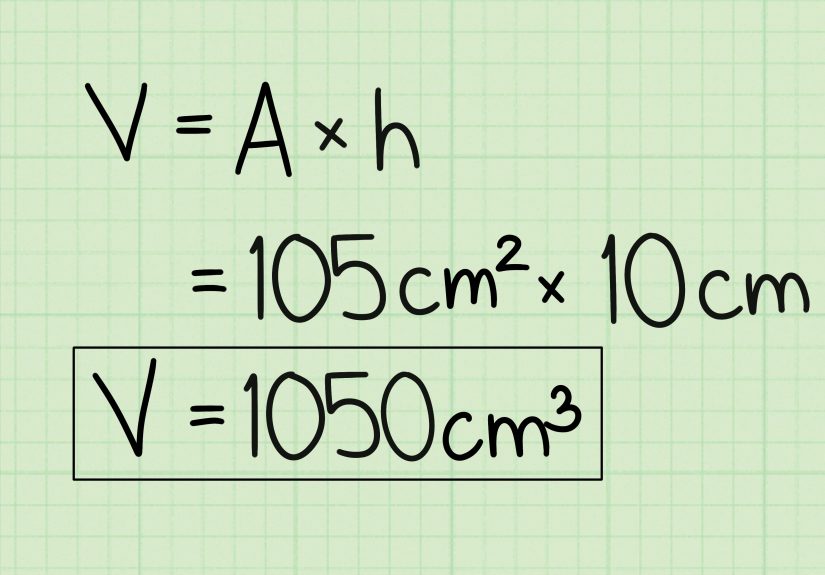
Volume of a prism: V = B × h
- B = area of the base
- h = perpendicular height (distance between bases)
Example: Triangular Prism
Suppose your prism has a triangular base with base = 10 cm and triangle height = 6 cm. The prism length (distance between the triangular bases)
is 12 cm.
- Find base area: B = (1/2) × 10 × 6 = 30 cm²
- Multiply by prism height: V = 30 × 12 = 360 cm³
This method is the “Swiss Army knife” of prism volume. Your only job is to correctly compute the base arearectangle, triangle, trapezoid,
hexagon, you name itthen multiply by the perpendicular height.
Way 2: For Rectangular Prisms, Multiply Length × Width × Height (The Shortcut That Deserves Its Popularity)
A rectangular prism (aka a box/cuboid) has a rectangular base, so the base area is just length × width. That turns V = B × h
into the well-known shortcut:
The Shortcut
Rectangular prism volume: V = l × w × h
Example: Shipping Box
A box is 8 inches long, 5 inches wide, and 3 inches tall.
V = 8 × 5 × 3 = 120 in³
Why This Counts as a Different “Way”
In real life, you often don’t think “base area times height”you just measure three edges and multiply. This method is especially handy for:
- Storage containers and bins
- Room volume estimates (small rooms are basically giant rectangular prisms)
- Any “box-shaped” object where l, w, h are obvious
Way 3: Build It from Layers (Unit Cubes, Slices, and the “Stack of Pancakes” Mental Model)
If the formula feels too magical, this method explains why it works. Imagine filling a prism with unit cubes
(little 1×1×1 blocks). A prism is basically a stack of identical layers.
How Layering Connects to the Formula
One layer covers the base, so it contains about B unit squares worth of area. Stack those layers up for h units
of height, and you get:
Volume = (cubes per layer) × (number of layers) = B × h
Example: Fractional Dimensions Without Tears
Say a rectangular prism has dimensions 4.5 ft × 2 ft × 1.25 ft. You can think of it as stacking 1.25-ft-thick “slabs,” each with base area 9 ft².
- Base area B = 4.5 × 2 = 9 ft²
- Volume V = 9 × 1.25 = 11.25 ft³
This “layer method” is great for teaching, checking your intuition, and catching mistakes. If someone gives you a “volume” of 11.25 ft² (square feet),
you’ll know something went wrong because volume can’t wear a 2D costume.
Way 4: Decompose (or Subtract) Complex Prisms into Simple Ones
Not every prism shows up looking like a neat cereal box. Sometimes you get an L-shaped prism, a stepped prism, or a “why did the designer do this”
storage compartment. When the base is a compound shape, the smartest move is to split it into simpler prisms, find each volume,
then add (or subtract) them.
Step-by-Step Strategy
- Identify a consistent prism height (the distance between the two bases).
- Split the base into familiar shapes (rectangles, triangles, etc.).
- Compute each base area, then multiply each by the same height.
- Add the volumes (or subtract cut-outs).
Example: L-Shaped Prism (Add-Subtract Method)
Imagine an L-shaped base that can be treated as a big rectangle minus a smaller missing rectangle:
- Big rectangle base area: 12 in × 10 in = 120 in²
- Missing rectangle area: 5 in × 4 in = 20 in²
- Actual base area B = 120 − 20 = 100 in²
- Prism height h = 6 in
- Volume V = 100 × 6 = 600 in³
This method is also the easiest way to handle “composite prisms” in homework and real-world construction estimatesbecause it turns a weird shape into a
few boring shapes. And boring shapes are the ones that behave.
Way 5: Use Cross-Sections and Cavalieri’s Principle (Especially for Oblique Prisms)
Here’s the cool trick: a prism can lean, tilt, and generally act dramatic, but its volume still depends on the base area and the
perpendicular height. One reason this works is Cavalieri’s Principle: if two solids have the same height and the same
cross-sectional area at every level, they have the same volume.
Why This Helps
If you have an oblique prism, the side edges are slanted, so measuring along an edge will overestimate the height. But if you slice the
prism with planes parallel to the base, every slice has the same area as the base (that’s the prism superpower). So volume becomes:
V = (area of each slice) × (height through the prism) = B × h
Example: Oblique Parallelogram Prism
Suppose the base area is 18 cm². The prism leans, but the perpendicular distance between the bases is 9 cm.
V = 18 × 9 = 162 cm³
Bonus: The “Integration Lite” Version
In calculus language, you’d say volume is the integral of cross-sectional area: V = ∫A(x) dx. For a prism, A(x) is constant (it’s always B), so the
integral collapses into B × h. Even if you’re not doing calculus today, it’s a satisfying explanation for why the formula is so universal.
Common Mistakes (And How to Avoid Them Without Throwing Your Ruler Across the Room)
- Using slant height instead of perpendicular height: For oblique prisms, the “height” is the straight, perpendicular distance between bases.
- Forgetting to compute base area first: The base might be a triangle, trapezoid, or polygondon’t treat it like a rectangle unless it is one.
- Mismatched units: Convert everything to the same unit system before multiplying.
- Answering in square units: Volume is cubic. If your final unit isn’t cubed, something’s off.
Conclusion
If prisms had a motto, it would be: “Find the base area. Multiply by the perpendicular height. Do not overthink it.”
The five methods you learned are really five lenses on the same idea:
- The universal formula (V = B × h) for any prism
- The rectangular prism shortcut (l × w × h)
- Layering with unit cubes to build intuition
- Decomposing complex shapes into simpler prisms
- Cross-sections and Cavalieri’s Principle for oblique prisms
Once you’re comfortable switching between these approaches, you’ll be faster, more accurate, and far less likely to mistake “slanted edge” for “height.”
(Your future self thanks you. Your math teacher also thanks you. The ruler thanks you.)
Real-World Experiences (500-ish Words of Prism Volume “Been There, Measured That”)
The first time most people calculate the volume of a prism outside a classroom, they don’t call it “a prism.” They call it “a box,” and they’re usually
holding it while wondering if it will fit in a closet, a trunk, or their life. I once watched a friend estimate the capacity of a moving box by eyeballing it,
declaring it “about a hundred,” and then acting shocked when the box either swallowed everything or refused to hold even one more shoe. That’s the moment
prism volume becomes less “geometry” and more “personal growth.”
Kitchens are secretly full of prisms. Cereal boxes, butter packages, loaf pansmost are rectangular prisms living normal lives until someone needs to know
how much they can hold. A loaf pan, for example, is basically a rectangular prism with rounded corners and hopes. If you know its approximate length, width,
and height, you can estimate batter capacity (and avoid the classic overflow situation that turns your oven into a smoke machine). You might not publish the number
on a chalkboard, but the math is the same: base area times height, with a tiny “please don’t spill” factor.
Aquariums are where prism volume meets reality in gallons. People buy a tank, fill it, then wonder why their “20-gallon” aquarium doesn’t look like it holds
20 gallons. The secret is that manufacturers measure to the brim, while real humans leave space for air, filters, and the fish’s personal boundaries. The volume formula
is still the starting point, though: convert dimensions to cubic inches (or cubic centimeters), then convert to gallons or liters. Suddenly, prisms aren’t abstractthey’re expensive
and full of water.
The most unexpectedly useful prism skill is decomposition. Any time you have a weird storage nooklike an L-shaped under-stair compartmentyou can split it into
two simple prisms and add volumes. That’s how people estimate how much insulation they need, how much soil fits in a raised garden bed, or how many foam packing peanuts
it will take to keep something from rattling like a maraca in the mail. The shape looks “custom,” but the math is delightfully unromantic: rectangle here, rectangle there, multiply,
add, done.
Even makers and hobbyists run into this. If you 3D print a container with a prism-like cavity, volume helps you predict how much resin, sand, or screws it can store.
If you’re pouring epoxy into a mold, knowing the approximate cubic volume can save you from mixing too little (panic) or too much (a hardened blob you’ll keep forever because
it feels wasteful to throw away). And if you ever want a quick sanity check, think in layers: “How big is one slice? How many slices stack up?” It’s the unit-cube idea with fewer cubes and more dignity.
The punchline is that prism volume shows up everywhere because prisms are the geometry of practical life. Boxes, tanks, bins, bricks, beamsif it has two parallel matching faces and a steady cross-section,
you’re basically living in Prism World. The formulas aren’t just test answers; they’re tools for making better guesses, wasting fewer materials, and finally winning the eternal battle of “Will this fit?”